

What if your Personal Year Number is less a forecast than a framework for asking better questions about the year ahead? If you’re wondering “what is my personal year number 2026,” you can calculate it using your birth month, birth day, and the year’s Universal Number. The arithmetic is simple. Interpreting the result calls for a little more care.
Numerology calculators can give you a result without showing how they reached it, and traditions may differ on Master Numbers or when a Personal Year begins. This guide explains the standard calculation step by step, notes where conventions vary, and helps you apply one method consistently. You’ll also find traditional themes for Personal Years 1 through 9, from new beginnings to completion, with questions to connect each theme to your circumstances. Use the result as a symbolic prompt for reflection, not as a fixed prediction or substitute for your judgment.
Key Takeaways
- Find out what is my personal year number 2026 with a transparent calculation you can follow and check yourself.
- Learn how the Universal Year number contributes to your result and why calculation conventions can differ.
- Explore traditional associations for Personal Years 1-9, along with questions to make each theme more personal.
- Use your number as a prompt for reflection and planning, not an instruction for major life decisions.
- Keep your calculation and reflections together, then explore numerology reports and self-guided resources for further study.
What your Personal Year Number means in 2026, and what it does not
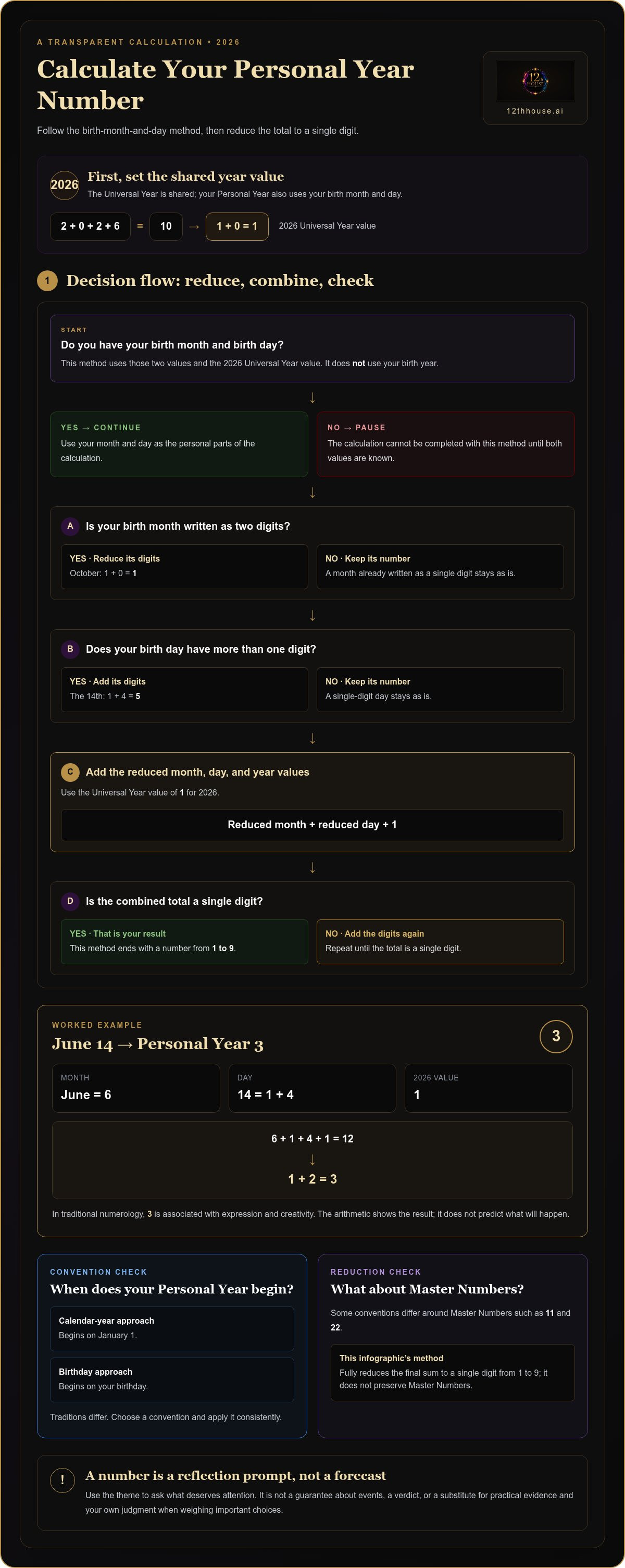
A Personal Year Number is a numerology cycle associated with your birth month, birth day, and a chosen year. In the usual calculation, those values are reduced and combined to produce a number with a traditional theme. For 2026, the calendar year reduces to Universal Year 1: 2 + 0 + 2 + 6 = 10, then 1 + 0 = 1.
This distinction matters when you ask, “what is my personal year number 2026?” The Universal Year is shared, while your Personal Year calculation includes your birth month and day. Numerology includes different systems and interpretations, so it helps to know which method you’re using. The general overview of Numerology offers context on the practice’s history and varied approaches. A Personal Year is a symbolic framework, not an evidence-based forecast.
Personal Year and Universal Year: what is the difference?
The Universal Year represents a shared numerological theme assigned to a calendar year. The Personal Year combines your birth month and day with that year’s value to produce an individual result. Think of 2026’s Universal Year 1 as the common setting; your Personal Year adds a personal layer. It doesn’t mean everyone will experience the same events or respond to the year in the same way.
A yearly theme is not a fixed forecast
Traditional numerology associates each number with themes such as initiative, cooperation, or reflection. These are interpretive prompts, not guarantees about relationships, money, health, or specific events. Treat the number as a lens for noticing patterns and clarifying intentions, not as an instruction or verdict.
That distinction gives the practice useful boundaries. A theme can help you examine what deserves attention without claiming to explain everything that happens. If your number is associated with change, for example, you might ask where you’re already seeking more flexibility. You don’t need to assume a particular disruption is destined or make a major decision because a number seems to endorse it.
Use the result as a question rather than a prediction: What would this theme help me notice? Where does it fit my circumstances, and where does it not? Your lived experience, responsibilities, and judgment remain central. Numerology can organize reflection, but it can’t establish what will happen or replace practical evidence when you’re weighing an important choice.
Timing can also affect how you interpret the cycle. Some numerologists begin a Personal Year on January 1; others associate its beginning with your birthday. Choose a convention and apply it consistently. This keeps your calculation clear while leaving room to use the number as a flexible prompt for attention, intention, and self-inquiry.
How to calculate your Personal Year Number for 2026
To answer “what is my personal year number 2026,” combine your birth month and day with the reduced value of 2026. This method uses your birth month and day, not your birth year. The arithmetic produces a number from 1 to 9, which you can then consider alongside traditional numerology associations.
The 2026 Personal Year formula, step by step
Follow these four steps. Reduce each part as needed, then reduce the combined total until it reaches a single digit. This method reduces all results to 1-9 rather than preserving Master Numbers.
- Reduce your birth month. Use its number from 1 to 12. If it’s already two digits, add those digits: October becomes 1 + 0 = 1.
- Reduce your birth day. Add the digits of the day if necessary. For the 14th, calculate 1 + 4 = 5.
- Reduce 2026. Add the year’s digits: 2 + 0 + 2 + 6 = 10, then 1 + 0 = 1. This is the Universal Year value used in the calculation.
- Add and reduce. Combine the reduced month, day, and Universal Year values. If the total has two digits, add those digits again until you reach a single digit.
Worked example: June 14 and the 2026 cycle
For a June 14 birthday, June contributes 6, and the day contributes 1 + 4. Add the 2026 Universal Year value of 1: 6 + 1 + 4 + 1 = 12. Reduce the total: 1 + 2 = 3. Using this method, the Personal Year result is 3.
This example demonstrates the arithmetic, not a claim about anyone’s future. In traditional numerology, 3 is associated with expression and creativity, but the number doesn’t establish what will happen in someone’s life. Treat it as a symbolic theme to explore, not a prediction.
Numerology sources may differ on whether a Personal Year begins on January 1 or on a person’s birthday. Reduction conventions can also vary, especially around Master Numbers such as 11 and 22. The calculation above uses the calendar-year approach and reduces the final sum fully to a single digit. When comparing results, check which timing and reduction rules each method applies, then use one approach consistently.
For a broader view of how birth-date calculations connect with other numerology patterns, explore 12th House numerology analysis.
What Personal Year Numbers 1-9 traditionally represent
Once you have your number, the next step is interpretation. If you’re asking “what is my personal year number 2026” to understand the result, use the themes below as symbolic vocabulary, not a verdict. Each number is traditionally associated with a different area of attention. The reflection question can help connect that association to your actual circumstances.
Numbers 1-3: beginnings, cooperation, and expression
These first three themes move from individual initiative to shared effort and outward expression. A 1 association can invite you to notice where a fresh start or more independence matters. A 2 can turn your attention toward patience, cooperation, and balance in relationships. A 3 can prompt questions about communication, creativity, and how fully you express what you think or feel.
Numbers 4-9: structure, change, reflection, and completion
The remaining themes offer different lenses: 4 considers the structures you’re building, 5 invites adaptation, and 6 brings care and responsibility into focus. A 7 association turns inward; 8 asks you to consider ambition and stewardship; 9 centers on completion and release. None is a higher or lower stage of personal worth.
| Number | Traditional association | Reflection question |
|---|---|---|
| 1 | Beginnings and initiative | What new direction would I like to explore? |
| 2 | Cooperation and patience | Where could listening improve a relationship? |
| 3 | Expression and creativity | What idea or feeling needs a clearer voice? |
| 4 | Structure and steady effort | What foundation would benefit from consistent attention? |
| 5 | Change and adaptation | Where might flexibility help me respond well? |
| 6 | Care and responsibility | How can I support others while respecting my own needs? |
| 7 | Introspection and analysis | What deserves quiet thought before I act? |
| 8 | Ambition and stewardship | How do I want to use my influence or resources? |
| 9 | Completion and release | What feels ready to be concluded or let go? |
These are traditional numerology themes, not universal definitions or promises that particular events will occur. A 5 association, for example, doesn’t guarantee a dramatic change; it can simply prompt you to examine how you respond to uncertainty. Likewise, 9 doesn’t require you to end a relationship, job, or project. The reflection question is an invitation to notice, not an instruction.
Choose the row that matches your calculated number, then make its question concrete. Write down one situation it brings to mind and what you might learn from considering it. Keep your interpretation open: a theme is useful when it sharpens your attention, while your values, evidence, and judgment guide what you do next.
How to use your 2026 Personal Year as a reflection tool
A Personal Year number becomes more useful when you connect its traditional theme to a question that’s already relevant in your life. You don’t need to search for proof that the number is “coming true.” Instead, use it to notice what you’re thinking about, what feels important, and whether the theme offers a fresh way to examine your experience.
Build a grounded Personal Year reflection practice
Start with a short written record. Note your number, its traditional association, and what that association means to you. Then choose one open question to revisit during the year. A single prompt gives you a steady point of reference without turning numerology into a search for certain outcomes.
- Record the framework. Write down your result and the theme you’re exploring. Include the calculation method if you want to compare interpretations later.
- Make the question yours. If your theme is cooperation, ask, “Where would a more balanced exchange help?” If it’s structure, try, “What part of my routine would benefit from attention?”
- Return and review. Revisit the question periodically. Note what has changed, what feels relevant, and what no longer fits. Let your interpretation adjust as your circumstances and understanding evolve.
Keep your answers descriptive rather than judgmental. You might record that a question helped you notice an ongoing tension, or that it didn’t connect with anything meaningful that month. Both observations are useful. They show how the symbolic lens meets your lived experience without requiring you to reshape that experience to fit the number.
Keep numerology in proportion to real-world choices
A symbolic system can prompt thought, but it isn’t proof of what you should do. Personal, financial, health, and relationship decisions call for real-world information and careful consideration. Don’t treat a Personal Year number as a substitute for professional or practical advice, or as the deciding factor in an important choice.
You can approach numerology spiritually, through cultural or personal meaning, or simply as a journaling prompt. Its value lies in the reflection you choose to make, not in claiming certainty about the future. A useful rule is: Use a symbolic system to ask better questions, not to prove what will happen.
To deepen your reflection, keep your calculation and notes together, then compare them with your experience over time. If you’d like a structured way to explore numerology alongside your own observations, explore 12th House numerology reports.
Explore your Personal Year through a deeper numerology practice
Your calculation becomes a more useful reference when you keep it beside your own reflections. Record the number, the traditional theme you’re exploring, and the question you chose to revisit. Over time, those notes create a personal record of how the symbolism resonates, changes, or stops feeling relevant. The aim isn’t to make the year fit the number. It’s to explore the connection, or the lack of one, with curiosity.
Continue learning through numerology
Numerology is a system readers can explore through study and personal reflection. As you learn, you may encounter related subjects such as numerology compatibility, which looks at number-based interpretations of connections between people. That differs from a Personal Year calculation: this article focuses on an annual theme derived from your birth month and day alongside the chosen year, while compatibility explores a different question and application.
Keep those frameworks distinct as you read. A Personal Year theme can help you shape a question about your own priorities; compatibility interpretations consider relational patterns. Neither determines how a relationship will unfold. Explore each as a separate symbolic lens, then decide whether it offers a useful perspective in light of your experience.
Turn curiosity into structured self-inquiry
To continue studying, explore 12th House Numerology Reports and its self-guided metaphysical library of books, videos, and ritual frameworks. These resources support a broader exploration of numerology while your own calculation and notes remain the reference point. Let the material add context, not certainty.
The platform’s AI assistant, Lala, offers personalized spiritual guidance. Use it as another space for reflection without assuming it will calculate your Personal Year or prescribe a particular outcome. Bring your own questions forward: Which traditional theme feels meaningful? What does it help you notice? What parts don’t fit your lived experience?
If your starting question was “what is my personal year number 2026,” you now have a method for calculating the number, a map of traditional themes, and a grounded way to work with the result. Keep your notes together and return to them when useful. Numerology can be a study, a spiritual practice, or simply a journaling prompt. The meaning you draw from it remains yours. If you’d like to continue exploring, explore 12th House at your own pace.
Carry your reflection into the year ahead
Let your Personal Year be a question you return to, not a script you have to follow. As the year unfolds, notice which parts of the theme help you see your choices more clearly, and set aside interpretations that don’t fit. If you began with “what is my personal year number 2026,” the next step is yours: decide what kind of reflection would genuinely support you.
For a more structured path of exploration, 12th House brings numerology together with self-guided learning through its metaphysical library. Its Numerology Reports offer another way to study the subject, while Lala, the platform’s AI spiritual guidance assistant, can support personal inquiry. Use these resources at your own pace and keep your judgment at the center.
Explore numerology and spiritual guidance with 12th House, and keep building a practice that feels thoughtful, grounded, and uniquely your own.
Frequently Asked Questions
What is the Universal Year Number for 2026?
The Universal Year Number for 2026 is 1. Add the year’s digits, 2 + 0 + 2 + 6, to get 10, then reduce 10 to 1. In numerology, this value serves as the shared year component in a Personal Year calculation. It doesn’t mean everyone has the same Personal Year, since each person’s birth month and day shape their individual result.
Does my Personal Year Number change on January 1 or on my birthday?
It depends on the timing convention you follow. Some numerologists treat the cycle as changing on January 1, aligning it with the calendar year; others place the transition on your birthday. The birthday-based approach may feel more intuitive if your birthday falls later in the year, while the calendar approach gives you a consistent year-wide frame. Choose one convention and use it consistently when comparing interpretations.
Can my Personal Year Number predict what will happen in 2026?
No. A Personal Year Number can’t reliably predict specific events, and numerology isn’t an evidence-based forecasting method. You can use its traditional associations as prompts for reflection, such as considering what “change” means in your current circumstances. Let practical information and your own judgment guide decisions about relationships, work, money, or health rather than treating a number as evidence that an outcome is certain.
Is a Personal Year Number the same as a Life Path Number?
No. A Personal Year Number is an annual calculation based on your birth month and day plus a chosen year. A Life Path Number is generally calculated from the full birth date and interpreted as a broader, enduring numerology theme rather than a year-specific cycle. Because the two numbers answer different questions, keep their meanings separate when reading a numerology profile or comparing interpretations.
Why do different Personal Year calculators give me different results?
Different calculators may use different conventions. One may preserve 11 or 22 as a Master Number, while another reduces every total to a single digit. Tools may also differ in how they handle the start of the cycle or reduce the birth month and day. If you’re checking “what is my personal year number 2026,” compare the calculator’s method with your own arithmetic before interpreting a mismatch.
Can I calculate my Personal Year Number for a year other than 2026?
Yes. Replace 2026 with the year you want to examine, reduce that year’s digits according to your chosen method, then combine its value with your birth month and day. For example, to calculate for 2027, begin with 2 + 0 + 2 + 7. Keep the same reduction and cycle-timing conventions across years so you can compare the results consistently.


