

What if your life path number is a map to a question, not a verdict to obey? If “what is my life path number meaning” is on your mind, you’re looking for more than a label. You want to know whether its symbolism can illuminate your patterns without defining your future.
That distinction matters. Numerology offers a structured language for reflection, but calculation methods can differ, and broad descriptions may not feel personal. Treat a number’s meaning as a set of themes to examine, not a fixed prediction or rulebook.
This guide explains what a life path number represents and how to calculate yours from your birth date, step by step, including how some traditions handle Master Numbers. You’ll also explore the symbolism behind the numbers and use it to ask more useful questions about your strengths, recurring challenges, and direction. Think of the interpretation as a starting framework: you decide what resonates with your experience.
Key Takeaways
- Explore what is my life path number meaning through numerology’s symbolic framework, without treating it as a diagnosis or forecast.
- Follow a transparent birth-date calculation method and check each step to see how your number is derived.
- Compare your number’s archetypal theme, possible strength, and growth question with your own experience.
- Learn how numerology commonly interprets Master Numbers 11, 22, and 33, while keeping those claims in perspective.
- Turn an interpretation into a journal prompt by testing it against real experiences and considering what doesn’t fit.
What Does Your Life Path Number Mean in Numerology?
A life path number is derived from your birth date and interpreted in numerology as a symbolic theme for your life’s development. If you’re asking “what is my life path number meaning,” the key distinction is that the number offers a lens for reflection, not an evidence-based personality diagnosis or a guaranteed forecast.
In numerology, numbers carry symbolic associations that people use to explore life themes. Traditions and calculation methods can differ. Numerology provides a broader overview of the practice, including its history and relationship to other divinatory arts. This context matters: a life path interpretation belongs to a symbolic system, not a scientific measurement of who you are.
Why look at it? A theme can give you a structured starting point for noticing recurring patterns, motivations, strengths, or areas where you want to grow. Perhaps you often take responsibility in group projects, or you find yourself drawn to creative work. A numerology reading might give you language to examine those experiences. It can prompt a useful question, but it can’t establish why a pattern occurs or prove that it will continue.
Keep the interpretation open. If a description resonates, test it against your experience: where does it fit, where doesn’t it, and what other explanations might apply? This keeps you in an active role. The number becomes a prompt for inquiry rather than an authority that decides what you can do. A numerology analysis can offer another way to explore a number’s themes, while your judgment remains central.
What does a life path number describe?
Think of it as one lens for considering recurring tendencies, motivations, and developmental themes, not a complete portrait. If independence is one of the themes you encounter, for example, ask whether you often initiate projects and whether you also make room for collaboration. The point isn’t to declare, “This is who I am,” but to notice what the prompt helps you examine.
How is a life path number different from a horoscope?
Numerology interprets numbers, including those derived from a birth date. Astrology interprets celestial positions and cycles, with a horoscope reflecting astrological placements. Both can function as symbolic frameworks, but they use different systems and inputs. A life path number is not a horoscope or a substitute for a birth chart. Each offers a distinct vocabulary for reflection, and neither should dictate your choices.
How to Calculate Your Life Path Number From Your Birth Date
Start with your full birth date: the month, day, and complete year. In the method below, add every digit together, then reduce the total by adding its digits until one digit remains. This approach is easy to reproduce, but it isn’t the only numerology convention. The treatment of Master Numbers can affect the final result.
The digit-reduction method, step by step
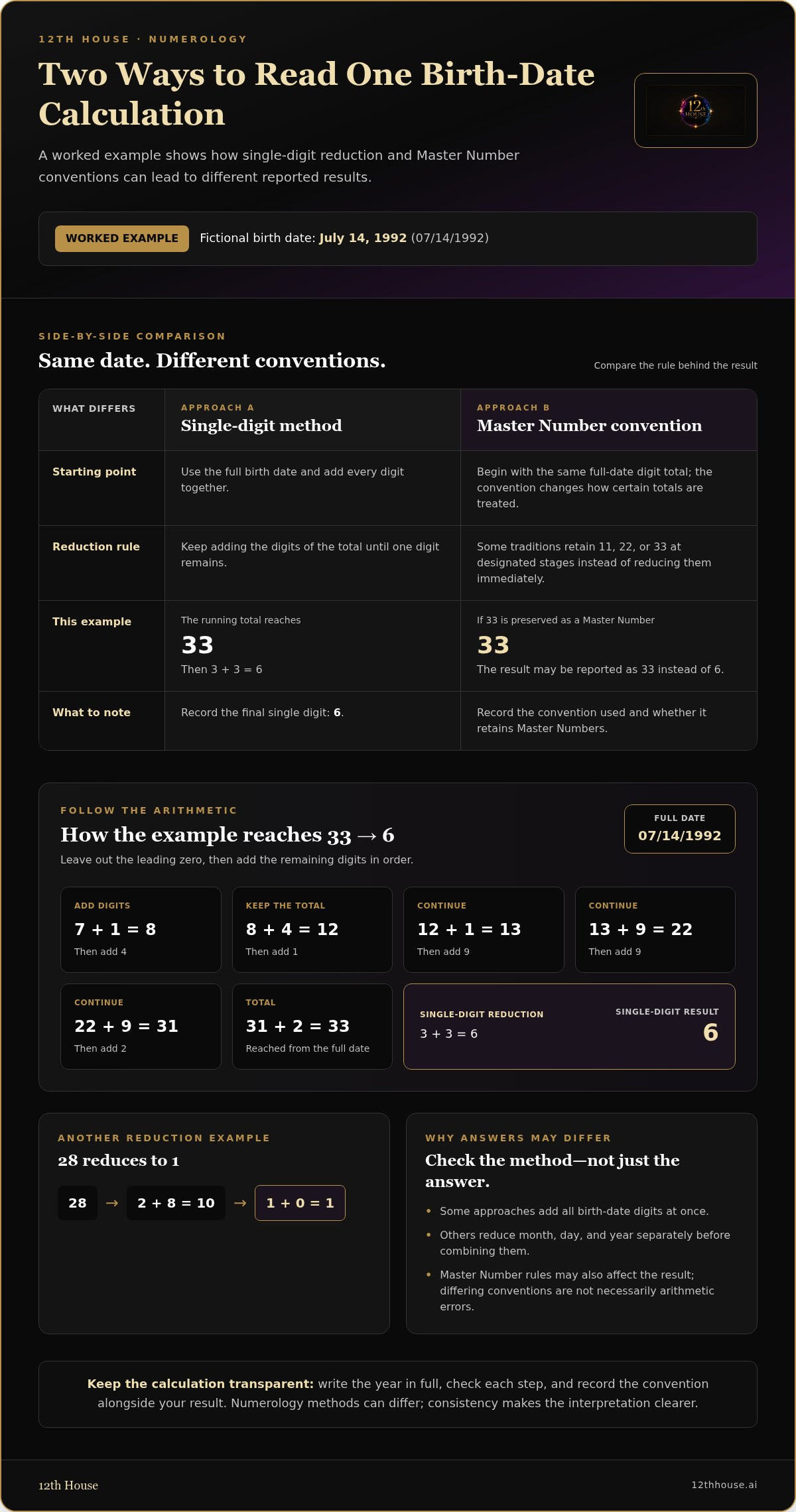
Use this fictional birth date as a worked example: July 14, 1992. It represents no real person’s profile. Write the date numerically as 07/14/1992, leave out the leading zero, and add the remaining digits in order:
- 7 + 1 = 8
- 8 + 4 = 12
- 12 + 1 = 13
- 13 + 9 = 22
- 22 + 9 = 31
- 31 + 2 = 33
- 3 + 3 = 6
Using the single-digit method, the result is 6. Each operation follows from the previous total, so you can check the arithmetic instead of relying on a calculator’s unexplained answer. Write the year in full: using only its last two digits would change the calculation and would not follow this method.
If your total is 28, for example, add 2 + 8 to reach 10, then add 1 + 0 to reach 1. Under this convention, keep reducing until you reach one digit. A guide to Life Path Number Meaning and Calculation also discusses calculation and number interpretations, giving you another reference as you compare approaches.
Why master-number conventions can change the result
Some numerology approaches retain 11, 22, or 33 at designated stages rather than reducing them immediately. In the example, a method that preserves 33 as a Master Number may report 33 instead of reducing it to 6. Other approaches reduce the month, day, and year separately before combining them and may apply Master Number rules during those steps. These conventions can produce different results from the same date without either being an arithmetic error.
If a calculator and a guide disagree, look at the method behind each answer. Check whether it adds all birth-date digits at once or reduces month, day, and year separately, and whether it preserves 11, 22, or 33. Record the convention alongside your result so the interpretation stays clear. The goal is consistency, not declaring one tradition definitively correct.
Once you have a result, use it as a starting point for exploring its themes. 12th House offers numerology reports for further exploration, while Ask Lala AI Spiritual Guidance can serve as a reflective companion as you consider what the symbolism brings up for you.
Life Path Numbers 1-9: The Core Meaning of Each Number
In numerology, each single-digit life path number is associated with an archetypal theme. These meanings are interpretive, not fixed traits. If you’re asking “what is my life path number meaning,” use the descriptions below as prompts to compare with your experience, not as verdicts about your character or future.
- 1, The Initiator: May point to independence and initiative. A potential strength is acting with conviction; a growth question is, “How can I lead while staying open to support?”
- 2, The Diplomat: May point to cooperation and sensitivity. A potential strength is bringing people into dialogue; a growth question is, “Can I honor my needs while considering someone else’s?”
- 3, The Communicator: May point to expression and creativity. A potential strength is giving ideas an engaging form; a growth question is, “What would help me follow through beyond the initial spark?”
- 4, The Builder: May point to structure and persistence. A potential strength is creating reliable foundations; a growth question is, “Where might flexibility serve me better than a familiar plan?”
- 5, The Explorer: May point to change and freedom. A potential strength is adapting to new conditions; a growth question is, “How can I pursue variety without losing sight of what matters?”
- 6, The Caregiver: May point to responsibility and care. A potential strength is offering steady support; a growth question is, “Am I helping by choice, or taking on more than is mine?”
- 7, The Seeker: May point to inquiry and introspection. A potential strength is examining ideas deeply; a growth question is, “How can I balance private reflection with connection and action?”
- 8, The Organizer: May point to ambition and material stewardship. A potential strength is coordinating resources; a growth question is, “How do I define success beyond control or achievement?”
- 9, The Humanitarian: May point to compassion and a wider perspective. A potential strength is caring about collective wellbeing; a growth question is, “How can I contribute without neglecting my own limits?”
How to read the strengths and growth edges
Each pairing holds both possibility and tension. Independence can support initiative yet make collaboration harder; care can build trust yet become over-responsibility. Take “may point to” literally. Choose one description, recall a real moment when it fit, then consider a moment when it didn’t. Comparing both helps you use the archetype thoughtfully instead of turning it into a label.
What if the description does not sound like you?
A short archetype can’t contain a whole person, their circumstances, or the choices they make. If a description feels distant, question the interpretation or set it aside. A mismatch isn’t a personal failure, and you don’t need to reshape yourself to fit a number. The most useful meaning opens an honest question rather than closing the conversation.
Master Numbers, Skepticism, and What Your Life Path Cannot Predict
Numerology may offer a meaningful structure for reflection, but its symbols have limits. Numerology is a symbolic practice, not a scientifically established forecasting method. There’s no reliable basis for treating a life path number as proof of personality or as a way to predict specific future events. Its value, if you find value in it, lies in the questions it helps you ask.
What are Master Numbers 11, 22, and 33?
Some numerology traditions give 11, 22, and 33 distinct symbolic interpretations rather than reducing them to single digits. In broad terms, 11 is often associated with intuition, 22 with building or bringing ideas into form, and 33 with compassion or service. These associations aren’t scientifically validated categories, and traditions differ in how they interpret them.
Whether a result is retained as a Master Number depends on the calculation convention. One approach may preserve 11, 22, or 33 at a designated stage; another may reduce the number further. Master Number status doesn’t prove greater ability, importance, or destiny. Treat the symbolism as one possible lens, not a rank or an obligation to live up to a special role.
Can a life path number predict your future?
No. A life path number shouldn’t be treated as a reliable or binding prediction. It can’t establish that a particular event will happen, tell you which choice to make, or remove uncertainty from a decision. Symbolic meaning-making is different from a verifiable claim about what lies ahead.
That distinction answers “what is my life path number meaning” without asking the number to do more than it can. A theme might help you notice a habit or consider a personal goal. But a short, generalized description can also feel persuasive because it’s broad enough to fit different experiences. Test what resonates against specific examples from your life, and pay attention to what doesn’t. You’re allowed to set aside an interpretation that feels inaccurate or unhelpful.
Keep your agency intact, especially when the stakes are high. Use evidence, practical circumstances, and your own judgment to make consequential decisions about relationships, work, health, or finances. A numerology reading can suggest a question to explore, but it shouldn’t substitute for relevant expertise or determine your next step.
If you want to explore the symbolism without treating it as a verdict, use a numerology report to examine your number’s themes. Explore your numerology themes as a reflective starting point, then decide for yourself what, if anything, fits.
How to Use Your Life Path Meaning for Reflection and Further Study
A life path interpretation becomes more useful when you test it against your experience. Rather than asking whether a description is simply “true,” examine where it fits, where it doesn’t, and what question it helps you consider. This keeps the symbolism in the role of a reflective tool, not an instruction manual.
A four-step life path reflection exercise
Choose one theme from your number’s description, then work through these steps in a journal. Use specific memories rather than broad claims about your personality.
- Name the theme. Choose one idea that resonates, such as creativity, cooperation, or independence. Write it down in your own words.
- Find supporting evidence. Record a specific experience that illustrates the theme. For instance, if independence stands out, describe a time you took initiative on a project and what prompted you to act.
- Look for a counterexample. Note an experience that complicates the interpretation. Perhaps you sought advice, shared responsibility, or chose not to lead. This helps prevent confirmation bias and makes room for a more complete picture.
- Choose an open question. Ask how the theme might inform a choice you control. For example: “Where would taking initiative help me now, and what support could make that choice wiser?”
Turn that final question into a journal prompt. Keep it exploratory: “What options do I have?” invites thought, while “I must act independently” turns symbolism into a rule. Your notes should help you see patterns, not pressure you to perform a particular identity.
When personalized numerology analysis can add context
A single life path number is one symbolic lens, not a complete profile of your personality or circumstances. If the theme raises questions you want to explore further, 12th House numerology reports offer another way to examine numerology interpretations. Use any additional symbolism as material for reflection, and decide for yourself what feels relevant.
Personal themes also differ from relationship analysis. A life path reflection focuses on how you interpret your own tendencies; compatibility explores how symbolic themes may be considered between people. If that distinction is useful, explore numerology compatibility insights as a separate lens rather than treating them as a verdict on a relationship.
You can also use Ask Lala for AI-based spiritual guidance as you examine a prompt. For context on AI-supported spiritual exploration, see the AI astrology assistant guide. Let the questions support your thinking, not replace your judgment. Your experience remains the final reference point.
Let Your Next Question Lead the Way
What is my life path number meaning beyond a familiar description? Let the answer become a question you can carry into daily life, one that helps you notice your choices without narrowing your sense of possibility. A symbolic theme can open a new perspective, but you remain the interpreter of your experience.
If you’re ready to explore what your number might bring into focus, 12th House offers numerology reports for further interpretation. Ask Lala also provides AI-based spiritual guidance as a companion for reflection. Use either as a starting point, then decide what feels relevant to your own path.
Explore numerology insights with 12th House, and take the next step with curiosity, discernment, and trust in your own judgment.
Frequently Asked Questions
Is a life path number the same as a destiny number?
No. They’re often calculated from different information, though terminology can vary across numerology traditions. A life path number is generally derived from your birth date, while a destiny number, often called an expression number, is commonly calculated from the letters in your full birth name. A person’s life path number stays tied to their birth date, while name-based calculations use a different symbolic input. Check how a particular guide defines each term.
Can your life path number change during your life?
No. The number calculated from your birth date doesn’t change, because the date itself remains the same. What can change is your relationship to its interpretation. A theme that feels abstract at one stage of life may become more relevant after a change in work, family responsibilities, or personal priorities. You can revisit the symbolism as your perspective develops, without assuming that your number or identity is fixed by it.
Are life path numbers scientifically proven?
No. Life path numbers are part of numerology, a symbolic belief system, and aren’t scientifically established as tools for measuring personality or forecasting outcomes. If you find an interpretation useful, treat it as a prompt for considering your experiences, not as evidence about what must be true. A description might lead you to reflect on how you handle change, for example, but your own behavior and circumstances offer more reliable information about your choices.
What should I do if two life path calculators give different answers?
Compare the methods before choosing between the results. Check whether each calculator adds every birth-date digit together or reduces the month, day, and year separately, and whether it preserves 11, 22, or 33 at particular steps. Then reproduce the arithmetic by hand using one stated method. If the answers still differ, record the method alongside each result. That way, you can interpret a consistent calculation instead of blending incompatible conventions.
Can two people have the same life path number?
Yes. The calculation reduces birth-date digits into a limited set of outcomes, so different people can arrive at the same number. Sharing a number doesn’t mean two people have identical personalities, experiences, or priorities. Two people might both explore a theme associated with independence while expressing it differently in family life or work. Use the shared symbolism as a conversation starter, not a basis for assuming you already understand someone.
Which numerology system should I use to calculate my life path number?
Choose a method that clearly explains its steps and use it consistently. Many popular guides use digit reduction, but they may differ in whether they reduce each birth-date component separately or keep certain totals as Master Numbers. There isn’t one convention that every numerology tradition follows. If you’re comparing interpretations, note the system and reduction rules used, so a difference in method isn’t mistaken for a difference in your birth date.
Can my life path number tell me which career I should choose?
No. A life path number can’t determine which career will suit you or guarantee success in a particular field. You might use its themes to generate questions, such as whether you value autonomy, teamwork, stability, or variety. Then compare those reflections with practical factors: your skills, interests, financial needs, and the day-to-day work involved. Treat numerology as one source of prompts, not a substitute for research, experience, or your own judgment.


