

If you’ve searched “what is the best tarot spread for beginners,” a three-card layout is a practical place to start. It gives you enough structure to compare a few perspectives without asking you to manage a long list of card positions or memorize the entire deck.
Tarot can feel intimidating at first. A large spread may turn one question into a maze of symbols, especially when the cards are unfamiliar. With three cards, you can focus on what each position means, then consider how the cards relate to one another.
This guide explains how to choose a spread, read a three-card layout in context, and build a repeatable practice. You’ll also learn when a one-card draw or a larger spread may suit your question better. Start with a simple framework, and let your interpretations develop through practice.
Key Takeaways
- For “what is the best tarot spread for beginners,” look for a layout with a few cards, clear positions, and room to reflect.
- Past, present, and future is one flexible three-card structure. You can also name positions to fit your question.
- Use a one-card draw for a focused prompt. Add cards when you need more context and are ready to interpret more connections.
- Build a repeatable practice by settling, framing an open-ended question, drawing, interpreting, and recording your reflections.
- Once you’ve learned the process, 12th House tarot readings and its metaphysical library offer ways to continue your self-guided practice.
What makes a tarot spread beginner-friendly?
A tarot spread is a layout that assigns a role to each card in a reading. One position might represent your current situation; another might invite you to look at a challenge or consider a different perspective. The positions help you connect the cards’ symbols to the question you brought to the reading.
A beginner-friendly tarot spread has a small number of clearly defined positions and gives you room to reflect on one question at a time. Look for distinct roles, such as “what’s happening” and “what could help,” rather than positions that seem to ask the same thing in different words. Clear roles make it easier to interpret each card in context.
So, what is the best tarot spread for beginners? There’s no single layout that fits every reader or question. A spread for thinking through a decision may not be the right fit for a short daily reflection. Choose a layout that matches what you want to explore, then keep its positions simple enough to explain before you draw. The aim is clarity, not complexity.
Why fewer card positions can make your first reading clearer
Every position adds something to interpret: the card’s imagery, its role, and its relationship to the other cards. Starting with fewer positions makes it easier to keep those elements in view. A short spread can still help you notice useful contrasts, such as what you already understand about a situation and what you may be overlooking.
You don’t need to memorize every card before you begin. Look at the image first, note your initial response, and consult a trusted reference if you want to explore traditional associations. Over time, repeated readings can help you recognize symbols and patterns without turning each draw into a memory test.
What a spread can and cannot tell you
A spread offers symbolic prompts for reflection, not a guaranteed prediction or a fixed verdict. To interpret a card, consider three things separately: your question, which sets the topic; the position, which defines the card’s role; and the imagery, which gives you symbols and details to examine. The same card may prompt different reflections in a position about support than it does in a position about a challenge.
Tarot card reading is a form of cartomancy where practitioners use tarot cards to gain insight into the past, present, or future. To keep your reading grounded, treat that insight as something to examine rather than an instruction you must follow. Ask what the card brings into focus, notice what resonates, and consider what you want to explore further.
For more context on tarot’s foundations and its use as a tool for insight, explore Tarot Mastery: A Professional Guide to Spiritual Clarity. A simple spread can give your self-inquiry structure while leaving room to adapt your approach as you learn.
How to read the three-card tarot spread for beginners
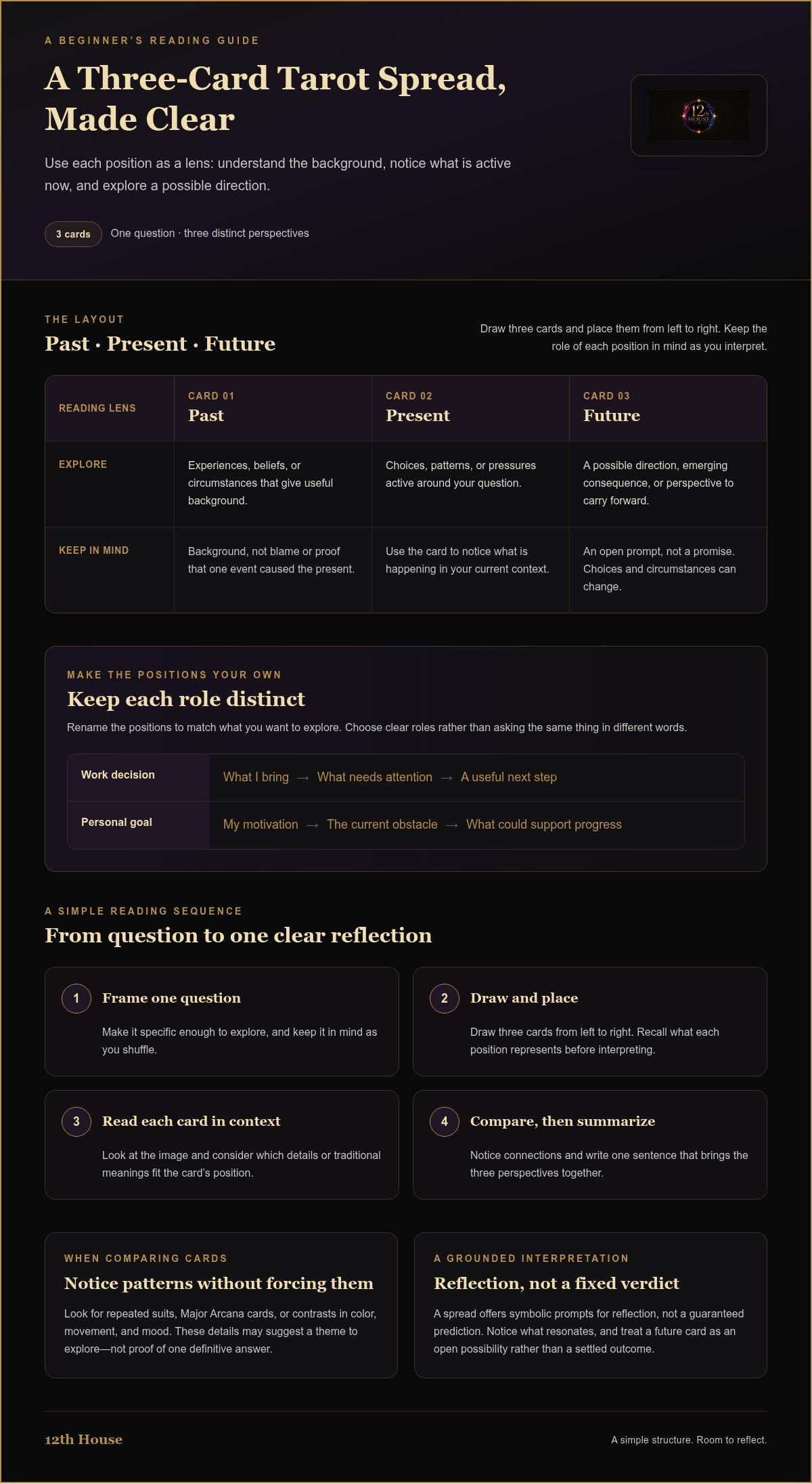
A past-present-future layout gives each card a clear place in a simple sequence. It’s a useful starting point, not a rule every reader or question must follow. If you’re asking what is the best tarot spread for beginners, this layout offers a straightforward way to see how a card’s position shapes its interpretation.
In this spread, the past offers relevant background, the present reflects what’s active now, and the future suggests a possible direction to consider. Read “future” as an open prompt, not a promise. Your choices and circumstances can change, so use the cards to explore possibilities rather than settle on a fixed outcome.
A simple past, present, and future layout
Start with one question that is specific enough to explore. Shuffle while keeping it in mind, then draw three cards and place them from left to right. Before interpreting, remind yourself what each position represents. Then look at each card in turn, using its position to guide which parts of its imagery and traditional meanings are relevant.
- Past: Look for experiences, beliefs, or circumstances that provide useful background. This position doesn’t assign blame or prove that one event caused the current situation.
- Present: Consider the choices, patterns, or pressures active around your question. Ask what the card helps you notice about your current context.
- Future: Explore a possible direction, emerging consequence, or perspective to carry forward. Keep it open-ended: decisions and circumstances can change.
You can rename the positions to suit your question. For a work decision, try “what I bring,” “what needs attention,” and “a useful next step.” For a personal goal, consider “my motivation,” “the current obstacle,” and “what could support progress.” Keep each role distinct, and avoid wording that demands a guaranteed outcome.
How to connect the three cards into one reading
First interpret each card on its own, using its position as a lens. Then compare them. Notice repeated suits, Major Arcana cards, or contrasts in color, movement, and mood. These details can suggest a theme, but don’t force a pattern. Treat a repeated element as something to explore, not proof of one definitive answer.
Illustrative example: Imagine asking, “What might help me approach a difficult conversation?” The past card shows a figure standing alone, the present depicts two people facing each other, and the future shows a path opening ahead. You might reflect on a habit of handling conflict alone, recognize that direct exchange is possible now, and consider what honest next step could open the way forward. This is one interpretation, not a universal meaning for those images.
Try summarizing the three cards in one sentence. If the summary sounds too certain, revisit the question and positions. A structured reading can support self-guided exploration, and 12th House offers tarot readings as another way to engage with tarot.
One-card, three-card, or larger tarot spread: which should you choose?
Choose a spread based on what you want to reflect on, not the number of cards that seems most impressive. One card can focus your attention. Three cards can add context and show relationships. A larger layout gives you more positions to interpret, which may help with a layered question but also asks you to track more connections.
| Spread | Card count | Useful for | Interpretive complexity |
|---|---|---|---|
| One-card draw | 1 | A daily reflection or focused prompt | Low, with one image and one role to consider |
| Three-card spread | 3 | Exploring a situation from a few connected angles | Moderate, with each card read alone and in relation to the others |
| Larger layout | More than 3 | A question that genuinely needs several distinct perspectives | Higher, with more positions and relationships to interpret |
If you’re asking what is the best tarot spread for beginners, let the scope of your question guide you. Start with the smallest layout that gives it useful structure. More cards don’t automatically make a reading more accurate; they add prompts and relationships that take care to interpret.
When a one-card draw is enough
A one-card draw can suit a narrow, open-ended prompt such as, “What would be useful to notice today?” Look at the image, consider the role you’ve assigned it, and notice your response. What catches your attention first? What feeling or question does the image bring forward? One card gives a single symbol room to unfold without adding extra positions. For a layered question, though, it may leave useful context unexplored.
When to try a larger layout
Add positions when they answer a real need. If your question has several distinct parts, a larger spread may help separate them. Before drawing an extra card, ask whether its position will clarify the question or simply give you more symbols to manage.
The Celtic Cross is a familiar larger layout, but it isn’t a beginner requirement or inherently more accurate than a one-card or three-card spread. Its multiple positions can provide a broader map, but they take attention to interpret coherently. Learn a simpler structure first, then explore a larger one when you can explain what each additional position contributes.
For a wider foundation in tarot interpretation, Tarot Mastery: A Professional Guide to Spiritual Clarity explores how card meanings and context work together. Let the question determine the layout: a focused prompt may need one card, while a request for added perspective may benefit from three.
How to do your first tarot spread, step by step
A repeatable process takes pressure off the reading. You don’t need to produce a perfect interpretation or remember every card meaning. Follow the same sequence each time, and let the question, positions, and images guide your attention. If you’re wondering what is the best tarot spread for beginners, start with a layout you can use thoughtfully and consistently.
Settle, ask, shuffle, draw, interpret, and record: this sequence gives your first tarot reading a clear beginning, middle, and end.
- Settle. Put distractions aside and take a moment to notice how you’re feeling. You don’t need a special ritual; pausing can help you approach the question with attention rather than urgency.
- Frame your question. Choose an open-ended prompt about your perspective, choices, or present circumstances. Focus on something you can reflect on rather than trying to control another person’s actions or demand a certain outcome.
- Shuffle. Hold the question in mind as you shuffle in a way that feels comfortable. There’s no need for a perfect technique. If you use reversals, decide before drawing whether reversed cards will have a different role. Beginners can leave reversals out; consistency matters more than adding rules.
- Draw and place. Draw the number of cards your spread calls for. Place each card in its assigned position before interpreting it, so the layout gives it a defined role.
- Interpret. Consider each card in sequence. Start with a familiar meaning, then notice the imagery and how the card’s position relates to your question. Read for possibilities and useful reflection, not a final verdict.
- Record. Write down the question, spread, cards, and first interpretation. Note what stood out, even if you’re uncertain. Your notes give you something to revisit without relying on memory.
Frame a question that gives the cards useful context
Broad concerns can be difficult to interpret because they don’t give the reading a clear focus. Narrow the prompt to one area you can examine. Instead of “Will everything work out at work?” try “What perspective could help me approach my current work challenge?” The question doesn’t ask the cards to guarantee an outcome. It gives you a specific lens for reflection.
Interpret the cards without memorizing every meaning
Begin with a conventional meaning, then look closely at the image, its position, and your own associations. Use a beginner guide or journal as a reference, not as a memory test. Record your first interpretation before looking back later. When you revisit it, notice what has become clearer without rewriting the original reading to make it seem certain.
Practice helps you develop a method that feels grounded and repeatable. Explore 12th House tarot readings as another way to engage with tarot and continue your reflection.
Build a thoughtful tarot practice with 12th House
A useful tarot practice doesn’t depend on elaborate spreads. It depends on choosing a layout that fits your question, reading each card through its position, and giving yourself time to reflect. After a reading, record what you noticed and what remains unresolved. Over time, those notes can help you see how your interpretations develop without turning each draw into a search for certainty.
If you’re still considering what is the best tarot spread for beginners, return to a simple principle: choose the smallest spread that gives your question enough context. A one-card prompt can focus your attention; a three-card layout can show a few related angles. The useful spread is one whose structure you can explain and whose cards you can consider thoughtfully.
Continue learning through structured tarot resources
Self-guided study can deepen your practice without requiring you to memorize every symbol at once. 12th House membership provides access to a metaphysical library for continued exploration. As you study, compare the symbols you notice with the interpretations you record. Keep familiar card associations distinct from your personal response to the imagery.
A simple journal entry can capture that difference: note the question, spread positions, cards, and first impressions. Later, review the entry and ask what you understand differently now. This kind of reflection helps you learn from your process while keeping the original reading intact. You don’t need to force a conclusion. Sometimes the most useful insight is a sharper question.
Explore tarot readings as another perspective
Once you’ve worked through the basic method, you may want to experience a reading beyond your own practice. 12th House offers tarot readings. Treat a reading as another perspective to consider, not as a substitute for your judgment. Notice what resonates, question what doesn’t, and decide for yourself how any insight relates to your circumstances.
There’s no need to rush into a larger layout or make every reading definitive. Choose a spread, give each position a clear role, reflect on the cards, and record what you learn. That repeatable structure makes tarot a practice of attentive self-guided exploration, one you can revisit as your understanding grows.
When you’re ready to explore further, explore 12th House for tarot readings and membership access to a metaphysical library.
Let your first reading open a new path
Your first spread doesn’t need to settle every uncertainty. Let it begin a conversation with your own attention. As you practice, notice which questions lead to useful reflection and which layouts help you think more clearly. The answer to “what is the best tarot spread for beginners” can change as your questions and confidence develop. Keep your approach simple, stay curious, and let your interpretations remain your own.
To continue exploring, 12th House brings tarot readings together with Ask Lala AI spiritual guidance and membership access to a metaphysical library. Use these resources as invitations to consider new perspectives, not as substitutes for your judgment.
Explore 12th House to continue your tarot practice with a thoughtful question and a spread that feels manageable. Let your own observations guide what you learn next.
Frequently Asked Questions
What is the easiest tarot spread for beginners?
A one-card draw is often the easiest place to begin because it gives you one image to consider without requiring you to connect several cards. Ask a focused question such as, “What quality could I bring to today?” Then describe what you notice before consulting a guide. If you’re asking what is the best tarot spread for beginners, start with one card for a brief reflection and add positions when you need more context.
Is a three-card tarot spread good for beginners?
Yes. A three-card spread can suit beginners because it gives a reading more context while keeping the number of relationships manageable. Try assigning the cards to “what I know,” “what I need to examine,” and “what I can consider next.” After interpreting each card, ask how they relate. They might reinforce one another, introduce a tension, or highlight different parts of the question.
How do you do a tarot spread for the first time?
Choose a spread and write down what each position means before drawing. Set one question, shuffle, then place the cards in order. Look at each image and note your first observation, even if it’s small, such as a figure looking away or a prominent color. Use a reference to explore possible meanings, then write a short interpretation. That record gives you something to revisit without relying on memory.
Can beginners use the Celtic Cross tarot spread?
Beginners can use the Celtic Cross, but they don’t need to start with it. Its many positions can be harder to keep distinct, especially if you haven’t developed a way to connect each card to the question. If you’re curious, write out the position meanings first and interpret one card at a time. If the reading becomes confusing, return to a smaller spread and explore the question in stages.
Do you need to know all tarot card meanings before using a spread?
No. You can begin before memorizing the deck. Keep a guide nearby and look up a card after noting what stands out in its image. To make learning manageable, choose one detail to track, such as the card’s central action or emotional tone. Over time, compare your notes with traditional meanings. The aim isn’t to test your recall; it’s to build a thoughtful relationship with the symbols.
Should beginners use reversed tarot cards in a spread?
Reversals are optional. You can read every card upright while you learn the deck, then decide whether reversed cards add a useful layer to your practice. If you include them, decide how you’ll interpret them before drawing and apply that approach consistently throughout the reading. A reversed card doesn’t have to mean the opposite of its upright meaning; treat it as an additional interpretive prompt.
What should I ask when using a beginner tarot spread?
Ask an open-ended question about something you can examine or influence. For example, “What could help me use my time more deliberately this week?” gives the reading a clear focus without demanding a prediction. Prompts about your perspective, priorities, or next steps leave room for reflection. Avoid asking the cards to determine another person’s feelings or guarantee a specific outcome.


