

What if the most useful tarot question isn’t what someone else thinks, but what you can choose next? If you’ve wondered, “is it okay to do a tarot reading about someone else,” your hesitation makes sense. A reading can feel like a way to find clarity, yet exploring another person’s private thoughts without their consent can cross an important boundary.
That doesn’t mean you have to ignore your questions or uncertainty. Tarot can offer a structured space to examine your own feelings, expectations, and role in a relationship. Its symbols are prompts for reflection, not proof of what another person thinks or a fixed prediction of what will happen.
This guide explores practical consent and privacy boundaries, explains why third-party readings deserve care, and shows how to reframe questions respectfully. You’ll learn to shift the focus from decoding someone else to understanding your own choices, so an unsettling card doesn’t become a verdict on a relationship. Use the reading as a map for reflection, not a claim of certainty.
Key Takeaways
- When asking “is it okay to do a tarot reading about someone else,” consider consent, privacy, and whether the reading could shape how you treat them.
- Interpret cards as symbolic prompts, not verified evidence of another person’s feelings, motives, or future behavior.
- Turn certainty-seeking questions into open ones about your own needs, boundaries, and next steps.
- Before drawing, check your intent; afterward, keep the interpretation private and avoid treating it as a verdict.
Is it okay to do a tarot reading about someone else?
It depends on what you’re asking the cards to do. If the spread is a tool for examining your own feelings, boundaries, or next steps, you can approach it as reflection. If you’re using it to claim knowledge of someone else’s private thoughts or actions, the reading moves into territory tarot can’t verify and may disregard their privacy. A third-party reading is a spread focused on a person who isn’t present, whether they’re a partner, friend, colleague, or someone indirectly involved.
The distinction is in the question. “What does my colleague secretly think of me?” seeks access to another person’s inner life. “How can I respond constructively to tension with my colleague?” turns attention to your own choices. Cards have images, positions, and symbolic associations that readers interpret; they don’t independently confirm feelings, motives, fidelity, or future behavior. For background on the practice and its methods, see Tarot card reading.
A tarot spread can help you examine your perspective; it cannot establish facts about someone else. Keep that boundary clear, especially if the interpretation might influence what you say or do.
What counts as a tarot reading about another person?
A reading is about another person when its central question asks what they feel, intend, conceal, or will do. The person could be known to you, absent from the reading, or only indirectly connected to the situation. By contrast, asking what you need in a relationship focuses on your own experience, even if another person is part of the context.
For example, someone waiting for a message might ask, “Why hasn’t Alex replied?” A card drawn in response can’t establish Alex’s reason. Reframing the question as “What would help me handle the uncertainty while I wait?” makes the spread a prompt to reflect on your own response.
Why people ask tarot about someone else
Uncertainty can make a relationship feel like a puzzle with missing pieces. You might be trying to understand a change in someone’s behavior, decide whether to initiate a conversation, or find steadiness while you wait for clarity. Wanting insight doesn’t make you intrusive by itself. What matters is how you frame the question and whether you treat the reading as reflection or as permission to assume you know another person’s private reality.
Tarot offers a symbolic structure for noticing which possibilities, fears, or expectations are shaping your perspective. A card may prompt you to consider what you need, what boundary feels relevant, or what you can ask directly. It can’t replace honest communication. If you need to know what someone means or wants, a respectful conversation is more reliable than interpreting symbols on their behalf. Let the cards clarify your own questions, not answer for them.
What tarot can, and cannot, say about another person
A card’s meaning isn’t a sealed message about someone else. Readers interpret imagery, card positions, and the question asked through a particular tradition or personal framework. That process can generate ideas for reflection, but it doesn’t independently verify what another person thinks, intends, or has done. So if you’re asking, “is it okay to do a tarot reading about someone else,” keep interpretation separate from evidence.
This distinction matters most with emotionally charged questions. A spread might prompt you to consider trust, uncertainty, or your boundaries. It can’t establish that someone is unfaithful, hiding something, or about to take a particular action. Interpretations vary among readers and practices, and the same card can carry different meanings depending on its context.
A card can illuminate a question you’re carrying; it can’t prove what another person holds inside.
Reading symbols without turning them into evidence
Tarot decks are commonly organized into the Major Arcana and Minor Arcana. The Major Arcana often addresses broad themes or turning points, while the Minor Arcana can explore everyday situations and experiences. These are general conventions, not fixed rules; readers may use different systems. Meaning also depends on the question, the card’s position in a spread, and the interpretive framework guiding the reading.
Imagine drawing a card associated in your practice with change while asking about a friend’s plans. You might use the image to explore your own response to uncertainty or the possibility of changing expectations. It doesn’t confirm that your friend intends to move, end a friendship, or make any other specific choice. The symbol opens a line of inquiry. It doesn’t supply independent evidence.
The querent’s perspective shapes the reading
The querent is the person asking the question and receiving the reading. Their hopes, fears, memories, and assumptions can influence which details stand out and how a card is interpreted. That doesn’t make reflection meaningless. It does mean a reading is shaped by the querent’s perspective, rather than offering a neutral report of an absent person’s inner life.
Try separating the record into three parts:
- Question: Write the exact question you asked before drawing.
- Interpretation: Record what the card brings to mind, using language such as “I’m wondering whether…” rather than “They definitely…”
- Grounded reflection: Note what you actually know, what remains uncertain, and what response is within your control.
This small practice helps you spot when an interpretation is echoing an assumption instead of opening a useful perspective. If you want a structured space for continued tarot reflection, 12th House tarot readings can complement your own notes as one tool for exploring the symbolism.
Consent, privacy, and the ethics of reading tarot about someone
Asking “is it okay to do a tarot reading about someone else” calls for more than a yes-or-no rule. Consider your intent, the person’s privacy, and what you might do with the interpretation. Some readers and traditions avoid third-party readings without consent; others may treat a spread as private reflection. Whatever your approach, don’t present symbols as access to another person’s confidential life, or let an uncertain interpretation become a basis for accusation or control.
Keep three actions distinct: reflecting privately, sharing what the cards suggested, and acting toward someone because of the reading. A personal journal entry may help you notice your own concerns. Repeating the reading as if it revealed a fact, or confronting someone based on it, can turn speculation into pressure. Use a reading to examine your choices, not claim ownership of another person’s story.
When consent is unavailable or the person is absent
Absence isn’t permission. Take particular care if your question concerns intimate or sensitive matters, such as someone’s health, sexuality, fidelity, finances, or personal history. A symbolic interpretation doesn’t authorize you to disclose a claim, investigate the person, or make decisions on their behalf. If consent isn’t available, redirect the spread toward what you need, what boundary matters, or how you want to respond.
For instance, replace a question about a partner’s private behavior with one about what you need to feel secure and what conversation you’re prepared to have. The focus remains honest: your uncertainty is real, but a card can’t settle the other person’s account.
When to pause or choose a different question
Pause before drawing if you’re seeking certainty at any cost, hoping to monitor someone, or looking for symbolic permission to control their choices. Also pause if you feel distressed enough that an alarming interpretation could quickly become an accusation. A reading should create room to think, not intensify fear or narrow your options.
- Check your intent: Are you exploring your response, or trying to uncover information the person hasn’t shared?
- Consider the effect: Could you treat a troubling interpretation as proof or use it to justify a confrontation?
- Choose another route: Where it’s safe and appropriate, direct conversation can help clarify what another person actually means or wants.
These checks don’t require you to dismiss tarot or your intuition. They help keep the reading within its proper limits: a way to examine your perspective, not a substitute for another person’s words or consent. 12th House offers tarot readings as a tool for self-guided exploration.
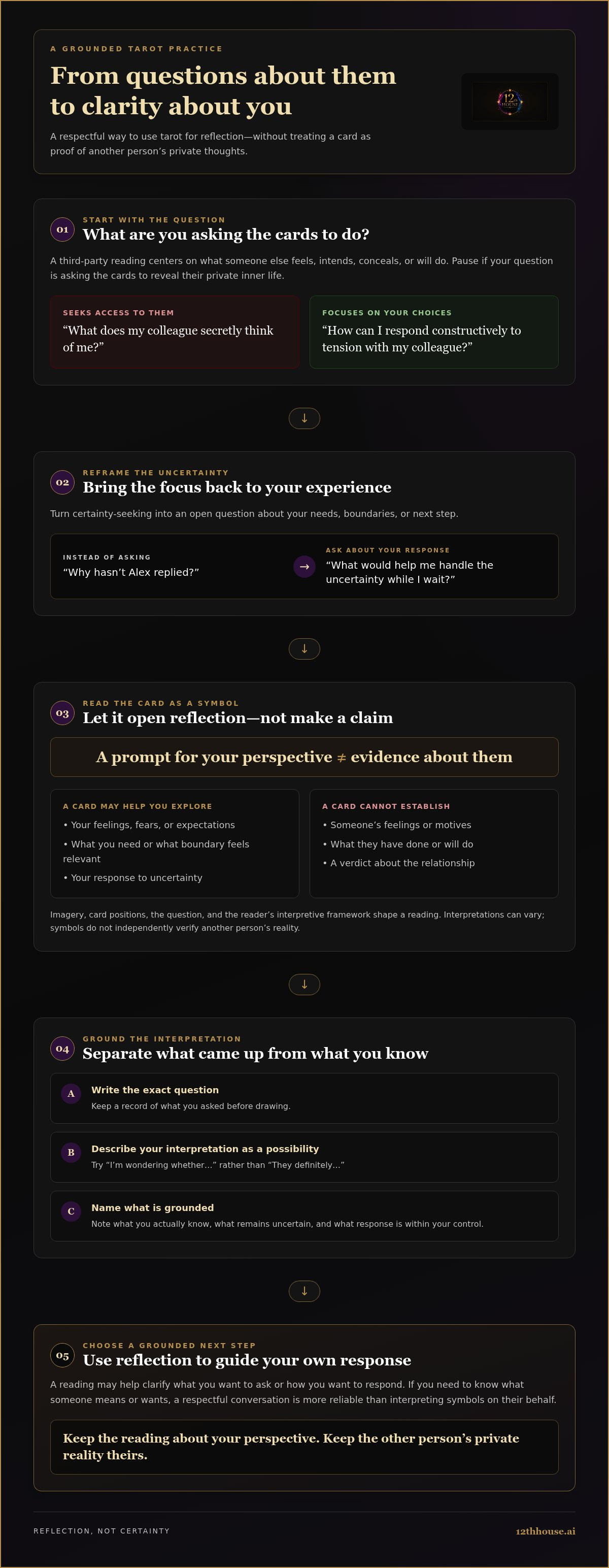
How to reframe a tarot question about someone else
A useful reframe doesn’t erase your concern. It changes the reading’s point of reference, from trying to decode another person to examining what you can notice and choose. If you’ve asked, “is it okay to do a tarot reading about someone else,” this process helps keep the practice centered on your own agency.
Move through the steps in order. The pause before drawing matters as much as the cards themselves.
- Name the concern. State plainly what feels uncertain, without turning a suspicion into a fact.
- Check your intent. Ask whether you want reflection or certainty about someone else’s private life.
- Reframe the question. Put your needs, boundaries, or possible responses at the center.
- Draw with that question in mind. Keep the wording visible so the original concern doesn’t quietly take over.
- Reflect before acting. Record possibilities, then consider what you know outside the reading.
Turn mind-reading questions into self-reflection
Change “What do they feel about me?” to “What do I need to understand about this connection?” Shift “What will they do?” to “What choices are available to me now?” These open questions don’t demand a single hidden answer. They leave room to consider different meanings, including the possibility that your own hopes or fears are shaping what you notice.
Use tentative language as you interpret: “This may invite me to consider…” or “One possibility is…” Then separate observation from assumption. “I feel unsettled after our last conversation” describes your experience. “They meant to hurt me” assigns a motive you may not know.
A simple spread for clarity without intrusion
This three-card layout is one possible exercise, not a universal rule or prescribed tradition. Set each position around your own agency: my concern, my boundary, and my next considered step. Before drawing, write down the question you’re using. Interpret each card in relation to its position, not as a report on the other person.
For example, a card in the “my boundary” position might prompt you to explore where you need more clarity or space. It doesn’t establish what someone else intends. Write down the image or detail you noticed, followed by your interpretation and any assumptions you’re making. Keeping these separate makes it easier to see where the card ends and your inference begins.
Give the notes time to settle before making a consequential decision. Ask yourself: What do I know from direct experience? What remains uncertain? What action still feels grounded if my interpretation turns out to be wrong? A spread can organize reflection, but it shouldn’t make a decision for you.
12th House tarot readings offer another way to explore tarot as a self-guided practice. Explore tarot readings on 12th House.
A grounded next step for your tarot practice
Ethical tarot begins before you shuffle. Ask what you hope to understand, whose privacy is involved, and whether the answer you want is something a spread can responsibly provide. The question “is it okay to do a tarot reading about someone else” becomes easier to navigate when you keep the reading’s purpose clear: reflection can help you examine your perspective, but a spread isn’t a verdict about someone else or a substitute for their words.
Use this brief check before drawing. If the question doesn’t leave room for your own judgment and responsibility, pause and reshape it.
A brief ethical checklist before drawing cards
- Intent: Are you looking for a reflective prompt, or certainty about another person’s private thoughts or actions?
- Privacy: Does the question reach into intimate details that the person hasn’t chosen to share?
- Interpretation: Can you hold the card’s meaning as one possible perspective rather than proof?
- Agency: Does the question help you identify your own choices, needs, or boundaries?
If a question fails one of these checks, you don’t have to abandon the reading. Reframe it around what you can decide: what you need to clarify, what boundary you want to honor, or what next step feels considered. Keep the interpretation tentative. A card may prompt a useful question, but it shouldn’t make a consequential choice on your behalf.
Continue learning with structure
Ethical practice grows through reflection and learning, not through a single fixed interpretation. 12th House’s metaphysical library includes books, videos, and ritual frameworks for self-guided learning. Returning to core ideas such as symbolism, context, and question framing can help you notice when an interpretation is drifting from reflection into assumption.
12th House offers tarot readings and a metaphysical library as resources for exploring tarot and related topics at your own pace. Use them as part of a self-guided practice: take time with the material, note what resonates, and decide what meaning you can responsibly carry into your choices. No reading needs to settle another person’s story for your reflection to be worthwhile.
Keep the cards as a mirror for your own inquiry, not a verdict on someone else. Explore 12th House for tarot readings and self-guided metaphysical learning.
Let your next reading begin with your own question
Before you draw again, ask what kind of understanding would genuinely help you. A more grounded question may not reveal what another person thinks, but it can show you where your attention, boundaries, and choices are asking to go. That shift keeps the practice open without asking the cards to settle someone else’s story.
So, is it okay to do a tarot reading about someone else? Let your answer rest on intention and care. Use the spread to explore your own perspective, and leave room for direct, respectful communication to provide what symbols cannot.
Keep developing that reflective practice at your own pace. 12th House offers tarot readings and, through membership, access to a metaphysical library for continued learning. Explore 12th House’s tarot and metaphysical learning tools and give your next question a thoughtful place to begin.
Your choices remain yours. Let the cards open a door to reflection, then step forward with clarity and care.
Frequently Asked Questions
Does the other person need to be present for a tarot reading about them?
No, physical presence isn’t required to shuffle or draw cards, but reading for someone and reading privately about them raise different consent questions. If they’ve asked for a reading, they may be able to participate remotely or receive the interpretation later, depending on the format. If you’re exploring a situation for yourself, keep the reading private and don’t present it to them as a message about their life. That distinction matters when asking, “is it okay to do a tarot reading about someone else?”
Do you need someone’s birth date to do a tarot reading about them?
No, a birth date generally isn’t necessary for a tarot reading. A reader can work with a question and a chosen spread without collecting identifying details. Birth dates are more commonly associated with systems such as astrology or numerology, though practices vary. If someone shares personal information with you, avoid including it in notes or conversations beyond what’s needed for the reading. Don’t treat additional personal details as proof that the cards can reveal more about them.
Can you do a tarot reading about someone you have never met?
You can draw cards while thinking about someone you don’t know, but the lack of firsthand context makes it especially easy to mistake your impressions for insight into their life. For example, rather than asking why an unfamiliar creator posted something, reflect on what their public work brings up for you. Keep the interpretation about your response. Avoid using a spread to invent private motives or personal circumstances for a stranger.
Is it okay to do a tarot reading about a public figure?
You can use tarot to reflect on your response to a public figure or their public work, while still respecting the boundary between public information and private life. For instance, you might examine your reaction to a politician’s published proposal, rather than asking about their intimate relationships or secret intentions. Public visibility doesn’t make a person’s inner thoughts available as fact. Keep the reading focused on your perspective, values, or choices as an observer.
Can tarot tell you whether someone is thinking about you?
No, a tarot spread can’t reliably establish whether a particular person is thinking about you. A card may bring your hopes, memories, or uncertainty into focus, but it can’t confirm another person’s current thoughts. If you’re deciding whether to reconnect, consider what you want from contact and whether reaching out would be welcome. Their response, or lack of one, offers more direct information than treating a card as a message from them.
What should you do if a tarot reading about someone makes you anxious?
Pause the reading and avoid making an accusation or major decision while you feel unsettled. Step away from the cards, take a few slow breaths, and write down three things separately: what appeared in the spread, what you interpreted, and what you know from direct experience. Revisit the notes when you feel calmer. If anxiety continues, talk it through with someone you trust, focusing on what would help you feel supported now.


