

What if the number you’re looking for comes from your name, not your birth date? If you’ve wondered, “what is my soul urge number,” that distinction is the first part of the answer. In numerology, the soul urge number is calculated from the vowels in your full birth name and is associated with inner desires and motivations. Your Life Path number, by contrast, is based on your birth date.
Different guides may treat a letter like Y differently or explain number reduction in conflicting ways. The method matters, so this guide lays out the calculation step by step, including how to total the vowels and when a master number may be preserved. You’ll also see how the soul urge number differs from other core numerology numbers.
Use its symbolism as a structured prompt for self-reflection, not a fixed prediction about who you are or what will happen. Numerology offers a framework for asking questions about what feels meaningful to you. Your result can be a starting point for that inquiry, rather than a verdict.
Key Takeaways
- Use the common Pythagorean vowel values as a clear starting point, while recognizing that conventions such as how to treat Y can vary.
- Follow a repeatable process to total the relevant letters and reduce the result, noting where different traditions may handle master numbers differently.
- Explore the traditional symbolism of your number as a possible lens on inner motivations, not a fixed description of your personality.
- Compare the soul urge number with Life Path and Expression numbers to see how numerology assigns each a different focus.
- If you’re asking “what is my soul urge number,” use the result to prompt reflection, test its themes against your experience, and keep only what helps you inquire further.
What Is a Soul Urge Number, and What Does It Represent?
If you’re asking, “what is my soul urge number,” you’re looking at a symbolic measure in numerology, traditionally calculated from the vowels in a person’s name. Some numerology traditions call it the heart’s desire number. The calculation uses a name, while the interpretation turns toward what may matter inwardly: motivations, values, and private aspirations that can shape choices.
That focus distinguishes it from a number derived from a birth date. In numerological interpretation, the soul urge number is less a map of external events than a lens for considering what feels meaningful beneath them. It may invite questions about what you seek, what sustains your sense of purpose, or which values you want your decisions to express.
Keep the framework in view. Numerology includes different systems and traditions, and its symbolic readings are not scientifically validated personality tests. A number can’t establish what you’re like or verify your hidden motives. Treat it as an interpretive structure: useful for reflection when it opens a thoughtful question, but not as evidence or a final verdict.
Why Do Numerologists Focus on Vowels?
Using vowels is a convention in common numerology methods, not a universal rule shared by every school. Within this symbolic framework, vowels are often associated with a name’s inward or less visible dimension, so their values are interpreted as a route into inner motivations. That association belongs to the tradition; it doesn’t prove that vowels reveal a person’s subconscious or determine their desires.
This distinction helps explain why methods and readings can differ. Numerologists may follow different systems or make different choices about how a name is treated. A result is easiest to interpret when you know the convention behind it, rather than assuming every reading follows identical rules.
What Can a Soul Urge Number Help You Explore?
Use the interpretation as a prompt, then compare it with your lived experience. If a reading highlights independence, for example, ask whether having room to make your own decisions feels important in a particular part of your life. The point isn’t to accept the label. It’s to see whether the theme helps you notice a value or desire you want to understand better.
- Which values feel most important in the choices you’re facing?
- What kind of activity or environment feels meaningful to you, and why?
- Does the interpretation fit your experience, challenge it, or leave you unconvinced?
One number can’t summarize a whole person, account for every influence on a decision, or determine the future. Let the symbolism begin an inquiry, not close one. Keep interpretations that lead to useful reflection, and release the ones that don’t.
How to Calculate Your Soul Urge Number From Your Name
To calculate a soul urge number, isolate the vowels in a chosen name, assign each its value, add the values, then reduce the total according to your chosen numerology convention. This gives you a result you can reproduce and compare. The common Pythagorean method offers a clear starting point, but it’s one established system, not the only possible convention.
Which Name Should You Use for the Calculation?
Many methods use the full name given at birth, while other numerology practices may handle name variations differently. There isn’t one universally correct choice for every tradition or personal situation. Choose the convention you intend to follow, then record it alongside your calculation. If you later calculate a different name, keep that result separate rather than mixing the two sets of vowels.
How Do You Add and Reduce the Vowel Values?
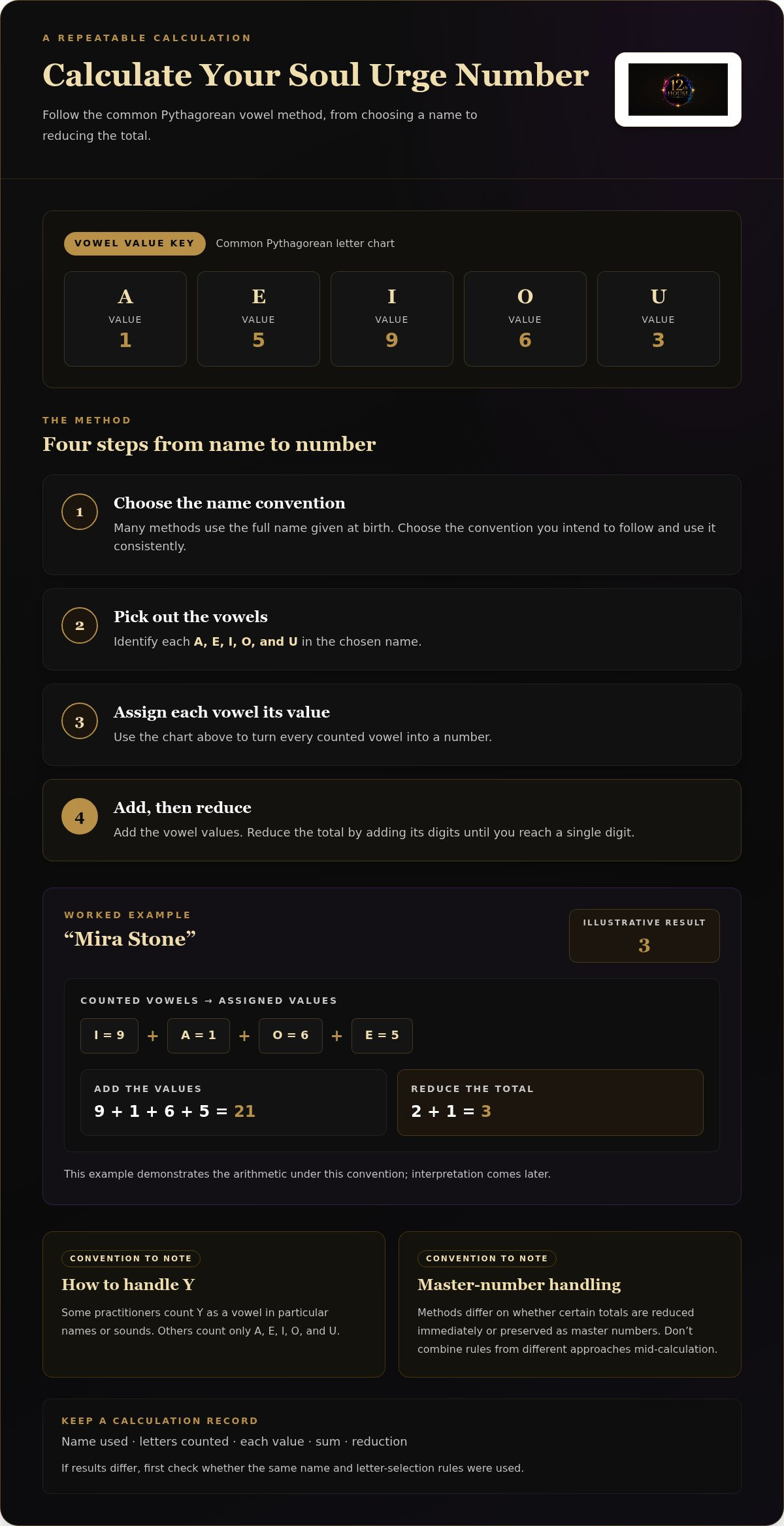
In the common Pythagorean letter chart, the vowel values are A=1, E=5, I=9, O=6, and U=3. Follow this sequence:
- Write the full name you’ve chosen, using the same name convention throughout.
- Identify each A, E, I, O, and U in the name.
- Assign each vowel its value from the chart.
- Add the values, then reduce the total by adding its digits until you reach a single digit.
Illustrative calculation: Use the fictional name “Mira Stone.” Its vowels are I, A, O, and E. Their values are I=9, A=1, O=6, and E=5. Add them: 9 + 1 + 6 + 5 = 21. Reduce the total: 2 + 1 = 3. Under this convention, the illustrative result is 3. This example shows the arithmetic only; interpretation comes later.
Keep a short record of your work: the name used, which letters you counted, each value, the sum, and the reduction. That makes it easier to spot a missed vowel or compare results without guessing where they diverged. If a second calculation gives a different total, first check whether you used the same name and letter-selection rules.
Some practitioners treat Y as a vowel in particular names or sounds, while others count only A, E, I, O, and U. Methods also differ on whether certain totals are reduced immediately or preserved as master numbers. These choices can change the result, so don’t combine rules from different approaches mid-calculation. The FAQ addresses these edge cases; consistency is the key.
Once you have a result, you can explore it alongside a broader numerology framework. 12th House offers numerology reports to support that symbolic inquiry, without treating a number as a fixed prediction.
Soul Urge Number Meanings: Read the Symbolism Without Overclaiming
If you’re wondering what is my soul urge number and what might it suggest, treat its meaning as a symbolic theme to examine, not a personality verdict. Numerology interpretations vary, and the themes below reflect common traditional associations. Notice what resonates, what doesn’t, and what questions each idea brings into focus.
How Are Numbers One Through Nine Commonly Interpreted?
In common numerology readings, each single digit carries a distinct symbolic emphasis. These themes aren’t rankings or fixed descriptions. Use the question beside each one to test the idea against your own experience, rather than trying to make yourself fit a number.
- One: Often associated with independence and initiative. Where do you want more freedom to choose or begin?
- Two: Often linked with cooperation and connection. What kinds of relationships or shared efforts feel meaningful to you?
- Three: Commonly associated with expression and creativity. What do you want to communicate, make, or explore?
- Four: Often connected with stability and practical foundations. What helps you feel grounded as you pursue what matters?
- Five: Commonly linked with change and exploration. Where might curiosity be asking for room in your life?
- Six: Often associated with care, responsibility, and harmony. Which forms of care feel freely chosen and sustainable?
- Seven: Commonly connected with inquiry and contemplation. What questions or subjects draw you toward deeper understanding?
- Eight: Often linked with ambition, influence, and material accomplishment. What does meaningful achievement look like on your terms?
- Nine: Commonly associated with compassion and broader perspective. How do you want your values to shape your contribution to others?
A number meaning is a symbolic lens for inquiry, not proof of who you are or a forecast of what you’ll become. If a theme feels familiar, ask why. If it feels inaccurate, that response is useful too. Disagreement can reveal how you define your values, especially where your lived experience differs from a traditional description.
What If Your Calculation Produces a Master Number?
Some numerology practitioners retain selected double-digit totals, commonly 11, 22, or 33, and interpret them as master numbers. Other methods reduce those totals to a single digit. Neither approach makes a result superior or predictive. Decide which convention you’re following, apply it consistently, and note the unreduced total if you want to compare interpretations later.
For example, a practitioner who preserves 11 may consider its symbolism alongside the reduced digit, 2, while another method may use 2 alone. Treat any master-number reading as tradition-dependent. The label doesn’t guarantee a particular outcome, assign greater worth, or define your potential. Let the interpretation raise a question, then decide whether it helps you understand your priorities.
Soul Urge vs. Life Path and Expression Numbers: What Changes?
Numerology uses several core numbers to organize different symbolic questions. If you’re asking, “what is my soul urge number,” the key distinction is its input: it’s commonly calculated from the vowels in a name. Life Path and Expression numbers use different material, so their interpretations aren’t expected to duplicate one another.
Which Details Belong to Each Numerology Number?
Compare the calculation input and traditional focus before interpreting a result. Methods can vary, but this overview reflects common conventions:
| Number | Calculation input | Traditional focus | Common use |
|---|---|---|---|
| Soul urge | Vowels in a name | Inner motivations, values, or desires | Reflecting on what feels personally meaningful |
| Life Path | Digits in a birth date | A person’s broad life journey or lessons | Considering recurring themes or direction |
| Expression, also called destiny | All letters in a full name | Traditionally associated with talents and potential | Exploring abilities and ways of expressing them |
The inputs are the clearest way to keep these numbers distinct. A soul urge calculation isolates vowels; a Life Path calculation begins with a birth date; an Expression calculation uses the name’s letters, not only its vowels. Reduction rules and name conventions can differ, so note the method you use if you compare results from separate sources.
Can Different Numbers Describe Different Tensions?
They can offer complementary or contrasting symbolic themes. Imagine a reading that associates a soul urge number with a desire for quiet reflection, while an Expression interpretation emphasizes communication. That contrast doesn’t diagnose an inner conflict or prove that one reading is wrong. It can prompt a more useful question: in which situations do you seek solitude, and when does sharing your ideas feel important?
Use each number as a separate lens. You might record its traditional theme, then compare it with a specific experience or choice. Look for nuances rather than forcing every result into one definitive identity. A symbolic framework can hold several tendencies at once, and your circumstances shape how those themes feel in practice.
Relationship-oriented numerology shifts the inquiry from one person’s themes to how two sets of symbolic patterns may be compared. Keep that separate from the individual-number distinctions above. For a broader view of how these numbers are organized, explore numerology reports as a resource for continued reflection.
How to Use Your Soul Urge Number as a Reflective Tool
A number becomes useful when it helps you notice something about your choices, not when it tells you who you must be. If you’ve asked, “what is my soul urge number,” let the result mark the beginning of an inquiry. Compare its traditional theme with real experiences and values, rather than treating it as a verdict or forecast.
Turn a Number Meaning Into a Better Question
Start with the theme associated with your result, then turn it into an open question. If the theme concerns stability, for instance, ask, “Where does a sense of security matter most to me?” Look for examples across different parts of life, such as work, relationships, creative interests, or everyday decisions. The exercise is exploratory, not therapy or professional advice.
Keep the process concrete. Write down the result and the name convention you used. Note the theme that interests you, then record one or two lived examples that seem to support it, complicate it, or contradict it. A mismatch is worth noticing too. Perhaps stability matters in your home life but less in your creative work. That detail can be more revealing than a broad label.
- Record the result. Include the calculation method and any interpretation you’re considering.
- Identify the theme. Translate it into a question about values, desires, or recurring choices.
- Test it against experience. Write down specific examples from more than one area of life.
- Keep or release the prompt. Retain what leads to useful inquiry; set aside what feels forced or unhelpful.
A soul urge interpretation can prompt symbolic reflection, but it isn’t evidence-based assessment or a prediction. Your experiences and decisions offer context that a single number cannot supply. Let the result invite curiosity, then remain free to disagree with it.
Where Can You Explore Numerology Further?
If you want to place one number in a wider symbolic framework, 12th House offers numerology reports alongside a digital library of books, videos, and ritual frameworks for self-guided learning. You can use these resources to explore related ideas at your own pace. Relationship questions call for a different lens: compare the themes associated with each person without treating one person’s result as the whole story.
To continue exploring, explore 12th House numerology resources. The platform also offers Lala, an AI assistant for personalized spiritual questions. Use these tools to deepen your questions and compare symbolic perspectives, without expecting an interpretation to dictate a choice or promise an outcome.
Let Your Next Question Lead the Way
Curiosity doesn’t have to end with a number. Ask what the interpretation brings into focus, then connect that question to a real choice, value, or aspiration you want to understand more clearly. If you’re still wondering “what is my soul urge number,” remember that the result is a starting point for reflection, not a definition you have to accept.
To continue your exploration, 12th House brings numerology reports together with a self-guided metaphysical library of books, videos, and ritual frameworks. Lala, its AI assistant, can engage with personalized spiritual questions. These are tools for inquiry, not promises about what your reading will reveal or what comes next.
Explore numerology and metaphysical guidance with 12th House through its online tools and learning resources. Follow the questions that feel most meaningful, and use the result as a prompt you can examine, refine, or set aside. Let the next step be guided by what you learn about yourself.
Frequently Asked Questions
Is the soul urge number calculated from my birth name or my current name?
Many numerology methods use the full name given at birth, while some people also explore a current or chosen name as a separate reading. If you’ve changed your name, you can compare the results, but label each one clearly. For example, write “birth name” and “current name” beside their totals. That way, any difference reflects the name convention you used, not a calculation error.
Does the letter Y count as a vowel in a soul urge number?
It depends on the convention and how Y functions in the name. Some methods count Y when it makes a vowel sound, while others use only A, E, I, O, and U. If you include Y, record that choice with your calculation. Apply the same rule throughout rather than counting Y in one part of a name but excluding it elsewhere.
Can accents or different spellings change a soul urge number?
Yes. A spelling change can alter which letters appear in the name and therefore affect the total. Numerology methods may also differ in how they handle accented characters, so there isn’t one approach to assume across every system. Choose a consistent convention, note how you treated the accent, and use the same rule if comparing two spellings. The resulting difference is a change in the calculation, not proof of a changed personality.
Should I keep master numbers when calculating a soul urge number?
Follow the reduction convention used by the numerology method you’ve chosen. Some practitioners retain selected totals such as 11, 22, or 33; others reduce them to a single digit. To make comparisons easier, you can write down both the original total and the reduced result, while identifying which one your interpretation uses. Don’t switch conventions just because one number’s meaning seems more appealing.
Is a soul urge number scientifically proven to reveal my personality?
No. A soul urge number is part of a spiritual and symbolic system, not a scientifically validated personality assessment. You can use its themes to generate questions, but they can’t establish your traits or explain your behavior on their own. For example, a reading might prompt you to consider what motivates a decision; your specific experiences and reasons remain more informative than the number itself.
Can my soul urge number change over time?
The arithmetic result stays the same if you use the same name, letter values, and reduction rules. It may differ if you calculate from another name or follow a different convention. Your relationship to an interpretation can also shift as your priorities and circumstances change. If you revisit a reading later, note what feels different and whether that reflects a changed perspective, a changed input, or both.
Can two people have the same soul urge number?
Yes. Different names can produce the same final number after their vowel values are added and reduced. A shared result doesn’t mean two people have identical motivations, histories, or personalities. Treat it as a shared symbolic category within the method, then consider how each person understands its theme in their own life. The number alone can’t describe the details that distinguish one person from another.


