

The more intuitive deck isn’t always the easier one to read. If you’ve wondered what is the difference between tarot and oracle cards, the key isn’t which system is more accurate. It’s how each deck organizes meaning. Tarot offers a shared symbolic architecture, while every oracle deck builds its own.
The terms are often used interchangeably, and the variety of decks can make choosing a first one feel like a test. It isn’t. Tarot follows a traditional 78-card structure, with established archetypes you can learn and apply across many decks. Oracle cards have no fixed structure; their themes and meanings are shaped by each creator, often with guidance in an accompanying booklet. Neither system is inherently more complicated or certain. Both can prompt reflection, not dictate what will happen.
This guide compares how tarot and oracle decks are structured, how readers interpret them, and what each approach can offer. You’ll also learn how to choose based on your curiosity and learning style, or combine both systems in one practice. Start with the framework that invites you to look more closely.
Key Takeaways
- To understand what is the difference between tarot and oracle cards, start with their frameworks: tarot follows a shared structure, while oracle decks each define their own.
- Learn how a deck’s design and guidebook shape the way you interpret its symbols and messages.
- Compare common differences in structure, learning curve, and interpretive flexibility without treating typical patterns as fixed rules.
- Choose a deck by your aim: study a symbolic system, reflect on a theme, or explore imagery that draws your attention.
- Consider using both systems for separate perspectives, while keeping each reading reflective rather than certain.
What Is the Difference Between Tarot and Oracle Cards?
The difference is structure: tarot decks follow a shared symbolic framework, while each oracle deck has its own card count, themes, and interpretive system. Tarot cards commonly use 78 cards divided into the Major and Minor Arcana; oracle cards have no universal structure. Both can offer symbols and prompts for reflection, but neither is inherently more accurate or able to guarantee what will happen.
If you’re asking what is the difference between tarot and oracle cards, think of tarot as learning a symbolic language with a recognizable grammar. Oracle cards are more like entering a system designed around one creator’s particular vocabulary. That distinction affects how you study a deck and build meaning from a reading, not the depth or personal value you can find in it.
Tarot cards: a shared framework with room for interpretation
A commonly used tarot deck contains 78 cards. The 22 Major Arcana cards depict broad archetypes and turning points, while the 56 Minor Arcana cards are organized into four suits and often relate to everyday situations, choices, and experiences. Together, these parts give readers a framework for interpreting individual cards and their relationships in a spread.
The Rider-Waite-Smith deck, first published in 1909, is a familiar reference point for many readers. Its imagery has influenced how tarot symbolism is taught and recognized, but it isn’t a universal template. Deck creators may change the artwork, emphasis, or details while drawing on familiar card names and structures. A useful overview of Tarot cards traces the system’s history and its Major and Minor Arcana.
This shared framework can make learning transferable: familiarity with a card’s conventional associations may help you approach another tarot deck. Still, interpretation isn’t mechanical. The image, question, spread position, and reader’s reflections all shape how a card is understood.
Oracle cards: a system shaped by each deck
Oracle decks don’t have a fixed card count or a universal set of suits, titles, or symbols. One might center on nature, emotional reflection, or a specific spiritual theme; another may use different imagery and a distinct vocabulary. The creator determines how the cards fit together and what interpretive guidance accompanies them.
Some decks print a keyword or message directly on each card. Others rely more heavily on imagery or an accompanying guidebook, which may explain a card’s meaning and suggest ways to work with it. That variety makes the deck itself an important part of the interpretive system. Learning one oracle deck doesn’t necessarily provide a key to another, as it might with a familiar tarot framework.
Flexibility doesn’t mean shallowness. A focused oracle deck can invite careful attention to a theme, image, or question. Tarot offers a recognizable structure to study; oracle decks offer distinct structures created deck by deck. Both can support thoughtful self-inquiry, with meaning emerging through interpretation rather than certainty.
How Tarot and Oracle Decks Build Meaning in Different Ways
A deck’s structure gives the reader a map for interpreting its cards. Tarot offers recurring categories and relationships; oracle decks draw their logic from the specific themes and symbols their creators choose. In both systems, a card’s meaning is shaped by more than its title. The image, its position in a spread, the question asked, and the reader’s circumstances can all influence how it resonates.
That’s why the question “what is the difference between tarot and oracle cards” also has an interpretive answer: tarot meanings often connect to a wider shared tradition, while oracle meanings are tied more closely to an individual deck’s design. Neither method turns a reading into certainty. Differences Between Tarot and Oracle Cards also considers how these distinct structures shape the guidance readers find in each.
Tarot symbolism, suits, and the Major and Minor Arcana
Tarot’s two Arcana groupings provide a repeatable way to organize meaning. The Major Arcana can frame a reading through broad archetypes or significant themes; the Minor Arcana brings attention to more specific situations and everyday dynamics. Reading them together lets you consider both the larger pattern and the details within it.
The four suits add another layer. In many familiar tarot traditions, suits are associated with different areas of experience, such as thought, emotion, action, or material concerns. These associations can guide interpretation, but they shouldn’t be treated as universal definitions that every deck follows in precisely the same way. Check how the deck itself presents its symbols.
The Rider-Waite-Smith tradition is a prominent reference point, shaped by writer A. E. Waite and artist Pamela Colman Smith. Its illustrated scenes have influenced how many readers encounter tarot symbolism. A reader might consider a card’s conventional associations, notice what stands out in the image, then test that impression against the spread position and question. The framework guides the inquiry; it doesn’t dictate a single answer.
Oracle imagery, themes, and creator-defined meanings
An oracle deck may build its vocabulary around a theme, such as nature, emotional reflection, or spiritual concepts. Its creator determines how that vocabulary is organized, what the images emphasize, and whether the cards carry keywords, longer messages, or other interpretive cues. That’s why there’s no single oracle method that explains every deck.
A guidebook can clarify the creator’s intended symbolism and offer a starting point for reflection. Some readers consult it closely; others begin with the imagery and record the associations it brings up. You can compare your first impression with the guidebook rather than treating either as the final word. A card’s meaning can develop through that deliberate exchange.
Try the same question with different decks and notice how their systems direct your attention. If you’d like a guided way to explore tarot symbolism, you can explore tarot readings as another route into this reflective practice.
Tarot vs. Oracle Cards: Which Differences Matter Most?
Tarot and oracle decks differ most in how they organize meaning, but the practical distinction isn’t a strict divide between complex and simple. Tarot tends to offer a recognizable framework that carries across decks. Oracle decks are shaped more directly by each creator’s design. These are common patterns, not rules: individual decks can depart from them, and your experience depends on the deck and how you work with it.
Use this comparison as a guide, not a ranking. It highlights what you’re likely to encounter while leaving room for each deck’s particular system.
| Feature | Tarot, typically | Oracle, typically |
|---|---|---|
| Structure | A shared framework, commonly 78 cards and two Arcana groupings | No fixed card count or universal structure |
| Consistency between decks | Familiar card names and archetypes can carry across decks | Symbols and meanings are usually specific to each deck |
| Learning curve | Rewards learning recurring associations and relationships | May feel direct, depending on its imagery and guidance |
| Guidebook reliance | Can support learning, but conventional meanings offer another reference | May be central to understanding the creator’s system |
| Interpretive flexibility | Interpret within a shared structure and the reading’s context | Interpret within the deck’s own vocabulary and themes |
Each row describes a tendency. A tarot deck may reinterpret familiar symbols or use a different structure; an oracle deck may have a detailed system that takes time to study. Read the cards and guidebook in front of you rather than assuming every deck follows the same pattern.
Is tarot harder to learn than oracle cards?
Tarot can feel demanding at first because you’re learning a network of card associations, suits, and relationships. That effort can pay off if you enjoy systematic study: the framework gives you repeated reference points to revisit as your interpretations develop.
An oracle deck may feel more immediately accessible if its images or guidebook communicate clearly to you. Another oracle deck might use unfamiliar symbols and require close study. Ease is a matter of personal fit, not a dependable measure of depth or quality. Notice whether you prefer learning a shared symbolic structure or entering one deck’s distinct vocabulary.
Does one card system give more accurate readings?
No. Accuracy is not a dependable measure for ranking tarot and oracle decks. Card readings are interpretive practices, not guaranteed factual predictions. The same card can prompt different reflections depending on the question, its position in a spread, the reader’s assumptions, and the situation being considered.
Before drawing, make your question clear and open enough to support reflection. Afterward, separate what the card shows from what you infer, then ask whether that interpretation fits your context. This approach keeps either system useful as a tool for examining perspectives without treating its message as certainty.
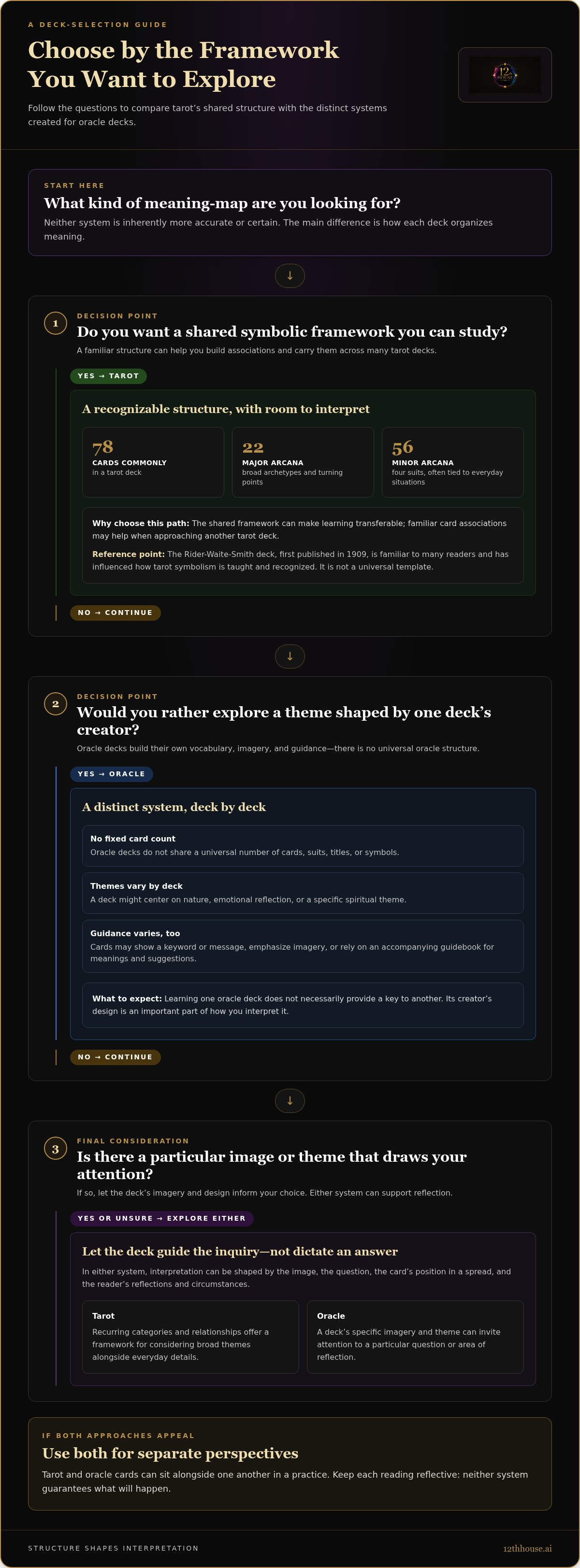
How to Choose Between Tarot and Oracle Cards for Your Practice
Begin with your aim, not the assumption that one system is better. Do you want to learn a repeatable symbolic language, reflect on a particular theme, or explore imagery that sparks your curiosity? Your answer can narrow the choice. If you’re still asking what is the difference between tarot and oracle cards, use that distinction practically: tarot offers a familiar structure to study, while oracle decks invite you into a creator’s specific world of symbols.
Before choosing, look at sample card art and read a few guidebook explanations if available. Notice whether the images hold your attention and whether the written meanings clarify your response or feel restrictive. A deck can be visually compelling yet hard to interpret in practice, so consider both the imagery and the interpretive approach.
- Name your purpose. Choose whether you’re seeking a system to study, a theme to reflect on, or images to explore.
- Review the deck’s language. Study sample cards and guidebook entries to see how it builds meaning.
- Try a reflection log. Record your question, the card drawn, your first interpretation, and later observations. Over time, notice which kinds of prompts help you think more clearly.
Choose tarot if you want a repeatable symbolic structure
If recurring archetypes and structured study appeal to you, tarot can provide a framework to return to as you learn. Start with one deck. Spend time with its own images and guidebook before comparing traditions, so you can form a grounded understanding rather than juggling several systems at once. For a deeper study path, explore the Tarot Mastery guide.
Choose oracle cards if a deck’s theme resonates with you
An oracle deck may draw you in through a clear theme or visual language. Read its guidebook to understand the creator’s intended vocabulary, then note what the imagery evokes for you. Personal resonance can make a card worth exploring, but it doesn’t establish that its message is certain or objectively predictive.
Your reflection log can help you evaluate the fit without rushing to a verdict. After a reading, write down what you noticed and which parts of the interpretation felt useful. Revisit the entry later. Did the card prompt a question you hadn’t considered? Did your understanding change as you learned the deck? Treat these notes as observations, not proof that a deck predicts events.
There’s no need to choose once and for all. You can begin with the system that best suits your current curiosity, then explore another when you’re ready. If tarot’s structured symbolism is the place you want to start, explore 12th House tarot readings as one way to continue engaging with the practice.
Can You Use Tarot and Oracle Cards Together?
Yes. Tarot and oracle cards can be used in the same reading, but combining them is optional, not a requirement for a complete practice. Treat each deck as a separate lens rather than blending both into one rulebook. Tarot can offer a structured exploration of a question, while an oracle card can introduce a distinct theme or prompt for reflection.
Keep the process simple. Choose one question, decide which deck will lead, and give each card space to speak through its own system. The goal isn’t to make two cards agree. It’s to notice what each brings into view.
A simple way to combine both card systems
Try tarot first if you want the main reading to follow a familiar spread or symbolic framework. Draw your tarot cards and write down your interpretation before reaching for the oracle deck. Then draw one oracle card as a separate prompt. Ask what new angle, feeling, or question it brings to the same topic, without treating it as confirmation of the tarot reading.
You can reverse the order. Draw an oracle card first and note the theme it suggests. Then use a tarot spread to explore the question through its own card meanings and positions. For example, if you’re reflecting on a change at work, an oracle card might focus your attention on a theme such as patience. A tarot spread can then help you examine your thoughts, concerns, or possible responses. Neither draw decides what you should do.
Record the interpretations separately before looking for connections. In a journal, label which deck each card came from, note the question, and write down your first impressions. Only then ask whether the two readings share a useful idea or illuminate different parts of the question. If they seem to conflict, leave the difference visible rather than forcing a single answer.
Keep the practice reflective, flexible, and grounded
The difference between tarot and oracle cards still matters when you use both together. Each system has its own vocabulary, so let the guidebook or familiar symbolism for each deck shape your reading. Don’t assign an oracle card a tarot position or assume a tarot card follows an oracle deck’s creator-defined meanings.
Stay with an open question, such as “What might I need to consider?” Then notice what resonates and what doesn’t. A card can prompt useful reflection without serving as proof, instruction, or a substitute for your judgment. If combining decks feels distracting, return to one at a time. A reading doesn’t become more meaningful simply because it uses more cards.
Explore this practice at your own pace. If you’d like to keep learning through tarot, explore tarot readings with 12th House as one way to continue your study.
Begin with a Practice That Invites Curiosity
Let your next step be an experiment, not a permanent choice. Set aside a quiet moment, bring one genuine question, and notice what kind of engagement feels meaningful to you: tracing symbols, responding to a theme, or sitting with an image. The question of what is the difference between tarot and oracle cards can guide your exploration, but your own observations will make the practice personal.
As you continue, give yourself room to learn without demanding a definitive answer from every draw. A written reflection, a return to a card later, or a new perspective can help you develop a thoughtful relationship with the symbols. The aim is attention, not certainty.
For continued exploration, 12th House offers tarot readings and a library of books, videos, and ritual frameworks. Explore tarot readings with 12th House and take your next step with curiosity. Your practice can begin simply, and deepen as you do.
Frequently Asked Questions
Can you use tarot and oracle cards in the same reading?
Yes, you can use both, as long as you keep each deck’s interpretation distinct. For example, use a tarot spread to examine different aspects of a decision, then draw an oracle card to prompt a fresh reflection. Write down each response separately before connecting them. If the messages seem different, treat that as a reason to consider another perspective, not as a problem you must resolve.
Do you need a guidebook to read oracle cards?
No, but a guidebook can help you understand the creator’s intended meanings, especially when a card’s image or wording feels unfamiliar. Start by noting your own reaction, then compare it with the entry. For example, record what a card’s image brings to mind before reading the booklet. This lets you learn the deck’s vocabulary while still noticing your personal associations.
Can you read tarot cards for yourself?
Yes. Self-readings can help you examine a situation, name your concerns, or consider options. Ask an open question, such as “What should I consider before making this choice?” rather than asking a card to make the decision for you. If you feel strongly invested in one outcome, write your initial interpretation down and revisit it later. A little distance can help you notice assumptions.
Do tarot or oracle cards predict the future?
Neither tarot nor oracle cards can guarantee future events. People may use them to explore possible themes or reflect on choices, but a reading is not proof of what will happen. If you’re wondering what is the difference between tarot and oracle cards in this respect, neither system has a dependable claim to greater predictive certainty. Treat a reading as a prompt, then base decisions on your circumstances and judgment.
Are oracle cards connected to a particular spiritual tradition?
Not necessarily. Oracle decks vary, and a deck may draw on a particular spiritual tradition, cultural symbolism, or a creator’s original framework. Look at the deck’s introduction and guidebook for context about its imagery and language. If it references a tradition, learn how the creator frames that connection rather than assuming all oracle decks share the same origins or beliefs.
How many cards should a beginner draw?
Start with one card. A single draw gives you room to study the image, consult the guidebook if useful, and write a focused response without managing several meanings at once. Ask one clear question and note what you observe before deciding what it might mean. Once that feels comfortable, you can try a small spread with positions that each serve a specific purpose.
Can you use tarot cards without memorizing every card meaning?
Yes. You can read with a guidebook nearby and learn gradually through repeated practice. Begin by describing what you see in the card, then consider its conventional associations and how they relate to your question. Keep notes on interpretations that feel useful or surprising. Over time, familiarity grows through observation and comparison, not only through memorizing definitions in isolation.


