

What if the loudest pattern in your birth chart points to where your attention gathers, but doesn’t define your whole personality? That’s the essential distinction behind what is a stellium in astrology: a concentrated emphasis in one part of the chart, not a complete diagnosis of who you are. If you’ve found different answers about how many planets count, or whether they need to share a sign or a house, the confusion is understandable.
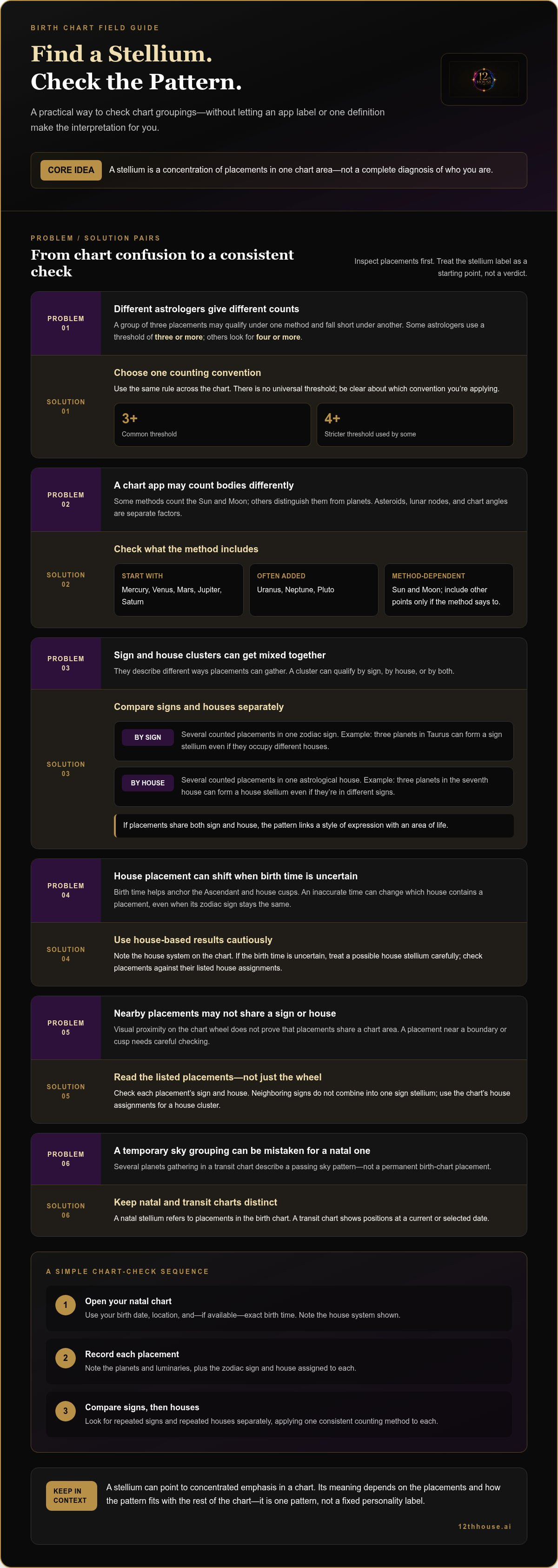
Astrologers don’t all use the same threshold. Three planets is a common standard, while some astrologers look for four. Interpretations can also depend on whether the planets cluster by sign, house, or both. This guide explains the common definitions, shows you how to check your birth chart, and walks through how to read a possible stellium using its planets, sign, and house. You’ll also learn how to weigh that emphasis against the rest of your chart, so one striking pattern becomes a useful point of inquiry rather than a fixed destiny.
Key Takeaways
- Learn what is a stellium in astrology and why astrologers may use different planet-count thresholds.
- Check your natal chart by comparing planetary placements across signs and houses; birth time is especially important for house placement.
- Interpret the planets, sign, and house as a connected pattern, with each planet contributing a distinct function.
- Consider a stellium as a possible area of focus or intensity, not a guaranteed outcome or fixed personality label.
- Use the planets, sign, house, and aspects as a framework for reflecting on how the pattern relates to your lived experience.
What Is a Stellium in Astrology? The Core Definition
What is a stellium in astrology? It’s a cluster of several planetary placements concentrated in one area of a birth chart, most often a zodiac sign, a house, or both. The grouping draws attention to shared themes in the chart. Astrologers commonly use a threshold of three or more planets, while some require four before they call the pattern a stellium.
The difference matters when you check your own chart. A group of three placements may qualify under one astrologer’s method and fall short under another’s. There’s no universal rule that makes one threshold correct for every tradition. Treat the count as an interpretive convention, and be clear about which convention you’re using.
Why astrologers disagree about the planet count
The simplest method counts three or more planets in a shared chart area. A stricter method looks for four or more, reasoning that a larger cluster creates a more pronounced concentration. Astrologers can also differ on what they include. Some count the Sun and Moon as planetary placements for this purpose, while others distinguish these luminaries from planets or exclude points such as asteroids and lunar nodes.
For a consistent reading, choose a counting method and apply it across the chart. Don’t add an asteroid to reach a preferred total in one area, then exclude it from another. If a chart tool labels a group as a stellium, check which bodies it counted before interpreting the result. The label is a starting point, not a verdict.
Sign stelliums and house stelliums are different patterns
A sign stellium is a grouping of several counted placements in one zodiac sign. A house stellium is a grouping of several counted placements in one astrological house. These are two ways of organizing the chart: signs describe a style or mode of expression, while houses map the life areas where chart themes may become more prominent.
A cluster can meet the definition by sign, by house, or by both. For example, three planets in Taurus could form a sign stellium even if they occupy different houses. Three planets in the seventh house could form a house stellium even if they’re in different signs. When the placements share both sign and house, the pattern connects a particular style of expression with a particular area of life.
Keep this distinction in mind as you read interpretations. A sign-based cluster and a house-based cluster don’t automatically describe the same emphasis, even when they involve the same planets. The details of the placements shape the pattern’s meaning.
A stellium is a concentrated chart pattern, not the same thing as one prominent planet. A single planet may stand out because of its position or relationships to other placements, but a stellium describes several placements gathered in one sign or house. A cluster deserves attention, yet it remains one pattern among many in the chart.
How to Find a Stellium in Your Birth Chart
Start with your natal chart, the map of planetary positions at your birth. To identify a possible cluster, inspect the placements rather than relying only on a chart app’s label. Apps may count different celestial bodies or use different thresholds, so check what’s included before interpreting the result.
- Open your natal chart. Use your birth date, location, and, if available, exact birth time. Note the house system shown on the chart.
- Locate the planetary symbols. Record the planets and luminaries, along with the zodiac sign and house assigned to each placement.
- Compare signs, then houses. Look for repeated signs and repeated houses separately. Apply one consistent counting method to each grouping.
Checklist: Open your natal chart, identify the counted placements, then compare their signs and houses using a consistent method.
Birth time is especially important for house placements. The Ascendant, or rising sign, marks the beginning of the first house and helps anchor the chart’s house cusps. An inaccurate time can shift those cusps and change which house contains a placement, even when the planet’s zodiac sign stays the same. If your birth time is uncertain, interpret a house-based result cautiously.
Keep natal and transit charts distinct. A natal stellium refers to placements in the birth chart, while a transit chart shows the sky’s positions at a current or selected date. Several planets may temporarily gather in one sign or house in a transit chart, but that describes a passing sky pattern, not a permanent natal placement. For a concise overview of the concept and its varieties, see Understanding Stelliums in Astrology.
Which placements should you count?
Begin with the traditional planets: Mercury, Venus, Mars, Jupiter, and Saturn. Many modern chart readings also include Uranus, Neptune, and Pluto. The Sun and Moon are luminaries, not planets astronomically, but astrologers differ on whether they count them in a stellium. Asteroids, lunar nodes, and chart angles such as the Ascendant are separate points or factors. Include them only if your chosen method explicitly does.
Check sign, house, and chart boundaries
Check each placement’s listed sign before calling a sign cluster; neighboring signs don’t combine into one sign stellium. For a house cluster, use the house assignments shown in your chart and note its house system. A placement near a sign boundary or house cusp needs careful checking against its exact chart position. Don’t assume that visual proximity on the wheel means placements share a sign or house.
To explore how your placements fit together, personalized astrology chart analysis can help you examine the pattern as part of the full chart, rather than as an isolated label.
What a Stellium Means: Read the Planets, Sign, and House Together
A stellium points to concentrated attention or activity in one area of a chart. It can suggest that certain themes recur or carry particular weight, but it doesn’t guarantee an event, talent, or life outcome. To interpret the pattern, look beyond the label: identify each placement, then consider how the sign and house shape its expression and context.
Start with the individual functions in the cluster. In traditional astrological symbolism, the Sun relates to identity and vitality, the Moon to needs and emotional responses, Mercury to thought and communication, Venus to affection and values, and Mars to action and desire. Jupiter is associated with growth and meaning; Saturn with limits, responsibility, and structure. If the grouping includes outer planets, Uranus is linked with change, Neptune with imagination, and Pluto with transformation.
Start with the planets before interpreting the cluster
Name what’s gathered before drawing conclusions. The Sun, Moon, Mercury, Venus, and Mars are personal placements, often read as closer to everyday experience and individual expression. Jupiter and Saturn describe broader processes of growth, commitment, and structure; Uranus, Neptune, and Pluto move more slowly and can be shared by people born around the same period. Their presence matters, but it doesn’t give everyone with the same grouping an identical story.
Each placement adds a distinct function to the group. Mercury and Saturn together, for example, might invite reflection on how thinking and communication meet discipline or caution. That’s a question to explore, not a fixed diagnosis. The full chart, including the placements’ relationships to other chart factors, helps refine an interpretation.
Use the sign and house to locate the emphasis
The sign describes a symbolic mode of expression, not a verdict about personality. The house points to a life area where the chart’s themes may receive more attention. Read them as coordinates: planets show which functions are involved, the sign suggests a style, and the house locates a possible area of focus.
For example, a cluster involving Mercury, Venus, and Mars could emphasize communication, connection, and initiative. In Gemini, an astrologer might explore how those functions express through curiosity, ideas, or exchange. In the seventh house, the interpretive focus could shift toward one-to-one relationships and agreements. These are symbolic possibilities, not predictions or universal descriptions.
The combination of planets, sign, and house matters more than the stellium label because it shows what functions are clustered, how they may express, and where their themes may be explored. That’s the practical answer to what is a stellium in astrology: not a single meaning to memorize, but a chart pattern to decode in context. Ask what each placement contributes, then test the interpretation against the rest of the chart and your lived experience.
Is a Stellium Good or Bad? Put Its Intensity in Context
A stellium isn’t inherently fortunate or difficult. It marks concentration, not a score. Astrologers may read that concentration as a place where attention, effort, or recurring themes gather. That focus could support practice and skill-building, or feel intense and absorbing. Neither outcome is guaranteed, and a chart pattern alone can’t tell you how it will unfold in someone’s life.
Think of a stellium as a strong signal in a larger map. A cluster may draw attention to certain concerns, while other placements point to different needs, resources, or priorities. If one area seems overemphasized, consider it an invitation to reflect on balance, not proof of an inevitable blind spot or struggle.
Astrology is a symbolic interpretive tradition, not an evidence-based personality diagnosis. Use its language as a framework for reflection, not as a clinical assessment or a fixed account of your character. The question “what is a stellium in astrology?” is best answered in context, with room for interpretation and personal experience.
How aspects and the rest of the chart change the reading
Planetary aspects describe the angular relationships between placements, and they can modify how planets within a cluster work together. A planet in the stellium may also form aspects with placements elsewhere in the chart, adding ease, tension, or a different emphasis to its expression. Read those connections alongside the cluster, rather than assuming every planet operates in the same way.
The chart ruler, determined by the Ascendant and its ruling planet, offers another layer of context. Placements outside the stellium matter too: they can point to themes that complement, redirect, or counterbalance the cluster. A single concentration can’t stand in for the whole natal chart.
Avoid common stellium reading mistakes
- Don’t turn a pattern into destiny. A stellium doesn’t guarantee exceptional talent, success, or difficulty.
- Don’t flatten the planets. Each placement has its own symbolic function, even when several share a sign or house.
- Keep natal placements distinct from transits. A natal pattern belongs to the birth chart; a transit cluster describes a temporary configuration in the sky.
For a more grounded reading, note what the cluster suggests, then compare it with the chart’s aspects, ruler, and other placements. Ask whether the themes resonate with your experience, and where they don’t. Use that difference to refine your interpretation, not to force your life into a label. Explore your placements and ask personalized follow-up questions with Lala’s reflective astrology guidance.
How to Work With Your Stellium as a Reflective Chart Pattern
A stellium becomes more useful when you treat it as a question to investigate, not a label to wear. Begin by recording the placements in the cluster and the counting method you used. Then note the shared sign and house, and review the aspects that connect those planets to one another and to the wider chart. This turns “what is a stellium in astrology?” from a search for a verdict into a structured inquiry.
Next, compare the chart’s themes with your own experience. If the cluster is in a relationship-focused house, for instance, ask where partnership, collaboration, or one-to-one agreements actually show up in your life. Don’t assume the placement describes every relationship or predicts what will happen. Look for patterns, exceptions, and questions that invite a more complete reading.
A grounded journaling exercise for chart reflection
Use a journal to keep the interpretation precise and open to revision. First, write down the planets, their sign and house, and the counting convention behind the stellium label. Add the relevant aspects. Then ask one focused question: “Where do these shared sign or house themes appear in my daily choices, work, or relationships?” Record a real example, not only an abstract description.
Return to your notes later. A chart interpretation is a symbolic framework, and your understanding may shift as you notice new experiences or context. Keep what feels useful, question what doesn’t, and avoid turning a single reading into a definitive conclusion about your character or future.
Take the next step with personalized chart questions
A complete natal chart helps place the cluster in relation to the rest of its structure. Explore how each planet contributes, how the sign colors its expression, what the house brings into focus, and how aspects add nuance. Ask specific questions rather than requesting a sweeping label: “How might this planet’s role interact with the others in the cluster?” or “What does this aspect add to the house theme?”
For relational themes, compare the stellium’s symbolism with the broader patterns involved in birth chart compatibility. Compatibility is also a chart-level inquiry, not a conclusion that one placement can determine on its own.
AI guidance can help you explore possibilities and generate thoughtful follow-up questions, but it shouldn’t replace your judgment. Use it as a reflective aid: test the ideas against your lived experience and keep your interpretation flexible. To continue exploring your chart with personalized questions, ask Lala, the AI astrology assistant.
Let Your Chart Open a Better Question
Your chart doesn’t need to deliver a final answer to be useful. Let a stellium prompt a question you can live with and examine: What patterns do I notice? Which interpretations feel grounded in my experience, and which need more context? The most meaningful reading leaves room for discovery rather than asking you to fit a predetermined story.
If you’re still asking what is a stellium in astrology in relation to your own life, move from the label to the details. Explore how the placements interact across your full chart, and follow the questions that help you understand your choices with greater clarity. Astrology birth chart and transit analysis can offer a wider framework, while Lala answers personalized questions about your chart as a tool for reflection, not fixed prediction.
Explore your chart with Lala, the AI astrology assistant, and bring your curiosity to the next layer of interpretation. Your chart is a map to explore, not a script you have to follow.
Frequently Asked Questions
Is a stellium rare in a birth chart?
Astrologers often describe a stellium as relatively rare because it takes several placements gathering in one chart area, but there’s no agreed statistic that measures its frequency. The answer also depends on the astrologer’s method: a stricter planet-count threshold will produce fewer stelliums, and including or excluding the Sun, Moon, or other bodies can change the count. Treat “rare” as a qualitative description, not a measured probability.
Can a stellium appear across two zodiac signs?
A sign stellium requires its counted placements to share one sign, so placements divided between neighboring signs don’t form a single sign stellium under that definition. They might still cluster in the same house, creating a house-based emphasis that spans signs. In that case, interpret each sign’s contribution separately rather than blending them into a new combined sign. The chart may show a meaningful cluster without meeting every stellium convention.
Do the Sun and Moon count in a stellium?
Some astrologers include the Sun and Moon when counting a stellium; others treat them as luminaries and reserve the count for planets. This distinction can change whether a chart meets a chosen threshold. If including a luminary brings a cluster up to the required count, note that choice when describing the pattern. For a clear reading, state your method and apply it consistently rather than switching rules to fit a preferred result.
What does a stellium in the 12th house mean?
In astrological symbolism, a 12th-house stellium may bring attention to private inner life, retreat, reflection, or matters that unfold beyond immediate view. Its expression depends on the planets involved: Mercury may direct thought toward introspection, while Venus may shape private values or attachments. These are interpretive themes, not evidence of a hidden problem or a guaranteed spiritual path. Consider how the placements connect with the rest of the chart.
Can a stellium change over time?
Your natal placements remain tied to the sky at your birth, so the natal stellium itself doesn’t change. Transiting planets do move, however, and may form a temporary cluster or interact with natal placements at particular times. For example, a transit can bring a chart theme into sharper focus without rewriting your birth chart. Compare the chart type and date before treating a newly appearing cluster as a lasting feature.
Can two people have a stellium in the same sign but express it differently?
Yes. A shared sign doesn’t make two charts identical. The people may have different planets in the cluster, different houses, or different aspects linking those placements to the rest of the chart. Their Ascendants and chart rulers also contribute distinct context. Even if the planetary group and sign match, interpret each person’s full chart separately. Astrology offers symbolic possibilities, not a uniform personality template for everyone with the same pattern.


