

What if the two numbers in your Human Design chart are a lens for self-observation, not a verdict on who you are? If you’ve searched “what is my human design profile” and found cryptic labels or descriptions that seem too broad to fit, the confusion makes sense. Profile, Type, and Authority each describe a different part of the system, and they aren’t interchangeable.
Your profile is made from two line numbers in your chart, calculated using your birth details. Each of the 12 profiles combines distinct themes, but those themes aren’t rules you have to follow or a fixed identity to inhabit. This guide explains how to find and read both lines, how profile differs from Type and Inner Authority, and how to explore the themes through specific observations in your life. Treat your chart as a framework for reflection: a map to test against your experience, not a script that speaks for you.
Key Takeaways
- To answer “what is my human design profile,” locate the two line numbers in your chart and read them as a combined profile.
- Use your birth date, time, and place to generate a chart, then find its profile field.
- Keep profile distinct from Type, Strategy, and Authority; each offers a different lens on the chart.
- Explore the 12 profile combinations as themes to observe, not fixed descriptions or instructions.
- Use a personalized Human Design profile from 12th House as a starting point for structured self-study.
What Is My Human Design Profile? The Two Numbers Explained
A Human Design profile combines two line numbers, each ranging from 1 to 6, into a paired pattern such as 3/5. Your Human Design profile is the two-number combination in your chart that represents a set of themes within the system’s interpretive framework. It’s one element of a larger chart, alongside your Type, Strategy, and Inner Authority. Each offers a different lens, so your profile isn’t a substitute for the rest of your chart.
If you’re searching “what is my human design profile,” begin with this distinction: the numbers are not a diagnosis, a personality test result, or a certainty about how you’ll behave. Human Design is a symbolic system for reflection, not a clinically validated assessment. Its concepts sit within a broader structure of types, centers, and the bodygraph, outlined in the Human Design Wikipedia overview.
What do the two numbers in a Human Design profile mean?
Each number refers to one of the system’s six lines. The first number is the first position in the profile; the second is the second. In traditional Human Design interpretations, each line has its own themes, and the combination gives the profile its particular symbolic emphasis. You don’t need to memorize all six lines to understand the notation.
Illustrative example: In a 3/5 profile, 3 is the first line number and 5 is the second. The slash separates the two positions; it isn’t a fraction or a ranking. You can explore what each line traditionally represents, then notice whether those themes resonate with your experience. Use the interpretation as a prompt to observe, not a box to fit.
Is a profile the same as a Human Design type?
No. Profile and Type are separate chart categories. Type describes a different aspect of the Human Design framework, while profile brings together two line themes. Strategy and Inner Authority are also distinct components, each with its own place in the chart. Keeping these terms separate makes a chart easier to decode.
Two people can share a profile and still have different Types, Authorities, or other chart features. The shared profile doesn’t mean their charts, decisions, or experiences are identical. Think of the profile as one coordinate in a larger map, not the map itself. To understand the other category, explore the article about the five Human Design types alongside this guide. Compare the concepts without collapsing them into one label.
How Is Your Human Design Profile Calculated From Birth Details?
Your profile is generated as part of a Human Design chart, using birth information rather than answers to a personality quiz. The system uses your birth date, time, and place to calculate chart placements. Because calculations depend on the details entered, a result is only as dependable as its input, especially if your birth time is uncertain.
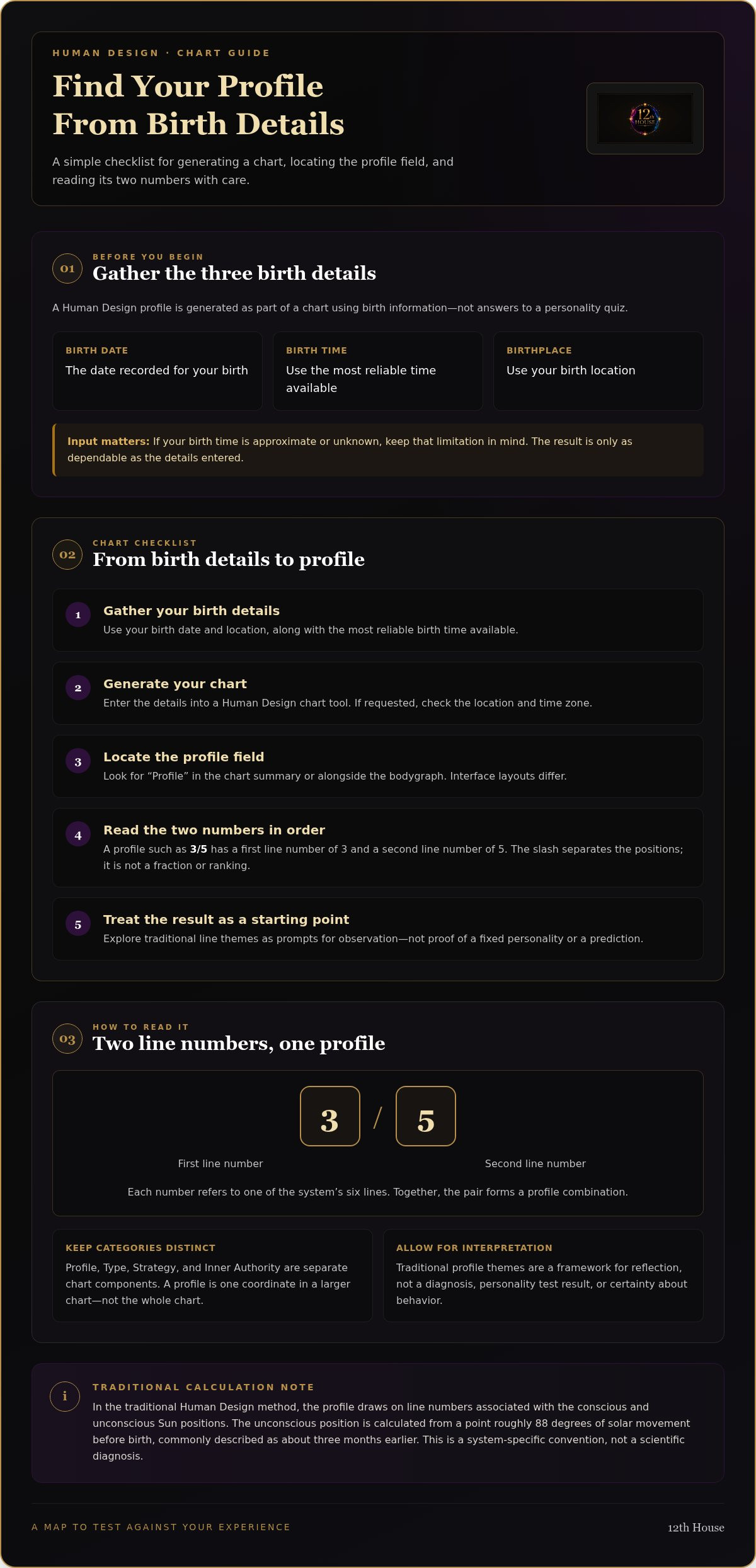
Birth date, birth time, and birthplace are the details commonly used to generate a Human Design chart. Once you have them, follow this sequence:
- Gather your birth details. Use the date and location recorded for your birth, along with the most reliable time available.
- Generate your chart. Enter the details into a Human Design chart tool, checking that the location and time zone are correct if the tool requests them.
- Locate the profile field. Look for a label such as “Profile” in the chart summary or alongside the bodygraph. Interface layouts differ.
- Read the numbers in order. A result such as 3/5 means the first number is the first line and the second number is the second line.
- Interpret with care. Use the result as a starting point for exploration, not as proof of a fixed personality or a prediction.
Which birth details do you need to find your profile?
Have your birth date, birth time, and birthplace ready. A recorded time is useful because the chart is calculated from specific birth information. If the time is approximate or unknown, keep that limitation in mind rather than treating every chart detail as certain. You can still explore a generated result, but be cautious about interpretations that depend on precise chart inputs.
Where does the profile appear on a Human Design chart?
Look in the chart’s summary area for “Profile” followed by two numbers separated by a slash, such as “3/5.” Read them from left to right; the displayed order matters. If you’re still orienting yourself to the bodygraph and its other components, a broader Human Design chart guide can help you place the profile in context.
In the traditional Human Design method, the profile draws on the line numbers associated with the conscious and unconscious Sun positions. The unconscious position is calculated from a point roughly 88 degrees of solar movement before birth, commonly described as about three months earlier. This is a system-specific convention, not a scientific diagnosis. The key practical point is that the profile is calculated from chart positions, not from a quiz or a personal preference.
If you’re unsure how a profile theme relates to your chart, use it as a prompt for structured self-study rather than a rule to follow. A personalized Human Design profile from 12th House can give you a starting point, and Lala, 12th House’s AI spiritual guidance assistant, can help you explore chart questions in context.
What Do the 12 Human Design Profiles Mean?
In Human Design, six line positions combine into 12 profile pairings, each with a traditional shorthand for its themes. These interpretations offer a vocabulary for reflection, not universal personality facts or forecasts. A description may feel relevant, partly familiar, or unlike your experience. Use it as a lens to investigate, not a verdict about who you are.
The labels below are common traditional interpretations of the lines and their pairings. Some sources or teachers may use different wording, particularly for line names. The central idea is that each profile combines two line themes; the short descriptions are entry points, not full readings.
| Profile | Traditional theme |
|---|---|
| 1/3 | Investigator / Experimenter: builds a foundation through inquiry and trial. |
| 1/4 | Investigator / Opportunist: combines research with influence through close connections. |
| 2/4 | Hermit / Opportunist: balances natural ability and time alone with a responsive network. |
| 2/5 | Hermit / Heretic: pairs private gifts with expectations or projections from others. |
| 3/5 | Experimenter / Heretic: learns through experience while meeting practical challenges. |
| 3/6 | Experimenter / Role Model: moves through trial and observation toward perspective. |
| 4/6 | Opportunist / Role Model: emphasizes relationships, community, and example. |
| 4/1 | Opportunist / Investigator: joins relational influence with a need for a solid foundation. |
| 5/1 | Heretic / Investigator: pairs practical problem-solving with research and preparation. |
| 5/2 | Heretic / Hermit: combines projected expectations with private ability and space. |
| 6/2 | Role Model / Hermit: brings long-view perspective together with a need for retreat. |
| 6/3 | Role Model / Experimenter: develops perspective through observation and lived experience. |
How do the six Human Design lines shape profile themes?
Traditional line names sketch six symbolic roles: the Investigator seeks a firm basis; the Hermit turns inward to develop natural strengths; the Experimenter learns by trying and adjusting; the Opportunist engages through relationships; the Heretic is associated with practical influence and others’ expectations; and the Role Model gains perspective over time. These are interpretive terms, not diagnoses. To understand the profile pairing, start with the two line themes rather than trying to unpack centers, channels, or the full BodyGraph.
How can two profiles with shared numbers differ?
Compare 2/4 and 2/5. Both include the Hermit line, but the second line changes the pairing’s traditional emphasis: the Opportunist points toward networks, while the Heretic points toward practical expectations and projections. A shared number doesn’t make two profiles identical. Chart context and lived experience affect what feels meaningful, and no profile is better, more evolved, or more desirable than another. Ask what fits, what doesn’t, and what you want to observe before deciding what the description means to you.
How to Use Your Human Design Profile Without Treating It as a Label
A profile is a reflection prompt, not a fixed script. It can help you notice patterns, but it can’t define your capacity, explain every choice, or tell you what you must do next. If you’re asking “what is my human design profile” because you want a clear answer about who you are, leave room for your own experience to complicate the description.
Try a simple three-part practice: choose one profile theme, look for it in ordinary situations, then record what you observe. For instance, if a description highlights learning through experience, notice how you approach a new task. Do you prefer to test an idea, study first, or combine both? The goal isn’t to prove the profile right. It’s to gather useful observations.
- Notice a theme. Choose one phrase from your profile rather than trying to interpret everything at once.
- Observe your experience. Look for specific examples in collaboration, learning, communication, or relationships.
- Record what fits and what doesn’t. Write down the situation and your response without forcing it to match the description.
What questions can help you reflect on your profile?
Make the inquiry concrete. Ask: “Where have I seen this theme at work?” “Does it show up differently with friends?” “What’s an example that doesn’t fit?” A profile description may seem persuasive in the abstract but less accurate when you examine actual situations. Keep both kinds of evidence. Revisit your notes over time instead of turning one familiar phrase into an immediate identity claim.
For example, if a theme suggests that relationships matter, consider a recent project. Did a connection create an opportunity, or did progress come from another source? If a description points toward solitude, notice whether time alone supports your learning, or whether that depends on the task. Specific observations give you more to work with than a broad label.
What should a profile not be used to decide?
Don’t use profile language as a substitute for medical, psychological, or other professional advice. Human Design is an interpretive framework, not a clinical assessment. Nor should a profile be treated as a guaranteed prediction, a limit on your potential, or a reason to avoid a choice. A chart can offer a question to consider; it can’t make the decision for you.
Keep your agency in the foreground. If a description says you need a particular environment or communication style, test that idea thoughtfully against your circumstances instead of treating it as a command. You’re allowed to change, disagree with an interpretation, and make choices that don’t match a profile summary. Reflection is useful when it sharpens your attention, not when it narrows your options.
Use a personalized Human Design profile as a starting point for structured self-study, then bring your own observations to the interpretation. Let the chart open inquiry, not close it.
Find Your Human Design Profile and Explore Its Meaning With 12th House
Turn chart discovery into a grounded practice: gather your birth details, generate your profile, then read its themes with discernment. Keep the result in proportion. A Human Design profile is one interpretive element in a larger chart, and its usefulness depends on how thoughtfully you engage with it.
- Prepare your birth details. Gather your birth date, time, and birthplace. If the time is uncertain, remember that limitation as you review the result.
- Generate your profile. Use a chart tool or personalized profile to identify the two-number pairing shown in your chart.
- Explore one theme at a time. Notice what feels relevant, compare it with specific experiences, and leave room for what doesn’t fit.
A useful profile explanation makes the notation understandable and places its themes in context. It should clarify how the two numbers work together without treating them as a complete account of your character. Look for language that invites observation rather than declaring what you must be, how you’ll behave, or what will happen next.
What to look for in a useful personalized profile
Choose an interpretation that explains profile themes clearly and connects them to the wider chart without confusing profile with Type or Authority. Then take it slowly. Select one idea, reflect on it in a real situation, and note what you learn. A profile can support self-study when it opens a question; it becomes limiting when you treat it as a verdict.
For example, instead of concluding “this is who I am,” ask: “Where have I noticed this theme, and where hasn’t it appeared?” That small shift keeps your observations specific. It also lets you engage with the system without handing it authority over your choices.
Continue your Human Design exploration
Profile is only one part of the chart. To explore a distinct element, read the existing guide to the five Human Design types. If you’re interested in asking personalized questions about chart themes, the article about the AI astrology assistant offers context on using AI guidance as a tool for exploration. Lala, 12th House’s AI spiritual guidance assistant, can also help you consider chart questions in context.
12th House’s Human Design profile offering gives you a structured starting point for personalized exploration. Bring your birth details, stay curious about the interpretation, and let your own experience remain part of the reading. Explore a profile when you’re ready to take the next step in your self-study.
Let Your Chart Open a New Question
The most useful answer to “what is my human design profile” may not be a final description of yourself. Let it be the beginning of a more attentive question: what patterns do you notice, and how might your perspective shift as you keep observing them? Your interpretation can evolve as your experience does.
Give yourself room to explore without needing to agree with every phrase. A profile can become a personal study, one you revisit when a familiar theme appears in a new context. If you want a structured place to begin, 12th House brings Human Design profiles into a digital spiritual guidance platform, with Lala available for AI-assisted chart exploration.
Explore your Human Design profile with 12th House and let curiosity guide your next step. Keep what helps you see more clearly, question what doesn’t, and trust your capacity to make meaning from your own experience.
Frequently Asked Questions
Can my Human Design profile change over time?
Within Human Design’s framework, a profile generated from the same birth details is generally treated as a stable chart element. What may shift is how you understand its themes as your circumstances and self-awareness develop. For example, a theme that seemed abstract earlier may become more recognizable after a change in work or relationships. This describes the system’s interpretation, not a scientific finding. If your original birth information was inaccurate, corrected inputs could generate a different chart.
What if I don’t know my exact birth time?
An unknown or uncertain birth time makes the chart result less certain, so avoid treating a chart generated with an assumed time as definitive. If you use an approximate time, record that alongside the result and keep it in mind as you explore the interpretation. Don’t assume your profile will stay the same across possible birth times; the effect depends on the chart calculation. Focus on what can be responsibly interpreted from the information you have.
Is a Human Design profile the same as a personality type?
No. In Human Design, “profile” and “type” refer to different chart elements: a profile uses two line numbers, while Type is another category in the system. Neither gives a complete account of a person. For instance, a profile description shouldn’t be used to explain every social preference or work habit. You can explore both as symbolic frameworks while giving your own observations more weight than any single label.
Can two people have the same Human Design profile?
Yes. Since Human Design has 12 profile combinations, two people can share the same pairing. That shared notation doesn’t make their full charts or personal histories identical. They may have different chart elements and very different circumstances, which shape how a theme feels in practice. If you’re comparing profiles with a friend, use the shared pairing as a conversation prompt, not evidence that you should react to situations in the same way.
Does my Human Design profile determine my career or relationships?
No. A profile shouldn’t prescribe a career, partner, or major life choice, and it can’t guarantee a particular outcome. You might use a theme to ask what kind of collaboration feels workable, then weigh that reflection against your skills, values, responsibilities, and actual opportunities. For consequential decisions, consider practical circumstances and trusted professional advice where relevant. The framework can prompt questions, but the decision remains yours.
How many Human Design profiles are there?
Human Design uses six line numbers that combine into 12 two-number profiles, including pairings such as 1/3 and 4/6. These combinations have traditional interpretations, but they aren’t scientific personality classifications or measures of ability. If you’re scanning a chart or report, check that the two numbers are shown as a paired profile rather than mistaken for separate scores. The meaning comes from the system’s interpretation of the combination.


