

What if the grand trine in your chart points to a natural strength, not a promise that life will always go your way? If you’ve spotted three placements linked by a triangle, you may wonder whether it signals a gift or helps explain where you feel stuck. Asking “what is a grand trine in my birth chart” is a useful first step, but the answer depends on more than the shape alone.
A grand trine forms when three planets connect through trine aspects, usually about 120 degrees apart. In astrology, this pattern is associated with ease and flow. That ease may support confidence or talent, but it can also make a strength so familiar that you don’t actively develop it. Neither interpretation is a verdict. The wider chart matters.
This guide explains how to check the three placements and their shared element, then interpret the planets and houses to explore where the pattern may show up in your life. Treat a grand trine as a reflective lens, not a guarantee of luck or a fixed description of who you are.
Key Takeaways
- Verify that three chart placements form a grand trine by checking their trine aspects and shared element.
- Use the planets and houses to connect the pattern’s broad symbolism to specific drives and areas of life.
- Compare Fire, Earth, Air, and Water themes as interpretive vocabularies, not fixed personality labels.
- Explore what is a grand trine in my birth chart without assuming it guarantees luck or success.
- Use reflection to notice where the pattern feels familiar and where your lived experience adds nuance.
What Is a Grand Trine in a Birth Chart?
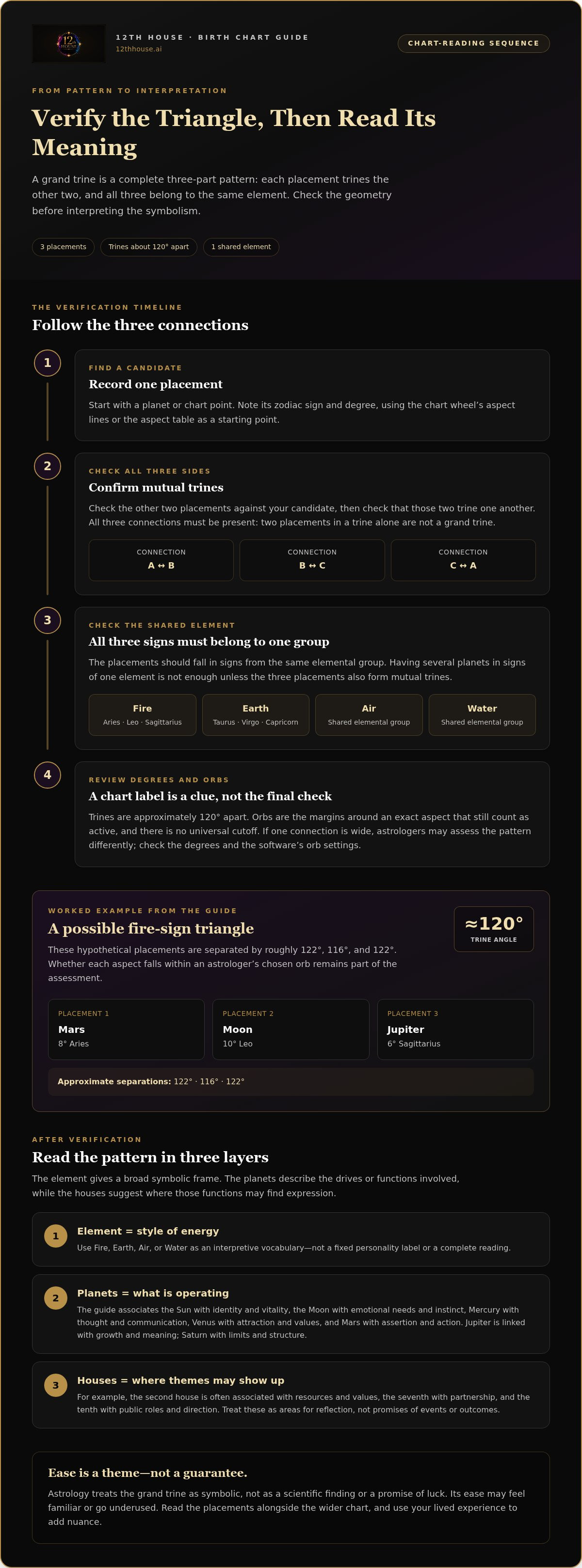
A grand trine is an astrological pattern in which three chart placements connect through trine aspects and fall in signs of the same element: fire, earth, air, or water. A trine is an aspect between placements approximately 120 degrees apart. Astrology treats this pattern as symbolic, not as a scientific finding or a guarantee of particular outcomes.
The defining feature is a complete three-part structure: each placement forms a trine with the other two, making three connected sides. Two placements in a trine form one aspect, not a grand trine. And several planets in signs of the same element don’t make a grand trine unless all three placements form mutual trines.
Astrological interpretations often associate the configuration with ease, harmony, and talent, while noting that an easy flow may be underused. The Grand Trine in Natal Astrology discussion offers a broader overview of this traditional interpretation. Use those themes as a starting point. The planets, signs, houses, and other aspects provide the detail.
How the three-part geometry forms
Imagine a natal chart wheel with three points connected by lines. If each point is about 120 degrees from the other two, the lines trace a triangle around the wheel. Check the geometry first, then the element. The three placements should occupy signs from one elemental group, such as Aries, Leo, and Sagittarius for fire or Taurus, Virgo, and Capricorn for earth.
Degrees matter. Two planets can be in signs of the same element but still be far from an exact 120-degree separation. Astrologers and chart software use orbs, the margins around an exact aspect that still count as active, and there is no universal cutoff. A program may flag a possible configuration that an astrologer would interpret more cautiously. Check the degrees and the orb settings rather than relying on the label alone.
How to spot the pattern in your natal chart
Start with the chart wheel’s aspect lines or aspect table, the grid listing relationships between placements. A colored triangle can help you find a candidate, but confirm each connection. To investigate what is a grand trine in my birth chart, trace the placements instead of relying only on a label generated by a website.
- Choose a candidate placement. Note the planet or point, its zodiac sign, and its degree.
- Check the other two placements. Confirm that each forms a trine with the first, then check that they trine one another.
- Confirm the element. Make sure all three placements fall in signs belonging to the same element.
- Review the degrees and orb settings. If one connection is wide, note that astrologers may interpret the pattern differently.
For a hypothetical example, Mars at 8 degrees Aries, the Moon at 10 degrees Leo, and Jupiter at 6 degrees Sagittarius are separated by roughly 122, 116, and 122 degrees. These placements make a fire-sign triangle by degree, though whether each aspect falls within an astrologer’s chosen orb remains part of the assessment.
How Planets and Houses Shape Your Grand Trine
The element provides a broad symbolic frame. The planets show which drives or functions are involved, while their houses suggest where those functions may find expression. Read together, these layers offer more context than an elemental label alone. A useful rule is: the element describes the style of energy, the planets describe what is operating, and the houses suggest where it may show up.
So, what is a grand trine in my birth chart beyond its geometry? Its interpretation depends on the specific placements and the rest of the chart. A fire grand trine involving Mars, Mercury, and Saturn has different symbolic ingredients from one involving the Moon, Venus, and Jupiter. The shared element offers a vocabulary, not a complete reading.
Read the planets before applying a general meaning
List the three planets or chart factors in the configuration. In traditional astrology, the Sun is associated with identity and vitality; the Moon with emotional needs and instinct; Mercury with thought and communication; Venus with attraction and values; and Mars with assertion and action. Jupiter is linked with growth and meaning, Saturn with limits and structure, and the outer planets with broader themes such as change, imagination, and transformation. These are symbolic functions, not predictions.
Next, consider how those functions might work through the element. Mercury in a water sign, for instance, can prompt reflection on how thought relates to feeling. Mars in an earth sign can raise questions about how action connects with practical effort. Neither placement guarantees a talent or behavior. Look at the combination rather than assigning the same meaning to every grand trine of that element.
Use the houses to locate the chart's life themes
Record the house occupied by each participating planet. Houses divide the chart into areas of life: the second is often associated with resources and values, the seventh with partnership, and the tenth with public roles and direction. These themes can help you ask where a planet’s symbolic function might be relevant. They don’t promise a particular event, relationship, or career outcome.
For example, if a grand trine links planets in the third, seventh, and eleventh houses, consider how communication, one-to-one bonds, and wider social networks relate in your experience. Treat those connections as questions, not conclusions. Relationship questions also call for more than one isolated feature in a natal chart. Birth chart compatibility considers the broader chart-to-chart context.
12th House’s astrology birth chart analysis can help you map the pattern’s planets and houses. Keep your own observations central: note what resonates, what doesn’t, and how the rest of the chart adds nuance.
Fire, Earth, Air, or Water: Compare the Four Grand Trine Types
In traditional astrology, a fire grand trine is associated with action, inspiration, confidence, and creative momentum; an earth grand trine with practical focus, steadiness, material concerns, and sustained effort; an air grand trine with ideas, communication, social exchange, and perspective; and a water grand trine with emotional awareness, intuition, imagination, and sensitivity. These are symbolic vocabularies for reflection, not personality diagnoses or promises of ability.
| Element | Traditional themes | Reflective question |
|---|---|---|
| Fire | Action, inspiration, confidence, creative momentum | Where do I feel moved to initiate, create, or take a risk? |
| Earth | Practical focus, steadiness, material concerns, sustained effort | What do I build patiently, and where might I benefit from more flexibility? |
| Air | Ideas, communication, social exchange, perspective | How do conversation and new viewpoints shape the way I make sense of things? |
| Water | Emotional awareness, intuition, imagination, sensitivity | How do I notice and respond to emotional undercurrents in my experience? |
What fire and earth may emphasize
Fire symbolism draws attention to how initiative, enthusiasm, or creative impulse moves through the chart. It doesn’t mean someone is always confident or naturally bold. Consider whether the planets involved suggest an urge to act, a need to express, or motivation that becomes clearer in particular situations. Their house placements can help locate where those questions matter.
Earth symbolism turns attention to tangible priorities: resources, routines, craft, or the work of making an idea durable. You might explore whether persistence feels accessible in one part of life but demanding in another. A grand trine isn’t proof of effortless success or financial security. The planets, houses, and other aspects shape the interpretation.
What air and water may emphasize
Air symbolism invites reflection on how ideas circulate through learning, dialogue, relationships, or communities. It doesn’t guarantee eloquence, sociability, or objectivity. Ask where exchanging information or changing perspective seems important in your experience, then consider which planets describe that process.
Water symbolism focuses on feeling, imagination, and sensitivity to emotional atmosphere. It doesn’t mean a person is always intuitive or emotionally fluent. A chart factor may describe a capacity, concern, or area of focus rather than a constant trait. Notice where emotional awareness seems meaningful, and where you need boundaries or clearer evidence before trusting an impression.
Use the element as an entry point, then refine your interpretation. Two grand trines can share an element but tell different symbolic stories because their planets represent different functions and their houses point to different life themes. If you’re asking, “what is a grand trine in my birth chart?” compare the element with the actual placements before applying a general description. Let the table generate questions, not conclusions. Your lived experience belongs in the interpretation too.
Does a Grand Trine Mean You Are Lucky? Reading Ease and Its Limits
No. Astrology often describes a grand trine as favorable because its three placements are thought to relate with ease. That symbolism doesn’t guarantee success, protection from difficulty, or good fortune. A low-friction pattern may point to something familiar or accessible, but what you do with that familiarity depends on your choices, circumstances, and the rest of the chart.
Think of the pattern as a possible route of least resistance, not a promise of an easy life. A quality that comes naturally in one setting might take practice in another. A grand trine may suggest a mode of expression that feels readily available in a particular area of life. On its own, it can’t predict what will happen or how someone will respond.
Potential strengths and blind spots
Familiarity can help you develop a skill. If organizing resources feels intuitive, for example, that inclination might support steady practice and competent decisions. But an easy capacity can also go unnoticed. You may assume everyone finds the task simple, or repeat a comfortable approach without asking whether it still serves you.
Keep the interpretation open to challenge. Rather than accepting a flattering label such as “naturally gifted,” compare it with specific experiences. Ask what you’ve learned, where the capacity appears, and whether it requires effort or support. If the symbolism doesn’t match your experience, don’t force a fit. The mismatch may be a reason to reconsider the interpretation, not evidence that your experience is wrong.
- Where does this quality feel accessible, and where does it require deliberate effort?
- Have I developed this capacity, or do I mostly assume it will be there when needed?
- What examples from my life support or complicate this interpretation?
Why the rest of the chart still matters
A grand trine is one pattern within a larger chart. Astrologers also consider the participating planets’ signs and condition, their houses, and aspects to other placements. These details can add nuance or introduce friction. A pattern associated with ease doesn’t erase competing themes or define a person’s whole character.
Astrology is a symbolic lens for reflection, not an evidence-based method for predicting individual outcomes. Use interpretations as questions to investigate rather than verdicts to obey. An AI astrology assistant can help you explore questions about your chart, but its responses shouldn’t replace your judgment. 12th House offers personalized astrology guidance to help you examine chart context and reflect on what resonates.
How to Interpret Your Grand Trine as a Practical Reflection Tool
Turn the pattern into a working hypothesis, not a verdict. If you’re asking, “what is a grand trine in my birth chart?” use it to form specific questions, then compare the symbolism with your experience. Astrology can provide a reflective framework, but it doesn’t establish facts about your future or replace personal agency, evidence-based decisions, or professional advice.
A four-step reading process for your chart
Work through these steps in order. Note the chart details and your observations so you can distinguish what the symbolism suggests from what you’ve actually experienced.
- Verify the geometry. Confirm that all three placements connect by trine aspects and complete the pattern. Check the orb approach used by the astrologer or chart software. If one connection is wide, note that interpretations may differ.
- Name the element. Identify whether the signs belong to fire, earth, air, or water. Use the traditional themes as a starting vocabulary, not a description you must fit.
- Map the planets and houses. Write down each planet’s symbolic function and the house it occupies. Then bring those pieces together in an open-ended interpretation. For instance, ask how a communication-related planet might operate in the house associated with shared resources instead of assuming a particular outcome.
- Test the reading against experience. Record where the pattern feels familiar, where it takes effort, and what complicates the interpretation. Treat mismatches as useful information, not something to dismiss.
Make your reflection concrete. Instead of writing, “I have a natural gift,” describe a situation: “I often take the lead when a group needs to begin a project, but I hesitate when the next step requires sustained follow-through.” Specific observations give you something to examine and keep a symbolic reading from becoming a flattering label that shuts down curiosity.
Return to your notes later. Does the interpretation still fit across different settings, or does it describe only one part of your life? Astrology can help organize reflection, but it shouldn’t determine a decision or stand in for qualified professional guidance on consequential personal matters. Keep your judgment in the process.
Keep exploring with personalized chart questions
A grand trine sits within a wider chart. Birth chart and transit analysis can help you explore its planets and houses alongside other chart factors, rather than reading the configuration in isolation. For follow-up questions, Lala, 12th House’s AI spiritual guidance assistant, offers a way to explore personal questions about chart symbolism. Use it as a prompt for reflection, not as an authority that replaces your own discernment.
Continue your chart exploration with Explore 12th House.
Let Your Chart Open a New Question
Your next step doesn’t need to be a final interpretation. Choose one placement in the pattern and notice how its themes appear in a current choice, relationship, or creative practice. Ask what you want to explore further, then let your experience shape the inquiry. The question “what is a grand trine in my birth chart” can be a starting point for observation, not a label you have to live by.
If you’d like to examine your placements within the wider chart, personalized astrology birth chart and transit analysis can offer another perspective. Lala, 12th House’s AI spiritual guidance assistant, can also help you explore follow-up questions about chart symbolism. Use these tools for reflection while keeping your judgment at the center.
Explore 12th House to continue exploring your chart with curiosity. Use it as a map for inquiry, while you choose your own path.
Frequently Asked Questions
Is a grand trine rare in a birth chart?
Yes, a grand trine is considered uncommon, with estimates placing it in approximately 1-3% of birth charts. The exact proportion can vary depending on which placements an astrologer includes and how wide an orb they allow. If you’re asking what is a grand trine in my birth chart, verify the aspects and the method used to identify them instead of relying on rarity alone to assign meaning.
Can a birth chart have more than one grand trine?
Yes. A chart can contain multiple distinct grand trines, including patterns that share one or more placements. For example, two triangles might have different planets at their points but both include the Moon. Check the aspects and orbs for each proposed triangle separately. Multiple patterns can add layers to a reading, but they don’t automatically have equal emphasis or combine into one interpretation.
Can a grand trine include the Ascendant or Midheaven?
Some astrologers include chart angles, such as the Ascendant or Midheaven, when identifying aspect patterns; others reserve the term for configurations involving planets. An angle can form a trine by degree, but it isn’t a planet. If a pattern includes an angle, note that distinction and check the astrologer’s approach. Accurate birth time and location are especially important for calculating the angles.
What is the difference between a grand trine and a kite in astrology?
A kite is generally described as a grand trine with an additional placement opposing one point of the triangle and forming sextile aspects to the other two points. That placement changes the geometry by adding a focal point. If your chart shows a triangle plus connecting lines to another planet, check the aspects and degrees to see whether they form this structure under the chosen orb rules.
Does birth time affect whether I have a grand trine?
It can, especially if the pattern includes the Ascendant or Midheaven, since these angles depend closely on birth time and location. A time difference can also shift house placements and change which life areas are emphasized. For a grand trine formed only by planets, birth time usually has less impact on the aspect geometry, though a borderline aspect or fast-moving body can make precise chart data relevant.
Can a grand trine involve more than three planets?
Yes. Three placements create the core triangular pattern, but additional planets may join one of its points or form aspects that extend the configuration. Astrologers may describe these planets as participating in or modifying the grand trine, rather than changing its basic three-point geometry. Check whether each extra planet actually forms the relevant aspects. Sharing a sign or sitting nearby doesn’t establish a connection on its own.


