

What if the “positive” aspect in your birth chart is less a gift than an invitation? If you’ve wondered what is a sextile in astrology, you may know it’s considered harmonious, but that label alone doesn’t explain what it means in daily life. A sextile can suggest an opening between two planetary energies, but potential isn’t the same as a guaranteed outcome.
This guide explains the sextile’s 60-degree geometry and why astrologers interpret it as supportive without assuming it works automatically. You’ll learn how orb limits vary, how a sextile differs from a trine, square, or conjunction, and how the planets, signs, and houses shape its interpretation. The goal is a repeatable way to read the aspect in your chart, not a one-word verdict.
Start with the angle, then identify the planets, note their signs and houses, and check how close the aspect is to exact. Read the sextile as a door you can choose to open: the chart maps a possible connection, while your choices give it form.
Key Takeaways
- To understand what is a sextile in astrology, start with its approximately 60-degree angle and treat its meaning as symbolic, not scientifically established causation.
- Read the planets, signs, and houses together; the angle alone doesn’t provide a complete interpretation.
- Compare a sextile with a trine, square, and conjunction to see how each aspect suggests a different kind of planetary relationship.
- Use a consistent chart-reading sequence: identify the planets, note the signs and houses, assess the orb, then consider the wider chart.
- Use a sextile as one prompt for reflection, not as a standalone prediction of relationships, talent, success, or life events.
What Is a Sextile in Astrology? The Meaning of a 60-Degree Aspect
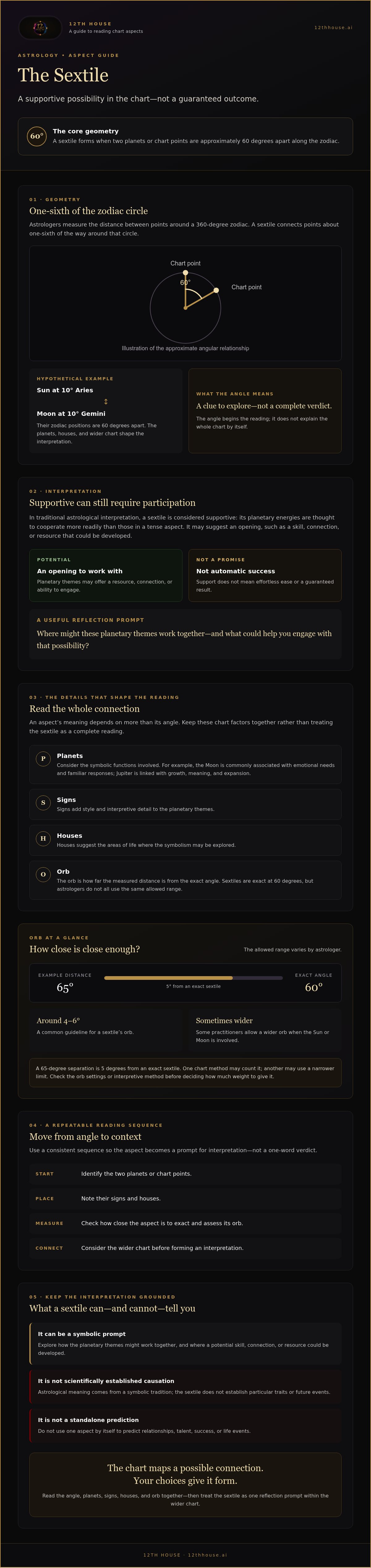
A sextile is an astrological aspect formed when two planets or other chart points are approximately 60 degrees apart along the zodiac. Astrologers commonly interpret this angle as a cooperative connection that may point to opportunities, complementary abilities, or resources to develop. This meaning comes from a symbolic tradition; it isn’t a scientifically established force that causes particular traits or events.
If you’re asking what is a sextile in astrology, begin with the geometry, then interpret the symbolism in context. The angle is a clue, not a complete verdict. For a general overview of how astrologers classify angular relationships, see this guide to the astrological aspect.
How the 60-degree angle appears in a birth chart
Astrologers measure the distance between two planets or chart points along the zodiac’s 360-degree circle. In a wheel chart, each point marks a position around the circle, and a sextile connects points about one-sixth of the way around it. Some chart displays draw a line between the points; others show aspects in a grid or list. If you don’t see a line, check the chart’s aspect grid.
Hypothetical example: Imagine the Sun at 10 degrees Aries and the Moon at 10 degrees Gemini. Their zodiac positions are 60 degrees apart, so an astrologer might identify them as a sextile. The planets’ symbolism, their houses, and the rest of the chart would shape the interpretation.
Why astrologers call the sextile a supportive aspect
In traditional astrological interpretation, a sextile is considered supportive because its planetary energies are thought to cooperate more readily than those in a tense aspect. Astrologers often describe it as an opening: a skill, connection, or resource that may be available to use.
Support doesn’t mean automatic success or effortless ease. A sextile may point to potential that develops through attention and participation. Treat it as a reflective prompt: where might the themes represented by these planets work together, and what action could help you engage with that possibility? Astrology offers a symbolic framework for exploring such questions, not evidence-based proof of an individual’s traits or future events.
How a Sextile Works: Planets, Signs, and the Astrological Orb
A sextile’s meaning comes from more than its angle. Astrologers consider the planets as symbolic functions, then use their signs and houses to add style and life context. An aspect’s meaning depends on the planets involved, their signs and houses, and how closely their degrees match the exact angle. Keep these factors together rather than treating the aspect as a complete reading by itself.
What the planets and zodiac signs contribute
Think of the planets as functions in a symbolic map. The Moon is commonly associated with emotional needs and familiar responses, while Jupiter is linked with growth, meaning, and expansion. Their signs describe how an astrologer might interpret those themes being expressed, while their houses suggest the areas of life where the symbolism may be explored.
Hypothetical example: A Moon at 12 degrees Cancer and Jupiter at 12 degrees Virgo are approximately 60 degrees apart. An astrologer might consider how emotional needs and growth-oriented themes relate, then look to Cancer and Virgo for additional interpretive detail. The houses add another layer. This doesn’t establish a fixed outcome or guarantee a particular talent; it offers a structure for reflection.
What orb means for a sextile
An orb is the permitted distance between an aspect’s exact angle and the measured distance between two chart points. A sextile is exact at 60 degrees, but some astrologers count it when the points fall a few degrees short or beyond. The allowed range isn’t universal: a common guideline is around 4 to 6 degrees, and some practitioners allow a wider orb when the Sun or Moon is involved.
For instance, two points separated by 65 degrees are 5 degrees from an exact sextile. One chart method may count that connection; another may use a narrower limit. Check the orb settings or interpretive method used by your chart source or astrologer before deciding how much weight to give the aspect.
To explore how planetary functions, sign placements, houses, and orb come together in your chart, consider personalized astrology chart analysis. Use it alongside your own judgment, not as a substitute for understanding the chart’s components.
Sextile vs. Trine, Square, and Conjunction: What Changes?
Aspect names describe different angular relationships between planets, but they don’t divide a birth chart into “good” and “bad.” To understand what is a sextile in astrology, compare its geometry and traditional interpretation with other aspects. A sextile is commonly associated with an opening that can be developed; a trine is often described as more naturally flowing. Neither description guarantees an outcome.
| Aspect | Approximate angle | Common interpretation | Practical caution |
|---|---|---|---|
| Sextile | 60° | Opportunity, cooperation, potential that may need engagement | Support isn’t automatic; consider how the planets and chart context shape it. |
| Trine | 120° | Ease, flow, or familiar abilities | What feels natural may not always be consciously developed or used. |
| Square | 90° | Tension, friction, or pressure to adjust and act | Challenge doesn’t mean failure; look at how the tension is handled. |
| Conjunction | 0° | Planetary functions joined or concentrated together | The planets involved matter; a conjunction isn’t automatically positive or difficult. |
These are common interpretive conventions, not fixed rules. Astrologers and traditions may weigh aspects differently, and no single angle should be read in isolation.
How a sextile differs from a trine
Both aspects are generally considered harmonious, but the sextile is often framed as a door opening, while the trine is described as a current that flows more readily. A sextile may suggest potential that benefits from attention or initiative. A trine may point to ease that feels familiar, though ease alone doesn’t ensure growth.
Hypothetical example: Imagine the same two planets forming either a 60-degree sextile or a 120-degree trine. In a symbolic reading, the sextile might suggest a useful connection to recognize and cultivate; the trine might suggest a connection that operates with less friction. Neither aspect is universally better or more powerful. The planets’ meanings and the wider chart still matter.
How a sextile differs from a square or conjunction
A square is commonly read as friction between planetary themes, which may prompt adjustment or action. A conjunction brings the planets close together, concentrating their functions so they may operate as a more unified combination. The interpretation depends on which planets are involved and how the rest of the chart modifies their relationship.
A favorable aspect doesn’t guarantee effortless success, a particular talent, or a specific life event. Read the angle as one interpretive layer, then consider the planets, signs, houses, and broader chart pattern before drawing conclusions.
How to Interpret a Sextile in Your Birth Chart
A useful reading follows a sequence instead of jumping from an aspect symbol to a conclusion. If you’re asking what is a sextile in astrology in practical terms, use it as a prompt to investigate how two planetary themes might work together in a specific chart context.
A beginner’s checklist for reading the aspect
- Identify the planets. Note the two planetary functions being connected. Ask what themes each represents in the interpretive tradition you’re using.
- Record the signs. The signs describe the style or mode through which astrologers might interpret those planetary themes.
- Locate the houses. Houses point to areas of life where the symbolism may be explored. Treat them as context, not a literal forecast.
- Check the orb. Look up the degrees between the planets and confirm the chart source’s aspect and orb settings. Different methods may count different ranges.
- Read the surrounding chart. Consider whether other aspects or placements reinforce, complicate, or redirect this connection.
In brief, interpret a sextile by identifying its planets, signs, houses, orb, and wider chart context, then consider how its symbolism relates to lived experience. Ask yourself: where do these themes already cooperate, and what constructive action might help you engage with that potential? Use your observations for reflection, not as a prediction that a particular event must occur.
Sextiles in natal charts, transits, and relationship charts
A natal aspect describes the relationship between planets in a birth chart. A transit aspect describes a time-specific relationship involving moving planets and is used to consider current astrological themes. The same aspect type can therefore address different questions: one concerns a birth chart pattern, while the other concerns a period of time.
In relationship astrology, astrologers compare placements from two people’s charts or combine chart information to explore the relationship as a symbolic subject. These methods offer different perspectives, not a verdict on compatibility. For an introduction to this approach, see birth chart compatibility.
To examine these factors in your own chart, explore your chart with astrology birth chart and transit analysis. You can also use Ask Lala, an AI assistant for personalized chart questions, as an optional aid while you continue learning the method.
What a Sextile Can, and Cannot, Tell You About Your Chart
A sextile can help you notice how two planetary themes may support one another, but it’s only one interpretive layer in a birth chart. Its usefulness lies in the questions it raises: What resources might be available? Where could cooperation develop? What might you choose to practice? The answers depend on the chart as a whole and on your own experience.
A sextile cannot independently predict a relationship, confirm a talent, guarantee success, or identify a future event. Astrology is a symbolic system for interpretation and reflection, not a scientific diagnosis or source of certainty. Let the aspect offer a perspective, not a final answer.
Common sextile interpretation mistakes to avoid
- Assuming support means ease. A sextile may be described as favorable, but its potential might not feel obvious or consistently beneficial. You may need to recognize and actively use what it symbolizes.
- Reading the angle alone. Consider the planets, signs, houses, orb, and broader chart pattern before forming an interpretation. A single aspect can’t carry the full meaning of a chart.
- Turning symbolism into prediction. Avoid treating an aspect as proof that a particular relationship, ability, success, or event will occur. Use it to frame questions rather than dictate conclusions.
Stay curious. If an interpretation doesn’t match your lived experience, don’t force it. Revisit the chart context, consider another interpretive approach, or set the idea aside. A reflective reading should expand your perspective, not limit your choices.
Explore the aspect in your own chart
Before settling on a meaning, write down the two planets, their signs and houses, and the orb shown by your chart source. Then ask where those themes appear in your life and what constructive action, if any, feels relevant. This keeps the reading grounded in observation instead of assumption.
If you’d like support exploring those details, 12th House offers astrology birth chart analysis and Ask Lala, an AI assistant that can answer personalized questions about charts. These tools can help you investigate your chart’s symbolism while keeping your own judgment central. Explore personalized astrology guidance with 12th House as an optional next step.
Put Your Sextile in Context
Understanding what is a sextile in astrology gives you a starting point: it’s a symbolic connection commonly associated with opportunity and cooperation. Its meaning depends on the planets involved, their signs and houses, the orb, and the wider chart. Compared with other aspects, a sextile may point to potential worth engaging, not a guaranteed outcome.
Use the aspect as a prompt for careful reflection. Notice where its planetary themes appear in your experience, and consider what actions could help you work with them. A sextile can add perspective, but it can’t independently predict a relationship, talent, success, or life event.
If you’re ready to explore how a sextile fits into your own chart, 12th House offers astrology birth chart and transit analysis. Ask Lala can also answer personalized questions about your chart, helping you investigate its symbolism in context.
Explore personalized astrology guidance with 12th House, and use what you discover as a thoughtful tool for self-understanding. Your chart can offer questions to explore; you remain the author of your choices.
Frequently Asked Questions
What is a sextile in astrology?
A sextile is an astrological aspect formed when two planets or chart points are approximately 60 degrees apart. To answer what is a sextile in astrology, think of it as a symbolic link commonly associated with cooperation, opportunity, or potential that can be developed. Astrologers interpret its meaning through the planets involved, their signs and houses, and the wider chart. It isn’t a scientifically established force that causes specific traits or events.
Is a sextile a good aspect in astrology?
Astrologers traditionally consider the sextile a supportive or harmonious aspect, but “good” doesn’t mean effortless, guaranteed, or beneficial in every situation. It may symbolize resources or openings that a person can choose to recognize and develop. The planets involved and the wider chart influence the interpretation. Rather than treating a sextile as a promise of success, use it as one symbolic prompt for reflection.
How many degrees is a sextile in astrology?
A sextile is approximately 60 degrees, measured between two planets or other chart points along the zodiac. An exact sextile is 60 degrees apart, though astrologers may allow some distance on either side, called an orb. Orb guidelines vary by practitioner and chart method. Check the settings or interpretive approach used by your chart source before deciding whether a less exact angle counts as a sextile.
What is the difference between a sextile and a trine?
A sextile forms at about 60 degrees, while a trine forms at about 120 degrees. Both are commonly described as harmonious aspects. Astrologers often associate a sextile with an opportunity that may need conscious engagement, and a trine with greater ease or natural flow. These are interpretive tendencies, not rankings. Neither aspect is automatically better, and both need to be read through the planets and chart context.
Can a sextile predict a relationship or life event?
No. A sextile on its own can’t reliably predict a relationship, talent, success, or specific life event. Within astrology, it’s interpreted symbolically as one connection between planetary themes, and its meaning depends on the full chart and the method being used. You can use that symbolism to reflect on your experience or choices, but don’t treat it as certainty or as a substitute for evidence-based decisions.
What does a sextile mean in a birth chart?
In a birth chart, a sextile describes an approximately 60-degree relationship between two natal planets or chart points. Astrologers use the planets to identify the themes involved, then consider their signs, houses, orb, and other chart factors. The aspect may suggest areas of cooperation or potential to develop. It doesn’t provide a complete reading by itself, so look at the connection within the wider chart.
Does the orb change the meaning of a sextile?
The orb helps determine how close two chart points must be to the exact 60-degree angle for an astrologer to count the aspect. A tighter orb is closer to exact; a wider one is farther away. Astrologers don’t all use the same limits, so the orb can affect whether a sextile is included and how much interpretive weight it receives. Check your chart source’s orb guidelines and read the aspect in context.


