

What if the clearest signs you are on the right spiritual path aren’t dramatic at all? You may be looking for certainty in a coincidence, a strong intuition, or a sudden change in priorities, then wondering whether you’re noticing genuine growth or what you hope to see. That uncertainty is part of the process. Spiritual progress doesn’t have to feel constant, unmistakable, or separate from ordinary life.
A more grounded measure is how your inner work shapes your choices. Are you becoming more honest with yourself, more considerate of others, or better able to set healthy boundaries? These shifts don’t prove a supernatural force is guiding you, but they can offer meaningful evidence of personal growth.
This practical checklist explores nine clues to help you assess your path without handing your judgment to coincidence, certainty, or outside authority. You’ll learn how to reflect on intuition, changing values, and moments of peace while staying connected to your responsibilities. Treat each sign as a prompt for inquiry, not a verdict. Your path is yours to examine.
Key Takeaways
- Use the signs you are on the right spiritual path as reflective clues, not a pass-or-fail test or proof of supernatural approval.
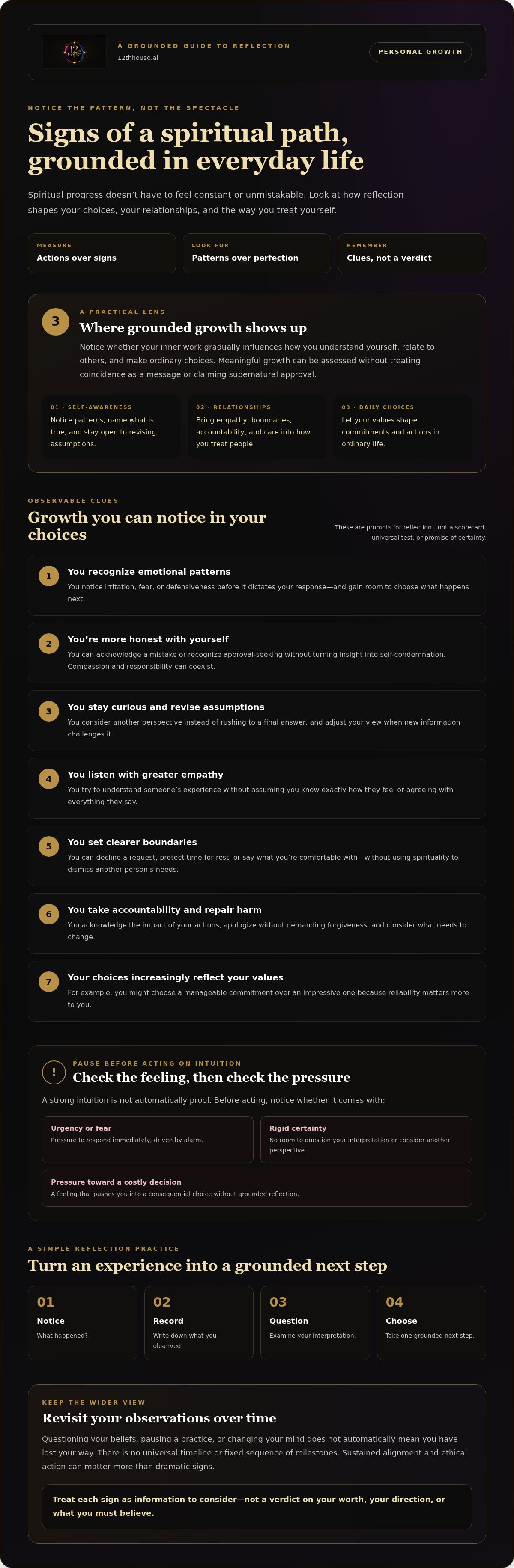
- Look for growth in three areas: your self-awareness, your relationships, and the choices you make in everyday life.
- Before acting on a strong intuition, check for urgency, fear, rigid certainty, or pressure to make a costly decision.
- Build a simple reflection practice: notice what happened, record it, question your interpretation, and choose one grounded next step.
- Revisit your observations over time. Sustained alignment and ethical action can matter more than dramatic signs.
What Are Signs You Are on the Right Spiritual Path? Start With Grounded Clues
Spiritual growth rarely brings constant certainty. You may feel connected to your direction one day and question it the next. That doesn’t automatically mean you’ve lost your way. The signs you are on the right spiritual path are better treated as reflective clues than as universal tests, guarantees, or proof of supernatural approval.
This article explores nine grounded indicators across self-awareness, choices, relationships, and daily life. The focus isn’t on interpreting every coincidence as a message. It’s on noticing whether your reflections help you live with greater honesty, care, and alignment with your values. You can assess that direction within your own framework, whether or not you belong to a religion or spiritual tradition.
What does being on a spiritual path mean in everyday life?
Being on a spiritual path can mean examining what matters to you, how you make sense of life, and whether your conduct reflects your values. Some people explore those questions through religious traditions or personal practices; others do so without identifying with a formal belief system. For a broad overview, see this definition of spirituality, which reflects the concept’s varied interpretations.
Spiritual growth is the observable practice of reflection that gradually shapes how you understand yourself and behave. In daily life, that might mean acknowledging a mistake instead of making excuses, listening carefully before responding, or reconsidering a choice that no longer fits your principles. The measure is not a special identity. It’s the work of bringing awareness into action.
Why spiritual progress may feel uncertain or nonlinear
Questioning your beliefs doesn’t mean you’ve failed. It can be part of taking them seriously. A new perspective may clarify one area of life while raising questions in another. You might pause a practice, revise an assumption, or find that an insight is harder to apply when work, health, or relationships demand attention.
There’s no universal timeline or fixed sequence of milestones to complete. Avoid using constant certainty as your measure of progress. Instead, observe what changes over time: how you respond to difficulty, whether you’re willing to learn, and how consistently your actions reflect your values. Treat each clue as information to consider, not a verdict on your worth or direction.
Nine Signs of Spiritual Growth You Can Notice in Your Choices
Grounded growth is easier to recognize when you look beyond how inspired you feel and notice how you respond. These nine clues aren’t a scorecard. Look for patterns, not perfection.
Inner awareness: notice, question, and revise
- You recognize emotional patterns. You may notice irritation, fear, or defensiveness before it dictates your response. That pause gives you room to choose what happens next.
- You’re more honest with yourself. You can name a mistake or admit that a choice was driven by approval-seeking without turning that insight into a reason to condemn yourself. Compassion and responsibility can coexist.
- You stay curious and revise assumptions. Instead of rushing to a final answer, you consider another perspective and adjust your view when new information challenges it.
Relationships: bring care and boundaries together
- You listen with greater empathy. You try to understand someone’s experience without assuming you know exactly how they feel or agreeing with everything they say.
- You set clearer boundaries. You can decline a request, protect time for rest, or name what you’re comfortable with without using spirituality to dismiss another person’s needs.
- You take accountability and repair harm. If your actions hurt someone, you can acknowledge the impact, apologize without demanding forgiveness, and consider what needs to change.
Growth doesn’t guarantee harmony. Some honest conversations remain difficult, and some relationships change. The University of Minnesota shares practical ideas to develop your spiritual resources, including forgiveness and connection with others. Use such guidance as material for reflection, then consider what fits your circumstances.
Everyday decisions: align values with action
- Your choices increasingly reflect your values. You might choose a manageable commitment over an impressive one because reliability matters more to you than appearing busy.
- You follow through in ordinary life. You attend to responsibilities, keep agreements where possible, and make practical adjustments when you can’t.
- You let experience inform your direction. When a decision doesn’t work as expected, you review what happened rather than treating the outcome as a verdict on your entire path.
Grounded personal growth takes shape through sustained choices that bring your actions closer to your values. These patterns are among the signs you are on the right spiritual path, not because they prove a particular belief, but because they show reflection taking form in daily conduct. If a symbolic framework helps you ask better questions, you can explore spiritual reflection tools while keeping your own judgment at the center.
Is It Intuition or Wishful Thinking? Test Spiritual Signs With Discernment
A powerful feeling can matter deeply to you without proving that an outside force sent a message. The signs you are on the right spiritual path shouldn’t require you to treat every coincidence, dream, or sudden certainty as instruction. Discernment lets you explore personal meaning while staying open to other explanations.
One useful concept is confirmation bias: once you expect a particular outcome, you may notice details that support it and overlook details that don’t. This doesn’t make your experience meaningless. It’s a reason to slow down and examine how you reached an interpretation. The University of New Hampshire’s overview of Signs of Spiritual Wellness also points toward grounded qualities such as ethical conduct and choices shaped by personal values.
How to reflect on a coincidence or strong intuitive feeling
Separate the event from the meaning you assigned to it. Write down what happened, what you felt, and what you think it might mean. Then ask what else could explain it. If you keep noticing a certain symbol, for example, consider whether it has personal significance, whether you’ve been thinking about it lately, or whether both could be true.
Look for patterns across time rather than building a conclusion around one striking moment. A journal can help you compare your first interpretation with what you learn later. Symbolic meaning can be valuable as a prompt for reflection, but it isn’t the same as independently verified evidence of a supernatural cause.
Consider the context, alternative explanations, and likely consequences before treating an experience as guidance. Does the interpretation fit what you know? What might change your mind? What could happen if you act on it?
When to pause before acting on a perceived spiritual message
Pause if an interpretation creates intense fear, urges you to isolate yourself, or demands an immediate decision. Be especially careful when it pressures you to spend beyond your means, end an important relationship abruptly, or disregard your safety. Urgency and rigid certainty aren’t reliable measures of truth.
For major health, financial, relationship, or safety decisions, talk with trusted people and seek qualified professional support where appropriate. Spiritual reflection may help you clarify your values, but it shouldn’t replace medical or mental health care, financial advice, or other professional guidance. You’re allowed to wait, gather information, and decide based on the full situation.
How to Use a Spiritual Path Checklist Without Turning It Into a Test
A checklist can help you notice patterns, but it can’t certify your spiritual status. The signs you are on the right spiritual path aren’t boxes you must tick to earn certainty. Use them as prompts for reflection, then return to them over time. One difficult week doesn’t erase meaningful growth, and a long list of “yes” answers doesn’t prove that every interpretation is correct.
A five-step reflection practice for moments of uncertainty
When an experience leaves you unsure, move through these steps without rushing toward a verdict:
- Notice: Describe what happened, separating observable details from your interpretation.
- Record: Write down your feelings and any decisions connected to the experience.
- Question: Ask what other explanations might fit and what information could change your view.
- Connect: Compare your interpretation with your stated values, responsibilities, and real-life context.
- Choose: Take one small, reversible action, such as having a conversation or setting aside time to reflect, rather than making a high-stakes leap.
Revisit your notes later. Look for recurring patterns and changes in your understanding, not a score. This practice supports self-inquiry; it isn’t a diagnosis, prediction, or proof of spiritual standing.
How symbolic tools can support self-inquiry without deciding for you
Astrology, tarot, numerology, and Human Design offer interpretive frameworks for asking questions about patterns, values, and choices. Treat their prompts as perspectives to examine, not instructions you must follow. Does an interpretation resonate with your lived experience? Does it hold up when you consider your obligations and the people affected by your decisions? Your judgment remains central.
If you’re curious about one framework, explore this guide to the five Human Design types as a starting point for self-inquiry. For a different approach to reflective practice, read Tarot Mastery: spiritual clarity and reflection. Neither framework can verify that a particular sign came from an external source or make a life decision on your behalf.
Want a structured way to explore a spiritual question? Explore 12th House’s spiritual guidance tools as optional aids for reflection, and interpret any insight in light of your own experience.
Keep Exploring Your Spiritual Path With Curiosity and Personal Agency
No single experience can certify that you’re moving in the right direction. Look instead at what your reflections make possible over time: greater alignment between your values and actions, more care in how you treat others, and a willingness to act ethically even when certainty is absent. These are more grounded measures than dramatic signs or an answer that promises to settle every question.
Choose one question you’re genuinely asking, such as “What values do I want guiding this decision?” Explore it with curiosity, then test any insight against your circumstances, responsibilities, and lived experience. The signs you are on the right spiritual path aren’t instructions to surrender your judgment. They’re prompts to keep examining how you want to live.
Choose a tool that matches the question you’re actually asking
Different frameworks offer different kinds of reflection. Astrology chart and transit analysis can help you explore chart themes and symbolic timing. Lala AI can respond to personalized spiritual questions using your spiritual context. Tarot may offer prompts for considering a situation, while numerology and Human Design provide other symbolic structures for reflection.
Use a framework because it helps you think, not because it can decide for you. Compare what it suggests with what you know about your life, and keep your own judgment in view. No spiritual tool replaces qualified professional support for health, financial, safety, or other specialized concerns.
Build a self-directed practice with 12th House
12th House offers digital spiritual tools and access to a metaphysical learning library for exploring symbolic frameworks. You might use one tool to develop a question, then reflect on whether its prompts fit your real-life context. Treat any result as material for inquiry, not an authoritative verdict about your path. Check the platform for current membership features and access terms.
If a structured space for exploration would be useful, Explore 12th House. Keep what supports thoughtful reflection, question what doesn’t, and let your choices remain your own.
Let Your Next Step Be Grounded in What Matters
The signs you are on the right spiritual path aren’t a promise of constant certainty. They’re clues you can test against how you live: whether your actions increasingly reflect your values, whether you can question your interpretations, and whether your growth supports care and accountability. Notice patterns over time rather than treating one coincidence or powerful feeling as a final answer.
Choose one question to explore next. Record what you notice, consider other explanations, and check any insight against your responsibilities and lived experience. Spiritual tools can offer useful prompts, but you remain the authority on your choices. They aren’t proof or a substitute for professional support when you need it.
For structured exploration, 12th House brings together digital tools for astrology, tarot, numerology, Human Design, and other metaphysical approaches. Lala AI offers personalized spiritual guidance through the platform as a resource for reflection rather than a verdict. Explore 12th House’s spiritual tools and choose the framework that fits the question you’re asking. Keep your curiosity, trust your discernment, and let steady, thoughtful action shape the way forward.
Frequently Asked Questions
What are the signs you are on the right spiritual path?
Grounded signs include greater self-awareness, choices that reflect your values, curiosity about other perspectives, and more care in how you relate to people. You may also become more willing to acknowledge mistakes, set boundaries, and follow through on commitments. These signs you are on the right spiritual path are reflective clues, not proof of supernatural approval or a universal checklist. Look for patterns over time, not perfection.
How do I know if I am spiritually awakening?
Spiritual awakening is a personal description, not a status you can confirm with one experience. You might be questioning assumptions, exploring meaning, or noticing changes in what you value. Consider whether those shifts lead to thoughtful, responsible choices in daily life. A striking dream or intense emotion can prompt reflection, but it doesn’t establish what is happening on its own. Give yourself room to explore without forcing a label.
Can doubt be a sign of spiritual growth?
Yes, doubt can accompany spiritual growth when it helps you examine beliefs and consider new information. Questioning doesn’t automatically mean you’re failing or moving backward. Ask what prompted the doubt and whether you’re exploring it with openness rather than fear or pressure. You don’t need to rush toward a final answer. Reflection can include uncertainty while you continue meeting your responsibilities and acting in line with your values.
How can I tell intuition from wishful thinking?
You can’t reliably identify intuition by how powerful a feeling is. Record what happened, what you think it means, and what other explanations might fit. Notice whether the interpretation invites considered reflection or demands immediate action through fear, urgency, or rigid certainty. Check it against what you know and the likely consequences. For high-stakes choices, seek trusted input and qualified professional guidance when appropriate.
Do repeated numbers or coincidences mean I am on the right path?
Repeated numbers and coincidences can feel personally meaningful, but they don’t prove that you’re on a particular path or receiving an external message. You can treat them as prompts to ask what you were thinking or feeling at the time. Consider ordinary explanations, too, such as increased attention to a pattern. Record recurring experiences and revisit your interpretations rather than making major decisions based on a single coincidence.
What should I do if I feel disconnected from my spiritual path?
Start by easing the pressure to feel certain or inspired. Take stock of what has changed, what currently matters to you, and whether a practice still feels useful. You might pause, return to a simple reflective habit, or talk with someone you trust. Disconnection isn’t proof of failure. If distress is affecting your well-being or daily life, consider support from a qualified health professional rather than relying on spiritual interpretation alone.
Can astrology or tarot tell me whether I am on the right path?
Astrology and tarot can offer symbolic prompts for self-reflection, but they can’t objectively verify that you’re on the right path or decide what you should do. Use a chart or reading to explore themes and questions, then compare the interpretation with your lived experience, values, and responsibilities. Keep your judgment at the center. For important health, financial, relationship, or safety decisions, seek appropriate professional support.


