

A symbol doesn’t have to fix your feelings to help you meet them with more clarity. A sigil for emotional healing can act as a visual anchor for reflection, giving a manageable intention a form you can return to. It can’t erase grief, control your emotions, or replace support from a qualified professional. That boundary doesn’t make the practice meaningless. It keeps its purpose clear.
If you’re unsure how to turn a feeling into a symbol, or you’ve found conflicting advice about how sigils should be made, start with a simple framework. Choose an intention that feels supportive and is within your control, shape it into a personal mark, then use it as a prompt for reflection. You don’t need artistic skill or a perfect ritual.
This guide explains how to create a symbol, use it without forcing an outcome, and keep realistic expectations. Treat the sigil as a point of focus, not a cure or command. You decide what it means, and you can pause whenever the process feels uncomfortable.
Key Takeaways
- Choose one manageable emotional intention to guide your sigil for emotional healing, rather than trying to resolve everything at once.
- Use a simple written-intention method or a more ritualized approach, depending on what feels meaningful and accessible to you.
- Treat your symbol as a prompt to notice and reflect on your feelings. Adapt or stop the practice whenever you need to.
- Keep sigil work in perspective: it can support personal reflection, but it isn’t a cure or a substitute for appropriate care.
- Consider 12th House’s Seal Creator as an optional tool for exploring symbolic design.
What Is a Sigil for Emotional Healing, and What Can It Offer?
When emotions feel difficult to sort through, a small personal practice can offer a moment to pause. You might give an intention such as “I can meet this feeling with patience” a form you can see and revisit. A sigil can help you focus on that intention without asking you to explain or solve everything you’re feeling.
A sigil is a personally created symbol connected to an intention. Methods vary: some people simplify words into an abstract design, while others build a symbol intuitively. There isn’t one universal formula or a single correct result. The term has a wider history and range of uses; the sigil entry offers an overview of those meanings.
A sigil for emotional healing is a personal symbol for reflecting on an intention, not a clinical treatment, diagnosis, or promise of emotional change. Its meaning comes from the person who creates it, not from a universal code that guarantees a particular effect.
How a personal symbol can support reflection
A symbol can serve as a visual anchor during journaling or quiet reflection. Look at it and ask, “What do I notice in myself right now?” or “What would patience look like in this moment?” The sigil doesn’t answer for you. It gives your attention a place to land while you consider your own response.
The meaning is personal. A curve, letter, or shape may remind one person of steadiness and mean something entirely different to someone else. Use the symbol as a reflection prompt or part of a simple ritual, not as evidence about your mental health or a substitute for therapy, diagnosis, or medical advice.
Set realistic expectations before you begin
Your response may change from one day to another. You might find the practice grounding, neutral, or simply not useful. None of those reactions measures your progress. You can adapt the ritual, skip it, or stop at any point. There’s no required frequency, and you don’t need to force a feeling or outcome.
Keep the intention modest and within your control. A symbol may remind you to pause, name a feeling, or approach yourself with care. It can’t guarantee symptom relief, release trauma, or transform distress quickly. If emotional distress is persistent, intense, or feels unsafe, seek support from a qualified mental-health professional or appropriate local support service. Symbolic practice can sit alongside care, but it shouldn’t replace it.
How to Create a Sigil for Emotional Healing, Step by Step
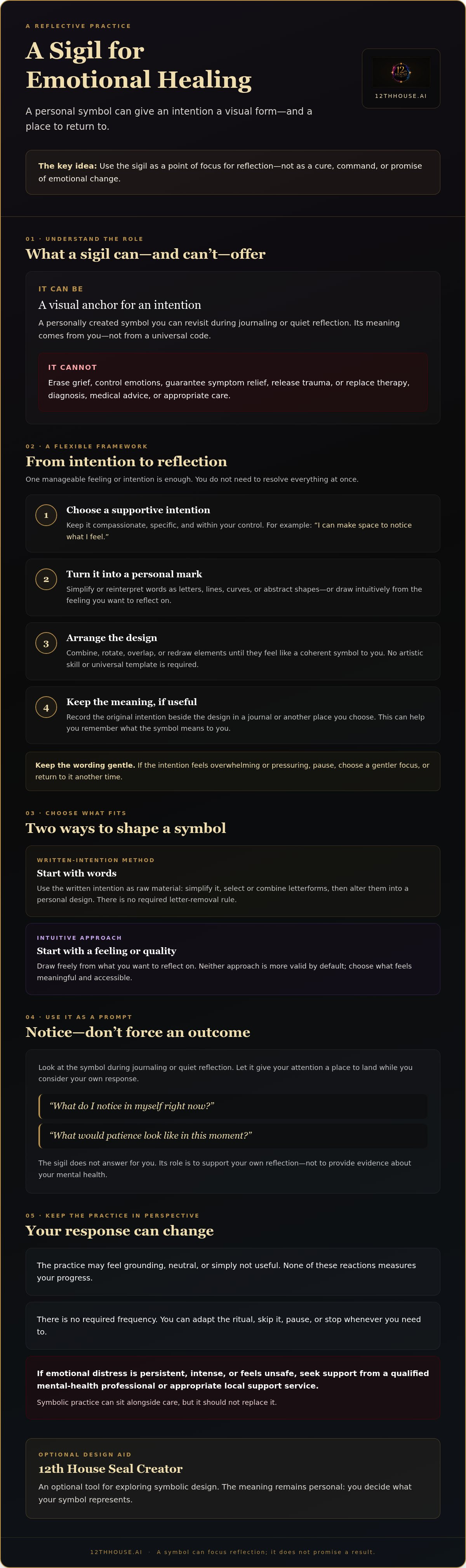
There’s no single authoritative formula for making a sigil. Practitioners and traditions use different approaches, so treat this process as a flexible framework, not a test you have to pass. For a sigil for emotional healing, keep the focus private and manageable. One feeling or intention is enough; you don’t need to resolve your whole emotional landscape in one design.
Shape an intention that feels emotionally safe
Start with an intention centered on your own attention or actions. Choose wording that feels supportive rather than demanding. For example: “I can make space to notice what I feel,” or “I will meet this moment with patience.” Avoid deadlines, absolutes, and instructions aimed at changing another person. A useful intention is specific, compassionate, and within your own agency.
Read your words slowly before turning them into a symbol. If they feel overwhelming, pressuring, or too large to hold right now, pause or choose a gentler focus. You can also set the intention aside and return to it another time.
Turn the intention into a personal design
One accessible method is to simplify the written intention into a visual arrangement. You might remove repeated letters, combine a few remaining letterforms, then alter them into lines, curves, or abstract marks. Another approach is to draw freely from the feeling or quality you want to reflect on. Neither method is more valid by default.
Follow these steps at your own pace:
- Write one intention. Keep it short and focused on your own choices or awareness.
- Reduce or reinterpret the words. Use letters, shapes, or marks as raw material; there’s no required letter-removal rule.
- Arrange the elements. Combine, rotate, overlap, or redraw them until the design feels like a coherent personal symbol.
- Record the meaning privately. Note the original intention beside the design in a journal or another place you choose. This helps you remember what you meant by it, even if the symbol is abstract.
Your design doesn’t need to be legible, polished, or made according to a universal template. Its meaning comes from the intention you attach to it. A dissertation in Santa Clara University Scholar Commons examines symbolic expression through art in relation to trauma. That scholarly work offers context for creative meaning-making, not proof that a sigil treats trauma or replaces care.
If you’d like to explore another route for symbolic design, 12th House offers a Seal Creator. Use it as an optional creative aid; your intention and interpretation remain your own.
Which Sigil-Making Approach Fits Your Practice?
There’s no single method you must follow to create a sigil for emotional healing. A simple personal process can be enough: choose an intention, make a private design, and use it as an optional reflection prompt. A more formal ritual may include additional steps, but practices vary. Choose based on your comfort, time, and beliefs, not fear of getting it wrong.
A simple personal method versus a formal ritual
A minimal approach needs little beyond paper and something to write with. Write an intention, turn its words into an abstract mark, then pause to reflect on what the design means to you. A ritualized approach may involve more preparation or symbolic actions, depending on the specific practice. Don’t treat different cultural or spiritual traditions as pieces of one supposedly ancient system. Claims about a particular origin or lineage need reliable, specific sourcing.
| Consideration | Simple personal method | More ritualized approach |
|---|---|---|
| Effort | Brief and easy to adapt | May involve more preparation |
| Materials | Paper and a pen or pencil | Depends on the specific practice |
| Personal meaning | Built directly from your intention | May draw on a defined set of symbols or steps |
| For beginners | Accessible if you want a low-pressure start | Can suit beginners when instructions are clear and well-sourced |
Neither approach is universally better. If added steps feel meaningful and you understand their context, you may prefer them. If they create pressure, keep the process simple. A practice should feel chosen, not compulsory.
How to choose symbols without copying meaning blindly
Use shapes or marks you understand and personally endorse. A spiral might remind you of returning to a subject with patience, but that interpretation is yours, not a universal emotional code. Before borrowing a culturally specific symbol, research its context and consider whether using it is appropriate. Don’t assume a symbol’s meaning based on an image alone.
If you’re interested in another system for reflecting on symbols and spiritual themes, explore Tarot Mastery: A Professional Guide to Spiritual Clarity. Tarot is a distinct practice, not a required step in sigil-making. Choose a method that serves your reflection while keeping the meaning and boundaries of each tradition clear.
How to Use a Sigil for Reflection Without Forcing an Outcome
Once you’ve made your symbol, use it as a prompt for attention, not a test of whether your feelings are changing. A sigil for emotional healing doesn’t require a particular response. You can look at it, notice what’s present, and decide whether reflection feels useful today.
A brief reflection practice after creating the sigil
Try this optional sequence when you feel comfortable. Keep it brief, and leave out any step that doesn’t suit you.
- Look at the symbol. Notice its lines, shapes, or the feeling it brings up. There’s no hidden correct meaning to uncover.
- Name what’s present. Ask yourself, “What am I feeling right now?” You can write a word, a few sentences, or nothing at all.
- Consider what you need. Ask, “What boundary or support might help me?” Then identify one small, realistic action, such as taking a pause or asking someone you trust to listen.
You might also write, “What does this symbol mean to me today?” Your answer can differ from what you wrote when you first made it. Revisit the design only when it feels useful. There’s no required schedule or ritual to maintain.
When to pause and reach for additional support
A reflective exercise should leave you free to stop. If focusing on the symbol brings up overwhelm, escalating distress, or a sense that you’re unsafe, set it aside. Pause the exercise if it increases distress, and seek appropriate support. You can reach out to a trusted person, a qualified mental-health professional, or a local support service. If you’re in immediate danger, contact local emergency services.
Symbolic practices can’t diagnose a condition or replace qualified mental-health care. They also can’t guarantee relief or resolve trauma on their own. Use the symbol only as an optional point of reflection, alongside the forms of care and support that fit your needs. Choosing not to continue is a valid choice.
If reflective spiritual questions are useful to you, explore Ask Lala AI spiritual guidance as a separate tool for reflection, not clinical care.
Explore Personal Symbolism with 12th House’s Seal Creator
A digital tool can offer another starting point for symbolic design, but it doesn’t have to define what your symbol means. 12th House offers a Seal Creator for exploring personal symbolism. You can also use paper and a pen. The practice doesn’t depend on a particular platform or on making a design that looks a certain way.
Use digital tools as aids, not authorities
Keep your intention at the center. A symbol’s personal meaning comes from your reflection and interpretation, not from a tool declaring what you feel or need. Don’t treat a digital or AI-generated symbol as a psychological assessment, expert treatment, or guarantee of emotional change. You remain the author of the meaning you choose to give it.
Digital tools can be part of a broader landscape of spiritual reflection. For a separate perspective, explore AI astrology assistant guidance. Astrology and symbolic design are distinct practices, and neither should be confused with mental-health care.
Choose a next step that respects your pace
If you’d like to continue exploring, the Seal Creator is one optional route. No specific digital process is necessary: you can keep working with the design you made by hand, or simply pause. You don’t need to share your intention, either. Keeping it private is a valid choice, especially if writing it down for yourself feels more comfortable.
A sigil for emotional healing is best understood as a personal symbol for reflection, not an authority over your emotions. Choose a next step that feels manageable, and leave room to change your mind. The tool can support exploration; it doesn’t set the pace or decide what healing should look like.
If you’d like to explore the platform and its symbolic tools, Explore 12th House at your own pace.
Carry Your Intention Forward at Your Own Pace
A sigil for emotional healing can give a personal intention a visible form, but its value lies in the reflection it invites, not in a guaranteed result. Keep your focus specific, choose a design that feels meaningful to you, and use it only when it supports your self-awareness. You can adapt the practice, set it aside, or seek qualified support when you need more than a reflective ritual.
There’s no perfect symbol to uncover and no schedule you need to follow. Let your next step be small and yours to choose. If you’d like to explore more symbolic and spiritual resources, 12th House offers a Seal Creator, a metaphysical library, and Ask Lala AI spiritual guidance. These are optional tools for exploration, not substitutes for mental-health care.
Explore 12th House and continue your practice with curiosity, care, and room to move at your own pace.
Frequently Asked Questions
What is a sigil for emotional healing?
A sigil for emotional healing is a personally created symbol linked to an intention, such as making space to notice a feeling with patience. You can use it as a visual focus during journaling or quiet reflection. Its meaning is personal, and people interpret sigils in different ways. It isn’t a proven treatment, diagnosis, or guarantee that an emotion or mental-health concern will change.
How do you make a sigil for emotional healing?
Choose one manageable intention focused on your own awareness or actions. Write it in a short phrase, then simplify the words into letters, shapes, or abstract marks to create a design that feels meaningful to you. There’s no universal formula or need for artistic skill. Record the original intention privately alongside the symbol so you can remember what it means to you.
Can a sigil help with anxiety or emotional distress?
A sigil may serve as an optional prompt for reflection, such as pausing to name what you’re feeling or consider what support you need. People respond differently, and it shouldn’t be treated as a way to diagnose or reliably reduce anxiety or distress. If distress persists, becomes intense, or leaves you feeling unsafe, contact a qualified mental-health professional or appropriate local support service.
What should I write as an intention for a healing sigil?
Choose compassionate, specific wording focused on something within your control. For example, “I can make space to notice what I feel” or “I will ask for support when I need it.” Avoid promises that a feeling will disappear, absolute demands, deadlines, or intentions aimed at controlling another person. If the phrase feels overwhelming, pause and make it gentler or choose a smaller focus.
Do I need to believe in magic for a sigil to work?
No particular belief is required to use a symbol as a reflection prompt. Interpretations differ: some people understand sigils spiritually, while others treat them as personal visual reminders connected to an intention. You can decide what the symbol means to you without asserting supernatural effects. Consider whether looking at it helps you reflect; if it doesn’t feel useful, you can adapt the practice or leave it aside.
How often should I use a sigil?
There’s no required schedule for using a sigil. You might look at it during a quiet moment, return to it when it feels relevant, or choose not to revisit it at all. Let your needs guide the choice rather than treating frequency as a measure of progress. If the practice feels distressing or pressuring, stop and consider reaching out for appropriate support.
Can I use a sigil instead of therapy?
No. A sigil is a personal symbolic practice, not therapy, diagnosis, or medical care. It may offer a prompt for reflection, but it can’t replace support from a qualified mental-health professional or guarantee change in a condition. If emotional distress is persistent, intense, or feels unsafe, seek appropriate professional or local support. You can choose to keep a personal ritual alongside care, but not in place of it.


