

What if the Moon’s darkest point isn’t a warning, but an invitation to pause? If you’ve searched “what is a dark moon in astrology,” you may have found conflicting answers. Some calendars use “dark Moon” and “New Moon” interchangeably, while other astrologers treat them as distinct. The term is also sometimes confused with Black Moon Lilith, a separate chart point.
That confusion can make a reflective symbol sound like an ominous prediction. In many astrological traditions, the dark Moon refers to the final one to three days before the New Moon, when the Moon is not visible. Its symbolism is often associated with rest, release, and introspection, not a fixed outcome.
This guide explains what astrologers mean by the dark Moon, where it falls in the lunar cycle, and how it differs from the New Moon and Black Moon Lilith. You’ll also find practical ways to explore its symbolism without treating it as a prediction. Use the dark Moon as a prompt for observation, not a universal omen.
Key Takeaways
- To understand what is a dark moon in astrology, start with the term’s varied use: it commonly refers to the waning crescent just before the New Moon.
- Follow the lunar sequence from waning crescent to New Moon to waxing crescent, and distinguish visible phases from their astrological symbolism.
- Reflection and rest are possible dark Moon themes, not predictions of danger. Black Moon Lilith is a separate astrological point.
- To explore the phase, note its timing, consider your circumstances, and journal about what feels complete or unresolved.
- Explore lunar symbolism in your personal chart with birth-chart and transit analysis, or use Ask Lala to consider questions about astrology.
What Is a Dark Moon in Astrology? The Meaning Behind the Term
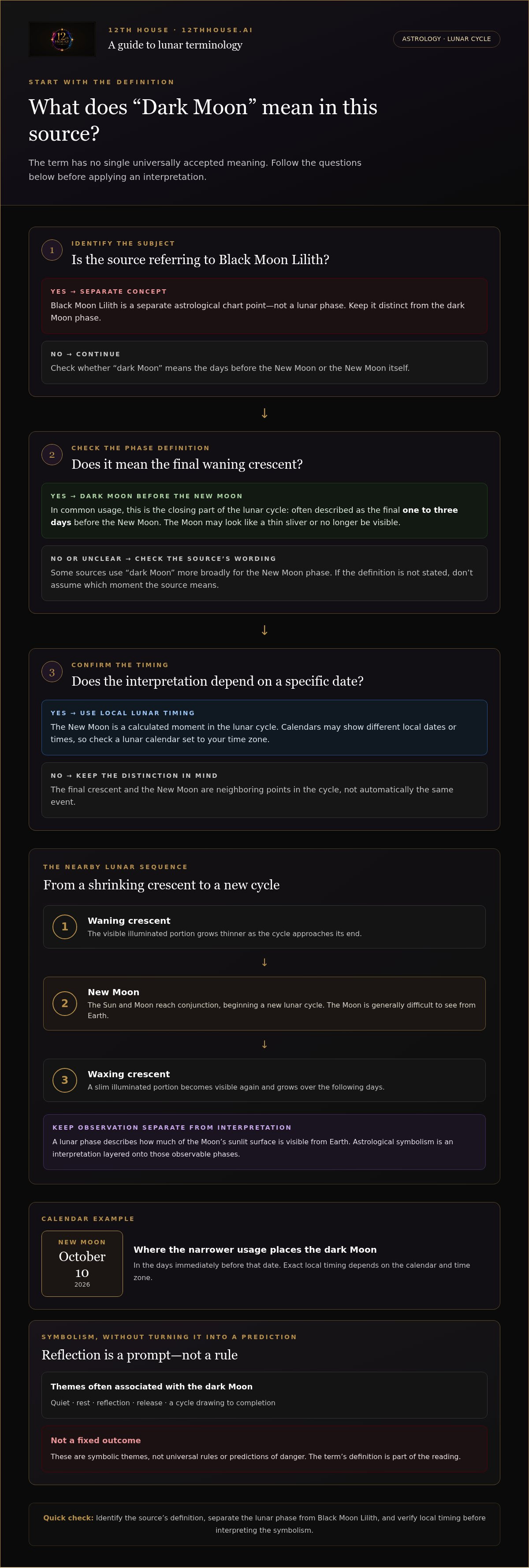
The dark Moon often refers to the final waning crescent, when the Moon appears as a thin sliver or is no longer visible shortly before the New Moon. The phrase has no single universally accepted meaning in astrology. Some astrologers use it for this closing stretch of the lunar cycle; others apply it more broadly to the New Moon phase itself.
In astrology, “dark Moon” is a variable term that can describe the waning crescent before the New Moon or, in some sources, the New Moon phase. That distinction matters when you’re reading an interpretation or following lunar timing. If you’ve wondered what is a dark moon in astrology, first identify how the source defines it rather than assume every astrologer means the same moment.
Keep two layers in view. Astronomically, a lunar phase describes how much of the Moon’s sunlit surface is visible from Earth. Astrological language adds interpretation to those observable phases, using them as a framework for reflection and meaning. “Dark Moon” belongs to that interpretive vocabulary; it is not a universally fixed technical phase name. The Dark Moon on Wikipedia also traces the term’s broader historical and cultural uses, helping explain its varied associations.
Does the dark Moon mean the same thing as the New Moon?
Not necessarily. In the narrower usage, the dark Moon is the last waning crescent before the exact New Moon, the point when the Sun and Moon meet at the same ecliptic longitude. The Moon may be difficult or impossible to see during this transition, so everyday descriptions can blur the days before the conjunction with the conjunction itself. A calendar, app, or astrologer may use “dark Moon” and “New Moon” differently. Check the source’s definition before applying its interpretation.
Why does dark Moon terminology vary?
Astrology draws on different traditions and interpretive systems, and they do not all use the same vocabulary. Some practitioners reserve “dark Moon” for the waning crescent; others use it as another name for the New Moon, when the Moon’s illuminated side faces away from Earth. A phase description tells you where the Moon is in its visible cycle. Symbolic meanings are interpretations layered onto that cycle, so the term can shift depending on the framework.
This variation doesn’t make the concept meaningless. It means the definition is part of the reading. Notice whether a source refers to a specific interval before the New Moon or to the New Moon moment, then follow its language consistently. That gives you a clearer basis for understanding the symbolism without mistaking different terminology for a contradiction.
How the Dark Moon Fits into the Lunar Cycle
To place the dark Moon in time, follow the transition from a shrinking crescent to the New Moon, then to the first visible crescent. The Moon doesn’t change shape. As it orbits Earth, we see different portions of its sunlit half. Astrologers may use visible phases as a symbolic framework, but phase and interpretation are distinct: illumination is observable, while meanings such as release or renewal belong to astrological practice.
Here’s the sequence most relevant to dark Moon timing:
- Waning crescent: The visible illuminated portion grows thinner as the cycle approaches its end.
- New Moon: The Sun and Moon reach conjunction, beginning a new lunar cycle. The Moon is generally difficult to see from Earth.
- Waxing crescent: A slim illuminated portion becomes visible again and grows over the following days.
In common usage, “dark Moon” points to the closing part of the waning cycle, often described as the final one to three days before the New Moon. For example, the New Moon in October 2026 occurs on October 10, so this usage places the dark Moon in the days immediately before that date. The exact local timing depends on the calendar and time zone.
What happens during the waning crescent?
During the waning crescent, the Moon’s visible lit portion diminishes night by night. Near the New Moon, the remaining crescent may be hard to spot, especially when it appears close to the Sun in the sky. Visibility depends on your location, when you look, the Moon’s position, and observing conditions such as the horizon and weather. Low visibility is an astronomical circumstance, not evidence of a particular spiritual effect.
When does the dark Moon occur in relation to the New Moon?
Think of the final crescent and the New Moon as neighboring points, not automatically the same event. The crescent is a visible phase before the conjunction; the New Moon is a calculated moment in the lunar cycle. Calendars may display dates and times for different locations, so use a lunar calendar set to your time zone when tracking a specific phase or planning a practice.
Once you know the timing, you can decide how much symbolic weight to give it. To connect lunar phases with your own chart rather than treat a calendar date as a prediction, astrology birth-chart and transit analysis can help you consider the broader context.
Dark Moon Symbolism: Reflection, Rest, and the Black Moon Confusion
In astrological interpretation, the dark Moon is often associated with quiet, reflection, release, and a cycle drawing to completion. These are symbolic themes, not universal rules. One person might use this interval to notice what feels finished; another may experience it as an ordinary day. The symbolism offers a language for inquiry, not a requirement to feel or act in a particular way.
Astrological symbolism offers a lens for reflection, not a fixed prediction of what will happen. That distinction keeps the dark Moon from becoming a forecast of loss or danger. A symbolic association can prompt a useful question, such as “What am I ready to set down?” It can’t establish that an ending is inevitable or that a specific event will occur.
Separate observation from conclusion. You might notice that you feel quieter during this part of the lunar cycle, then consider what else is happening in your life, from workload to relationships. That personal meaning can be useful without treating the Moon as the proven cause of your mood. Astrology can serve as a framework for examining experience rather than a system of guaranteed outcomes.
Is the dark Moon a negative or dangerous astrological sign?
No. Dark Moon symbolism isn’t inherently a warning or prediction of misfortune. Reduced visibility and the closing of a cycle can suggest retreat, rest, and review, but those images don’t make the phase dangerous. You don’t need to perform a ritual or take protective action. If the symbolism resonates, use it as an invitation to reflect; if it doesn’t, leave it aside.
Dark Moon and Black Moon Lilith are not interchangeable
Black Moon Lilith isn’t a lunar phase or a physical moon. It’s a calculated point in an astrological chart associated with the Moon’s apogee, the farthest point in its orbit from Earth. Astrologers may interpret it through themes such as instinct, autonomy, or shadow material. Because both terms include “Moon,” searches can mix them up, and some astrologers use “dark Moon” for Lilith. Check the context: a phase refers to lunar timing, while Black Moon Lilith is a chart point.
This distinction keeps the symbolism in perspective. A dark Moon interpretation concerns how someone reads a phase or interval in the lunar cycle. A Black Moon Lilith interpretation concerns the placement of a calculated point in a birth chart. Neither label, by itself, establishes a fixed character trait or determines an outcome. Treat the language as a starting point for questions, then consider the broader chart and lived context before drawing meaning.
How to Work with Dark Moon Astrology in a Grounded Way
Use the dark Moon as a prompt for observation, not a timetable that dictates what you should feel or do. First identify the lunar phase and how your calendar defines it. Then note what’s happening in your life, reflect on what stands out, and avoid turning an impression into a fixed prediction. This keeps the symbolism connected to experience without treating it as proof of cause or outcome.
For a clear starting point, follow these steps:
- Identify the phase. Check a lunar calendar and note the date, time zone, and whether the source means the waning crescent or the New Moon.
- Record your context. Note relevant circumstances, such as your energy, responsibilities, or a change already underway.
- Reflect without forcing an answer. Write about what feels complete, unresolved, or ready for quieter attention.
- Keep conclusions open. Treat any insight as a question to revisit, not an instruction or guaranteed forecast.
A simple dark Moon reflection practice
Keep the practice small. Record the lunar date and phase, then describe what you’ve observed in your mood, attention, or surroundings without assuming the Moon caused it. Ask: What feels complete? What remains unresolved? Where might rest or quieter attention help? You don’t need to reach a profound conclusion. Use your notes as prompts for reflection, not rules for making decisions.
Rituals are optional. You might spend a few quiet minutes, write in a journal, or pause to review the week. These are personal practices, not required interventions, and they can’t guarantee a particular outcome. If a ritual feels pressured or out of step with your needs, leave it aside.
How to add birth-chart context without overclaiming
Some astrologers interpret a lunar phase alongside current transits and natal placements, considering which parts of a birth chart are involved. This can add a personal layer to broad symbolism, but context changes an interpretation rather than proving what will happen. If you’re exploring birth chart basics, focus on how chart factors are read together, not on treating one placement as a complete explanation of your experience.
To explore the symbolism in your own chart, use astrology birth-chart and transit analysis to ask more specific questions. Ask Lala, 12th House’s AI spiritual guidance assistant, can also help you explore questions about astrology and chart symbolism. Keep your own judgment in the process; a chart reading can inform reflection without replacing it.
Explore your astrology chart and transit symbolism to bring lunar timing into a broader personal context.
Explore Dark Moon Meaning Through Your Personal Astrology
General symbolism gives you a starting point. Your birth chart offers a wider map for considering why a lunar phase feels relevant, or why it doesn’t. Rather than asking the Moon to supply a single answer, consider how its timing fits within the astrological framework you’re using and the circumstances you’re actually living through.
If you’re still asking what is a dark moon in astrology for you personally, begin by identifying the phase and the definition behind it. Then consider what questions the symbolism raises. A personal interpretation is a way to organize reflection, not a verdict about your character or a forecast of events.
What personal chart context can add
Astrologers may examine a lunar transit in relation to natal placements, including the Moon’s position and the houses or planets involved. Interpretive approaches differ, so there isn’t one universal reading. Birth-chart and transit analysis can help situate lunar symbolism in a broader pattern without promising a revelation or a specific outcome.
Use questions to keep the interpretation open:
- Which definition of “dark Moon” am I using: the final waning interval or the New Moon moment?
- What does this phase symbolize within my chosen astrological framework?
- Does the symbolism connect with something I’m already noticing, or am I trying to force a connection?
- What other chart factors or life circumstances might add context?
These questions help separate symbolic language from assumptions about what must happen. For example, a theme of completion might prompt you to review a project that’s already winding down. It doesn’t prove that the project will end or tell you what decision to make. Weigh the interpretation alongside your observations, values, and practical circumstances.
Use guided questions to deepen your interpretation
Ask Lala AI Spiritual Guidance can help you explore questions about astrology and chart symbolism. You can also use the metaphysical library for continued self-guided learning. Treat both as supports for inquiry: compare ideas, note which framework an interpretation draws from, and decide what feels useful without handing over your judgment.
Astrology Birth Chart & Transit Analysis offers a way to explore lunar timing in personal chart context. Use it to consider how a transit is interpreted alongside natal placements, while leaving room for uncertainty and individual meaning. The goal is not to turn a phase into a command, but to build a clearer map for reflection.
If you’d like to continue exploring, take a look at 12th House’s astrology tools and follow the questions that feel relevant to your own chart.
Let Curiosity Shape Your Next Step
Choose one question to carry forward: What am I noticing, and what meaning do I want to explore? Your answer doesn’t need to become a prediction or a decision. Let it be a thread you can follow with curiosity, returning to it as your perspective develops.
Understanding what is a dark moon in astrology can open a wider inquiry into how symbolic timing meets personal experience. Astrology birth-chart and transit analysis can help you explore that context, while Ask Lala AI Spiritual Guidance offers a way to consider questions about chart symbolism. The metaphysical library supports self-guided learning as you deepen your understanding at your own pace.
Explore 12th House’s astrology tools and choose a thoughtful next step for your own study. Let your questions lead, and keep the interpretation yours.
Frequently Asked Questions
Is the dark Moon the same as the New Moon?
Not always. Some sources use “dark Moon” for the closing crescent before the New Moon, while others use it for the New Moon itself. An astrology calendar might label a date “dark Moon” without specifying whether it means the full interval or the exact conjunction. If you’re asking what is a dark moon in astrology, check the source’s terminology before comparing dates or interpretations.
When does the dark Moon happen in the lunar cycle?
It’s commonly placed in the final part of the waning cycle, just before the New Moon. The exact timing shifts with each lunar cycle, and the New Moon’s clock time falls on different local dates depending on your time zone. Use a lunar calendar set to your location for the conjunction, then consult its phase display or observe the sky for the preceding crescent.
Does a dark Moon have a special meaning in a birth chart?
Usually, “dark Moon” describes lunar timing rather than a permanent point or placement in a natal chart. An astrologer might consider the Moon’s phase at birth or a current lunar transit alongside other chart factors. Interpretations vary, so avoid treating one phase as a complete personality description. Note it as one factor to explore, then compare it with the rest of the chart.
Can the dark Moon affect your mood or energy?
Astrology doesn’t establish that the dark Moon causes a particular mood or energy level. If you’re curious about a possible personal pattern, keep a brief log of your mood, sleep, attention, and daily circumstances across several lunar cycles. Look for observations rather than a conclusion you expect to find. A demanding week, for instance, may offer relevant context for feeling tired regardless of the lunar phase.
What is the difference between the dark Moon and Black Moon Lilith?
They refer to different astrological concepts. “Dark Moon” commonly names a phase or interval near the end of the waning cycle. Black Moon Lilith is a calculated point used in some chart systems, not a visible lunar phase. If a chart app lists Lilith among placements, it’s showing a chart point, not the Moon’s current illumination. Similar wording can make search results confusing.
What can you do during a dark Moon?
You can journal, pause for quiet reflection, observe the sky, or do nothing special. If you choose to write, note one unfinished matter, one thing that feels complete, and what you’d like to revisit later. These prompts don’t require a ritual or a particular belief. Keep any insight as a personal reflection, and make decisions based on your circumstances rather than expecting the lunar phase to guarantee an outcome.


