

What if a relationship had its own astrological map, separate from either person’s birth chart? That’s the idea behind a composite chart. If the term sounds technical, or you’re unsure how it differs from synastry, you’re not alone. So, what is a composite chart in astrology? It’s a symbolic chart for the relationship itself, created by calculating the midpoints between corresponding placements in two people’s natal charts.
A composite chart doesn’t replace either person’s chart, and it isn’t a compatibility score or a fixed verdict on whether a relationship will last. It offers another lens for exploring a partnership’s shared identity, recurring patterns, strengths, and areas that may call for attention.
This guide explains how astrologers construct a composite chart and how to read its main placements, including planets, houses, and aspects. You’ll also learn how it differs from synastry, when it can be useful, and where its limits lie. Use it as a framework for reflection, not as a prediction that overrides what you know and experience in the relationship.
Key Takeaways
- Understand what is a composite chart in astrology and how midpoint placements symbolically map a relationship as a shared dynamic.
- Follow a grounded reading order, from the chart’s overall emphasis to its luminaries, personal planets, houses, and aspects.
- Use synastry to explore how two people affect each other, and a composite chart to examine the relationship’s shared pattern.
- Interpret placements in context rather than treating any single factor as a label or prediction.
- Turn chart themes into reflection: compare them with lived experience, then use them to open an honest conversation.
What Is a Composite Chart in Astrology? The Relationship as a Third Entity
What is a composite chart in astrology? It’s a chart that symbolically represents a relationship through calculated midpoint placements drawn from two people’s natal charts. Unlike an individual birth chart, which maps one person’s placements, a composite chart maps a shared relationship dynamic. Astrologers read it alongside both natal charts, not as a replacement for either one.
The word “composite” describes how the chart is assembled: corresponding points from two charts are combined to create one set of placements. The midpoint concept is central to this method; Midpoint (astrology) offers background on how astrologers understand the halfway point between two positions. The resulting chart gives astrologers a framework for exploring themes that may arise between people, rather than measuring how well they match.
People consult a composite chart to consider what repeatedly shapes a connection. It can help them reflect on shared strengths, recurring tensions, or the atmosphere they tend to create together. Treat those themes as questions to investigate, not proof that the relationship has a particular nature. A chart can suggest a lens, while the people in the relationship bring the lived experience that gives it meaning.
What does a composite chart represent?
Astrologers sometimes describe the relationship as a “third entity.” This is a metaphor for the connection between two people, not a claim that the relationship is a literal person with its own independent will. The chart’s placements offer symbolic prompts for examining how that connection feels and functions. Consider them hypotheses to compare with real conversations and choices.
Illustrative example: A couple might use a chart theme associated with communication to reflect on how they handle difficult discussions. Do they talk things through and feel closer, or avoid important subjects? The symbolism doesn’t settle the answer. It gives them a focused starting point for noticing a pattern and discussing what actually happens.
Who might use a composite relationship chart?
Romantic partners may explore a composite chart when they want to understand recurring patterns in their relationship, rather than receive a simple compatibility judgment. The same reflective framework can prompt questions about other close relationships, such as a friendship or significant creative partnership. It’s most useful when the people involved are curious about their shared dynamic and willing to compare astrological ideas with experience.
You don’t need to know technical astrology before you begin. Start with the basic distinction: a natal chart describes one person’s symbolic map, while a composite chart describes the relationship formed by two people. If an unfamiliar placement or term appears, treat it as a prompt: ask what theme it might represent, then look for examples in the relationship. The aim is clearer understanding, not a prediction or a verdict on whether the connection should continue.
How Is a Composite Chart Calculated? Understanding the Midpoint Method
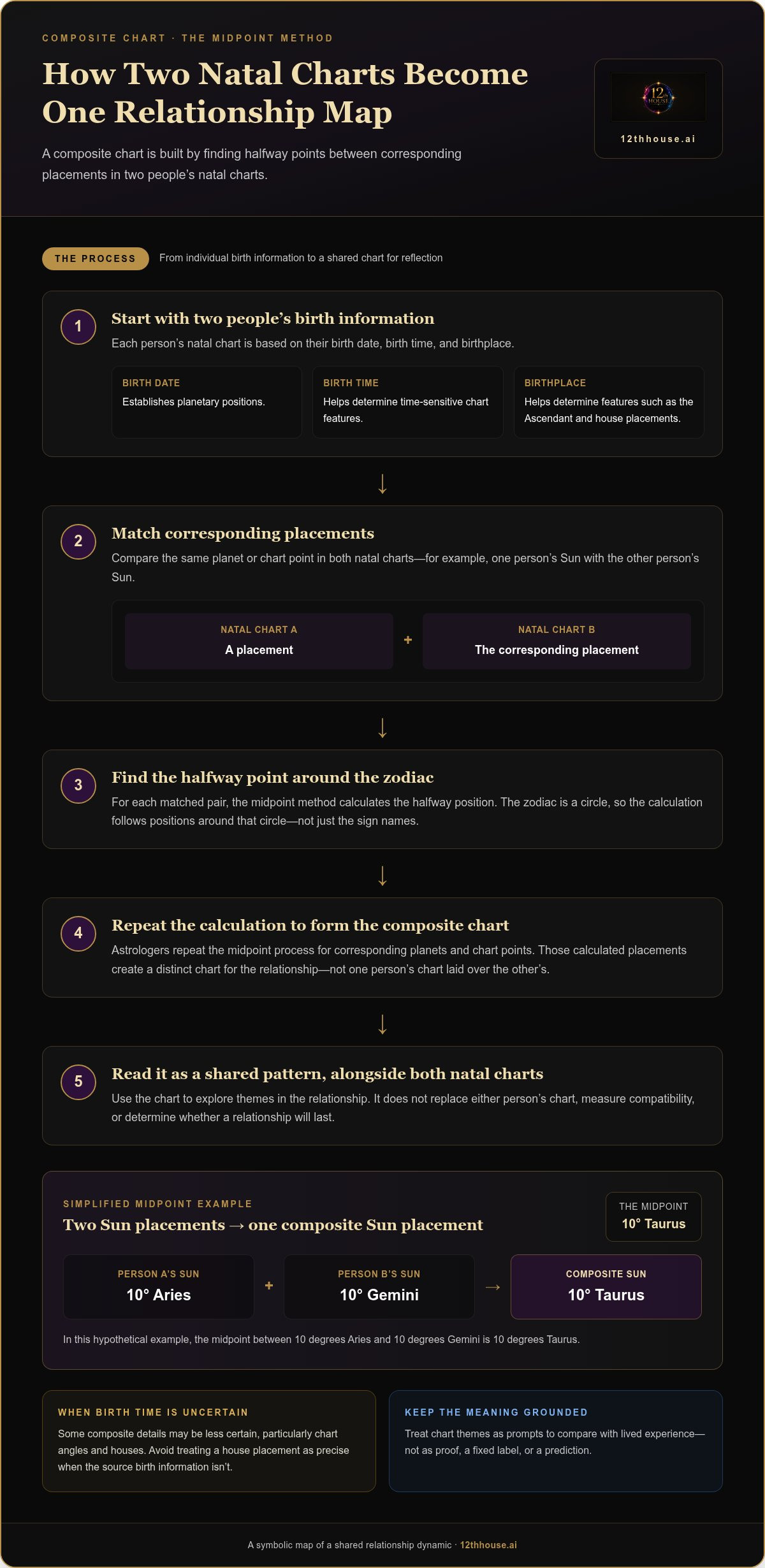
The common method for creating a composite chart is the midpoint method. An astrologer compares corresponding placements in two natal charts, then calculates the halfway point between each pair. The process is applied across the charts to form a new set of relationship placements. A composite chart derives its placements from two charts rather than describing either chart alone.
Think of it as a calculation built from two maps. The result isn’t simply one person’s chart laid over the other’s; the paired positions generate a distinct chart for interpretation. That’s the technical foundation behind what is a composite chart in astrology.
What birth information goes into a composite chart?
Each individual natal chart is based on that person’s birth date, birth time, and birthplace. The date establishes the planetary positions, while the time and location help determine time-sensitive chart features such as the Ascendant and house placements.
If a birth time is uncertain or approximate, some composite details may also be less certain, particularly those that depend on chart angles and houses. Avoid treating a calculated house placement as precise when the source birth information isn’t. The chart can still offer material for reflection, but its limits should remain part of the interpretation.
How does the midpoint method work in broad terms?
Hypothetical example: Imagine one person’s Sun is at 10 degrees Aries and the other person’s Sun is at 10 degrees Gemini. The midpoint along the zodiac is 10 degrees Taurus, so that becomes the composite Sun position in this simplified example. A degree is a position within a zodiac sign; you don’t need to calculate it yourself to understand the principle.
Astrologers repeat this process for corresponding planets and chart points. The zodiac is a circle, not a straight line, so sign boundaries can make a midpoint less intuitive: positions near the end of one sign and the beginning of another may be close together along the circle. The calculation follows their positions around the zodiac, not just the sign names.
Why can calculation methods or chart settings matter?
Different chart settings and calculation conventions can affect some chart details. The midpoint composite is also distinct from a Davison relationship chart. Rather than finding midpoints between corresponding planetary placements, the Davison method calculates a chart for the midpoint in time and location between two births. It’s a separate approach, not another name for the midpoint composite.
When comparing interpretations, note which method produced the chart and whether either birth time is approximate. That context can help explain why chart details differ without turning the difference into a contradiction. If a placement raises questions, Lala’s personalized astrology guidance can help you explore chart symbolism and relationship patterns as part of your own reflection.
How to Read a Composite Chart: Start With Its Core Relationship Pattern
Read a composite chart in sequence rather than searching for one placement that explains everything. If you’re learning what is a composite chart in astrology, start with the chart’s overall emphasis, then look more closely at individual placements and how they interact. A composite chart is an interacting system, so each placement gains meaning from the others around it.
- Notice the chart emphasis. Look for repeated sign or house themes, or a cluster of planets in one area. This offers an initial sense of what may draw attention in the relationship’s shared pattern.
- Consider the Sun and Moon. Read them as symbolic lenses on shared direction and emotional rhythms, not fixed descriptions of what either person feels.
- Explore the personal planets. Mercury, Venus, and Mars can prompt questions about communication, affection, and initiative within the connection.
- Read the houses. They suggest areas of life where chart themes may become more noticeable.
- Look at aspects. These are the geometric relationships between placements. They can add ease, friction, or complexity to a planet’s symbolism.
What can the composite Sun and Moon symbolize?
The composite Sun can offer a lens on the relationship’s shared identity or direction: what the connection seems to organize itself around. The Moon can offer a lens on emotional rhythms and shared needs, such as the conditions that help the relationship feel supported. Neither placement is inherently positive or negative. Treat both as prompts to investigate, then compare the symbolism with what you actually experience together.
How do houses and aspects add context?
Houses locate themes in areas of life, such as communication, home, or shared goals. Aspects show how placements relate and may modify how their symbolism is expressed. Illustrative example: A composite Mercury in a communication-focused house might invite reflection on how the pair exchanges ideas. If Mercury also forms a tense aspect with another planet, that may raise questions about misunderstandings or competing priorities. This is a starting point, not a complete interpretation; the rest of the chart matters too.
What should beginners avoid when interpreting placements?
Don’t treat one challenging aspect as proof of incompatibility or failure. A sign stereotype is no substitute for considering the planets, houses, and aspects together. Astrology describes symbolic patterns, not what a partner must feel, intend, or do. Ask open questions instead: Where does this theme appear in our experience? Does it fit consistently, or only in certain situations? What other chart factors might complicate the picture? This keeps interpretation curious and grounded, rather than turning a placement into a fixed label for the relationship or either person.
Composite Chart vs. Synastry: Which Relationship Question Does Each Answer?
Are you trying to understand how two people affect each other, or to step back and consider the relationship as a whole? Synastry and composite astrology offer different lenses. Synastry compares two natal charts to explore how their placements interact. A composite chart maps the relationship as a combined chart. If you’re asking what is a composite chart in astrology, this distinction is central: one approach focuses on the exchange between individuals; the other explores patterns in the connection they form.
| Method | Chart inputs | Central focus | Question it explores |
|---|---|---|---|
| Synastry | Two individual natal charts | Interactions between people’s chart placements | How might our individual patterns affect one another? |
| Composite astrology | A combined relationship chart derived from two natal charts | Recurring themes in the relationship as a shared system | What patterns seem to characterize this connection? |
When is synastry the more relevant lens?
Use synastry when you want to consider the dynamic between two distinct people. It can prompt questions such as: How do our communication styles meet? Where might our needs differ? What kinds of exchanges feel supportive or challenging? These are questions for reflection, not conclusions about what either person will do. Synastry keeps the focus on interaction while recognizing that each person brings a full, individual chart and personal agency.
When might a composite chart add another perspective?
A composite chart may be useful when you’ve considered each person’s chart and want to look at the relationship’s recurring themes as a shared pattern. It doesn’t replace synastry; it shifts the frame from “How do we affect each other?” to “What characterizes this connection?” For a broader introduction to interpreting two people’s charts together, explore this guide to birth chart compatibility.
The two methods can complement one another. For instance, synastry might help you reflect on contrasting ways of expressing needs, while a composite chart can invite questions about how that contrast plays out in the relationship overall. Keep both interpretations open to revision. Choose the lens that fits your question, rather than looking for one chart to deliver a final score.
What can neither chart establish?
Neither method can objectively rank compatibility or determine a relationship’s fate. Astrology can’t establish consent, prove trust, or reveal another person’s intentions. It also can’t replace direct communication, lived experience, or your own judgment. A symbolic interpretation may suggest a theme worth exploring, but it isn’t an empirical diagnosis or evidence about someone’s character.
Use a chart to form a thoughtful question, then compare that question with what you observe and discuss together. If you want to explore chart symbolism or relationship patterns further, ask Lala a personalized astrology question.
Use a Composite Chart as a Reflection Tool, Not a Relationship Verdict
A composite chart is most useful when it helps you notice a pattern, not when it tells you what decision to make. If you’re asking what is a composite chart in astrology, keep its role clear: it’s a symbolic framework for reflection, not an authority over your relationship. It can’t decide whether you should stay together, establish what someone intends, or override your boundaries. Your experience and judgment remain essential.
Try this simple sequence:
- Identify a theme. Choose one chart placement or pattern that catches your attention.
- Compare it with experience. Ask where the idea fits your shared life, and where it doesn’t. Look for observable examples rather than searching for proof.
- Discuss it openly. Share the theme as a question, not a verdict. Listen to how the other person understands the pattern.
Turn chart symbolism into useful questions
Replace “What will happen?” with “What do we notice?” You might ask, “Where does this theme show up in how we make decisions?” or “Does this placement resonate in everyday life, or not?” Open questions make room for nuance. A symbol can offer a useful prompt, but a mismatch is meaningful too. Don’t force lived experience to fit an interpretation.
Bring personal context into chart exploration
The same symbolic idea can feel different depending on each person’s circumstances, history, and choices. Separate an interpretation from a fact about your partner: “This placement makes me wonder about how we handle change” invites reflection; “This proves you avoid change” assigns a fixed trait. For more context on personalized chart exploration, read this AI astrology assistant guide.
Keep boundaries clear. Astrology shouldn’t be used to diagnose someone, excuse harmful behavior, or pressure a person to accept a situation that feels wrong. A chart can’t establish consent or trust. Those depend on real actions, communication, and respect. Let symbolism support inquiry, never replace the evidence of your own experience.
Continue exploring with personalized questions
If a chart theme leaves you curious, make the question specific. Ask what a placement may symbolize in a composite chart, how it might connect with another chart factor, or what reflective questions could help you explore a recurring relationship pattern. Lala, 12th House’s AI assistant, can answer personalized questions about charts and compatibility. Treat its insights as material for consideration, not a definitive relationship answer.
Keep learning at your own pace, and bring each interpretation back to what you actually observe. Explore 12th House for personalized astrology questions and self-guided metaphysical learning.
Let Your Next Question Guide the Exploration
The most useful answer to “what is a composite chart in astrology” may be a better question about your own experience. Choose one relationship pattern you’re curious about, notice when it appears, and stay open to what your observations reveal. Let the symbolism widen your perspective, not narrow your choices.
If you want to explore a chart theme in more depth, 12th House offers astrology chart and transit analysis, while Lala can respond to personalized questions about chart symbolism and compatibility. You might ask how a particular placement is commonly interpreted, or what questions could help you reflect on a recurring dynamic. Keep your lived experience at the center as you consider any interpretation.
Explore 12th House and continue your chart inquiry. Take the next step with curiosity, and let insight support your own thoughtful judgment.
Frequently Asked Questions
Is a composite chart the same as a synastry chart?
No. They’re different ways to explore relationship astrology, and astrologers may use both. If you’re asking what is a composite chart in astrology, it’s the relationship-focused framework; synastry looks at connections between the two individual charts. For example, if communication feels difficult, synastry can prompt reflection on each person’s style, while a composite reading may raise questions about communication as a shared theme. Neither method ranks partners or settles compatibility.
Can you make a composite chart for friends or business partners?
Yes. Astrologers may apply composite-chart techniques to close friendships or business partnerships as well as romantic relationships. Start with a clear question about the connection, such as what helps a collaboration stay productive. Treat any interpretation as a prompt for discussion, not evidence of a partner’s intentions, competence, or future decisions. In a work setting, use direct communication and observed actions to assess responsibilities and trust.
Does a composite chart predict whether a relationship will last?
No. A composite chart can’t reliably establish whether a relationship will continue, because symbolic interpretation doesn’t determine future events or another person’s choices. If a reading raises a concern, look at what’s happening in the relationship now: Are agreements being kept? Can you discuss difficult subjects? Do your needs and boundaries receive respect? Use those observations and honest conversations to guide decisions, rather than treating a chart as a forecast.
Does the exact birth time matter for a composite chart?
It can, especially for chart features that depend on birth time, such as angles and houses. If a time comes from memory or an estimate, mark it as uncertain rather than reading those placements as exact. When comparing interpretations, record each person’s birth-time source and note which chart features depend on it. This keeps uncertainty visible and helps you distinguish a change in the data from a change in interpretation.
Can a composite chart show who is more invested in the relationship?
No. A composite chart describes relationship symbolism, not a measurement of either person’s feelings or level of commitment. It can’t establish who cares more or explain someone’s motives. If you’re unsure where you stand, ask directly what commitment means to each of you, then compare the answers with consistent actions. Use astrology to find language for reflection, not to make accusations or draw conclusions on someone else’s behalf.
What is the difference between a composite chart and a Davison chart?
They’re separate relationship-chart methods, so their chart details and interpretations may differ. A composite chart commonly uses midpoints between corresponding placements in two natal charts; a Davison chart is calculated from a midpoint in time and location between the births. If two readings seem to disagree, first identify which method each uses and whether the underlying birth details match. Neither method offers a definitive forecast or a final judgment about the relationship.


