

What if a dream about your ex says more about your life now than about the relationship you left behind? If you’re asking, “what does my dream about my ex mean,” you may be wondering whether old feelings remain, whether your ex will return, or whether you should reach out. A dream isn’t proof of a destined reunion or an instruction to make contact.
Even when you feel fully moved on, an ex can appear as a symbol of an emotion, a past chapter, or a pattern that feels relevant now. The dream may leave you unsettled, nostalgic, or simply puzzled. Notice those reactions without assuming they require action.
This guide will help you separate emotional reflection from prediction and consider what a dream may connect to in your current circumstances. The setting, your ex’s role, and your feelings can all offer clues. Use them to form possibilities, not a fixed verdict, and check whether an interpretation fits your own experience.
Key Takeaways
- To explore “what does my dream about my ex mean,” start with the emotion the dream left behind and what it brings up in your life now.
- Separate the dream’s events, your feelings within it, and your waking-life context instead of treating symbols as fixed answers.
- Compare scenes such as an argument, reunion, apology, or everyday conversation with current situations that may echo their emotional themes.
- Record the details, name your emotions, and notice your personal associations before deciding whether the dream has practical significance.
- Use 12th House’s Dream Interpretation Tool or Lala AI as optional supports for organizing reflection, not as sources of certainty or prediction.
What Does a Dream About Your Ex Mean? Start With the Emotion, Not a Prediction
If you’re asking, “what does my dream about my ex mean,” start with what the person represents in the dream, rather than trying to forecast your future. An ex may bring memories, emotions, or relationship themes into focus. They might represent a time when you felt secure, a pattern you’re reconsidering, or a need that feels present in your life now. The dream alone can’t establish that you still love them or that you’ll reunite.
Pay attention to the emotional sequence. Were you relieved when you saw your ex, uneasy during a conversation, or sad after waking? Feelings in the dream can point toward what your mind is revisiting; feelings after waking can show what still has emotional weight. Neither is a verdict. A warm dream might bring up comfort or nostalgia, while an upsetting one may connect to a boundary or hurt you’re still processing.
Dream interpretation is personal reflection on remembered images and emotions, not a reliable prediction or a universal code with one meaning for everyone. The long history of Dream Interpretation includes different traditions and theories. That range is a reminder to treat interpretations as possibilities and compare them with your own experience.
Does dreaming about an ex mean you still have feelings?
Not necessarily. A dream can feature someone who mattered without showing that you want them back. Ask what you miss, if anything: the person as they are, or the familiarity, belonging, affection, or life stage associated with the relationship? Those are different forms of longing. Compare the dream’s emotion with how you feel while awake. If you feel settled and uninterested in reconnecting, the dream doesn’t cancel that clarity.
Why can an ex appear even when you have moved on?
Moving on doesn’t erase memory. A familiar person may surface after a reminder, during stress, or while you’re navigating a relationship theme that echoes the past. These are possibilities, not fixed causes. For instance, a dream about an ex who dismissed your needs might come to mind when you’re practicing speaking up in a current relationship. The useful question is what feels active now, not what a dream dictionary assigns to that person.
To look for a connection, note the strongest emotion and ask what recent situation carries a similar feeling. You don’t need to search for a hidden message or take immediate action. Let the dream open a line of inquiry, then check whether your interpretation fits your present circumstances. If it doesn’t, set it aside. Your own context is the best frame for exploring it.
How to Interpret a Dream About Your Ex Without Treating It as a Sign
Use the dream as material for reflection, not as a code that guarantees one correct answer. Dream interpretation has a long history, but a symbolic reading isn’t scientific proof of what you feel, what your ex thinks, or what will happen next. If you’re wondering “what does my dream about my ex mean,” separate what happened in the dream from the emotion you remember and the circumstances you’re living through now.
A dream can offer a prompt for self-reflection, but it can’t reveal an ex-partner’s private thoughts or establish your future. That boundary matters, especially when a dream feels vivid or emotionally charged. You can take its imagery seriously without treating it as an instruction. Notice what it brings to mind, then decide whether that association fits your waking experience.
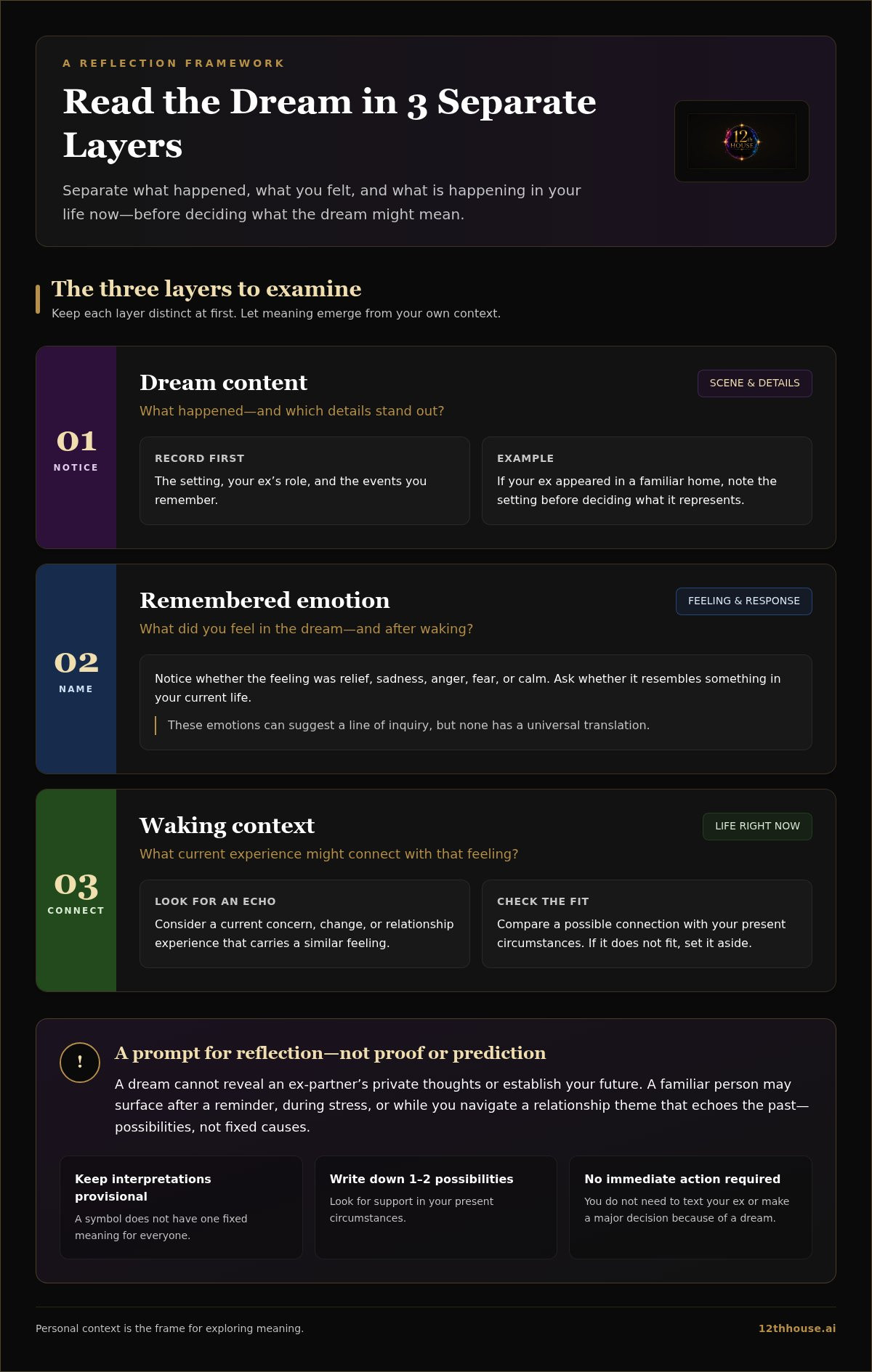
Try mapping the dream across three layers:
- Dream content: What happened, and which details stand out?
- Remembered emotion: What did you feel in the dream, and what lingered after waking?
- Waking context: What current concern, change, or relationship experience might connect with that feeling?
Keep the layers distinct at first. If your ex appeared in a familiar home, record the setting before deciding what it represents. Then ask what that home means to you and whether it connects to anything happening now. This helps slow the jump from image to conclusion.
What the dream emotion can help you notice
Relief, sadness, anger, fear, or calm can each suggest a different line of inquiry, but none has a universal translation. Ask whether the feeling resembles an experience in your current life. Relief might connect with a recent decision; anger could echo a present boundary concern. These are questions, not diagnoses. A single dream can’t establish an attachment pattern or determine your mental health.
How dream symbols depend on personal context
A location, object, or conversation doesn’t carry one fixed meaning for everyone. A train station might suggest transition to one person and an ordinary memory to another. Ask, “What does this detail mean to me?” Consider your own memories and associations before consulting generic symbol lists. Spiritual language can help frame that inquiry, as long as reflection stays distinct from claims of proof, fate, or prediction.
Let an interpretation remain provisional. Write down one or two possible connections, then look for support in your present circumstances. You don’t need to text your ex, change a relationship, or make a major decision because of a dream. If a structured prompt would help you sort remembered details, use 12th House’s Dream Interpretation Tool as a reflection aid, not a final authority.
Common Dreams About an Ex: Compare the Scene With Your Current Life
A dream scene gives you material to examine, not a ready-made interpretation. Reunion can feel comforting to one person and unsettling to another. The difference may lie in relationship history, the emotion in the dream, or what’s happening now. If you’re asking, “what does my dream about my ex mean,” use these questions to connect the scene with your own associations rather than assign it a fixed meaning.
- You reunite: What feels appealing: this person, a familiar kind of closeness, or a change you wish you could revisit?
- You argue: Does the tension resemble a current disagreement, or does it recall a past hurt?
- Your ex apologizes: What would being heard or acknowledged mean to you now?
- Your ex is with someone new: Did you feel jealousy, relief, indifference, or surprise, and where else does that emotion appear?
- You have an ordinary conversation: What did you discuss, and does its subject connect to a present concern?
Dreaming that you reunite, argue, or receive an apology
A reunion may invite you to examine longing, personal change, or a question that still feels unfinished. It doesn’t establish that you should try again. An argument could echo tension, but it can also replay a familiar dynamic without confirming that conflict remains unresolved. If your ex apologizes, consider what recognition would mean to you. The scene reflects your experience; it can’t verify that your ex regrets anything.
Let the details shape your first impression. In a reunion dream, do you feel at ease, or are you trying to convince yourself the relationship is different? In an argument, can you speak freely, or do you fall into an old role? An apology may bring relief, frustration, or doubt. Each response offers a distinct question, not a universal answer.
Dreaming your ex has moved on or appears in everyday life
Seeing an ex with someone new can stir jealousy, but it may also leave you calm or even relieved. Notice your actual reaction before deciding what it means. An everyday scene, such as sharing a meal or discussing errands, may draw on a familiar memory or touch a relationship theme in your current life. It doesn’t forecast your ex’s relationship status or future choices.
A vivid dream can feel like a message, and a recurring one can make that feeling stronger. Neither vividness nor repetition proves you’re meant to reconnect. If the same scene returns, compare what changes: your emotional response, your role, or what’s happening around you. Recurrence can be a reason to reflect on what remains important to you, not an instruction to contact your ex. Keep the focus on what the scene may bring up about your current concerns.
What to Do After Dreaming About Your Ex: Reflection Process
Give the dream some structure before giving it a verdict. A short record can preserve details that fade quickly and help separate what you remember from the story you build around it. If you’re asking “what does my dream about my ex mean,” work through these steps slowly. The goal is to notice a possible connection with your present life, not to decode a command.
- Record the scene. Note who was there, where you were, what was said, and which detail stayed with you. Describe the dream plainly before adding an interpretation.
- Name the emotion. Choose words that fit, such as relief, grief, irritation, fear, warmth, or confusion. If your feelings changed during the dream, record that shift too.
- Notice associations. Ask what the people, setting, or words bring to mind for you. Add recent reminders or current events as context, not as proven causes.
- Connect it to the present. Consider whether the emotion points toward a current need, boundary, or question. Keep more than one explanation open if the connection isn’t clear.
Record the dream before assigning it meaning
Keep observation and interpretation in separate notes. “We spoke in the kitchen” describes the dream; “I want them back” is a conclusion added after waking. That conclusion may or may not fit. This distinction is useful when a dream feels vivid, because intensity can make an interpretation seem certain before you’ve examined the details.
Then ask what the relationship represents in your life today. Does the dream bring up a need for reassurance, a boundary you’re trying to hold, or an unanswered question about how you want to be treated? You might connect the scene to a current situation without assuming the dream is literally about your ex. If your thoughts turn toward relationship guidance, a useful lens is AI Love Readings: A Professional Guide to Seeking Clarity, approached as reflection rather than proof.
Pause before contacting your ex solely because of a dream. First, consider whether reaching out fits your waking intentions and circumstances, independent of what happened while you were asleep. A dream can prompt a question, but it doesn’t decide what action is right for you.
If a theme returns, note it briefly and look for changes in your response or present-day context. You don’t need to track every dream or force a pattern; pause if recording starts to fuel anxiety. For a structured way to consider remembered details, use 12th House’s Dream Interpretation Tool as a reflection aid, not a fixed answer.
Explore Your Dream About an Ex With 12th House’s Reflection Tools
Once you’ve recorded the dream and considered its emotional tone, a framework can help you organize your thoughts. 12th House’s Dream Interpretation Tool lets you explore remembered details, while Lala AI responds to personalized spiritual questions. Use these tools to generate reflection, not to determine what your ex feels or what you should do next.
Use dream interpretation as a framework, not a verdict
Bring three things into your reflection: what happened in the dream, how it felt, and what’s happening in your life now. For example, a conversation with an ex might prompt you to consider whether you’re seeking closure, reassurance, or clearer communication in a current relationship. Treat any interpretation as a possibility. Keep what resonates, question what doesn’t, and leave room for more than one reading.
This approach also applies to spiritual guidance. The phrase The Digital Sage: Why an AI Astrology Assistant is Your New Metaphysical Architect captures a useful idea: technology can help structure inquiry, but it doesn’t replace your judgment. Lala AI offers personalized spiritual guidance, not certainty. You remain the person best placed to decide whether an interpretation fits your experience.
12th House’s metaphysical library offers books, videos, and ritual frameworks for self-guided learning. Use what you learn to expand your perspective, not override what you know about your history, boundaries, and current needs. No tool or framework can make a personal decision for you.
Choose a next step that supports your own clarity
You might journal about the dream, revisit your notes after some time has passed, or use the Dream Interpretation Tool to organize the details. Ask whether the reflection has clarified something about your present life. If it hasn’t, set it aside. A dream doesn’t obligate you to contact an ex, reopen a relationship, or take any particular action.
Curiosity is enough. You don’t need to force a message from the dream or find one definitive answer to “what does my dream about my ex mean.” Let your interpretation stay flexible, and trust your own assessment of what feels relevant. For a structured starting point, explore the Dream Interpretation Tool and consider its reflection alongside your own.
Let the Dream Become a Starting Point
You don’t have to solve the dream tonight. Let its questions sit with you, then notice whether your perspective changes as your circumstances do. The answer to “what does my dream about my ex mean” may become clearer through ongoing self-understanding, rather than through a single, final interpretation.
If you’d like a structured space to explore what you remember, explore your dream with 12th House’s reflection tools. Use what feels relevant, leave what doesn’t, and let your own judgment guide any next step. A dream can open a door to curiosity without deciding where you go. Trust yourself to choose the path forward.
Frequently Asked Questions
Is dreaming about my ex a sign that they miss me?
No. A dream can’t tell you what another person privately feels or intends. It may draw on your memories, emotions, or current relationship concerns, but it isn’t evidence that your ex is thinking about you. If the dream leaves you wanting reassurance, pause and separate that wish from what you actually know. Consider what you’d conclude about the relationship if you hadn’t had the dream.
Can dreaming about my ex mean I should contact them?
Not on its own. Before reaching out, identify what you hope contact will achieve, such as exchanging belongings, apologizing, or reopening a conversation. Then consider whether that goal respects both people’s boundaries and supports your wellbeing. If you can’t name a waking-life reason for contact beyond the dream, give yourself time before acting. A meaningful decision should still make sense after the dream’s emotional intensity has passed.
Why do I keep dreaming about my ex years later?
Recurring dreams can revisit a familiar person or relationship theme without proving that you want to reunite. Notice whether the dreams appear around a particular kind of change, such as starting a new role or facing a difficult conversation. Record only the details that stand out, rather than monitoring every night for a hidden pattern. If the dreams cause distress or interfere with sleep, consider discussing their impact with a qualified professional.
What does it mean if I dream my ex is with someone else?
The scene can’t confirm your ex’s current relationship status or predict their choices. Your response may offer a more useful starting point: jealousy might bring up comparison, while indifference could reflect how you feel now. Ask whether anything in your current life has made you think about being replaced, moving forward, or defining your own priorities. Treat that connection as a question to explore, not a fixed symbolic answer.
Does dreaming about an ex mean I have not moved on?
No single dream can measure your progress. An ex may appear in a dream even when you feel settled and have no wish to reconnect. Look instead at your day-to-day choices: whether you can maintain boundaries, invest in your present life, and respond to memories without feeling compelled to act. If one dream brings up a strong emotion, let that feeling pass before judging how far you’ve come.
What does it mean if I dream my ex apologizes to me?
An apology in a dream doesn’t show that your ex feels remorse or plans to make amends. It may prompt you to consider what accountability would mean to you now. For example, would you want an explanation, an acknowledgment of harm, or simply the confidence to trust your own account of what happened? You can explore that need without waiting for a real apology or treating the dream as a promise.
Should I worry if I dream about my ex while in a new relationship?
A dream alone doesn’t mean you’re being unfaithful, unhappy, or secretly planning to return to a former partner. People from earlier chapters can appear in dreams without defining present commitments. Ask whether something specific needs attention while you’re awake, such as a communication concern or a boundary you want to clarify. Respond to the real situation, not to the dream as a test of your loyalty.


