

If you’ve wondered “what does my birth chart say about my career,” you may be looking for clues that connect your strengths and values to real vocational options, not a job title dictated by one placement. Your birth chart doesn’t name your career, but it can offer a symbolic map for exploring what makes work feel meaningful.
It’s understandable to feel skeptical when astrology articles make a single planet or house sound like a career verdict. A birth chart is more layered than that. Its symbols become useful when you read them together and compare their themes with your actual preferences, skills, and experiences.
This guide explains the main chart factors linked to vocation, daily work, and resources, including the Midheaven and the 2nd, 6th, and 10th houses. You’ll learn how to combine placements without getting lost in technical details, and how to use them as prompts for reflection rather than predictions. Your chart can help you ask better questions about work. Your choices remain your own.
Key Takeaways
- Use the Midheaven, tenth house, and its ruling planet as connected clues to vocational themes, not as a fixed job-title formula.
- When asking “what does my birth chart say about my career,” compare several placements and test their themes against your skills, preferences, and lived experience.
- Turn chart observations into practical notes about recurring strengths, preferred work environments, and conditions that matter to you.
- Explore career-related chart questions through astrology birth chart and transit analysis, treating symbolic insights as prompts for reflection rather than predictions.
What your birth chart can, and cannot, say about your career
Can a chart reveal what kind of work might feel meaningful to you? It can offer a symbolic way to examine that question, but it can’t make the decision for you. A career reading interprets vocational themes across multiple natal chart factors, then considers how those themes might relate to your motivations, preferred ways of working, and relationship with resources. It’s a framework for inquiry, not a verdict.
In natal astrology, a birth chart is understood as a map of planetary positions at the time and place of birth. Astrological traditions use that map to explore personality and life themes. Asking “what does my birth chart say about my career” is therefore a question about symbolic interpretation, not a scientifically established way to predict a profession or guarantee an outcome.
A birth chart describes themes, not a fixed occupation
Chart symbolism may suggest preferences, motivations, and recurring work themes. For example, a pattern associated with communication could prompt you to consider whether teaching, writing, advising, or collaborative problem-solving feels engaging. That’s a clue to investigate, not a prediction that you’re destined for one of those jobs. People with similar placements can pursue very different careers because their interests, circumstances, and choices differ.
Hold each interpretation lightly. Ask whether it resonates with your experience, where it doesn’t, and what real examples support your view. A chart can help you notice a pattern, but it can’t establish your abilities or tell you what you must become.
Why career readings use more than one chart placement
Work has several dimensions. Vocation concerns direction and contribution; daily work involves routines and tasks; income relates to earning and resources. Astrologers consider different chart factors for these themes, then interpret how they connect. A sign label on its own leaves out the surrounding context, including the placement’s house and relationships with other parts of the chart.
This is why a single placement can’t carry the whole reading. One symbol may point toward visibility, while another adds a need for independence or steadiness. Read together, those themes create more useful questions than a job-title answer. If you’re new to chart structure, the natal chart guide can help clarify how placements form a connected system.
Keep the distinction between symbolic themes and lived conditions in view. Qualifications, financial needs, access to opportunities, caregiving responsibilities, health, and personal choice all shape what work is possible or desirable. A chart doesn’t measure those realities. Use its themes to generate questions, then compare them with your skills, values, and circumstances. The strongest reflection leaves room for both meaning and practical judgment.
The birth chart placements that illuminate career themes
To understand career symbolism, look beyond one sign. Astrologers often begin with the Midheaven and tenth house, then add factors connected with earning, daily responsibilities, and motivation. Together, these placements offer a layered view of how you might approach work, which conditions matter, and where you may want to direct your effort.
The Midheaven, tenth house, and their ruler
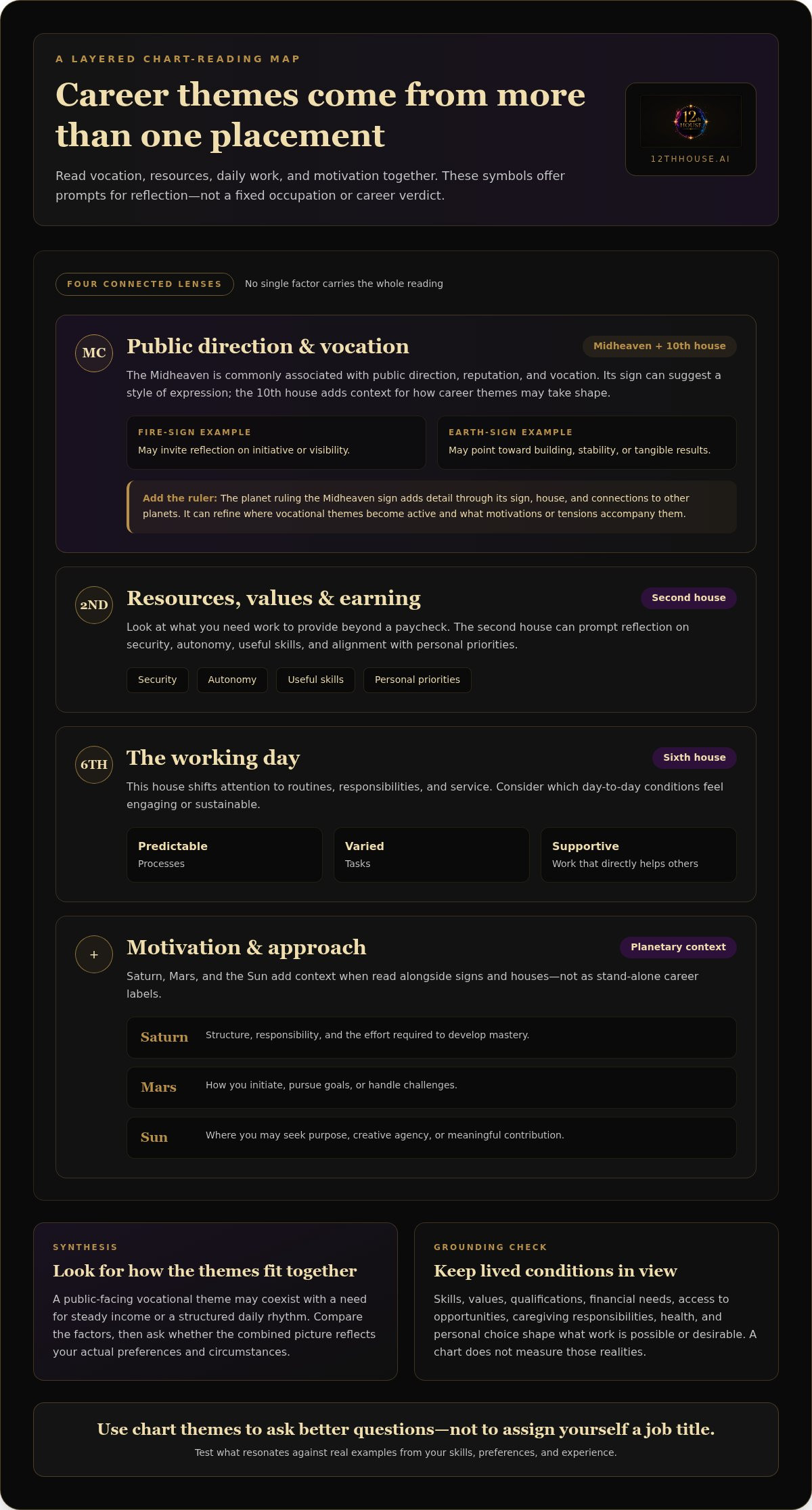
The Midheaven is a chart angle commonly associated with public direction, reputation, and vocation. Its sign can suggest a style of expression, while the tenth house provides context for how career themes may take shape. For example, a fire-sign Midheaven might invite reflection on initiative or visibility; an earth-sign Midheaven might point toward building, stability, or tangible results. Neither indicates one required profession.
Astrologers also examine the planet that rules the Midheaven sign. Its location by sign and house, along with its connections to other planets, can add detail about where vocational themes may become active and what motivations or tensions accompany them. For instance, a Midheaven associated with communication could be expressed through teaching, advocacy, or coordination, depending on the rest of the chart and the person’s experience. The ruler helps refine the question, not dictate the answer.
The second house, sixth house, and planetary motivation
The second house is often read for resources, values, and earning. In career reflection, consider what you need work to provide beyond a paycheck: security, autonomy, useful skills, or alignment with personal priorities. The sixth house shifts attention to the working day itself, including routines, responsibilities, and service. It can prompt practical questions: Do you prefer predictable processes, varied tasks, or work that directly supports others?
Saturn, Mars, and the Sun can add further context, but none should be assigned a single job. Saturn may raise questions about structure, responsibility, and the effort required to develop mastery. Mars can point toward how you initiate, pursue goals, or handle challenges. The Sun may offer clues about where you seek purpose, creative agency, or a sense of meaningful contribution. Read these themes alongside house and sign placements rather than as stand-alone career labels.
Career interpretation combines vocation, daily work, resources, and motivation. That framework helps answer “what does my birth chart say about my career” with more precision than a single-placement reading. Compare the symbols: a public-facing vocational theme may coexist with a need for steady income or a highly structured daily rhythm. The useful question is how those factors fit together and whether the resulting picture reflects your actual preferences and circumstances.
If you want to examine how these indicators interact in your chart, astrology birth chart and transit analysis can support continued symbolic exploration without turning chart themes into fixed predictions.
How to synthesize career placements without overreading one sign
A single placement can’t name your ideal career or settle a decision. A Midheaven sign, for example, is one part of a larger symbolic pattern, not a professional assignment. To synthesize chart factors, look for themes that repeat, note where they differ, and turn both into questions you can compare with your work experience. This gives you a method for interpreting the chart without treating it as a verdict.
Read repeating patterns before interpreting isolated placements
Start with the Midheaven, its ruler, and the houses connected with work and resources. Record recurring ideas before assigning meaning to any one sign. If communication appears in one factor and service in another, note both; if a third factor suggests a need for stability, include that too. Repetition can make a theme worth exploring, but it doesn’t make an interpretation certain.
Use a comparison like this to organize your first observations. The themes are possibilities, not conclusions.
| Chart factor | Possible theme | Reflective question |
|---|---|---|
| Midheaven and tenth house | Public direction or contribution | What kind of contribution do I want others to recognize? |
| Midheaven ruler | How or where vocational themes may develop | Which settings bring this theme into my work? |
| Sixth house | Daily routines, responsibilities, or service | What working rhythm helps me function well? |
| Second house | Resources, values, or earning priorities | What do I need my work to provide? |
Imagine a hypothetical chart where communication-related symbolism repeats, service themes also appear, and resource indicators suggest valuing stability. Rather than conclude “this person should be a counselor” or “this person will succeed as a writer,” treat the pattern as a set of prompts. Would explaining complex ideas to help others feel satisfying? What level of income predictability matters? The answers come from the person’s circumstances and experience, not the chart alone.
When chart symbols seem to point in different directions
Different placements may describe different needs, not a contradiction. One can suggest meaningful contribution, another financial security, and another more autonomy in the daily schedule. Ask what each factor might refer to: the purpose of work, the conditions around earning, or the way tasks are organized. Then compare those possibilities with what you’ve actually enjoyed or found difficult.
For instance, autonomy and structure can coexist. You might prefer independence in deciding how to complete a project while still wanting clear expectations, reliable income, or a consistent routine. That combination doesn’t point to one inevitable occupation; it helps define work conditions to seek, negotiate, or test.
As you ask “what does my birth chart say about my career,” keep a record of the symbols, your interpretation, and the real-life evidence that supports or challenges it. Lived experience supplies essential context. Let the chart widen the questions you can ask, then use your judgment to decide which themes matter in practice.
Turn your career birth chart into grounded reflection
A chart becomes more useful when you connect its symbols to evidence from your own life. Instead of asking it to choose a career, use it to shape a focused inquiry: Which tasks suit me? What conditions help me do good work? What kind of contribution feels worthwhile? The question “what does my birth chart say about my career” can start a reflection, but your experience should help interpret the answer.
A practical sequence for exploring career themes
Begin with accurate birth details, since the chart depends on the time and place of birth. State one clear question, such as, “What work conditions help me stay engaged?” Then record your observations in separate categories, so one compelling placement doesn’t blur every part of the reading.
- Observe: Note themes connected with vocation, daily work, resources, and motivation.
- Compare: For each theme, list specific skills, tasks, and environments you’ve enjoyed or found draining.
- Account for reality: Include qualifications, financial needs, access, responsibilities, and other constraints that shape your options.
- Test one idea: Choose a low-risk action, such as talking with someone whose role interests you, volunteering for a related task, or starting a small project.
Keep the experiment manageable. If a chart theme suggests communication, for example, try presenting an idea at work or writing a short piece on a subject you know. Notice whether the activity feels engaging, what skills it draws on, and which conditions make it easier. Treat what you learn as useful feedback, not proof that you must pursue a particular occupation.
Use the chart as a prompt, not a decision-maker
Give each symbolic theme a practical question. What tasks energize you, and which consistently drain you? Do you prefer clear structure, freedom to set your pace, or a mix of both? What would make your contribution feel meaningful? Record recurring skills, preferred environments, and work conditions you value. These notes turn broad interpretations into criteria you can use when assessing roles or considering a change.
Pair reflection with practical research. Review job responsibilities, training requirements, working conditions, and likely trade-offs before acting on an idea. Qualified career guidance can also help you assess options, especially when a decision involves substantial financial or professional change. Interests and circumstances shift; the same chart theme may find different expression at different stages of life.
For a personalized, iterative way to explore questions about your chart placements, ask Lala about your career chart. Use the exchange to clarify symbolic themes and generate questions for reflection, while keeping your judgment and real-world research at the center of any decision.
Explore your career chart with 12th House and Ask Lala
Once you’ve identified chart themes and compared them with your real experience, you can continue the inquiry with focused questions. 12th House offers astrology birth chart and transit analysis for exploring natal patterns and current transits. Ask Lala provides personalized AI spiritual guidance, so you can ask about specific placements and follow up as your thinking develops. Use these tools to examine possibilities, not to outsource a career decision.
Bring a specific career question to your chart exploration
Broad prompts can produce broad reflections. Instead, name the chart factor you’re considering and the work question behind it. For example, ask how a Midheaven placement might relate to the kind of contribution you value, or how a sixth-house theme could prompt reflection on your preferred routines. You might also explore whether a chart pattern connects with skills you’ve noticed in past projects.
Try questions such as:
- Which chart themes could help me reflect on the skills I use most naturally?
- What questions can this placement raise about the structure or pace of my work?
- How might I explore this vocational theme through a small, practical experiment?
Ask one question at a time. If a response raises an idea, follow up by asking how that interpretation relates to another placement or what practical question it suggests. Treat AI guidance as a prompt for reflection. It can help you explore symbolic connections, but it can’t verify your abilities, predict a specific outcome, or replace your own judgment.
Continue the inquiry through chart and transit analysis
Your natal chart refers to the placements associated with your birth. In career reflection, it offers a symbolic framework for considering enduring themes and preferences. Transit analysis looks at how current planetary movements are interpreted in relation to that natal chart. It offers another lens for considering what you’re focused on now, rather than a timetable that guarantees a promotion, job offer, or career change.
Keep the distinction clear: natal themes can help you ask what kinds of work matter to you, while transits can provide a symbolic context for reflecting on a current question. Neither determines the right moment to act. Combine chart exploration with practical information about roles, training, finances, and your present circumstances. For a closer look at personalized AI-based chart inquiry, the AI astrology assistant guide explains how an assistant can support continued exploration.
12th House provides personalized chart exploration through AI-guided spiritual questions. Let the chart open a line of inquiry, then decide for yourself which insights fit your experience and next steps.
Carry your career questions into the next chapter
Let your chart open a question, not close a door. As your skills, priorities, and circumstances evolve, the way you express a vocational theme can evolve too. Return to your notes when you face a new choice, and ask what the symbolism helps you notice about your needs now. The question “what does my birth chart say about my career” can become a starting point for thoughtful decisions grounded in both self-knowledge and real-world information.
12th House offers astrology birth chart and transit analysis, while Ask Lala provides AI-guided responses to personalized spiritual questions. Use these as reflective tools, keeping your own judgment at the center.
Explore your career chart with 12th House and take your next step with curiosity, clarity, and confidence.
Frequently Asked Questions
What birth information do I need for a career birth chart reading?
You’ll need your birth date, birthplace, and, ideally, your exact birth time. The time helps calculate the chart angles and house cusps, which astrologers commonly use when examining vocational themes. If you’re unsure of the time, check a birth record or ask a family member before interpreting house placements. Keep track of whether the time is exact or approximate, since that affects how confidently those chart factors can be read.
Can I understand my career chart if I do not know my exact birth time?
Yes, you can still explore some chart factors, but treat time-sensitive details with caution. Planetary signs are often calculable from the birth date, while the Ascendant, Midheaven, and house placements depend on birth time and may be uncertain. You can focus on placements that don’t rely on houses, then avoid drawing firm conclusions from a potentially inaccurate chart angle. A time-unknown chart can still prompt useful questions, just with a narrower lens.
What does an empty tenth house mean for my career?
An empty tenth house doesn’t mean you lack ambition, career direction, or opportunities. It simply means no planets are placed in that house in the chart. Astrologers may look at the sign on its cusp and the condition of that sign’s ruling planet for further interpretation. For example, note where the ruler is placed and what other chart factors connect with it. Treat that as one avenue of reflection, not a measure of career potential.
Can astrology show when a career change might happen?
Astrology can offer symbolic timing themes, but it can’t reliably guarantee when you’ll change jobs or receive an opportunity. Some astrologers examine transits in relation to the natal chart to reflect on periods of activity, reassessment, or transition. Use that lens to clarify what you’re considering, then weigh concrete factors such as savings, application timelines, and available roles. Don’t postpone or rush a decision solely because a transit appears favorable or challenging.
How are career transits different from natal chart career indicators?
Natal indicators describe the chart calculated for your birth and are used to explore enduring symbolic patterns. Transits compare current planetary positions with that natal chart, adding a time-specific layer of interpretation. For example, a transit might invite reflection on how you’re approaching responsibility or public goals at this point in life. It doesn’t erase natal themes or guarantee an event. Think of it as a changing lens on the chart, not a forecast with fixed outcomes.
Does a birth chart reveal whether I should be self-employed?
No chart placement can decide whether self-employment is right for you. You can use chart themes to reflect on preferences that matter in independent work, such as autonomy, collaboration, routine, or uncertainty. Then test those preferences against practical needs: income variability, business skills, health coverage, and the structure you’d need to stay on track. A small freelance project or side venture may help you gather evidence before making a larger commitment.
Can my birth chart explain why I feel unfulfilled at work?
A chart can give you prompts for exploring dissatisfaction, but it can’t identify its cause with certainty. Ask what feels absent: meaningful contribution, variety, recognition, learning, or control over your time. Then compare those needs with your current role and note when the feeling appears. The question “what does my birth chart say about my career” may help you frame the inquiry, but conversations, practical changes, and support from a qualified career professional can add real-world perspective.


