

What if a broken life line says less about how long you’ll live and more about how palmistry represents periods of change? If you’ve noticed a gap in your palm, it’s understandable to wonder whether it signals early death, illness, or a difficult fate. But the answer to “what does a broken life line mean in palmistry” isn’t a prediction: traditional readings treat it as a symbolic marker, often associated with transition or disruption.
The uncertainty can deepen when one source calls a break alarming and another reads it as renewal. A true break also isn’t always easy to distinguish from a faint stretch, an overlap, or a nearby crease. Palmistry is a symbolic framework for reflection, not a medically validated forecast or certainty about what will happen.
This guide explains the life line’s role, how palmists distinguish breaks from related markings, and how overlaps, squares, and repeated interruptions may affect an interpretation. You’ll find practical ways to examine the pattern without treating your palm as a verdict on your health, lifespan, or future.
Key Takeaways
- Learn what does a broken life line mean in palmistry through traditional symbolism, without reading it as a forecast of lifespan or fate.
- Identify the life line by its route around the base of the thumb and consider its surrounding palm features.
- Compare clean gaps, overlaps, multiple breaks, and faint continuations as distinct patterns with different traditional interpretations.
- Use neutral observations and compare both hands before exploring possible symbolic meanings.
- Approach palmistry as a reflective framework, not proof of future events or a substitute for medical guidance.
What Does a Broken Life Line Mean in Palmistry? Start With the Symbolism
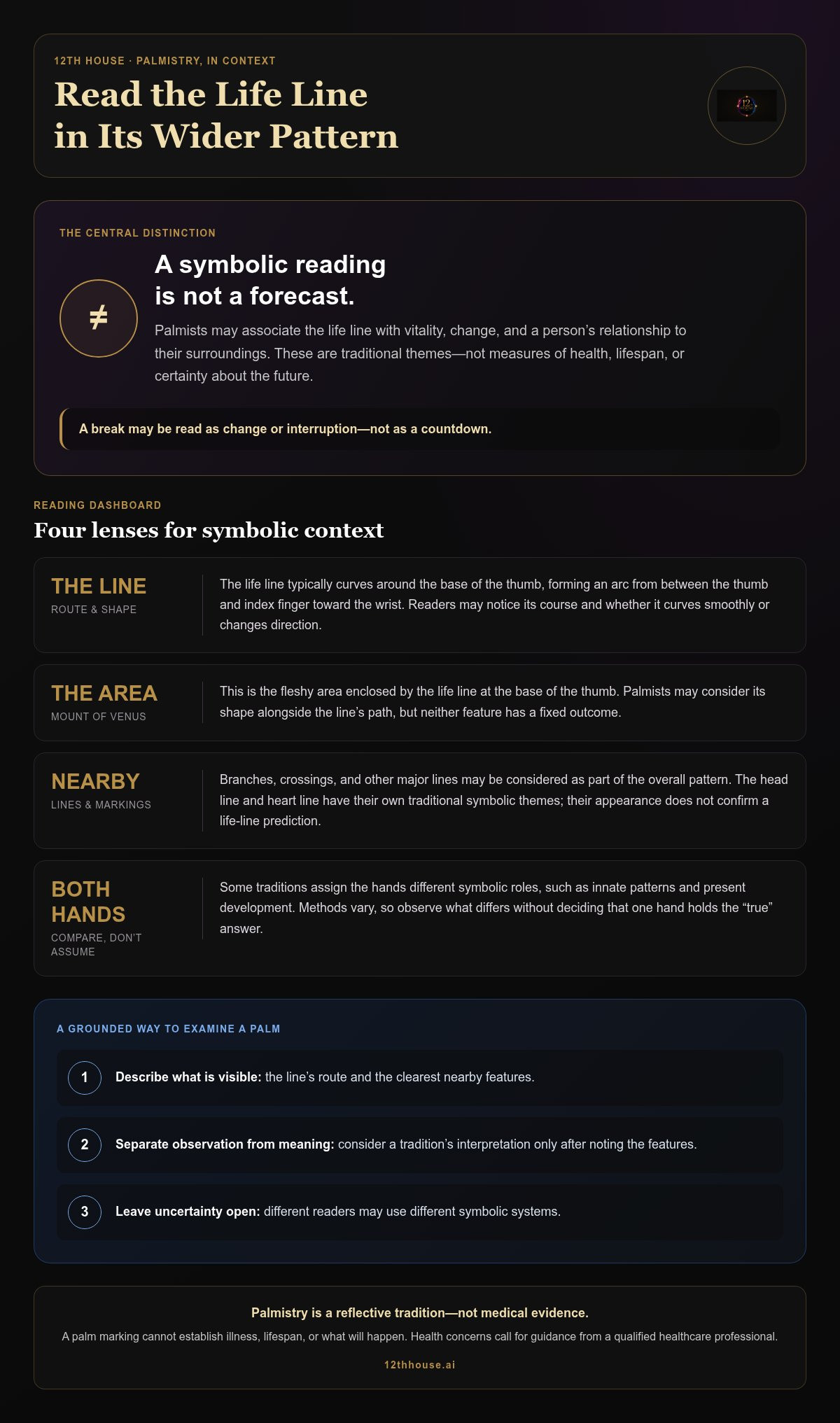
Palmists interpret a break in the life line symbolically, not as a reliable forecast of what will happen. A broken life line in palmistry is traditionally read as a possible marker of change or interruption in a person’s life experience, not as a measure of lifespan. The life line is the crease that typically curves around the base of the thumb, forming an arc from the area between the thumb and index finger toward the wrist.
That placement gives the line its name, but the name can invite a misleading conclusion. In traditional palmistry, the life line is not a clock or countdown. Palmistry is a divinatory tradition that assigns symbolic meanings to features of the hand. Those meanings may offer a prompt for reflection, but they aren’t established facts about someone’s body or future. The overview of Palmistry describes the practice’s history and cultural variations, while also identifying it as pseudoscience. A symbolic system may feel meaningful to a reader without functioning as a scientific prediction method.
What the life line traditionally represents
Readers commonly associate the life line with vitality, periods of change, and a person’s relationship to their surroundings. These are broad interpretive themes, not clinical measures of energy, health, or resilience. A palmist may consider the line as one part of a wider symbolic reading, looking at its course alongside other features rather than treating a single mark as a complete account of someone’s life.
Interpretations aren’t uniform. Palmists may draw on different schools, cultural traditions, or personal methods, so two readers might describe the same marking differently. Keep the wording conditional: “one traditional reading suggests a transition” is more accurate than “this proves a major event is coming.”
Does a broken life line mean death or illness?
No. Palmistry cannot establish when someone will die or become ill, and a marking on your palm is not evidence of either. If you’re worried because of a symptom or a health concern, speak with a qualified healthcare professional. A palm reading cannot assess your health, replace medical advice, or determine what care you need.
So, what does a broken life line mean in palmistry? Within the tradition, it may be treated as a symbolic sign of change, but its meaning depends on the reader’s framework and the broader hand. Treat it as an invitation to consider how you understand change, not as a verdict about your fate. Palmistry offers an interpretive lens; reliable conclusions about health and lifespan require evidence beyond palm markings.
How Palmists Interpret the Life Line’s Shape, Course, and Context
To understand what does a broken life line mean in palmistry, readers usually look beyond the gap itself. They may trace the line’s route, notice whether it curves smoothly or changes direction, and compare it with surrounding features. This provides a broader symbolic picture instead of asking one mark to carry the weight of an entire interpretation.
The Mount of Venus is the fleshy area enclosed by the life line at the base of the thumb. Palmists may consider its shape and the line’s path around it, but neither feature has a fixed outcome. The head line and heart line are separate creases, traditionally associated with different symbolic themes. Their presence or appearance doesn’t confirm a prediction drawn from the life line.
A single palm marking cannot support a certain forecast because symbolic interpretation is not evidence that a future event will occur. Treat each feature as one element in a tradition, not as a diagnostic clue or proof. A wide arc, a close-set curve, or a crossing line may prompt different reflections, but none establishes what a person will experience.
Which hand should a beginner look at?
Some palmistry traditions compare both hands and assign them different symbolic roles, such as contrasting an innate pattern with a person’s present development. Conventions vary. Handedness may also affect how a reader approaches the comparison, and not every school uses the same framework. For a beginner, observe both palms and note what differs without deciding that one hand must reveal the “true” answer.
Why surrounding lines and markings matter
A palmist may consider nearby branches, crossings, or other major lines to understand how a feature fits the hand’s overall pattern. This is a method of symbolic interpretation, not evidence about health or future events. Avoid turning every fine crease into a coded message. Start with the clearest features, describe what you can actually see, and leave uncertain details open rather than forcing them into a fixed reading.
To keep the interpretation coherent, separate observation from meaning. First note the line’s route and the visible features around it. Then consider what a particular palmistry tradition associates with those details. This can help make sense of conflicting sources: they may be applying different symbolic systems, not uncovering competing facts about your destiny.
For a structured way to explore your hand through a symbolic lens, try 12th House palmistry analysis. Use the reading to support self-inquiry, not to seek certainty about what will happen.
Clean Break, Overlap, or Multiple Gaps: Compare Common Life Line Patterns
Before considering what a marking might symbolize, describe what you can see. A clean gap has two visible ends that appear separated. An overlap looks different: one segment seems to continue beside or across another. Faint sections and several apparent gaps add uncertainty. These are visual descriptions first, not evidence of a particular event.
The table summarizes common interpretations found in palmistry. Traditions don’t assign every pattern the same meaning, so use these readings as examples rather than a universal code. Pattern descriptions are symbolic categories, not predictions.
| Visible pattern | Common symbolic reading | Interpretive caution |
|---|---|---|
| Clean gap with separated ends | Sometimes associated with interruption or transition. | A visible gap doesn’t establish what caused it or what will happen. |
| Overlapping or parallel segments | Some readings connect this pattern with continuity, recovery, or a new phase. | Check whether the lines truly overlap; a nearby crease can change the visual impression. |
| More than one apparent gap | May be interpreted symbolically as repeated periods of change. | Several faint marks can be mistaken for multiple breaks, and traditions may disagree about their significance. |
| Faint continuation after a gap | Can be read as a line that continues, though less clearly. | Lighting, skin texture, and the visibility of the crease can make this observation subjective. |
A clean break versus overlapping line segments
Look closely at the ends. In a clean break, the main crease appears to stop and resume after a small space. With an overlap, another section appears alongside or across the gap, creating an impression of connection. In some traditional readings, a break suggests transition, while an overlap suggests continuity or renewal. Neither pattern confirms danger, loss, or a specific life event.
If you’re asking what does a broken life line mean in palmistry, its shape can help you compare interpretations, but it can’t settle the question as fact. Even a clear-looking gap may be read differently depending on the source and the other features considered. Keep the observation separate from the interpretation: “two ends appear separated” is a description; “this predicts a major change” is a claim the marking can’t prove.
Multiple breaks, faint sections, and nearby markings
Several visible gaps differ from one interruption because the line appears discontinuous in more than one place. A faint stretch, however, may simply be difficult to distinguish from surrounding creases. Nearby marks can also influence a traditional reading, but they shouldn’t turn every line into a meaningful sign. Palmistry sources may disagree, so describe the pattern neutrally and keep its meaning conditional.
For a careful comparison, note whether the line continues beyond each apparent gap and whether any segment runs beside it. Then consider nearby markings only if they’re clear and relevant to the tradition you’re using. This method keeps the reading grounded in what’s visible while leaving room for uncertainty instead of forcing a fixed outcome.
Examine a Broken Life Line Without Jumping to Conclusions
A careful palm reading begins with observation, not a verdict. If you’re wondering what does a broken life line mean in palmistry, first separate what you can see from what a tradition might say it represents. “A faint gap near the center of the curve” is an observation. “Something bad will happen” is an unsupported conclusion.
Use this sequence to examine the line:
- Observe the line: Look at the whole curve in steady light. Note where the apparent interruption begins and ends, and whether the line continues beyond it.
- Compare both hands: Look at the corresponding area on your other palm. Record any differences without assuming the lines should match.
- Note nearby features: Describe clear branches, crossings, or parallel segments, but don’t assign meaning to every fine crease.
- Consult a tradition cautiously: Explore how a particular palmistry framework interprets the pattern, while remembering that interpretations can differ.
Keep your notes in two columns if that helps: one for visible details and one for possible symbolic readings. This makes it easier to notice when an interpretation goes beyond what the palm itself shows.
A beginner’s observation checklist
Start with neutral terms such as “gap,” “faint section,” or “overlap.” Compare the same general area on both palms, but don’t treat a difference as a sign that one hand is right and the other wrong. Write down what you observe before looking up meanings. That order helps prevent a dramatic interpretation from changing what you think you see.
Questions that make a reading more reflective
After recording the visible pattern, use questions that invite reflection rather than certainty: “Does this symbol bring a period of transition to mind?” or “What priorities have been changing for me?” These are prompts, not proof. You might also ask which palmistry tradition you’re using and whether other sources interpret the same feature differently.
For a structured approach to personalized symbolic inquiry, the AI Astrology Assistant guide explores how an AI assistant can support reflective questions. Keep those reflections separate from claims about illness, death, or inevitable events. A palm marking can’t establish any of them.
If examining your palm increases your anxiety, pause rather than checking it repeatedly for reassurance. Set the interpretation aside and return only if it feels useful and grounded. You can also explore 12th House palmistry analysis as a symbolic framework for self-inquiry, not as a forecast. The aim is clearer reflection, not greater fear.
Explore Palmistry as a Reflective Practice, Not a Fixed Forecast
A palm line can open a question, but it can’t answer what your future holds. Palmistry offers a symbolic vocabulary for reflection, not proof that a particular event will occur. If you’ve been asking what does a broken life line mean in palmistry, treat the answer as one possibility within a tradition, not a verdict about your life.
You don’t have to dismiss the symbol. Instead, hold it lightly. A reading may help you consider how you relate to change, but it can’t diagnose a condition, guarantee an outcome, or prevent an event. Your own experience and choices remain more substantial than any single interpretation of a palm marking.
Use the symbol as a prompt for self-inquiry
Try questions that leave room for your own perspective instead of supplying a predetermined answer:
- What changes or transitions have been on my mind lately?
- Where have I shown resilience or adapted to new circumstances?
- What priorities feel different now, and what would I like to carry forward?
Your answers don’t validate a prediction. They show what the symbol brings to your attention today. Another person might see the same marking and connect it with a different theme. Treat your personal association as an avenue for exploration, not an outside authority that must dictate your choices.
If a reading feels frightening, set it aside. You don’t need to search for certainty in your hand or force a reassuring meaning onto the line. A useful symbolic practice leaves room for thought, disagreement, and uncertainty. It should never replace evidence-based care or guide decisions through fear.
How palmistry fits among symbolic systems
Palmistry is one interpretive tradition, centered on the features of the hand. Tarot uses cards as symbolic prompts, while astrology interprets celestial placements within its own framework. These practices aren’t interchangeable, and one system doesn’t prove the conclusions of another. Each offers a different structure for exploring a question, with meanings shaped by its symbols and interpretive conventions.
If you’re curious about how card symbolism supports reflection, the Tarot Mastery guide explores tarot as a separate practice. Keep your focus on the question that brought you here: what does this marking evoke for you, and how can you explore that meaning without turning it into certainty?
12th House palmistry analysis offers a structured way to explore the symbol as part of personal reflection. Approach it with curiosity, not alarm, and keep the interpretation open to your own judgment.
Explore palmistry with 12th House.
Carry Your Curiosity Into the Next Step
Let your palm raise a question, not dictate an answer. You can explore what a symbol brings to mind while keeping your choices anchored in your own judgment. The question “what does a broken life line mean in palmistry” can become a starting point for reflection rather than a search for certainty about what lies ahead.
If you’d like to continue exploring, 12th House offers palmistry analysis alongside Ask Lala, its AI spiritual guidance assistant. Use these tools to explore symbolic meanings through open-ended questions, and keep your interpretation open. Explore palmistry as a tool for self-discovery.
Your hand can be a map for reflection, not a command. Move forward with discernment, and let your own insight lead.
Frequently Asked Questions
Does a broken life line mean you will die young?
No. A broken life line can’t tell you that you’ll die young, and palmistry has no reliable method for calculating lifespan. Within the tradition, a line is read through symbolic associations, while a factual claim about longevity requires evidence palm markings can’t provide. If you searched “what does a broken life line mean in palmistry” after noticing a gap, treat it as a symbol to explore, not a personal timeline or reason to fear.
Is a broken life line a bad sign in palmistry?
Not necessarily. Palmistry traditions differ, and a break isn’t universally classified as negative. Some readers associate it with transition, change, or a shift in circumstances; others may interpret the same shape differently based on its appearance and surrounding features. Rather than label your palm “good” or “bad,” ask what the interpretation means within the specific tradition you’re exploring, and avoid treating it as a guarantee of difficulty.
Can a broken life line heal or change over time?
Palm lines may look different as your hands change or as viewing conditions shift. Dry skin, lighting, hand position, or a close-up photograph can make a faint crease seem more or less distinct. Some palmists also believe lines can change over time, but a visual difference doesn’t prove that a destined event has changed. If you compare your palms later, use similar lighting and note only what’s visibly different.
What does a break at the beginning of the life line mean?
Some palmists interpret a break according to where it appears along the line, including near its beginning, but there’s no universal meaning for that location. The reading may depend on the school of palmistry and on whether the mark is a clear gap, a faint stretch, or a nearby crease. Describe its position and appearance first. Don’t use it to predict a particular event or assign a fixed story to your life.
What does it mean if the life line overlaps after a break?
An overlap is a pattern in which a segment appears to run beside or across another section, rather than stopping with two clearly separated ends. Some palmistry traditions associate this visual arrangement with continuity or renewal, but the symbolism isn’t consistent across sources. Check whether the apparent second segment is actually part of the life line or a nearby crease. Either way, an overlap can’t confirm that a specific event will occur.
Should I worry if my life line looks broken?
Seeing a break can feel unsettling, but the marking itself isn’t evidence that something is wrong with your health or future. Palmistry can’t assess symptoms or predict illness. If you have a health concern, new symptom, or change in how you feel, speak with a qualified healthcare professional instead of relying on a palm reading. If repeated palm-checking is making you more anxious, step away from the interpretation and give yourself a pause.
How can you tell whether a life line is truly broken?
Look for two visible ends separated by a space to identify an apparent gap. If a segment seems to continue alongside or across the space, it may look like an overlap; if the crease becomes hard to see but appears to continue, describe it as faint. Use steady light and a relaxed hand, since shadows, skin creases, and viewing angle can alter what stands out. A visual label is more certain than its symbolic meaning.


