

What if a dream of your own death is not a forecast, but a reason to look more closely at what’s changing? Asking “what does it mean to dream of your own death” can feel urgent when you wake with fear still in your body. That reaction makes sense. A vivid dream can seem like a warning, especially when its images linger or return, but it isn’t reliable evidence that a future event will happen.
If the dream carries meaning for you, its context matters: current stress, transitions, relationships, and the emotions in the dream may be more useful to consider than a fixed symbol dictionary. This guide explores common psychological and symbolic interpretations without treating them as a diagnosis or certainty. You’ll learn how to separate a dream from a prediction, use focused questions to connect its details with waking life, and respond if the dream repeats or disrupts sleep. It also explains when ongoing distress or thoughts of harming yourself call for support from a qualified mental health professional.
Key Takeaways
- When asking “what does it mean to dream of your own death,” consider your personal associations rather than searching for one universal symbol code.
- Stress, grief, fear, change, or recent experiences may offer context, but the same dream image can mean different things to different people.
- Record what you remember soon after waking, and separate clear details from interpretations or guesses.
- Notice the emotions in the dream and any patterns in your waking life or sleep to guide reflection.
- If recurring dreams cause ongoing distress or disrupt sleep, consider discussing them with a qualified professional.
What Does It Mean to Dream of Your Own Death?
A dream about your own death, by itself, doesn’t predict when or how you’ll die. It may feel like a message demanding an answer, but there’s no reliable basis for treating a dream as evidence of a future death. If you’re asking, “what does it mean to dream of your own death,” begin with what the dream brought up for you, not with a fixed definition.
Dream symbols don’t work like a universal codebook. Some people may associate death imagery with change or the end of a chapter; others may connect it with grief, fear, a recent experience, or something entirely personal. None of these possibilities is automatically correct. The dream’s emotional tone and your own associations offer more useful context than a symbol’s supposed meaning in isolation.
A dream can feel vivid, frightening, or emotionally important after waking. That intensity is worth acknowledging, but it doesn’t prove the dream predicts an event or contains one hidden message. For broader context, research into dream content describes the varied ways dreams are studied, including their relationship to psychological experience. Use that context to stay curious without forcing certainty.
Does dreaming about your own death predict the future?
No. A dream is not reliable evidence that you’ll die or that a particular event will happen. People may hold spiritual beliefs about dreams, and those beliefs can matter personally. But a personal interpretation is different from a claim that can be verified. You can respect what the dream means within your worldview without treating it as a forecast or letting it dictate what you do next.
Why can a death dream feel so real?
Dreams can combine strong emotion with detailed imagery, so fear may remain after the scene itself fades. Some details may feel clear, while others are difficult to recall or shift as you think about them. Remembering a dream vividly doesn’t show that it carries a special message. It means the experience stayed with you. Take a moment to steady yourself before deciding what, if anything, it might represent.
Context is a useful next step. Ask what you felt during the dream and immediately after waking. Was it terror, sadness, relief, or calm? What does death imagery bring to mind for you personally? These questions don’t prove one interpretation. They help you consider the dream alongside your current feelings and experiences, leaving room for uncertainty instead of turning a disturbing image into a prediction.
Why Might You Dream About Your Own Death?
There isn’t one explanation that fits every death dream. Stress, change, grief, fear, and recent experiences may shape what appears during sleep, but they’re possibilities to explore, not proven causes. Asking “what does it mean to dream of your own death” is most useful when it leads back to your circumstances rather than a fixed interpretation.
An ordinary stressful period may influence dream content without implying that something is wrong with you. A demanding week, uncertainty about a decision, a loss, or an emotionally intense story could be relevant context. These connections don’t establish a diagnosis or prove that a particular event caused the dream. They’re starting points for reflection.
How stress, change, and grief may shape dream themes
Look gently at what has occupied your attention. Have you faced upheaval, felt uncertain about what comes next, experienced a loss, or encountered something unsettling? You don’t need to force a connection. Sometimes a dream resonates with a waking concern; sometimes the link isn’t clear. Treat each possibility as a question, not a verdict about your mental health or your future.
Death imagery may bring endings or transition to mind, but it doesn’t always represent transformation. It could connect with fear, grief, a recent experience, or a personal association with no obvious symbolic meaning. Even two people with similar dreams may understand them differently because their lives, memories, and beliefs differ.
How the details and emotions change the interpretation
Notice what the dream felt like without assigning each emotion a fixed code. Fear might reflect how disturbing the scene was; relief, acceptance, or detachment may suggest a different personal response. None of these feelings proves what the dream “really” means. They help you identify which parts may be worth considering.
Recall the details you can, while leaving gaps open:
- Was there a particular cause or setting?
- Did anyone witness what happened, and what did their presence mean to you?
- Did you wake at a specific moment, and what emotion stayed with you?
Symbolic interpretation is a personal hypothesis about what an image may mean to you, not a diagnosis or established universal code. Your associations matter more than a generic symbol dictionary. If it helps you sort through those associations, a dream interpretation tool can offer prompts to consider. Treat any interpretation as a possibility, not a certainty.
Is Dreaming of Your Own Death a Bad Omen?
No. A dream about your own death shouldn’t be treated as a forecast or a warning that a future event will happen. The question “what does it mean to dream of your own death” can invite reflection, but no symbolic reading can establish what will happen to you. A spiritual belief may offer personal meaning; it isn’t the same as verifiable evidence about the future.
That distinction matters. You can take the dream seriously as an experience without treating it as a prediction. The image may feel significant, but significance and certainty are not the same.
What a symbolic interpretation can, and cannot, tell you
Use symbolism as a question, not a translation key. Death might bring endings, change, or transformation to mind, but those are possible associations, not the definitive meaning of the dream. Ask whether an interpretation fits your experience. If it doesn’t, set it aside. A dream dictionary or one-size-fits-all spiritual explanation can offer ideas, but it can’t confirm hidden facts about your life or future.
A personal symbol may help you reflect on what you’re feeling; it isn’t evidence of what will happen next. This keeps interpretation open and grounded. Rather than asking only, “What does this symbol mean?” consider, “What does this image bring up for me, and does that connection fit?”
When a dream is different from waking thoughts about death
Dream imagery alone doesn’t establish that you want to die, intend to harm yourself, or have a mental health condition. A disturbing dream can occur without reflecting a waking wish. But persistent thoughts about death, self-harm, or not wanting to be alive deserve attention on their own, whether or not you’ve had a death dream.
If those thoughts are troubling you, tell someone you trust and consider speaking with a qualified mental health professional. You don’t have to interpret the dream first or prove that your concern is serious enough. If you may act on thoughts of harming yourself or can’t stay safe, contact emergency services or crisis support where you are now.
Let the dream prompt care, not fear. Its imagery doesn’t diagnose you, and symbolic interpretation can’t replace support for what you’re experiencing while awake.
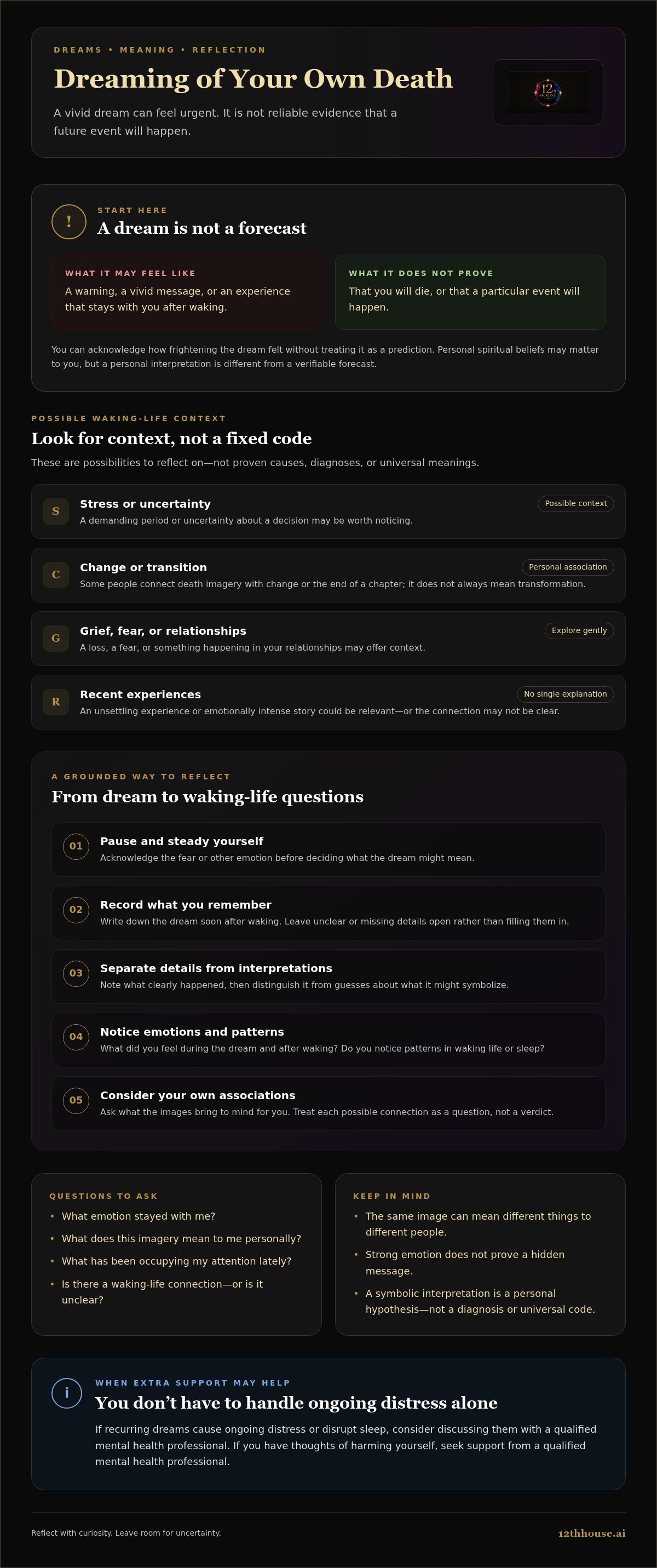
How to Interpret a Dream About Your Own Death
There’s no single correct meaning to uncover. Instead, make a careful record, connect the dream with your present context, then test possible interpretations against your lived experience. If you’re wondering “what does it mean to dream of your own death,” this process can help you explore the question without treating repetition or vivid imagery as proof of a prediction.
Record the dream before searching for a meaning
Write down what you remember soon after waking, before outside interpretations fill in the gaps. Note the setting, people, sequence of events, and sensory details. Name the strongest emotion during the dream and just after waking. If it has happened before, record what stayed the same and what changed. Mark uncertain details as uncertain instead of turning a guess into a remembered fact.
Connect the dream to your present context
Look for possible connections, not a forced explanation. Ask whether endings, fears, transitions, grief, or recent experiences have been on your mind. Then list more than one interpretation. For instance, the dream might bring up anxiety about change, a recent loss, or no clear connection to waking life at all. Which possibility best fits your feelings and circumstances? Revisit your notes later; new context may change your view.
Use interpretation tools without surrendering your judgment
Dream dictionaries and spiritual frameworks can offer prompts, but they aren’t authoritative verdicts. Compare a symbolic idea with a grounded account of what you’ve recently felt, experienced, or thought about. Keep interpretations that help you reflect, and set aside those that don’t fit. A recurring image may be worth noticing, but repetition alone doesn’t establish its meaning or predict an event.
A dream journal can make this process more deliberate. Separate the record of the dream from your interpretations, so you can see which details you clearly remember and which meanings you added afterward. If you’d like another prompt for reflection, explore the Dream Interpretation Tool and treat its interpretations as possibilities, not certainty. Your own context remains the central reference point.
What to Do After a Disturbing Death Dream
A frightening dream can leave your body on alert even after you know you’re awake. Start with the present, not an interpretation. Look around and name a few things you can see, feel your feet against the floor, and take a slow breath. Remind yourself that you had a dream and are now here. You don’t need to solve its meaning immediately.
When you feel settled, write down what you remember. Note the date, main images, and strongest emotions, then leave space for thoughts about what might have influenced the dream. Over time, notice whether it coincides with stress, changes in your routine, or disrupted sleep. Patterns can help you reflect, but they don’t prove a cause or forecast.
When should you seek support for recurring nightmares?
Consider talking with a qualified professional if distress persists, gets worse, interferes with daily life, or makes it difficult to sleep. You don’t need to diagnose yourself or know why the dreams are happening before asking for support. If you have waking thoughts of self-harm, feel unable to stay safe, or may act on those thoughts, contact local emergency or crisis services now, or reach out to someone you trust who can help you connect with immediate support.
How a dream interpretation tool can support reflection
If you’re asking what does it mean to dream of your own death, an interpretation tool may offer another perspective to consider. 12th House’s Dream Interpretation Tool is an optional reflective aid for exploring possible meanings. Compare any interpretation with what you remember, feel, and know about your own life. Keep what offers a useful question; set aside what feels inaccurate. It isn’t clinical care, a diagnosis, or a prediction.
For recurring dreams, a simple journal can help you track what changes from one version to the next and whether sleep or stress patterns shift alongside them. Keep the record factual: distinguish details you clearly remember from guesses made afterward. If reflection starts increasing your fear, pause and focus on grounding or seek appropriate support instead.
When you feel ready to explore possible symbolism at your own pace, explore 12th House’s dream interpretation tools. Use them as prompts for reflection, while keeping your judgment and wellbeing at the center.
Reflect on the Dream, Then Choose Your Next Step
If you’re still wondering “what does it mean to dream of your own death,” remember that the dream alone doesn’t predict the future. Its possible significance depends on your personal context, emotions, and associations, not a universal symbol dictionary. Record what you recall, note what’s happening in your life, and allow more than one interpretation to remain possible.
If the dream keeps returning, causes ongoing distress, or disrupts your sleep, consider speaking with a qualified professional. Waking thoughts of self-harm or feeling unsafe deserve immediate support, regardless of what a dream may symbolize.
For self-guided reflection, 12th House offers a Dream Interpretation Tool and a metaphysical library. Use these resources as prompts for exploring possible symbolism, not as a diagnosis or prediction. Explore 12th House’s dream interpretation tools and continue at a pace that feels right for you.
A vivid dream can be unsettling, but it doesn’t have to define what comes next. Stay curious, grounded, and gentle with yourself as you make sense of it.
Frequently Asked Questions
Does dreaming about your own death mean you are going to die?
No. A dream about your own death isn’t reliable evidence that you’ll die or that a future event is coming. If you’re asking “what does it mean to dream of your own death,” consider the dream’s emotions and your personal context rather than treating it as a prediction. You can reflect on possible symbolism, but no interpretation can confirm what will happen in the future.
Is dreaming about your own death a bad omen?
No, you don’t need to treat it as a bad omen. Some people may view death imagery symbolically, perhaps as a prompt to consider change or an ending, but that’s a personal interpretation, not a verified forecast. A dream dictionary or spiritual framework can offer possibilities to explore. Keep what resonates with your circumstances, and set aside interpretations that create fear or don’t fit.
What does it mean if you feel calm when you dream of your own death?
Feeling calm doesn’t have one fixed meaning. It might reflect acceptance, emotional distance, or simply the particular tone of that dream, but none of these possibilities is certain. Ask what calmness means to you and whether it connects with anything in your waking life. Your feeling is useful context for reflection, not proof of a hidden message, desire, or prediction.
Can stress cause dreams about your own death?
Stress may be associated with changes in dream content, including unsettling imagery, but it doesn’t prove what caused a particular dream. Consider whether uncertainty, a demanding period, grief, or an emotionally intense recent experience could be relevant. These are reflection prompts, not signs of a specific condition. A stressful period can affect what you dream about without meaning that something is wrong with you.
What should I do after dreaming about my own death?
First, ground yourself: notice your surroundings, feel your feet on the floor, and take a slow breath. When you’re ready, write down what you remember, including the strongest emotion, and separate clear details from guesses. You might use 12th House’s Dream Interpretation Tool to explore possible symbolism, but treat it as a reflection aid, not care or prediction. If you feel unsafe or may harm yourself, contact local emergency or crisis services now.
What happens if I keep dreaming about my own death?
Recurring dreams don’t prove that a prediction is coming true. Keep a brief record of each dream, noting what changed and whether stress or sleep patterns seem relevant. If the dreams keep causing distress, worsen, disrupt sleep, or interfere with daily life, consider discussing them with a qualified professional. If you’re also having waking thoughts of self-harm or feel unable to stay safe, seek immediate help from local emergency or crisis services.


