

If you’re asking, “what do crossed lines on my palm mean,” start by looking at where the mark appears. In palmistry, an intersection is not automatically a mystic cross, and a cross is not a reliable sign of bad luck or psychic ability. Its traditional meaning depends on its shape, position, and relationship to the other lines on your hand.
A small crease meeting a major line may be read differently from a distinct cross in the central palm, traditionally located between the heart and head lines. Palmistry traditions also differ in how they name and interpret markings. Treat these meanings as symbolic associations, not scientific evidence or guarantees about what will happen.
This guide shows you how to inspect a mark, locate the traditional mystic cross, and consider the surrounding lines before interpreting it. Use the steps to make a careful observation and a useful reflection prompt, not to reach a fixed verdict about yourself or your future.
Key Takeaways
- Before interpreting crossed lines on your palm, distinguish an ordinary intersection from a clearly formed palmistry symbol.
- Use the heart and head lines as landmarks when looking for the traditional mystic cross, while allowing for differences in palm shape.
- Compare a mark’s location and form with common palmistry traditions instead of treating it as a prediction.
- Use a simple reading sequence: observe the mark, locate it, consider traditional associations, then reflect without treating it as an omen.
- Explore a personal palm-reading question through 12th House Palmistry Analysis as a prompt for self-reflection.
What Do Crossed Lines on Your Palm Mean in Palmistry?
In palmistry, crossed marks are interpreted according to their shape and location. An intersection alone does not establish that you have a named symbol: two creases may meet, overlap, or branch without forming what palmists traditionally call a mystic cross. If you’re wondering what crossed lines on your palm mean, identify what you can see before deciding what it might symbolize.
A mystic cross is a distinct cross-shaped marking traditionally found between the heart line and the head line in the central palm. Palm readers generally look for separate strokes that visibly cross, rather than any two creases that happen to touch.
What palm readers call a mystic cross
The commonly cited mystic cross appears in the space between the heart line, which runs beneath the fingers, and the head line, which typically crosses the middle of the palm. In traditional readings, it is treated as a separate marking in that area. The term does not automatically apply to every intersection elsewhere on the hand.
Look at how the strokes meet. A distinct cross has lines that appear separate from the major lines around it. A fork in a main line, a faint crease touching another, or a cluster of fine lines may be interpreted differently. Palmistry schools do not always use the same names or criteria, so the label can vary by tradition.
Why crossed lines do not have one universal meaning
Palmistry is an interpretive system, not a standardized measurement. A reader may consider a mark’s shape, position, clarity, and nearby lines before assigning a symbolic meaning. For example, a clear cross between the head and heart lines is commonly identified as a mystic cross, while a mark near a major mount may be interpreted through that area’s traditional symbolism.
Different interpretations can reflect different palmistry schools. One may associate a marking with spirituality, while another focuses on its location or classifies it as a different symbol. The broader Palmistry tradition includes varied systems for reading hands, rather than one universal rulebook.
Keep the limits clear: palmistry is a cultural and symbolic practice, classified as pseudoscience. Its interpretations are not scientifically established evidence of personality, psychic ability, or future events. A cross cannot diagnose a trait, guarantee an outcome, or prove that something good or bad will happen. Use an interpretation as a reflection prompt, not a verdict.
For a careful first reading, note the mark’s position in relation to the major lines, then describe what you can actually see. Is it a clear crossing, a branch, or a cluster of creases? That observation is a more useful starting point within palmistry than assigning meaning based on the word “cross” alone.
How to Identify a Mystic Cross and Locate It on Your Palm
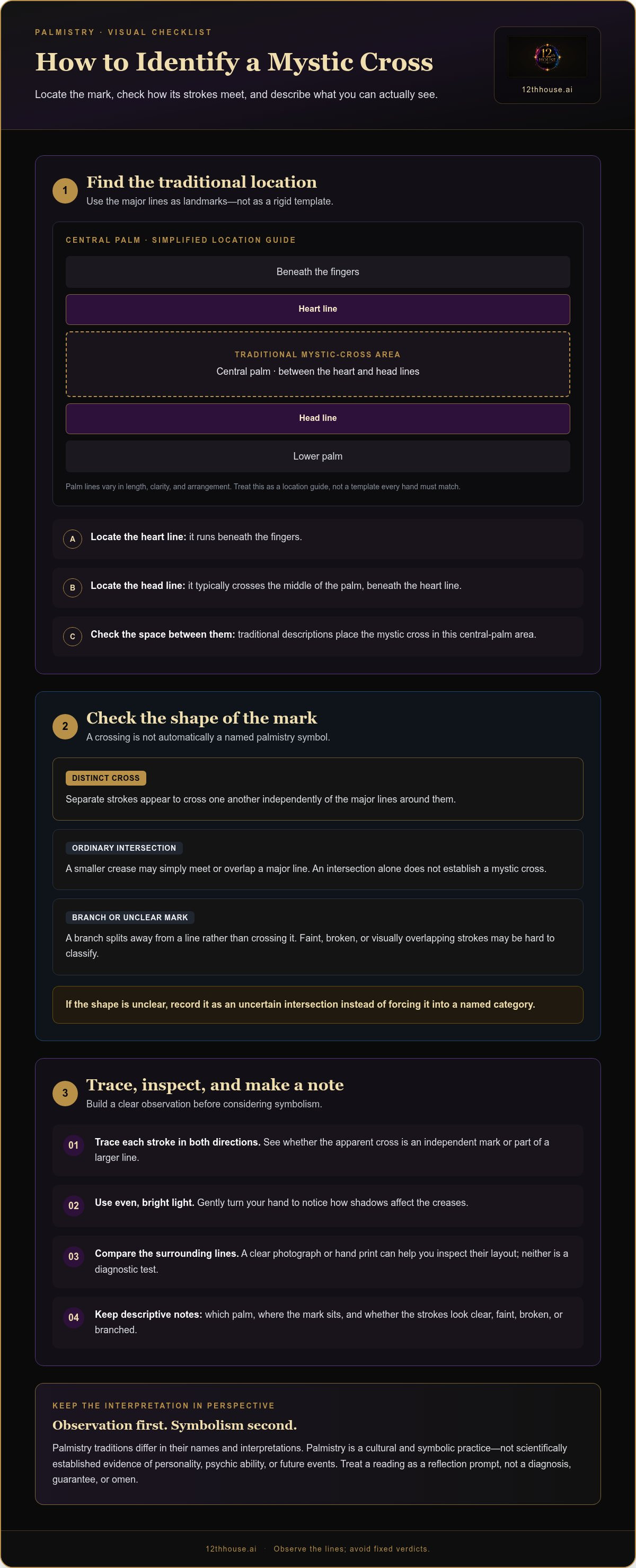
Start with the layout of your hand, not the mark that caught your attention. In traditional palmistry, the heart line runs below the fingers and the head line crosses the palm beneath it. A mystic cross is generally sought in the space between them, but palm lines vary in length, clarity, and arrangement. Use the location as a guide, not as a template every hand must match.
Follow this visual checklist:
- Find the major lines. Locate the heart line beneath the fingers and the head line crossing the palm. Do not assume every crease is one of these major lines.
- Inspect the central palm. Look at the area between those lines, then note whether the mark sits there or elsewhere.
- Assess the crossing. Check whether two distinct strokes cross independently, or whether one line branches, bends, or simply meets another.
Where the traditional mystic cross is said to appear
Traditional descriptions place the mystic cross in the central palm, between the head and heart lines. It may be discussed on one hand or both. A matching mark on the other palm does not, by itself, settle the identification. Before naming the shape, trace the surrounding lines in both directions. This can help you see whether the apparent cross is an independent mark or part of a larger line.
How to tell a distinct cross from an ordinary intersection
Look at where each stroke begins and ends. A distinct cross appears as separate lines meeting across one another. An ordinary intersection may form where a major line runs through a smaller crease, while a branch splits away from a line rather than crossing it. Some markings are faint, broken, or visually overlapping. If the shape is unclear, describe it as an uncertain intersection instead of forcing it into a named category.
For a closer look, examine your palm in even, bright light and gently turn your hand to see how shadows affect the creases. A clear, well-lit photograph can help you compare the mark with the surrounding lines; a hand print can also make their layout easier to inspect. These are observation aids, not diagnostic tests. Neither can prove a personality trait or predict an event. For background on palmistry’s origins and limits, see Britannica’s overview, What is Palmistry?
Keep your notes descriptive: record which palm you examined, where the mark sits, and whether its strokes look clear, faint, broken, or branched. That gives you a visual reference before you consider traditional symbolism. If you want to explore your observation as a reflective palm-reading question, 12th House Palmistry Analysis offers a structured point of entry.
What Crossed Lines Mean by Palm Location and Shape
In palmistry, a crossed mark is interpreted in relation to its position, form, and surrounding lines. The traditional reading can differ depending on whether a mark sits in the central palm or near a mount below a finger. These associations belong to a symbolic tradition, not a verified method for measuring personality or predicting events.
How palm location shapes a traditional reading
Within palmistry traditions, a cross’s location affects its symbolic reading. A mark in the central space between the head and heart lines is commonly associated with intuition or spiritual interest. Crosses near the mounts below the fingers may be read through the qualities traditionally assigned to those areas. The table summarizes common associations, not fixed meanings.
| Location | Traditional association | Interpretation caveat |
|---|---|---|
| Central palm, between the head and heart lines | Mystic cross; often linked with intuition or spiritual interests | Traditions differ on what shape qualifies and what the symbol suggests. |
| Mount of Jupiter, below the index finger | Ambition, leadership, or aspiration | A nearby cross doesn’t establish that a person has these traits. |
| Mount of Saturn, below the middle finger | Responsibility, reflection, or seriousness | These are symbolic themes, not a personality assessment. |
| Mount of the Sun, below the ring finger | Creativity, recognition, or self-expression | Placement alone can’t predict success or public attention. |
| Mount of Mercury, below the little finger | Communication, adaptability, or commerce | Interpretations vary, and a mark may be classified differently. |
Mount names provide a coordinate system for palmistry readings. Their traditional associations help explain why two similar-looking crosses may receive different interpretations. They do not turn a palm into a reliable forecast.
How line shape and clarity influence interpretation
Shape helps a reader classify a mark before assigning symbolism. A distinct cross has two identifiable strokes meeting across one another. A faint or fragmented mark may be harder to distinguish from fine creases, while a crowded intersection can appear to involve several lines at once. Depth may affect how visible a mark looks, but it does not prove a particular trait or destiny.
Nearby lines matter, too. What first appears to be a cross may be a branch from a major line, an overlap, or two creases that happen to meet. A palm reader may classify each differently, and conventions vary across schools. Note the location and visible form first, then leave the meaning open if the pattern is ambiguous. This keeps the reading grounded in observation instead of turning one marking into a verdict.
How to Read Crossed Palm Lines Without Treating Them as an Omen
A palmistry reading can offer a symbolic lens, but it should not take authority away from you. A cross on your palm is not reliable evidence of bad luck or psychic ability. Start with what you can observe, then separate that description from the meaning a tradition assigns to it. This keeps curiosity in the process and fear out of the conclusion.
A grounded four-step self-reading
Work through these steps in order. Keep your notes factual before adding an interpretation.
- Observe the mark. Describe its shape and clarity. Is it a clear crossing, a faint meeting, a broken stroke, or a cluster of lines? Note which hand you’re looking at.
- Locate it. Record where the mark sits in relation to the major lines and nearby palm areas. “Near the center, between the head and heart lines” is more useful than “somewhere in the middle.”
- Compare it with a named tradition. For example, compare a distinct central cross with the traditional mystic-cross interpretation. Label that meaning as a palmistry association, not an established fact about you.
- Reflect without predicting. Turn the symbolism into a question: “Where am I paying attention to intuition?” Avoid statements like “This proves I’m psychic” or “Something bad will happen.”
This sequence gives you two separate records: what appears on your palm and how a palmistry tradition might interpret it. If the mark is ambiguous, preserve that uncertainty in your notes. You do not need to choose a definitive label just to complete the exercise.
What palmistry can and cannot establish
Palmistry is a symbolic practice, not a scientifically validated way to predict the future or verify personality traits. A line marking cannot establish that you’ll experience bad luck, possess psychic powers, or face a particular outcome. It also should not be used to infer health conditions or determine what another person intends. Those conclusions require evidence beyond palm symbolism.
Within palmistry, the meaning of crossed lines depends on the symbol and the tradition used to read it. Outside that framework, the mark is a visible feature of your hand, not a verdict. Hold any interpretation lightly. You can consider what an idea brings up for you without accepting it as fact, and make choices based on your values and real circumstances.
If you’d like to explore your observation as a personal reflection, use 12th House Palmistry Analysis to examine your palm-reading question through a structured symbolic lens.
Explore Your Crossed Lines Through a Personal Palmistry Reading
You’ve moved from spotting a mark to describing its location and considering how palmistry traditions might interpret it. The next step is not to search for a final verdict. Instead, turn your observation into a focused question that supports reflection. Start with the details you can see, then decide which symbolic interpretation you want to explore.
Turn a palm observation into a focused question
Write down a plain description before asking for an interpretation. For example: “I notice a distinct crossing in the central palm, between the head and heart lines. What does this placement traditionally symbolize?” This prompt separates the visible feature from the meaning assigned to it, making the reading easier to consider carefully.
Questions can invite exploration without turning symbolism into a forecast. Try asking:
- What associations do palmistry traditions give this location?
- How might I use this symbol as a prompt to reflect on intuition or inner life?
- What details about the mark could change how it’s interpreted?
Your interpretation remains personal and revisable. A symbolic reading may help you notice a question or theme, but you are not required to accept it as fact. Other traditions use their own symbolic structures. Tarot symbolism and spiritual clarity offers a distinct framework for reflection, rather than a way to prove what a palm marking means.
Use a structured space for metaphysical exploration
12th House offers Palmistry Analysis as a tool for exploring a personal palm-reading question. Bring a careful description of the mark, its location, and what you’re curious about. That gives your inquiry a clear starting point without assuming that one symbol has a universal answer.
Ask Lala, 12th House’s AI spiritual-guidance assistant, can support personalized questions as part of self-guided exploration. Consider its responses as perspectives, not supernatural proof or certainty about your future. For broader context about how an AI assistant fits into metaphysical exploration, read the AI astrology assistant guide.
Keep your method steady: describe what you see, ask what a tradition associates with it, and notice what the idea brings up for you. The value lies in thoughtful inquiry, not in surrendering your judgment to a line on your hand. A palmistry reading can provide a structured space for self-reflection while leaving room for uncertainty, choice, and new understanding.
Carry Your Palmistry Question Into Further Exploration
A palm mark can be a starting point for a question, not a final answer. Let your first impression develop into a more considered inquiry: what does this symbol bring to mind, and what would you like to understand about yourself? You can revisit the question as your perspective changes.
If you’re still wondering what crossed lines on your palm mean, keep your interpretation open. Curiosity does not require certainty. A thoughtful reading can give you a framework for reflection while leaving your choices, experiences, and sense of meaning in your own hands.
12th House brings together Palmistry Analysis, Ask Lala AI spiritual guidance, and a metaphysical library for self-guided exploration. Use these resources to explore a palmistry question at your own pace and consider the symbolism from more than one angle.
Explore your palm through a personal reading with 12th House, and use your next question as a starting point for self-reflection.
Frequently Asked Questions
Can a crossed line on my palm mean I am psychic?
No, a crossed mark can’t establish psychic ability. In palmistry, it may be associated with intuition, but that association reflects a belief, not a test. Consider whether the idea encourages grounded reflection or makes you feel pressured to claim a special identity. Your experiences and decisions matter more than a symbolic label. Don’t use a palm reading as proof of unusual powers.
Does a mystic cross have to appear on both hands?
No, traditional accounts may describe a mystic cross on one hand or both. If you compare your palms, note whether the markings are in similar locations and whether their shapes are equally clear. Some palmistry systems assign different roles to each hand, but those conventions aren’t universal. A matching mark doesn’t make an interpretation more certain; it simply gives you another detail to consider.
Do crossed lines on my palm mean bad luck?
No, a crossed line isn’t a reliable warning of misfortune. Palmistry interpretations depend on tradition and context, not on a dependable forecast. If a reading makes you anxious, pause and write down what you can observe separately from what you fear it might mean. Let real-world evidence guide decisions, not an ominous interpretation.
Can the lines on my palm change over time?
Their appearance can seem different as lighting, hand position, or skin condition changes. For a fair visual comparison, look at the same area with similar lighting and a relaxed, open hand. A photograph can help you compare what you see, but small differences in angle or focus may alter how creases appear. Palmistry interpretations of changing lines are symbolic, not evidence that your future or personality has shifted.
Is every X-shaped mark a mystic cross?
No, an X-shaped mark isn’t automatically a mystic cross. Before using that name, check whether it appears in the traditionally described central area and whether it looks separate from the major lines. One stroke may simply branch from another, or several fine creases may overlap. If you can’t distinguish the line paths, call it an X-shaped intersection for now rather than choosing a label prematurely.
Which palm should I examine first for crossed lines?
Start with whichever hand lets you see the mark most clearly, then compare the other palm. Note the location and shape on each separately, rather than assuming the hands must match. This is a practical way to keep your observations organized, even when palmistry traditions differ about how to interpret the hands. Treat any contrast as a prompt for further thought, not proof that one reading is more accurate.
Can palmistry diagnose a health condition from a crossed line?
No, a crossed palm line can’t diagnose a health condition. Palmistry is a symbolic practice, not a substitute for medical assessment. If you notice a new skin change, persistent pain, or another physical symptom that concerns you, seek appropriate medical advice instead of interpreting it through palmistry. Keep symbolic exploration separate from choices about health, treatment, or whether to seek care.


