

What if the clearest clue to what are my spiritual gifts isn’t a quiz result, but a pattern that keeps appearing in your life? Perhaps people turn to you for steady counsel, clear explanations, or practical help. It’s natural to wonder whether that points to a spiritual gift, a learned skill, or simply your personality. One label doesn’t have to explain everything.
People understand spiritual gifts in different ways. In Christian traditions, they’re often viewed as abilities given by the Holy Spirit to serve others and strengthen the church. Outside that framework, people may use the phrase for recurring forms of insight, care, or contribution. Either way, a test can offer language for reflection, but it can’t prove what your gifts are.
This guide will help you compare definitions, distinguish recurring patterns from isolated strengths, and use a practical checklist to reflect on how your abilities show up in daily life. You’ll also find next steps that can fit your beliefs, whether that means prayer and community feedback or exploring symbolic systems as optional lenses. The aim isn’t to assign you a fixed identity. It’s to help you observe with care.
Key Takeaways
- Clarify what “spiritual gifts” means within your worldview, since traditions differ in how they explain and recognize them.
- To explore what are my spiritual gifts, look for recurring interests, impressions, and helpful actions across different situations.
- Compare what surveys, community feedback, personal reflection, and symbolic systems can offer, while recognizing each approach has limits.
- Record specific examples, then choose one thoughtful way to work with a pattern and notice its effect.
What Are Spiritual Gifts? Understand the Different Meanings
Spiritual gifts can mean abilities understood within a spiritual tradition as given or shaped for a sacred purpose, or strengths people interpret as meaningful through personal reflection. These definitions overlap, but they aren’t identical. If you’re asking, “what are my spiritual gifts,” first identify the framework behind the question. It shapes what counts as a gift, where it’s believed to come from, and how someone might recognize it.
A talent is something you may do well; a learned skill develops through practice. In some frameworks, a spiritual gift also carries a sense of purpose, relationship, or service. These categories can intersect. Someone may develop a talent for listening, for example, and understand its spiritual significance through the care it enables. The skill alone doesn’t establish that interpretation.
The meaning of a spiritual gift depends on the beliefs and interpretive framework through which a person understands it. This distinction makes room for sincere religious belief and thoughtful personal exploration without treating either as a universal measurement.
How Christian traditions describe spiritual gifts
In Christian traditions, spiritual gifts are commonly understood as abilities given by the Holy Spirit for serving others and building up the church community. Romans 12 and 1 Corinthians 12 offer examples, including service, teaching, encouragement, and healing. These passages are influential, but Christians don’t all interpret them as one fixed checklist.
Denominations and individual readers differ on how to interpret biblical gift lists, whether the lists are exhaustive, and whether every described gift remains active today. The Spiritual gift (Christianity) overview provides context on these theological interpretations. Within this framework, reflection may involve prayer, scripture, service, and feedback from a faith community.
How a broader personal-growth lens uses the term
Outside a specifically Christian framework, people may use “spiritual gifts” to describe perceived strengths, sensitivities, or recurring ways of contributing. Someone might notice that they pick up on emotional shifts in a group, find meaning in dreams, or help others think through a difficult choice. These are prompts for inquiry, not established universal categories or proof of a supernatural ability.
Astrology, tarot, numerology, and other symbolic systems can offer language for examining personal themes, but they don’t verify that someone possesses a particular gift. Treat them as optional lenses: compare an interpretation with lived experience, and keep what helps you reflect. Ask not only which label seems to fit, but whether a pattern recurs, how it affects others, and what meaning your worldview gives it.
What Patterns Might Reveal Your Spiritual Gifts?
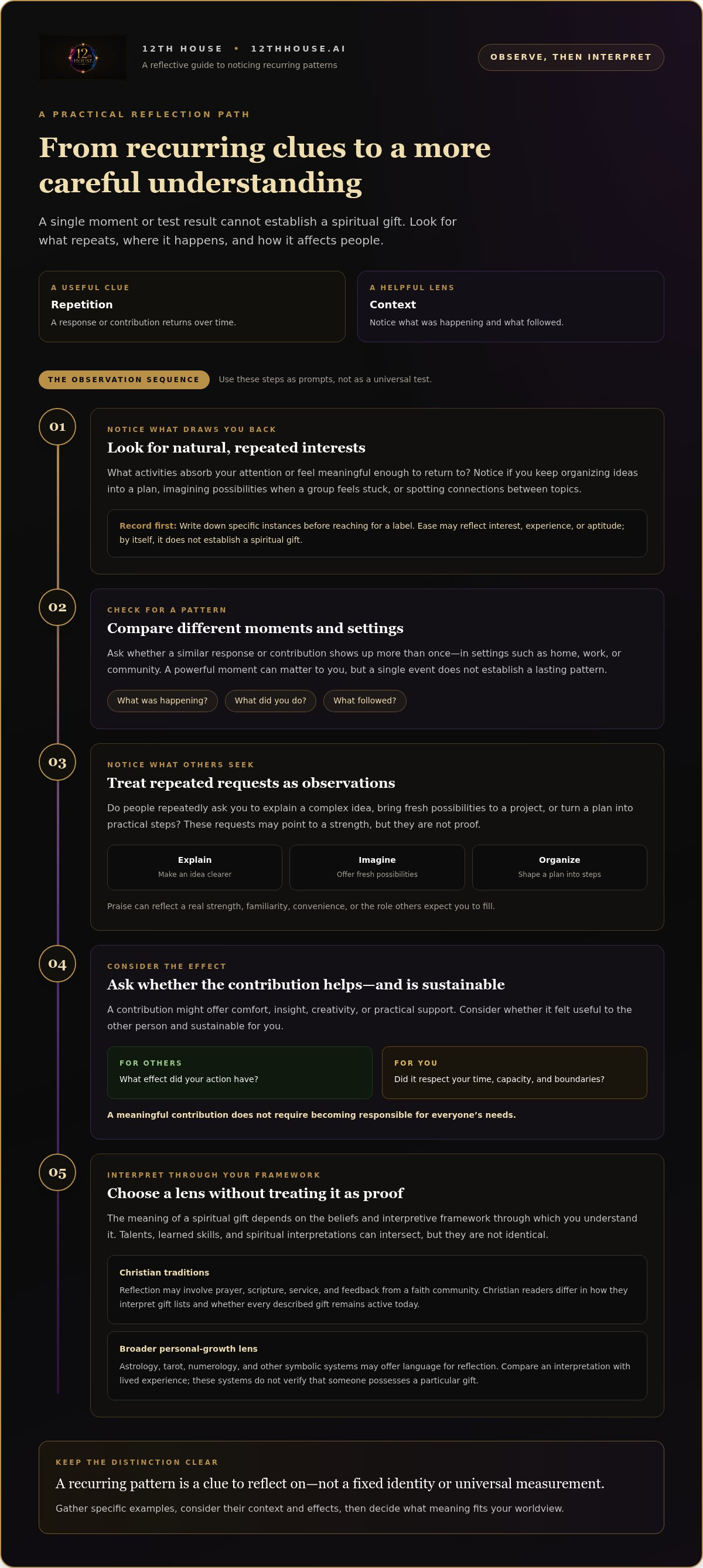
Look for clues in everyday life, not just in a dramatic experience or a questionnaire result. The prompts below aren’t a universal checklist of proven traits. They’re ways to gather observations and consider what those observations mean within your spiritual or personal framework.
A powerful moment can stay with you, but a single event doesn’t establish a lasting pattern. Notice whether a similar response or contribution appears in different settings, such as at home, at work, or in a community. Repetition gives you a clue; context helps you interpret it. Ask what was happening, what you did, and what followed.
Notice what comes naturally and consistently
Which activities absorb your attention or feel meaningful enough that you return to them? You might find yourself organizing scattered ideas into a clear plan, imagining possibilities when a group feels stuck, or spotting connections between topics. Record specific instances before reaching for a label. Ease may point to interest, experience, or aptitude; by itself, it doesn’t establish a spiritual gift.
Notice what you choose to do when there’s no recognition attached. Do you keep making space for creative work, helping a project take shape, or exploring questions others leave open? Consistency matters more than intensity. A burst of enthusiasm can be genuine, but a pattern repeated over time gives you more to reflect on.
Look at how your actions affect other people
Consider what people repeatedly seek from you. Do they ask you to explain a complex idea, bring fresh possibilities to a project, or turn a plan into practical steps? Treat those requests as observations, not proof. Praise can reflect a real strength, but it can also reflect familiarity, convenience, or the role others expect you to fill.
Look at the effect, too. Your contribution might offer comfort, insight, creativity, or practical support. Ask whether it felt useful to the other person and sustainable for you. A meaningful contribution doesn’t require you to become responsible for everyone’s needs. Notice where you can help with care while respecting your time, capacity, and boundaries.
For a Christian perspective on identifying gifts through reflection and community, the United Methodist Church’s Exploring Your Spiritual Gifts guide offers one tradition-specific reference. If you use astrology, tarot, or another symbolic system, treat its interpretations as prompts to compare with lived examples, not confirmation of a fixed identity. You can also use Lala AI for personalized spiritual reflection to explore questions that arise as you notice your patterns.
Spiritual Gifts Tests, Faith, and Metaphysical Tools: What Can Each Show?
If you’re asking, “what are my spiritual gifts,” different tools can help you examine the question from different angles. A faith-based survey may organize responses within a religious framework. Personal reflection can surface experiences a questionnaire misses. Community feedback adds another perspective, while symbolic systems offer interpretive prompts. None can verify a gift on its own.
Use each approach for what it can reasonably offer. If results conflict, don’t force them into one answer. A mismatch may reflect different assumptions, a narrow question, or a pattern that needs more observation. Compare the interpretation with your lived experience and the values you use to make meaning.
| Approach | What it can offer | Its limits |
|---|---|---|
| Faith-based survey | A profile organized around a particular tradition’s language and beliefs. | Questions and categories may not fit every denomination or worldview. |
| Personal reflection | Space to review recurring choices, experiences, and contributions. | Memory and self-perception can be selective. |
| Community feedback | Observations about how your actions affect others over time. | Other people may see only certain roles or settings. |
| Symbolic systems | Metaphors and questions that prompt a fresh angle on personal themes. | A reading isn’t objective evidence that you possess a specific gift. |
What a spiritual gifts assessment can and cannot tell you
A questionnaire gathers your self-reported answers and arranges them into a possible profile. That can help you name areas to explore, especially if the questions reflect a faith tradition you share. But the wording, its underlying beliefs, and your current understanding of yourself all shape your answers. Treat a result as a hypothesis: look for real examples that support, complicate, or challenge it. Some Christian resources also frame gifts around service, such as ChurchGrowth.org’s Spiritual Gifts and Their Relationship to God's Will.
How reflection tools can offer another perspective
Astrology, tarot, numerology, and Human Design are distinct symbolic systems with their own structures and vocabularies. They can prompt questions about how you communicate, make decisions, or respond to change, but they aren’t scientifically established methods for identifying spiritual gifts. A tarot spread might invite reflection on a recurring concern; a chart or profile might give you language to examine a theme. Neither confirms a capacity. For example, explore Tarot for spiritual reflection as a way to frame questions, or read about the five Human Design types as a symbolic framework, then compare any insight with your observed experience.
When signals disagree, separate the observation from the interpretation. Write down what happened, what a tool suggested, and what you think it means. Keep those as distinct notes. Over time, you can see whether an idea holds across settings or belongs to one particular lens.
A Practical Checklist for Exploring Your Spiritual Gifts
Turn your reflections into a simple record. Instead of deciding what an experience means in the moment, capture what you noticed and review it later. This works whether you understand spiritual gifts through faith, personal growth, or another worldview. The goal isn’t to collect signs or reach a verdict. It’s to see whether meaningful themes recur across different parts of your life.
Use a simple reflection log
For several weeks, note moments that feel meaningful, intuitive, or energizing. Keep entries brief and factual at first. Include the setting, what you did, and what you observed afterward. A conversation, group task, quiet creative activity, or family decision can each offer useful context. Don’t force a label onto an entry.
- Notice: What caught your attention, or what did you feel drawn to do?
- Record: Where were you, what action did you take, and what happened next?
- Reflect: Does this resemble another entry, or is it an isolated experience?
Include examples from more than one setting. If you often help people organize their thoughts, note whether that happens with friends, colleagues, or family. When you review the log, group similar entries and look for repeated actions or outcomes. A vivid event can be worth remembering, but it doesn’t have to become a conclusion.
Check interpretations with care
Once a possible theme emerges, examine it from more than one angle. Ask whether acting on it supports your wellbeing and other people’s agency. Does it respect boundaries, or does the label make you feel responsible for fixing every problem? A useful interpretation should invite thoughtful practice, not override consent, judgment, or personal limits.
You can ask a trusted person what they’ve observed, using specific examples rather than asking them to define your identity. Compare their perspective with your own and, if relevant, the beliefs of your faith tradition. Their feedback is one viewpoint, not a final ruling. You remain responsible for deciding what fits.
- Does the pattern appear in different situations?
- Can you describe its effect without relying only on praise or assumption?
- Does the interpretation leave room for uncertainty and choice?
Pause if a label creates fear, grandiosity, or pressure to act beyond your capacity. You can set an interpretation aside and keep observing. If you’re exploring what are my spiritual gifts through a symbolic system, treat its language as a prompt for reflection, then compare it with your log and lived experience.
To continue reflecting, explore personalized spiritual questions with Lala AI and consider how its perspective aligns with the patterns you’ve recorded.
How to Work With What You Discover
An insight becomes useful through practice, not through a label alone. Whether you understand a recurring strength as spiritual, personal, or both, choose a small action that lets you explore it without making it your whole identity. Keep the experiment manageable. You’re gathering context, not trying to prove one interpretation right.
Turn one insight into a grounded experiment
Choose one pattern you’ve noticed and express it in a manageable way. If you often help people clarify ideas, offer to listen and summarize what you hear. If you’re drawn to creative possibility, contribute one idea to a project. If practical support is a recurring strength, take on a clearly defined task rather than assuming responsibility for the whole outcome.
Before you act, ask: does this feel aligned, and does it help in a way that respects everyone’s boundaries? Afterward, note what happened. Did the action feel meaningful or draining? Was it useful to the people involved? You don’t need a dramatic result. Ordinary feedback can help you understand the pattern more accurately.
Keep the interpretation flexible. An experiment may confirm part of an idea, complicate it, or show that it fits only in certain settings. Review new experiences as they arise. A perceived gift shouldn’t require you to ignore your limits, take on unwanted duties, or make decisions for someone else.
Continue exploring with structured spiritual tools
If you want another perspective, use a tool to sharpen your questions rather than settle them. Lala can respond to personalized questions about spiritual topics, charts, spells, and compatibility. You might ask what a recurring theme in your notes brings up for you, or how a chart interpretation connects with an experience you’ve recorded. The response can help structure reflection; it doesn’t establish a definitive answer.
Astrology, tarot, numerology, and Human Design each offer distinct symbolic frameworks. Explore one that fits your interests, compare its language with your lived experience, and set it aside if it doesn’t resonate. An AI astrology assistant may help you consider chart themes as reflective prompts, while a tarot reading or numerology report can offer a different symbolic vocabulary. None should override your judgment or serve as proof of a specific ability.
Asking “what are my spiritual gifts” doesn’t require you to arrive at a final identity. Let your understanding develop through observation, chosen practice, and reflection. The next useful step may simply be one thoughtful experiment, followed by an honest review of what you learned.
Explore spiritual guidance with 12th House to continue your reflection with personalized questions and optional metaphysical tools.
Let Your Next Step Be an Experiment
You don’t need a final label before you begin. Let “what are my spiritual gifts” remain an open question as you choose one small, intentional way to express a pattern you’ve noticed. Pay attention to what feels meaningful, what supports others without crossing your limits, and what you learn from the experience. Your understanding can change as you gather context.
If a structured reflection tool would help, Lala AI responds to personalized questions about spiritual topics and chart-related inquiries. Explore that perspective alongside astrology, tarot, numerology, Human Design, and self-guided learning resources, using each as an optional lens rather than a verdict.
Explore personalized spiritual reflection with 12th House and bring your questions, curiosity, and lived experience into the process. You’re allowed to move at your own pace. Each honest observation can help you find a next step that feels grounded and true to you.
Frequently Asked Questions
How many spiritual gifts can one person have?
There’s no single number that applies across traditions. Some Christian assessments identify a dominant gift while recognizing other strengths; broader personal frameworks may not rank gifts at all. If you’re asking what are my spiritual gifts, resist the pressure to choose one category too quickly. For example, someone might regularly teach a skill while also offering practical care. Consider how your own beliefs define gifts, and leave room for more than one pattern.
Can your spiritual gifts change over time?
Your expression of a perceived gift can shift as your roles, interests, and circumstances change. A person who once supported a community by organizing events might later contribute through mentoring or creative work. Some faith traditions understand gifts as given by God; other reflective approaches focus on how strengths develop or become more visible. Review what you actually do across life stages, rather than treating a temporary change in activity as proof that a gift has appeared or vanished.
Are spiritual gifts the same as talents or strengths?
Not necessarily. A talent often describes an ability, such as singing or explaining a complex idea, while a strength may refer to a behavior you use effectively, such as patience or careful planning. “Spiritual gift” can add religious or metaphysical meaning, depending on your framework. Clear communication, for instance, may be a practiced skill and, within a faith tradition, understood as serving a wider purpose. The ability alone doesn’t determine which interpretation applies.
Are spiritual gifts tests accurate?
A spiritual gifts test can summarize your answers, but it can’t independently confirm a spiritual or metaphysical claim. Results may be shaped by the test’s categories and by how you interpret its questions. If a survey identifies teaching as a strength, consider whether you can name situations where you’ve explained something clearly and what happened afterward. Treat the result as a possibility to examine, not a verdict. Be cautious of tests that promise certainty from a score alone.
Can you have spiritual gifts if you are not religious?
People use the phrase in different ways, so the answer depends on what they mean by “gift.” Christian assessments generally place gifts within faith, scripture, and service. Others use the term as personal language for qualities such as empathy, creativity, or intuition, without making a religious claim. You can reflect on recurring qualities without adopting a belief system. Be clear with yourself about whether you’re describing a faith-based conviction or a personal interpretation.
How can I tell intuition from anxiety?
A feeling alone can’t reliably distinguish intuition from anxiety. Note what triggered it, what you know as fact, and what you’re predicting or fearing. For example, before interpreting a sudden worry about a conversation as a spiritual message, consider whether you have specific information or are anticipating a difficult outcome. Give consequential choices time and seek a grounded perspective. If anxiety is disrupting daily life, consider speaking with a qualified mental health professional.


