

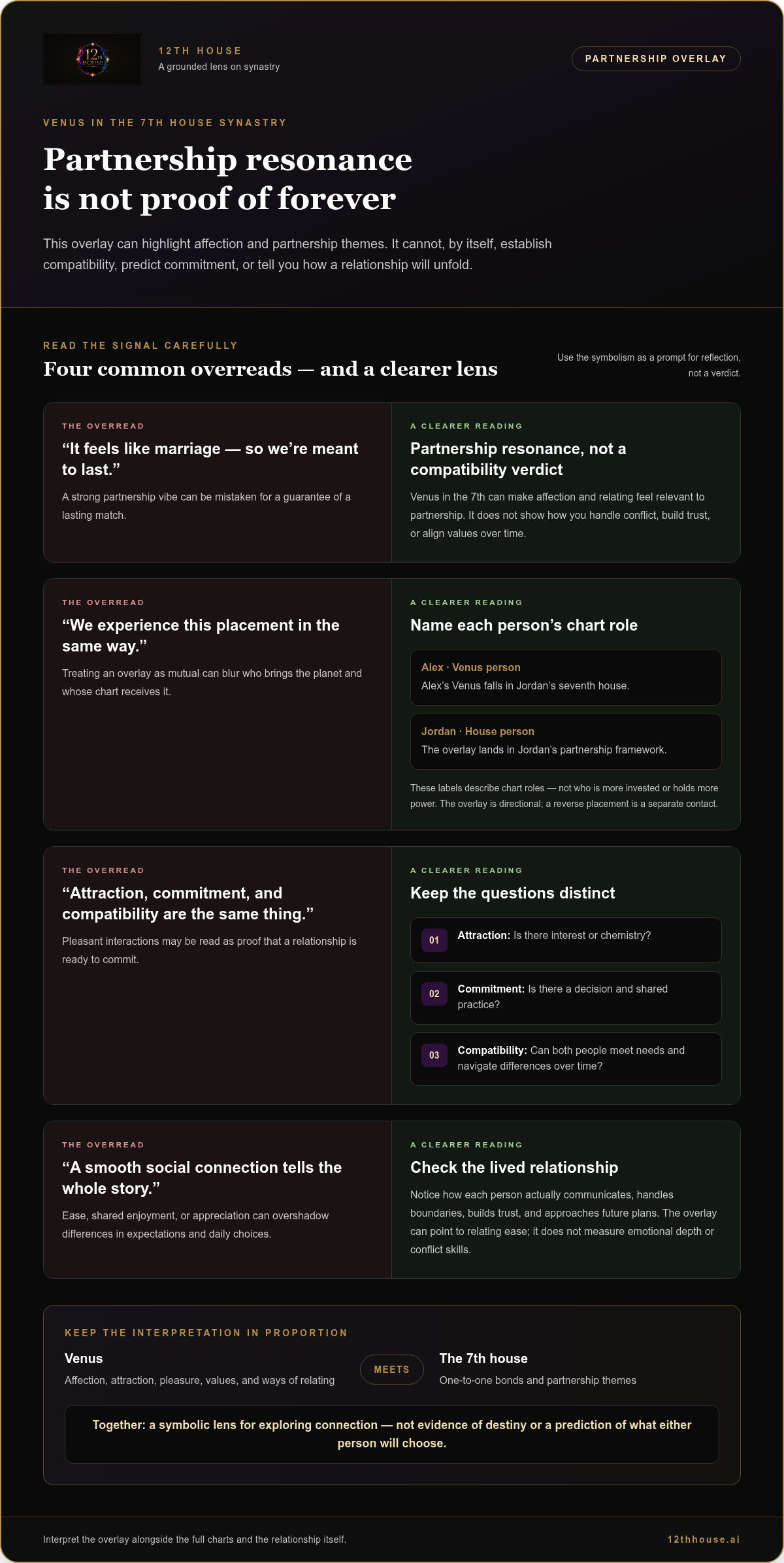
What if a strong sense of partnership is meaningful, but not a promise of forever? Venus in the 7th house synastry describes an overlay in which one person’s way of expressing affection may resonate with the other person’s ideas about partnership. The house person may see the Venus person through the lens of an ideal mate, but that impression is only one part of the relationship.
It’s easy to read that “marriage vibe” as proof that you’re naturally suited to be together. But attraction and compatibility aren’t the same thing. This overlay highlights relationship themes; on its own, it can’t tell you how you’ll handle conflict, build trust, or align your values over time.
This guide clarifies each person’s role, what the placement may suggest, and what it can’t guarantee. It also shows how to place the overlay within the wider synastry chart, where aspects and other planetary connections add context. Use the interpretation as a framework for reflection, not a verdict. Personalized chart questions with Lala can help you explore both partners’ placements in more detail.
Key Takeaways
- Identify whose Venus falls into whose seventh house before interpreting the overlay. The Venus person and house person may experience it differently.
- Read Venus in the 7th house synastry as one layer of the relationship chart, not a verdict on long-term compatibility.
- Compare the overlay with Venus aspects, Moon contacts, and each person’s seventh-house ruler for a fuller picture.
- Check both birth times before relying on house placements, since an uncertain time makes house overlays less secure.
- Use personalized chart questions with Lala to explore both partners’ placements and develop your own interpretation.
What Venus in the 7th House Synastry Means for a Relationship
In synastry, Venus in the 7th house synastry occurs when one person’s Venus falls in the other person’s seventh house. Synastry compares two natal charts by placing one person’s planets against the other person’s chart, including its houses. This creates an overlay: a connection between one person’s planetary symbolism and an area of life in the other person’s chart.
Astrologically, Venus is associated with affection, attraction, pleasure, values, and ways of relating. The seventh house is associated with one-to-one bonds and partnership. Together, these symbols suggest that Venusian qualities may feel especially relevant to how the house person thinks about partnership. They don’t establish what either person will feel or do in real life, and the overlay can’t stand in for the rest of the charts or the relationship itself.
This overlay suggests partnership resonance, not proof of compatibility. It offers a symbolic lens for exploring what each person brings to the connection, not a verdict about whether the relationship will last.
Who is the Venus person, and who is the house person?
Imagine Alex’s Venus falls in Jordan’s seventh house. Alex is the Venus person, because it’s Alex’s planet making the contact. Jordan is the house person, because the overlay lands in Jordan’s seventh house. Astrologers interpret Alex’s Venus through the framework of Jordan’s chart. These labels describe chart roles, not who is more invested or who holds more power.
Alex brings their particular style of affection, appreciation, and relating to the connection. Jordan may interpret those qualities through partnership themes. That doesn’t mean Jordan automatically sees Alex as an ideal partner, or that Alex experiences the relationship in the same way. Each person’s chart provides a different frame. The overlay is directional: if Jordan’s Venus also falls in one of Alex’s houses, that’s a separate contact to interpret, not an automatic consequence of Alex’s placement.
Why the seventh house is linked with partnership
In astrological symbolism, the seventh house provides a framework for committed one-to-one bonds, agreements, and the qualities encountered through close partnership. It sits opposite the first house, which is associated with the self and personal approach. This axis gives astrologers a way to examine how a person relates to others.
The Descendant marks the beginning of the seventh house and forms the opposite point to the Ascendant. Astrologers use it as a reference point when interpreting partnership themes and qualities a person may notice in significant others. When another person’s Venus overlays this area, the symbolism connects their Venusian expression with the house person’s partnership framework. This is an interpretive tradition, not evidence that two people are destined or objectively suited to each other. Treat it as a prompt for observation: what kind of relating does each person actually experience?
How Venus in the 7th House Synastry Can Shape Attraction and Partnership
In a traditional reading, the Venus person’s way of expressing affection may appeal to qualities the house person associates with partnership. Interactions may feel pleasant or socially easy. The two people might enjoy similar settings, appreciate one another’s style, or find it natural to offer kindness. But Venus in the 7th house synastry doesn’t show whether both people feel the same level of attraction or whether the connection will develop into commitment.
Think of this overlay as a relationship theme to examine, not a script. Venus can describe preferences and relating style, while the seventh house gives those themes a partnership-oriented setting. What happens depends on the people involved, their full charts, and how they treat each other in daily life.
What the Venus person may experience
The Venus person may be drawn to qualities they associate with a partner, such as the house person’s way of collaborating, social ease, or approach to one-to-one bonds. They might want to create harmony or show appreciation. These are possibilities within the symbolism, not universal effects. Venus’s sign, aspects, and wider natal chart shape how the person gives and receives affection.
What the seventh-house person may experience
The house person may find the Venus person’s warmth, taste, or social manner appealing within a partnership context. That can feel comfortable or affirming, especially if the Venus person’s style fits what the house person values in a close bond. But comfort and appreciation don’t automatically mean romantic desire, exclusivity, or a decision to commit. Look to the person’s words and choices for those answers.
An astrological theme offers a lens for understanding connection; it doesn’t predict what either person will choose. That distinction matters. Attraction is an experience of interest or chemistry. Commitment is a decision and shared practice. Compatibility involves whether two people can meet each other’s needs and navigate differences over time. These questions can overlap, but a single overlay can’t answer all three.
For example, two people might enjoy each other’s company and move easily through social settings, yet have different expectations about time, boundaries, or future plans. Another pair may feel less effortless at first but communicate clearly and build trust through consistent actions. Venus in this house can point to ease in relating, but it doesn’t measure emotional depth or conflict skills. Notice where the symbolism matches real interactions and where lived experience tells a more complex story.
To explore how this pattern fits alongside both partners’ placements, ask personalized questions about chart compatibility. Use the interpretation as a prompt for reflection, then compare it with what you observe and discuss together.
Venus in the 7th House Synastry Compared With the Rest of the Chart
An overlay is one coordinate in a larger synastry map. To understand how it may function, compare it with planetary aspects, emotional contacts, and partnership indicators in both charts. A supportive Venus overlay may sit alongside tension elsewhere, while challenging contacts may complicate how affection is expressed. Neither automatically erases the overlay. Each factor adds a different layer to the interpretation.
Overlay placement versus planetary aspects
A house overlay describes where one person’s planet lands in the other person’s chart. An aspect describes the angular relationship between two chart points, such as one person’s Venus and the other’s Saturn. Read them as complementary layers: the house points to a life area activated, while the aspect describes an interaction between planetary functions. For a wider framework, explore birth chart compatibility.
| Overlay theme | Other chart factor to inspect | Interpretive question |
|---|---|---|
| Venus in the seventh house | Aspects to the Venus person’s Venus | Do other planets support or complicate how affection is expressed? |
| Partnership-oriented attraction | Moon contacts between charts | Do emotional needs and habits feel understood or mismatched? |
| One person’s planet in the other’s house | Both partners’ seventh-house rulers | How does each person’s broader partnership pattern connect? |
| Possible ease in relating | Reciprocal overlays and aspects | Does the chart show meaningful connection in both directions? |
Use the table as a set of questions, not a scoring system. A harmonious aspect may suggest easier cooperation between the planets involved; a tense aspect may describe friction that calls for awareness or adjustment. For instance, a difficult Venus-Saturn contact could symbolize caution or differing approaches to affection, but it doesn’t cancel the house overlay. It changes the context in which you interpret it.
Reciprocity, house rulers, and the wider relationship pattern
Check both charts rather than assuming one person’s placement is mutual. Does the house person’s Venus, Moon, or another planet also contact the other person’s partnership indicators? Then locate the ruler of each seventh house, based on the sign on that house cusp, and examine its placement and contacts. This adds another symbolic layer for considering how each person approaches partnership.
Keep the interpretation proportionate. If one chart shows a clear overlay but few other links, describe that specific emphasis instead of calling the entire connection reciprocal. If several factors converge, note the pattern while leaving room for differences in lived experience. Ask what the chart suggests, which placements modify that suggestion, and what the two people’s communication and choices reveal.
How to Read Venus in the 7th House Synastry Without Overreading It
A careful reading starts with chart mechanics, then turns to lived experience. Venus in the 7th house synastry offers a symbolic perspective, but its meaning depends on accurate data, the direction of the overlay, and the wider relationship pattern. Use this sequence to keep your interpretation grounded:
- Confirm the chart data. Check that each chart is assigned to the right person and that the birth details were entered correctly. House placements depend on birth time and chart calculation, so an error can shift the overlay.
- Identify the roles. Name whose Venus is involved and whose seventh house receives it. This keeps the interpretation directional and prevents you from assuming both people experience the contact in the same way.
- Inspect the overlay. Consider what the Venus person’s style of affection and relating may bring into the house person’s partnership framework. Treat this as a theme to investigate, not a description that must fit.
- Add chart context. Look at relevant aspects, emotional contacts, and partnership indicators in both charts. Then compare the symbolism with what you know about the connection.
Check birth data and identify the overlay correctly
Birth time matters because the Ascendant and house cusps are calculated from the time and place of birth. If either person’s time is uncertain, the house overlay is less secure and shouldn’t be treated as definite. You can still examine Venus and other planetary contacts, but keep conclusions about the seventh house provisional. Chart roles matter too: swapping the charts changes whose Venus is being interpreted in whose house.
Turn the symbolism into useful reflection
Test the interpretation against observable experience. Does the Venus person show affection in ways the house person appreciates? Does the house person feel comfortable discussing partnership expectations? Consider behavior, boundaries, and communication alongside chart symbolism. A broader birth chart interpretation can help place one contact within the full synastry picture.
Ask questions that invite honest answers rather than predictions: Do both people feel valued? Are expectations about commitment clear? Can each person express a need or boundary without pressure? If the symbolic reading suggests ease but daily interactions feel strained, take that discrepancy seriously. Astrology can offer language for reflection; it shouldn’t override what either person says or does.
A single synastry placement shouldn’t decide a relationship because it describes one symbolic connection, not the full reality two people create together. Let the chart raise questions, then give real communication and mutual choices the final weight.
To examine both partners’ placements through personalized chart questions, explore your compatibility with Lala as a reflective aid, not a source of guaranteed outcomes.
Explore Your Venus in the 7th House Synastry With Lala
General interpretations give you a framework; your own chart brings the details: whose Venus is involved, which house receives it, and what other placements shape the connection. If you’re exploring Venus in the 7th house synastry, Lala can answer personalized questions about charts and compatibility, helping you examine both partners’ placements instead of relying on a one-size-fits-all description.
Use AI guidance as a reflective aid. It can help you explore astrological symbolism and organize questions, but it can’t guarantee what a relationship will become or determine what another person feels. Keep your own judgment, conversations, and observations at the center.
Ask questions that clarify your specific chart
Start with the chart structure. Ask which person is the Venus person, whose seventh house receives the overlay, and what the placement may symbolize for each partner. Then add context with follow-up questions about aspects to Venus, Moon contacts, or each person’s seventh-house ruler. Focus on interpretation, not certainty about someone else’s feelings.
- “In our charts, whose Venus falls in whose seventh house?”
- “How might this overlay interact with the aspects to each person’s Venus?”
- “What other placements could add context to our partnership themes?”
- “What questions can this symbolism help me reflect on in our actual communication?”
These prompts create a more useful inquiry than asking whether the placement means you’re destined to be together. They direct attention toward chart roles, connections, and lived experience. If a birth time is uncertain, include that context in your question, since the house placement may be less reliable.
Continue your study with structured relationship guidance
Follow a question through the chart instead of treating one placement as the whole answer. 12th House’s metaphysical library supports self-guided learning, so you can build familiarity with the symbolic language behind synastry. For more context on using AI as a chart-study tool, read the AI astrology assistant guide.
Let each interpretation open a line of inquiry, then compare it with what both people express and choose. That keeps astrology in its proper role: a structured lens for reflection, not a substitute for direct communication or personal discernment.
Explore personalized chart guidance with Lala to examine your compatibility questions through the placements in both charts.
Let Your Chart Open a Better Question
The most useful next step may not be asking whether a connection is destined to last. Ask what kind of partnership you’re building, what each of you needs to feel respected, and whether your actions align with the relationship you want. These questions bring the symbolism into lived experience, where clarity comes from honest reflection and conversation.
Use Venus in the 7th house synastry as a point of inquiry, not a verdict. Let it sharpen your attention to how you give affection, respond to one another, and define partnership. Then make room for the evidence of daily life. Astrology can help you notice patterns, but your choices shape what happens next.
Explore both charts with Lala to consider your specific questions. Bring curiosity, keep your own judgment in view, and let each insight support a more intentional connection.
Frequently Asked Questions
Does Venus in the 7th house synastry mean marriage?
No. Venus in the 7th house synastry can highlight partnership themes, but it can’t confirm marriage or predict a relationship’s outcome. The seventh house is associated with one-to-one bonds, not a guaranteed legal commitment. Two people might value each other’s company yet want different levels of commitment. Discussing expectations and observing how both people act offers more practical insight than treating one placement as a promise.
Can Venus in the 7th house synastry be platonic?
Yes. The overlay can describe appreciation, ease, or cooperation in a close one-to-one bond without requiring romantic attraction. Friends, creative collaborators, or business partners may enjoy each other’s style and find it natural to work together. The chart doesn’t define the relationship’s label. Consider the setting, each person’s intentions, and the boundaries they communicate before interpreting partnership symbolism as romantic interest.
Does the Venus person or the house person feel the attraction more?
There’s no reliable rule that assigns stronger attraction to one person. The Venus person may recognize appealing qualities in the house person, while the house person may experience the Venus person’s style through partnership-related themes. Neither description establishes who feels more or whether attraction is romantic. Compare each person’s broader chart and, most importantly, their expressed interest and behavior rather than trying to rank feelings from the overlay.
What if Venus is close to the Descendant in synastry?
If one person’s Venus is close to the other person’s Descendant, astrologers may give extra attention to the contact because the Descendant marks the beginning of the seventh-house axis. Check the exact degrees and the house system used before interpreting it. A close contact can sharpen a partnership theme symbolically, but it still doesn’t establish mutual attraction, commitment, or compatibility. Birth-time accuracy matters because the Descendant depends on the chart’s recorded birth details.
Can you interpret this overlay if one person does not know their birth time?
You can examine other synastry factors, but the house overlay may be uncertain without a reliable birth time. The houses and Descendant depend on birth details, so an estimated time can place Venus in a different house or shift its distance from the Descendant. Avoid presenting the seventh-house placement as definite. You can still consider planetary contacts that don’t rely on houses, while treating house-based conclusions as provisional.
Does Venus in the 7th house synastry affect both partners equally?
No. It’s a directional overlay: one person’s Venus lands in the other person’s seventh house, so each has a different chart role. The house person’s chart provides the area receiving the contact; the Venus person’s chart provides the planet and its particular expression. This doesn’t prove one partner feels more invested. To explore reciprocity, look for additional connections from both charts and compare them with what each person communicates.
Can this overlay matter if the relationship is not romantic?
Yes. In a platonic or professional relationship, astrologers may read the seventh-house symbolism through cooperation, negotiation, or the experience of working closely with another person. For instance, the contact might prompt reflection on how each person approaches fairness or shared decisions. It doesn’t mean the bond should become romantic. Interpret the symbolism in light of the relationship that actually exists and the boundaries both people choose.


