

What if a tarot card didn’t tell you what will happen, but helped you notice what’s happening inside you now? Anxiety can make it difficult to slow down and name what’s driving a feeling. Using tarot to overcome anxiety can offer a structured moment of reflection, but it can’t diagnose or treat anxiety, and it shouldn’t replace mental health care.
A card’s symbolism can feel confusing or alarming, especially when you’re already unsettled. Read the imagery as a prompt for inquiry, not a prediction or verdict. With clear boundaries, a simple spread can help you pause, identify a concern, and consider one grounded next step without asking the cards to make decisions for you.
This guide walks you through a brief, bounded tarot reflection practice, explains how to interpret cards without turning them into diagnoses or forecasts, and covers when support beyond a self-guided ritual may be important. Use tarot as a tool for self-understanding, alongside the care and practical support your wellbeing requires.
Key Takeaways
- Use tarot as a symbolic prompt to explore feelings, not as a clinical reading of your mental state.
- Choose open-ended questions that invite reflection instead of asking the cards to predict what will happen.
- Notice when repeated draws become a search for certainty, and give yourself permission to pause.
- Try a five-step practice for using tarot to overcome anxiety as a bounded reflection ritual, not a treatment plan.
- Explore 12th House tarot readings and Lala for metaphysical inquiry, while turning to mental health care for anxiety support.
Using tarot to overcome anxiety with clear boundaries
Keep the practice focused on one question about your present experience. Treat the card as a starting point for reflection, not evidence about your health or a way to get certainty about the future. If the exercise increases distress, stop and choose another form of support.
Tarot for Anxiety: What the Practice Can and Cannot Do
Wanting a calm, personal way to examine difficult feelings makes sense. Anxiety can feel diffuse: you may notice tension or unease before you can name what’s on your mind. Tarot can offer a pause and a symbolic structure for reflection. It doesn’t reveal a hidden diagnosis or guarantee that a difficult feeling will pass.
Tarot can support reflection, but it cannot diagnose or treat anxiety. Treat the cards as prompts for meaning-making, not as a clinical method or a verdict about your health. Worry may arise around a specific event and ease as circumstances change. Distress that persists or interferes with daily life deserves attention, but noticing that pattern isn’t the same as diagnosing yourself. The cards can’t determine what’s causing it.
What does tarot offer when anxiety feels difficult to name?
A card’s image gives your attention something concrete to work with. Instead of trying to solve every thought at once, ask, “What feeling is most present for me right now?” Describe what you notice in the image and what it brings to mind. Tarot card reading has been used for divination and self-reflection; in a grounded practice, symbolism invites you to consider your own response. It isn’t proof about your inner state.
For example, imagine drawing a card that depicts a figure standing at a crossroads. You might notice uncertainty, impatience, or nothing in particular. You don’t need to decide that the card explains why you feel anxious. You can simply write, “I feel unsettled when I think about making a choice,” and leave the cause open. Insight can help you describe an experience, but it doesn’t show that symptoms have changed or establish what support you need.
Why tarot is not a substitute for mental health care
Tarot isn’t diagnosis, psychotherapy, or medical treatment. A reading can’t assess symptoms, provide a treatment plan, or replace care from a qualified mental health professional. Using tarot to overcome anxiety should mean using it as a bounded reflection tool, not asking it to carry responsibilities it cannot fulfill.
If anxiety persists or disrupts sleep, work, relationships, or ordinary routines, consider reaching out to a mental health professional or healthcare provider. You don’t need to wait until you feel certain that your distress is “serious enough” to ask for support. A reflective ritual may sit alongside professional care, but it should never delay it. If you’re in immediate danger or facing a crisis, contact local emergency services or a crisis service. In that moment, prioritize direct human support over a card reading.
How tarot reflection works: symbols, questions, and emotional distance
A tarot card doesn’t provide an objective reading of your mental state. Its images and traditional meanings offer material to interpret, while your own experience supplies the context. Symbolic meaning can prompt reflection, but it isn’t factual evidence or a clinical assessment. That distinction can create useful emotional distance: look at an image, notice your reaction, and consider what it brings up without treating the card as an authority on what you feel.
Keep your interpretation provisional. A guidebook may suggest one association, while the image brings another to mind. Accept what feels useful, set aside what doesn’t fit, and stop if an interpretation feels distressing. You don’t have to force meaning from a card or treat discomfort as proof that it has revealed a hidden truth.
Turn an anxious thought into a grounded tarot question
Notice the difference between asking for certainty and asking for perspective. “Will something go wrong?” invites a prediction you can’t verify through a card. “What deserves my attention today?” shifts the focus to what you can observe. Other open prompts include:
- “What feeling would be useful to acknowledge?”
- “What need might I be overlooking?”
- “What choice is available to me right now?”
These questions don’t promise an answer. They define a point of inquiry, which can help when a thought feels too broad to examine. If you catch yourself rephrasing the same question or drawing again for a more reassuring result, pause instead of seeking another card for certainty. Using tarot to overcome anxiety shouldn’t become a cycle of checking whether a feared outcome will happen.
Read a card without treating it as a warning
Begin with observation, not a verdict. Describe what’s visibly present: a person’s posture, the setting, the direction of movement, or the atmosphere of the image. Then notice your response. Does the scene feel tense, hopeful, familiar, or unclear? Naming your reaction keeps the interpretation connected to your perspective instead of turning one traditional meaning into a fixed conclusion.
Next, allow more than one reading. A closed door might suggest a limit, privacy, or simply a detail that catches your eye. Ask which interpretation resonates with your present context, and remember that resonance is personal, not proof. Even cards commonly described as difficult don’t forecast danger, illness, or inevitable events. If an interpretation increases distress, set it aside. You can choose not to use it.
For a structured prompt that keeps the focus on symbolic exploration, 12th House spiritual guidance offers another way to frame a metaphysical question. Keep the same boundary: a prompt can support reflection, but it cannot establish facts about your future or mental health.
Tarot and anxiety: reflection versus reassurance-seeking
A reading can feel reassuring in the moment, but it can’t establish what will happen or remove anxiety on demand. The distinction lies in how you use the cards. Reflection lets a prompt open a question. Reassurance-seeking asks the cards to settle uncertainty, often by returning to the same concern until an answer feels safe enough. That urge is understandable. It doesn’t mean you’ve done anything wrong, but it may be a cue to pause.
For example, drawing a card to consider what you need in the present is different from repeatedly asking whether a feared event will occur. A card can’t verify the future, and a reassuring interpretation can’t guarantee an outcome. If you find yourself searching for certainty, step back from the reading rather than reshuffling for a different answer. Using tarot to overcome anxiety should leave space for uncertainty, not turn the deck into a checking mechanism.
Signs a tarot session is supporting reflection
A reflective session has a clear purpose and a natural endpoint. You can consider what a card brings to mind without treating it as an instruction, prediction, or measure of your wellbeing. The result doesn’t need to resolve the whole concern. A useful prompt might lead to a small observation, such as noticing that you feel stretched thin and could make room for a quiet break.
- You can disagree with an interpretation or leave it open.
- You stop when your planned reflection is complete, rather than drawing until you feel certain.
- You keep high-stakes choices grounded in relevant facts, your own judgment, and appropriate advice.
These are signs of a bounded practice, not a test you must pass. If the session leaves you unsure, you don’t have to force a conclusion.
When to pause a reading and seek additional support
Pause if a card leaves you feeling more frightened or trapped, or if you feel compelled to draw again to neutralize its meaning. Put the deck aside. Bring your attention back to the room: notice your feet on the floor, name a few things you can see, or take a slow breath without trying to interpret anything. The aim is to return to the present, not to prove that a feared outcome is impossible.
If anxiety keeps returning, escalates, or interferes with daily functioning, consider speaking with a qualified mental health professional or healthcare provider. Tarot is not a substitute for that care, and a reading shouldn’t delay reaching out. You can also stop using tarot for this topic entirely. A tool that intensifies distress isn’t serving your reflection, and choosing a different form of support is a sound boundary.
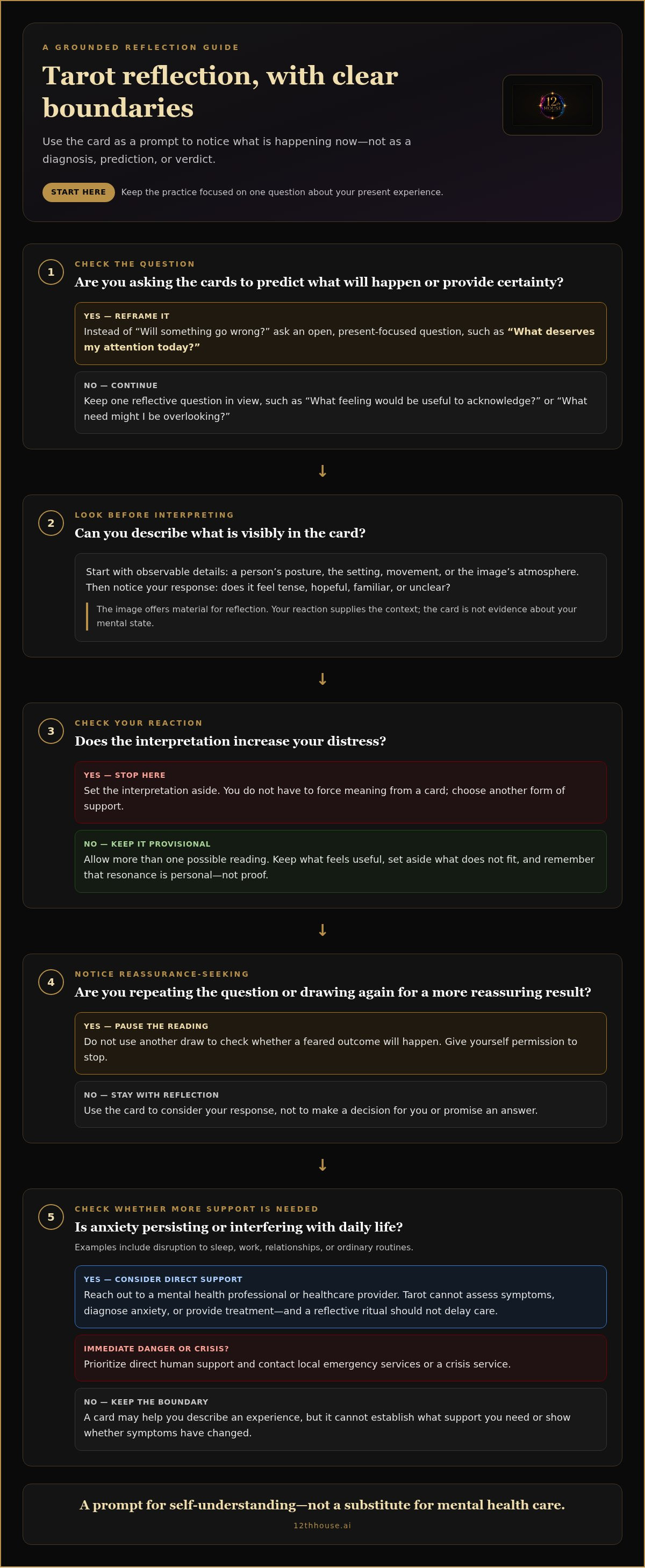
A five-step tarot practice for calmer, bounded reflection
A simple structure can keep a tarot session focused on reflection rather than turning it into a search for certainty. Use one card, or skip the draw and work with a symbolic prompt instead. You’re not interpreting the card as treatment, and you don’t need a complex spread to make space for a thoughtful pause.
Prepare your space, ask one open question, draw one card, reflect without forcing meaning, and close the session. Each step has a specific role. Move through them in order, and let the boundary be part of the practice.
- Prepare. Choose a moment when you can pause without rushing. Decide on an endpoint before you begin, such as finishing after one written reflection. Take a breath, notice your surroundings, and name the feeling you’re bringing to the exercise. If you already feel overwhelmed, it’s fine to choose a different grounding activity instead.
- Ask. Frame one open, present-focused question about your experience or choices. For example: “What might deserve my attention today?” or “What would help me meet this moment with care?” Avoid asking the cards to guarantee an outcome or settle a high-stakes decision. A question is a lens, not a demand for certainty.
- Draw. Pull one card and place it where you can see the image clearly. A single card keeps the exercise contained and makes it easier to stay with one prompt. If drawing feels unhelpful, keep the question and write a few words about it without using a deck. You can stop here at any point.
- Reflect. Describe what you notice before looking up a fixed meaning: colors, figures, movement, or the mood of the scene. Write down one association that feels relevant, while allowing for uncertainty or disagreement. Then note one feeling, need, or small practical next step. Don’t treat the card as a cure, instruction, or forecast.
- Close. Set the card aside, put the deck away, and mark the end of the exercise in a simple way, such as closing your journal. Check in with yourself without judging the result. If distress remains or increases, step away from interpretation and seek appropriate support rather than drawing again.
This method makes using tarot to overcome anxiety a bounded reflection practice, not a promise of relief. The useful outcome may be a clearer question or a small action, not certainty. If you want a structured space to explore tarot symbolism, explore 12th House tarot readings as a tool for spiritual reflection, not mental health care.
Explore tarot for self-reflection with 12th House
Once you have a bounded reflection practice, you can explore tarot as part of a wider study of symbolism. 12th House offers tarot readings for spiritual exploration, alongside Lala, an AI assistant for personalized metaphysical questions, and a library of books, videos, and ritual frameworks for self-guided learning. These tools can help you engage with symbolic systems, but they aren’t anxiety care, clinical assessment, or a replacement for professional support.
Keep your intention clear before you begin. Ask what perspective you’d like to consider, what value you want to bring to a situation, or what part of an experience you want to examine. A symbolic interpretation is a prompt for your own thinking, not a prediction or prescription. You can reflect on an idea without treating it as a fact or instruction.
Choose a reflective question before exploring a reading
Try questions that leave room for your judgment: “What matters most to me in this situation?” or “What perspective haven’t I considered?” Keep the inquiry focused on reflection rather than asking a reading to settle what will happen. If you use Lala, approach its responses as AI-generated metaphysical guidance, not clinical authority; the guide to AI astrology assistance offers context for understanding that boundary.
For broader tarot foundations, the Tarot Mastery guide can help you explore the practice’s symbolic language and interpretive structure. Use that learning to deepen your understanding, not to turn a card into a verdict about your mental health.
Keep spiritual exploration connected to real-world support
Spiritual inquiry can sit alongside practical care, but it can’t replace it. If anxiety persists, disrupts daily functioning, or escalates, consider speaking with a qualified mental health professional or healthcare provider. You can pause tarot exploration whenever it increases distress, and you don’t need to resolve a feeling through symbolism before seeking support.
Approach the platform as a space for learning and reflection at your own pace. Explore a reading, ask Lala a metaphysical question, or use the library’s resources to study tarot within a broader symbolic framework. Keep the role of each tool precise: they can support curiosity and self-guided exploration, while care for anxiety belongs with appropriate mental health support.
Choose your next step with care
Let the next step be modest. You might carry one question into your day, write down an observation, or decide that you’re finished exploring for now. You don’t need to turn a symbol into a plan. The value of using tarot to overcome anxiety lies in the space it can create for reflection, not in certainty or a guaranteed change in how you feel.
If symbolic exploration remains useful to you, 12th House offers tarot readings and self-guided metaphysical learning resources. Lala, its AI spiritual guidance assistant, can help you explore personalized metaphysical questions, but it isn’t a clinician or a source of mental health care. Keep professional support in the picture if anxiety persists or affects your daily life.
Continue at your own pace, with curiosity and clear boundaries. Explore tarot and spiritual guidance with 12th House as one path for ongoing self-reflection. You can meet the symbols thoughtfully while staying rooted in the care and choices that support you.
Frequently Asked Questions
Can tarot help with anxiety?
Tarot may help you organize thoughts or find language for a feeling, but it isn’t a treatment for anxiety. For example, a card might prompt you to notice that uncertainty about a conversation is weighing on you. That observation can guide journaling or a practical conversation, but it doesn’t show that anxiety has eased. Using tarot to overcome anxiety should mean using it for reflection, not relying on it to manage symptoms.
Can tarot cards predict an anxiety attack?
No. Tarot cards can’t reliably predict whether or when you’ll experience an anxiety attack. If you’re concerned about recurring episodes, focus on patterns you can observe, such as situations, sensations, or thoughts you notice before distress rises. Keep those notes for yourself or discuss them with a healthcare professional. Don’t use a card draw to decide whether symptoms are safe to ignore or whether you need care.
Which tarot card represents anxiety?
No single tarot card represents anxiety for everyone. Some readers associate the Nine of Swords with worry or troubled thoughts, but that’s a symbolic convention, not a mental health assessment. A card’s meaning depends on the deck, the question, and your associations with its imagery. If a card feels alarming, you can set that interpretation aside rather than treating it as evidence about your emotional state.
How often should I use tarot for anxiety?
There’s no clinical schedule for using tarot, and you don’t need to draw cards every day. Consider using it only when you have a clear reflective question and feel able to accept an uncertain answer. If you notice yourself returning to the deck repeatedly for reassurance, take a break. A journal entry, conversation with someone you trust, or professional support may be a more useful next step.
Can tarot replace therapy or medication for anxiety?
No. Tarot can’t replace therapy, medication, or advice from a qualified healthcare professional. If you’re already taking medication, don’t change or stop it based on a card reading; discuss treatment questions with the professional who prescribed it. Tarot may be a personal reflection practice alongside appropriate care, but it can’t determine what treatment is right for you or assess whether your symptoms need attention.
What should I do if a tarot reading makes me more anxious?
Stop the reading and put the cards away. Shift attention to something concrete, such as naming objects in the room or feeling your feet against the floor. Avoid drawing another card to cancel out a frightening interpretation. If the anxiety continues, affects your daily activities, or feels difficult to manage, reach out to a qualified mental health professional or healthcare provider for support.
Is a tarot reading online as useful as reading cards myself?
It depends on what helps you reflect. Reading your own cards lets you choose the question and record your immediate associations. An online reading can provide a different interpretive perspective, but it shouldn’t be treated as more authoritative or factual. With either format, usefulness comes from whether the process supports thoughtful inquiry without pressuring you to accept a prediction or make a high-stakes decision.


