
The calendar gives you a window, not a verdict: a second Saturn return typically occurs around ages 57 to 60, when Saturn returns to its natal position after roughly 27-29.5 years. Using tarot to understand my second Saturn return can turn that timing into structured reflection, not a fixed prediction.
If this period feels like a threshold, that makes sense. A Saturn return can bring questions about identity, responsibility, relationships, work, and what deserves your energy now. Astrology offers a symbolic framework for exploring those questions; tarot adds imagery that can help you name what’s shifting.
Here, you’ll learn when Saturn returns occur and how a nine-card spread can support reflection on your second return. We’ll explore the astrological timing, themes that may surface in this life chapter, and how to use the spread as a tool for inquiry rather than a forecast. Map the questions you’re carrying, then consider what your answers ask of you.
Key Takeaways
- Locate your second Saturn return by comparing Saturn’s current position with Saturn in your birth chart; the return typically falls around ages 57 to 60.
- Use the life transitions of this period to frame reflection on what you’re ready to release, sustain, or begin.
- Approach the nine-card spread as a structured prompt for insight, not a fixed prediction of what will happen.
- Read each card through its position and orientation to build a more nuanced picture of the questions facing you.
What’s a Saturn return?
A Saturn return is a rite of passage in astrology: Saturn returns to the position it occupied in your birth chart. The second return, commonly placed around ages 58 to 60, can prompt a review of the life structure you’ve built.
Second-Return Challenges and Life Changes
This transit can bring practical transitions as well as questions about identity and purpose. Retirement, caregiving, relationships, health, career, and long-held dreams may all come under review.
For example, a work change may affect your finances and daily routine, while children leaving home can reshape family roles. Naming these pressures can bring clarity: distinguish what needs attention now from what you may want to release or redesign.
Tarot can help you reflect on a second Saturn return by giving a question or tension symbolic form. A card can prompt you to examine a choice, but it can’t predict what will happen or replace practical judgment.
Life Themes of the Second Return
The second return is often framed as a transition into life’s third act, with attention shifting toward legacy, meaningful work, and how you want to spend your time. Some people reassess commitments begun around age 30; others consider a new creative or personal direction.
Use a reading to organize your reflection: name one current concern, draw a card, and connect its imagery to a concrete choice or pattern. You can read tarot alongside astrology without a professional reader, using a deck and your birth-chart information independently.
Keep the limits clear. Astrology is a symbolic language, not a science of cause and effect, and a tarot card cannot determine the right answer to a major health, financial, or relationship decision. Treat the reading as reflection, then weigh the real-world consequences.
Saturn, Aging, and Transition Cards
The World is associated with Saturn, while Capricorn is the sign Saturn rules. In tarot, The World can represent completion and integration, making it useful when you’re considering what a long chapter has taught you.
Five minor arcana cards also offer reflective angles: the 5 of Wands for conflict, 10 of Wands for burdens, 8 of Cups for departure, 3 of Swords for sorrow, and 7 of Pentacles for patience and assessment. Their meanings depend on the question and spread position. Read them as prompts to examine experience, not as forecasts of aging or fate.
Timing and astrological definition of Saturn returns
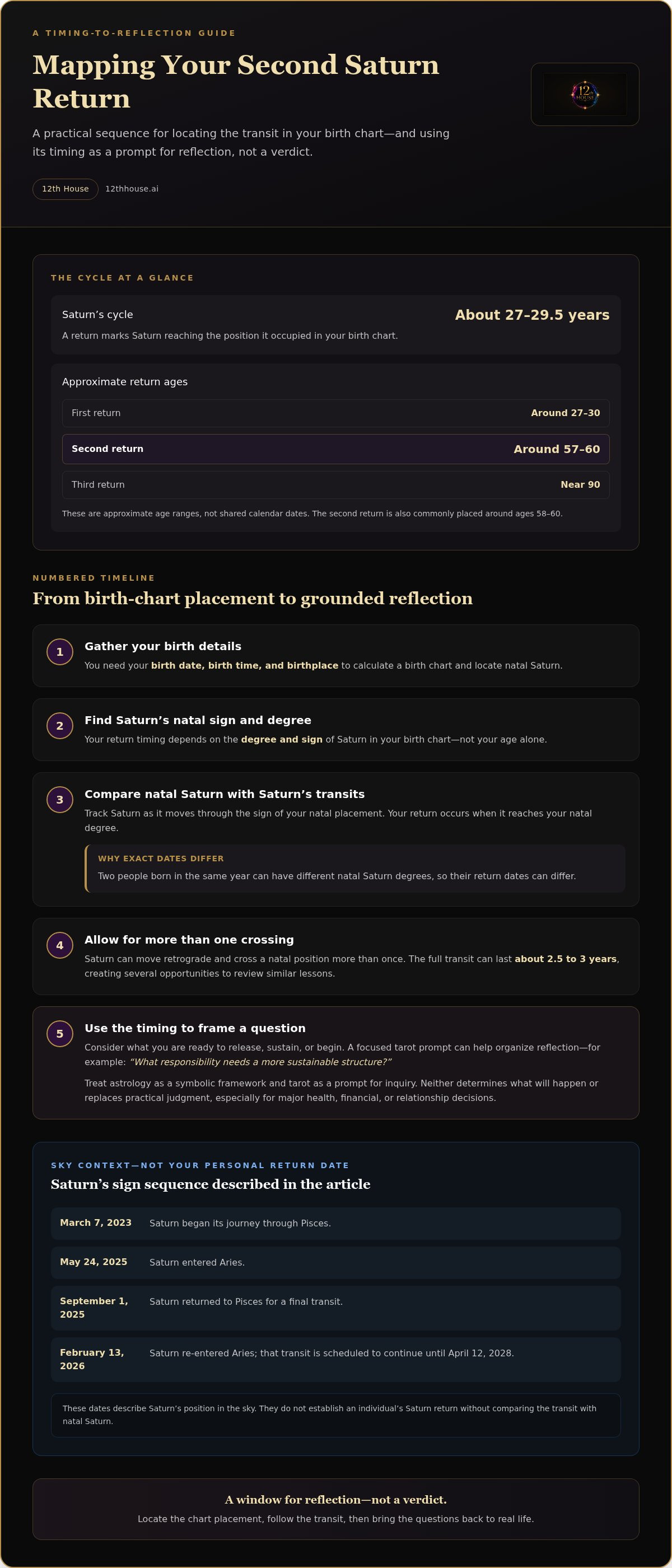
In astrology, a Saturn return marks Saturn’s return to its natal position in a birth chart. Saturn takes about 27-29.5 years to complete this cycle, so the first return typically occurs around ages 27 to 30, and the second around ages 57 to 60. The third may arrive near age 90. These are age ranges, not calendar dates shared by everyone.
A return’s timing depends on the degree and sign of natal Saturn, not age alone. Saturn’s movement through a sign can include retrograde motion, so it may cross a natal position more than once. The full transit can last about 2.5 to three years, bringing several moments to review the same lessons rather than one defining date.
Saturn’s recent sign sequence offers useful context. It began its journey through Pisces on March 7, 2023, and returned there on September 1, 2025, for a final transit. Saturn entered Aries on May 24, 2025, then re-entered Aries on February 13, 2026, with that transit scheduled to continue until April 12, 2028. These dates describe Saturn’s sky position, not an individual’s return by themselves.
How can you calculate the exact dates of your second Saturn return? You need your birth date, birth time, and birthplace to calculate a birth chart and locate natal Saturn. Then compare that position with Saturn’s transit dates. The return occurs when Saturn reaches the natal degree, and retrograde motion can create multiple crossings.
For instance, two people born in the same year can have different natal Saturn degrees, so their return dates can differ. Focus on the chart position first, then track Saturn’s movement through that sign. An Astrology Birth Chart & Transit Analysis can help map the natal placement against the transit, giving you a more precise framework for reflection.
A nine-card Saturn return tarot spread
A nine-card spread gives a Saturn transit a clear structure for reflection. Rather than treating the planet’s movement through the zodiac as a verdict, use the cards to examine the responsibilities, patterns, and choices shaping this stage of adulthood. The spread can also support reflection during other life transitions.
Use any tarot or oracle deck. If you’re learning the spread, read every card upright first; this avoids adding reversals before you know the layout. Ask one focused question about the return, such as, “What responsibility needs a more sustainable structure?” A clear question gives the reading a coherent frame. For anyone using tarot to understand a second Saturn return, a focused prompt keeps the reading grounded in personal reflection.
The World is associated with Saturn. Its themes of completion and integration can help you consider what a long chapter has shaped and what you’re ready to carry forward. Five minor arcana cards offer additional lenses:
- 5 of Wands: conflict or competing demands.
- 10 of Wands: burdens that may need reassessment.
- 8 of Cups: leaving something that no longer feels meaningful.
- 3 of Swords: sorrow or a difficult truth.
- 7 of Pentacles: patience and review of what you’ve invested.
Read each image in relation to your question, not as an isolated forecast. For example, if the 10 of Wands appears beside a concern about careers, examine which obligations feel costly and which remain purposeful. The card doesn’t decide whether you should retire, change direction, or stay; it helps make your assumptions visible.
Across the nine cards, look for repeated symbols, tensions, or contrasts. Images of burden and departure might invite a closer look at commitments, while cards suggesting completion may prompt reflection on what adulthood has taught you. Record each card, your first association, and one practical question it raises. This makes tarot a reflective way to understand your second Saturn return, not a forecast.
Card positions for reflection and guidance
Each position gives its card a specific task, turning a nine-card reading into a reflective map. Use the ascending seven-card layout to trace a concern, then let the final two cards bring your observations together.
Card Positions for Reflection
For a practical reading, assign each position a clear prompt before drawing. This keeps a striking image from overpowering the question you brought to the spread.
- Position one: What is shaping this transition now?
- Position two: Which responsibility needs attention?
- Position three: What resistance or conflict should I examine?
- Position four: What resource can support me?
- Position five: Where do I need firmer boundaries?
- Position six: What pattern may be ready to change?
- Position seven: What grounded action can I take?
Place positions eight and nine after the ascending line as synthesis prompts: what has the reading revealed, and what deserves continued reflection? These prompts offer a framework, not fixed meanings for every nine-card spread.
Interpretation Without Prediction
How do you interpret tarot cards without treating them as predictions? Read each card as a prompt about your present perspective, choices, or assumptions, not as a fixed account of the future. For example, the 7 of Pentacles can invite you to assess an investment of time without declaring whether it will succeed.
Include orientation and position in your interpretation. A reversed card may suggest a softer, blocked, or more inward version of its upright meaning, shaped by its place in the spread. If the 5 of Wands appears at the boundaries position, consider where tension needs attention; don’t treat it as proof that conflict is coming.
Record each card, your first response, and one real-world question. If you want a structured prompt for that reflection, explore guided tarot support.
12Th House: Ask Lala AI Spiritual Guidance
12th House’s Ask Lala AI Spiritual Guidance offers a way to organize questions that surface during a Saturn return. Bring a specific reflection from your spread, such as which commitment needs clearer boundaries, and use it to explore the thought from another angle.
Astrology Birth Chart & Transit Analysis can help you examine Saturn’s natal placement alongside its transit. Tarot Readings offer another way to explore card imagery and the themes behind your question. Choose the format that fits your next step: clarify the astrology, reflect through tarot, or shape a broader spiritual inquiry.
Visit 12thhouse.ai to explore Ask Lala AI Spiritual Guidance.
Carry Your Reflection Into Action
A useful reading doesn’t end when you gather the cards. Turn one insight into a question you can work with: What do I want to protect, change, or make room for in the next chapter? Write your answer beside the card that prompted it, then revisit it as your priorities shift.
My approach to using tarot to understand my second Saturn return is an active practice, not a search for a final verdict. The symbols can help me notice where my attention is drawn; my choices give that insight shape. I can keep using tarot to understand my second Saturn return by grounding each reflection in what I value and the realities of daily life.
If you want a structured space to explore your next question, continue your reflection with 12th House. Take the insight that feels most relevant and use it to move forward with intention.
Frequently Asked Questions
First, what does Saturn symbolize in astrology?
Saturn symbolizes structure, responsibility, limits, and the work required to sustain commitments. In a birth chart, its placement offers a symbolic lens on how someone meets obligations or develops discipline. For example, someone might consider whether a demanding routine supports a lasting goal or simply continues through habit. Astrology uses this symbolism for interpretation, not as a measure of personal worth.
What can you expect from this second rite of passage?
Expect a period of review rather than one predetermined event. You might question whether a role, relationship, or daily commitment still fits your priorities, then decide what needs attention first. Turn reflection into grounded questions: what can change now, what needs more planning, and which people or resources can support the process?
What deck can I use?
You can use any tarot or oracle deck for this reflective practice. Choose images you can interpret comfortably, rather than a deck that promises a particular answer. If you’re new to reading, stick with one deck while learning its symbols. For example, note how a recurring image relates to your question before drawing more cards.
What does a planet’s “return” mean in astrology?
A planet’s return is the point in its cycle when it returns to the place it occupied in someone’s birth chart. Astrologers compare its current position with that natal placement. A return is different from simply noticing a planet in a particular zodiac sign: the chart’s specific position matters to the interpretation.
What is a second Saturn return and when does it occur?
A second Saturn return is the later cycle in which Saturn revisits its natal chart position. It typically occurs around ages 57 to 60, after Saturn completes another orbit of roughly 27-29.5 years. The age range is a useful orientation, but the person’s birth-chart placement determines the relevant transit timing. Birth date, time, and location help calculate that chart position.
What themes are commonly associated with a second Saturn return in astrology?
Common themes include retirement planning, health, caregiving, close relationships, community, and making room for meaningful passions. These questions can connect: a work change may reshape finances, routines, or time for creative pursuits. Rather than treating any theme as universal, identify the area most pressing in your circumstances and focus your reflection there.


