
Supporting a Generator partner isn’t about matching their pace or managing their energy. Learning how to support a Generator partner means understanding their responsive energy, respecting what engages them, and making room for your own needs. For a Manifesting Generator, support also means allowing flexibility to move between interests.
If your partner’s enthusiasm, pace, or need for space differs from yours, it can be hard to know what that means. Human Design offers a framework for noticing these patterns without treating them as proof that either person is doing something wrong.
This guide explains how Generator energy differs from other types and shares practical ways to support Generator and Manifesting Generator partners. You’ll explore how to talk about energy, respect individual rhythms, and build a relationship where support means understanding each other, not becoming the same.
Key Takeaways
- Notice where your partner’s energy and decision-making rhythm differ from yours, then discuss what each of you needs without treating the difference as a problem.
- Support a Generator by making room for responses, genuine enthusiasm, and rest instead of setting their pace for them.
- Give a Manifesting Generator flexibility to explore interests, move independently, and capture ideas before turning them into plans.
- Use Human Design as a framework for reflection, and explore Ask Lala AI Spiritual Guidance when you want help examining your relationship patterns.
1. Generator and partner energy differences
In Human Design, a Generator’s energy is described as responsive, not constantly available. A different pace doesn’t automatically signal disinterest or incompatibility. Notice what engages your Generator partner, then compare it with how you make decisions and recharge. One person may want to discuss an invitation immediately, while the other needs quiet before responding. Name the difference without assigning blame.
Human Design distinguishes Generators from Manifestors, Projectors, and Reflectors. A Generator’s defined Sacral Center is associated with responding to what arrives, while another type may follow a different rhythm. The framework says roughly 70% of people have a defined Sacral Center and are here to respond. Treat that as context, not a ranking of whose energy matters more. Ask what works for each person in the actual moment.
Reflectors, described as 1% of the population, may need time alone after absorbing the atmosphere around them. A Generator can avoid personalizing that need by agreeing on clear language: “I need quiet now; let’s reconnect later.” Partners who share a type can also compare how the same pattern appears differently in their lives. Use specific examples, such as how each person handles plans, social time, or changing priorities.
Fairness is more useful than expecting identical effort. If one partner has more energy for a task, the other can contribute through planning, listening, or taking on a different responsibility. A Manifestor and Reflector can also value their distinct strengths without expecting matching schedules. Discuss what feels fair, then adjust the arrangement when circumstances change.
Technical power-system rules describe equipment, not relationship energy. According to the Federal Energy Regulatory Commission, unless otherwise agreed, the test conditions include a five percent (5 percent) change in a large generating facility’s terminal voltage. Separately, according to the Federal Energy Regulatory Commission, a generator operator with a synchronous generator equipped with a power system stabilizer must keep it in service during 98 percent of all operating hours. These technical requirements don’t define a Human Design Generator or determine how partners should relate.
2. Supporting a Generator partner
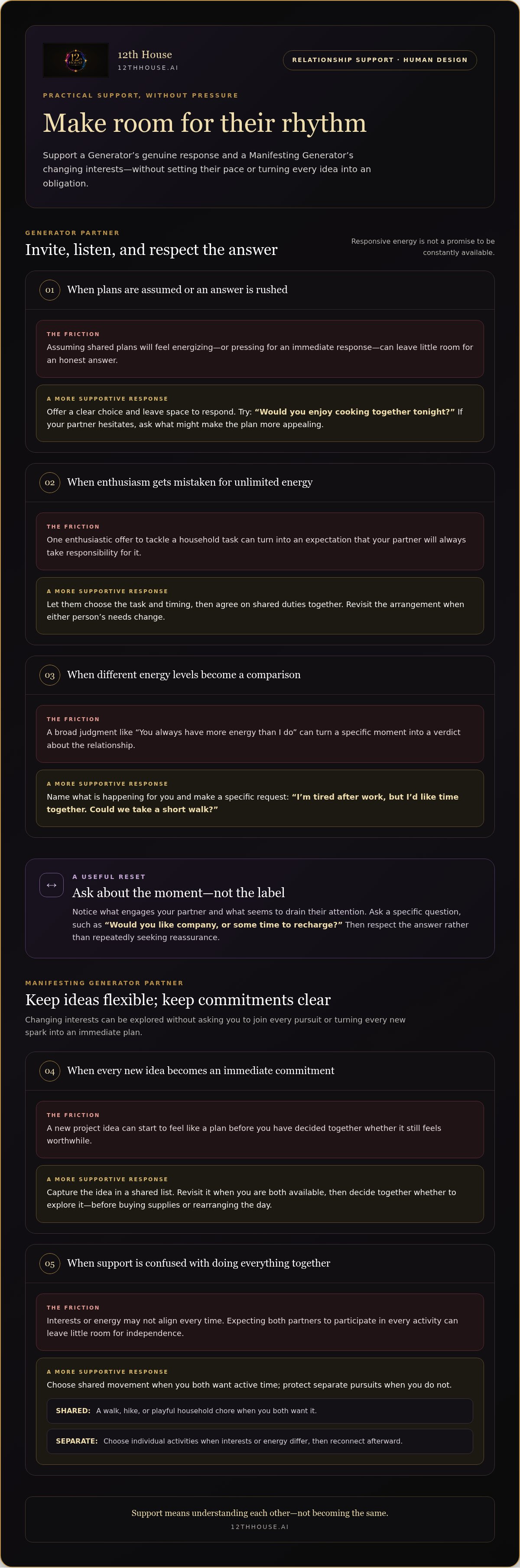
To understand how to support a Generator partner, focus on invitations, not pressure. Human Design describes Generator energy as responsive, so offer a clear choice and leave room for an honest answer. Try, “Would you enjoy cooking together tonight?” rather than assuming shared plans will feel energizing. If your partner responds enthusiastically, agree on the details. If they hesitate, ask what might make the plan more appealing.
Notice which activities leave your partner engaged and which seem to drain their attention. They might light up while discussing a project, then grow quiet after a busy social evening. Don’t interpret every shift as a verdict on your relationship. Ask a specific question, such as, “Would you like company, or some time to recharge?” Then respect the answer rather than repeatedly seeking reassurance.
Support also means making space for your partner’s energy without turning it into an obligation. If they enjoy tackling a household task, let them choose the task and timing. Don’t turn one enthusiastic offer into a permanent expectation. A spontaneous decision to prepare dinner doesn’t mean they’ve taken responsibility for every meal. Agree on shared duties together, and revisit the arrangement when either person’s needs change.
- Invite, then listen: Offer a real choice about a date, activity, or shared decision.
- Recognize enthusiasm: Notice when your partner’s interest becomes focused, and ask what they want to pursue.
- Make rest welcome: If a Projector partner feels guilty accepting care, agree on a practical exchange, such as one person cooking while the other handles tomorrow’s planning.
Keep communication specific. Instead of saying, “You always have more energy than I do,” describe the moment: “I’m tired after work, but I’d like time together. Could we take a short walk?” This avoids comparing the two of you and makes it easier to discuss what would help. It also keeps Human Design focused on understanding choices, rather than assigning one person the role of caretaker, planner, or source of energy.
3. Supporting a Manifesting Generator partner
A Manifesting Generator may move quickly between interests, plans, and hands-on activities. Human Design offers a framework for this pattern, not a schedule your partner must follow. Notice how they respond when an idea comes up: do they want to talk it through, try a small step, or leave it for later? Ask what kind of support would help instead of assuming every new interest needs your participation.
Keep plans flexible without making shared commitments meaningless. If your partner suggests a weekend project, write down the idea together before buying supplies or rearranging the day. Revisit it when you’re both available and decide whether it still feels worthwhile. A shared note can hold future plans without turning each passing spark into an immediate obligation.
- Capture ideas: Keep a shared list for new plans, then choose together which one to explore.
- Move together: Try a walk, hike, or playful household chore when you both want active time.
- Protect solo pursuits: Choose separate activities when interests or energy don’t align, then reconnect afterward.
Movement can bring you closer without requiring constant conversation. A hike, for example, gives your partner room to change pace, while a playful kitchen clean-up can turn a routine task into shared activity. Choose something that suits both of you that day. If one person prefers quiet, shorten the activity or plan separate downtime afterward.
Independence matters, too. Manifestors and Generators may prefer to pursue some activities separately rather than doing everything together. Agree on a simple way to signal a change of plans, such as sending a message before leaving or naming a time to reconnect. This reduces confusion without requiring your partner to explain every shift in interest. Support flexibility while staying clear about practical commitments, such as shared meals, travel plans, or household responsibilities. That balance makes room for spontaneity and trust.
Putting ideas and future plans in writing creates a pause for consideration: Manifesting Generators and Generators may benefit from writing down ideas and future plans rather than acting on them immediately. Shared movement can offer a practical outlet, too; Manifesting Generators can use walks, hikes, or playful household chores to expend excess energy together, choosing whichever feels suitable.
4. Your generator
Your own Human Design chart is a comparison point, not a verdict on your relationship. Start by identifying your type and considering how you approach decisions, commitments, and rest. Then note an example from daily life: perhaps you need quiet after work while your partner wants to begin a shared project. This contrast can help you negotiate routines instead of judging each other’s pace.
Human Design isn’t a fortune-telling system. Use it as a framework for observation, then compare its language with your lived experience. Over several conversations, notice what happens when you accept an invitation, change a plan, or ask for time alone. Does the description help you express a need more clearly? Keep what supports honest communication, and don’t use a chart label to excuse dismissive behavior.
Explore your differences with specific questions. What helps each of you feel engaged? Which shared commitments need advance planning? When does solo time help you return with more attention? For example, you might agree that one partner attends a social event while the other enjoys a quiet evening. This respects separate needs without turning time apart into a test of affection.
- Track your patterns: Write down one decision or energy shift each day, then discuss examples together.
- Compare needs: Name one activity you enjoy together and one you prefer doing independently.
- Review agreements: Revisit shared plans when work, rest, or interest changes.
A chart becomes useful when it leads to clearer choices. Explore a structured Human Design profile to examine your own patterns and bring more precise language into relationship conversations. Use the insights to open discussion, not to define your partner for them. A lived example and a direct question will tell you more than relying on a type label alone.
Generator sizing should account for a building’s electrical load and the startup demands of major systems. Standby generators also require ongoing maintenance and service after installation. Generator installation support can include routine maintenance and inspection, load banking, troubleshooting, and repairs. A qualified standby-system partner should understand automatic transfer switches: a home cannot be connected to utility power and generator power at the same time through the transfer switch.
12Th House: Ask Lala AI Spiritual Guidance
12th House’s Ask Lala AI Spiritual Guidance can help you reflect on relationship questions that remain after learning about Generator energy. Turn to it when you want to examine a recurring pattern, clarify what you need, or find language for a conversation with your partner. Use your real experiences as the starting point, such as differing preferences around shared plans or time alone.
Astrology Birth Chart & Transit Analysis offers another way to explore chart-based themes alongside your reflections. These tools provide a structure for considering your perspective, not a substitute for direct communication. Bring any useful insight into a conversation and let your partner describe their experience.
Visit 12thhouse.ai to explore Ask Lala AI Spiritual Guidance.
Build a Relationship That Can Adapt
Make your next step a conversation, not a verdict about either person’s design. Ask your partner what helps them feel understood, then share one of your own needs. Keep the exchange specific: choose a recent moment, describe what you noticed, and agree on one small adjustment to try. This gives both of you room to respond honestly without turning a chart into a set of rules.
Learning how to support a Generator partner takes ongoing attention and clear communication. Your needs matter just as much as your partner’s. Return to the conversation when circumstances shift, and let mutual respect guide any adjustments.
If you want another reflective lens, explore Tarot Readings as a way to consider the questions you’re carrying into your relationship. Explore 12th House’s spiritual guidance and continue your self-discovery with intention. Each honest conversation can help you build a connection that makes space for both of you.
Frequently Asked Questions
What does “generator partner” mean?
A “Generator partner” is someone whose Human Design type is Generator. The phrase describes their chart type, not their role or level of commitment in the relationship. For example, if your partner identifies as a Projector and you’re a Generator, you’re the Generator partner. A Manifesting Generator is a related but distinct Human Design type, so name the specific type you mean.


