

A tarot spread for a quarter-life crisis works best as a reflection map, not a verdict about your future. Try the Compass Spread to explore where you’re coming from, what’s directly behind you, what lies ahead, and a next move to consider. Its positions give uncertainty structure without asking the cards to decide for you.
It’s natural to want one clear answer when your goals, work, or relationships no longer feel aligned. A useful reading won’t erase the complexity; it can help you examine what’s changing and identify the questions that need your attention. Learn how to prepare a transition reading, interpret each position, and turn the cards into practical prompts for journaling. Revisit the spread as your circumstances shift, so it supports your choices rather than replacing them.
Key Takeaways
- Use the Compass Spread to map what shaped you, what’s behind you, what lies ahead, and a practical next move.
- Read the cards as prompts for examining inner dynamics and outside influences, not as fixed predictions.
- Begin a transition reading when change starts, then revisit it occasionally instead of repeating it too frequently.
- Ask focused questions about the challenge, the change you’re facing, and the perspective that could help you move forward.
Adapting to change and identifying challenges
Map the change before choosing a response. A clear spread position can help separate your priorities from expectations tied to work, family, or a relationship.
- Write down one goal you set in your 20s, then assess whether it still fits your present values. During the Uranus opposition, people may reassess or revamp goals established in their 20s. Treat that as a prompt to review your direction, not a command to abandon a career, relationship, or plan. Note what still matters and what has changed.
-
Confront Life Changes
Use the Pluto square as a prompt to examine changes that challenge your established structure. It occurs between ages 36 and 42, depending on birth year. Ask which part of your life needs an honest review: work, commitment, identity, or responsibility. Avoid treating a transit or card as proof that you must make a dramatic decision; identify the specific pressure you can address.
-
Find Encouragement During Change
Use a card position to represent a resource you can draw on now, such as support, patience, or a skill you’ve developed. If a move disrupts familiar routines, for example, name one person you can talk with and one habit that helps you feel steady. Keep encouragement concrete: note a manageable next action rather than asking the reading to promise an easy outcome.
-
Explore Career Uncertainty and Life Direction
Draw a card for your current career concern and treat it as a reflection prompt. The Eight of Pentacles can invite you to consider skill-building and consistent effort; the Two of Wands can direct attention to future options. For a broader life assessment, Judgement raises the question of whether your choices align with what you want. Compare the card’s theme with your actual circumstances before acting.
Using tarot as a tool for reflection rather than prediction
- Set a reflective intention before your reading. Ask, “What needs my attention as I consider this change?” Tarot can help you examine internal dynamics and outside influences, but it doesn’t predict a fixed outcome. Note your first reaction to each card, then compare it with what’s happening in daily life.
- Turn the cards into a journaling structure. Draw two cards: let the first represent the challenge and the second a perspective to explore. If a work decision feels confusing, write what each card brings to mind, what facts you still need, and one practical step you can take. The connection between the cards may reveal assumptions worth examining.
- Keep a record after each reading. Note the date, your question, the cards, and the interpretation that felt most relevant. Add recurring signs or synchronicities to the same journal, then look for patterns over time rather than treating one coincidence as a directive. This makes your spiritual practice a traceable reflection process.
- Use a full moon reading as a deliberate self-reflection point. You can do the reading anytime within 24 hours of the full moon. Choose one question about what needs attention or healing, then write down one action that supports that work. Tarot can prompt reflection, but it can’t diagnose or treat mental health conditions; persistent distress or safety concerns call for qualified mental health care.
- Translate insight into a grounded plan. After interpreting the cards, separate what you feel from what you know: list the emotion, the evidence, and a next step you control. If you want a structured prompt for continued reflection, Ask Lala AI Spiritual Guidance can support your inquiry without turning the cards into a verdict.
Tarot spread for navigating major life transitions
Choose a spread that maps your transition instead of demanding a prediction. Start with the Compass Spread, then adapt its positions to the decision in front of you.
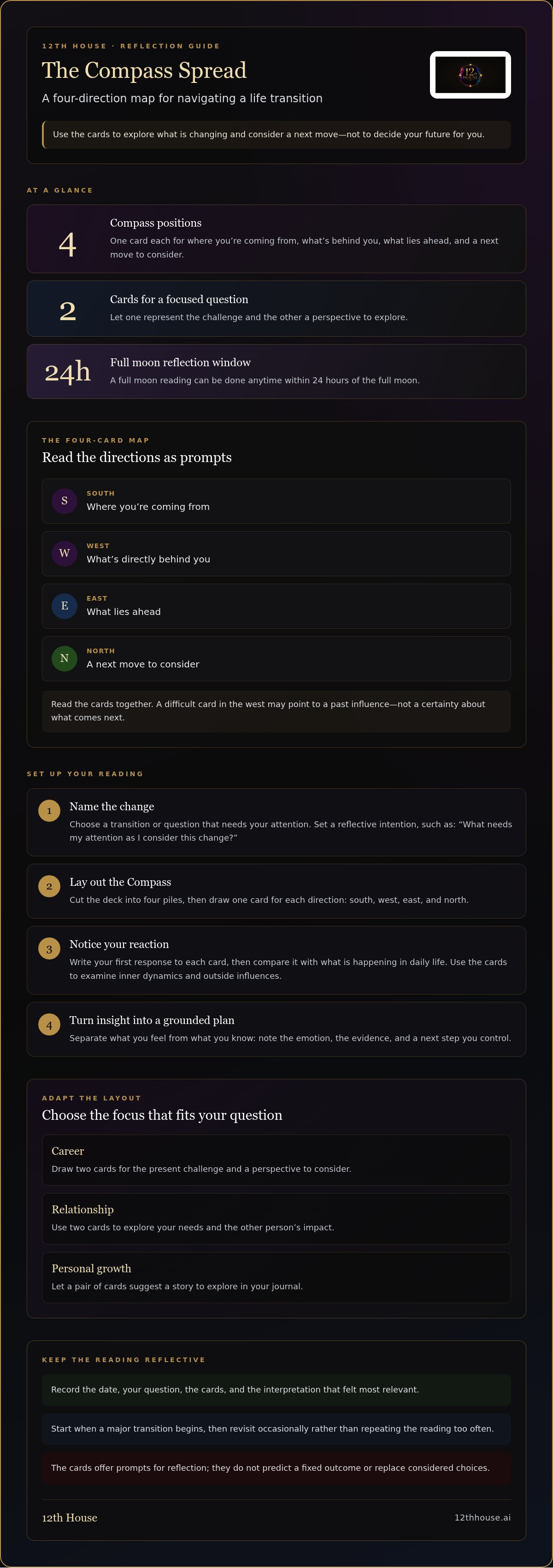
- Lay out the Compass Spread as a directional map. Cut the deck into four piles, then draw a card for each position: south shows where you’re coming from, west what’s directly behind you, east what lies ahead, and north a next move to consider. Read the cards together. A difficult card in the west, for example, may point to a past influence, not a future certainty.
- Choose a different spread when you want to focus on one area of life. For a career question, draw two cards for the present challenge and a perspective to consider. For a relationship, use them to explore your needs and the other person’s impact. For personal growth, let the pair suggest a story to journal about. If a card appears reversed, consider whether its theme feels blocked, inward, or delayed in your situation. Follow your deck’s conventions and your own reading logic rather than assuming a reversal is negative.
- You can find free layouts online by searching for a transition tarot spread, or build the Compass Spread from the instructions here. Josephine Hardman created a tarot spread for difficult and uncertain times. As you compare layouts, choose positions that clarify your past, present pressure, and next step. A simple structure is easier to interpret than one with positions that repeat the same question.
- Start a reading when a major transition begins, such as changing jobs or ending a relationship. Record the date, question, and cards, then check in occasionally rather than repeating the reading too often. Let new events inform your interpretation. The cards offer prompts for reflection; your circumstances and considered choices shape the path forward.
What questions should a quarter-life crisis tarot spread explore?
- Ask what feels out of alignment, then name an area such as work, belonging, or independence. Try: “Which expectation am I following because I chose it, and which did I inherit?” Write your first response beside the card. This can help clarify whether your dissatisfaction comes from the goal itself or pressure surrounding it.
- Give a card position to a relationship or community that shapes your choices. Ask, “Whose perspective am I carrying into this decision?” The idea that your social circle reflects the people you spend the most time around can serve as a prompt, not a rule. Consider whose influence supports your values and whose expectations deserve closer examination.
- Ask what needs care in your daily life, including your body. Pair the card with a question such as, “How can I cherish my body more?” Then choose a specific response, like making room for rest or noticing how stress affects your routine. The card offers a perspective to explore; your lived experience helps you decide what action fits.
- Explore the tension between security and change with a question focused on choice. Try, “What am I protecting, and what possibility am I avoiding?” If a card brings up fear about leaving a familiar role, list the practical concern beneath it. Separate a real constraint from an assumption, then identify what information would help you assess the choice.
- End with a next-step question: “What can I do now that respects what I’ve learned?” Keep the answer within your control, such as drafting a career question or starting an honest conversation. For structured support in exploring your prompts, begin a Tarot Reading and use its themes to deepen your reflection.
12Th House: Ask Lala AI Spiritual Guidance
12th House’s Ask Lala AI Spiritual Guidance offers a structured way to continue exploring questions raised by your cards. Turn to it when you want to develop a reading’s themes, examine a transition from another angle, or shape a focused question before making a decision. It supports reflection, while the choices remain yours.
If your question centers on timing or recurring life patterns, Astrology Birth Chart & Transit Analysis can add an astrological perspective. For a closer look at card symbolism, Tarot Readings offer another way to explore the themes in your spread. Choose the format that fits your question, and bring a clear intention to the process.
Explore Ask Lala AI Spiritual Guidance at 12thhouse.ai.
Turn insight into a deliberate next step
Clarity doesn’t have to arrive as a complete life plan. Treat your next choice as an experiment: name what you want to learn, take one grounded action, and notice what changes in your perspective. A tarot spread for a quarter-life crisis can help frame the inquiry, but your observations give the symbols meaning. Let new information refine your direction rather than waiting for certainty before you begin.
Choose an action small enough to take without resolving every open question. You might explore a role, set a boundary, or start a conversation you’ve been postponing. Afterward, record what felt aligned, what created resistance, and what you want to explore next. This makes reflection an evolving practice, not a test you can pass or fail.
If you’d like to explore tarot in a guided setting, contact 12th House to explore tarot. Move at your own pace, and let your next choice create useful information.
Frequently Asked Questions
Why This Spread?
This spread is useful because it turns an undefined transition into distinct areas for reflection. A quarter-life crisis can involve connected questions, such as whether your work fits your values or whether you’re choosing under pressure. Separating those concerns helps you decide what deserves attention first. Use each position to explore one part of the situation, then identify a real-world question to consider next.
What tarot spread is best for a quarter-life crisis?
The best spread is one whose positions address the decision you’re actually facing. For an overall transition, use the Compass Spread to get a broad directional view. For a narrower concern, such as accepting a job, choose positions that explore your priorities, concerns, and what you need to learn. A tarot spread for a quarter-life crisis should clarify your thinking, not choose for you.
How do you do a five-card tarot spread for feeling stuck in your 20s?
For a five-card reading, arrange the cards in a crescent, as in a full moon tarot spread. Assign each card a prompt: what feels stuck, what’s influencing it, what you may be overlooking, what resource you can draw on, and what step to consider. Read the cards as one connected reflection. Write a brief interpretation for each before deciding what resonates.
How can tarot help with quarter-life crisis reflection without predicting the future?
Use each card to generate a question, not a forecast. If a card brings up independence, ask where you want more autonomy and what practical choice could help create it. Compare your interpretation with your current circumstances, such as your responsibilities or available options. This keeps the reading focused on awareness and agency rather than treating symbols as instructions about what will happen.
What journaling prompts pair well with a tarot spread about life transitions?
Try prompts that connect a card’s theme with a specific choice: “What would I prioritize if nobody were evaluating me?” or “Which part of this change feels chosen, and which feels imposed?” Add, “What would make this decision feel more informed?” Answer plainly, then underline the point that feels most actionable. That sentence can guide your next reflection.
Where can you find free quarter-life crisis tarot spread layouts online?
Search online for a transition tarot spread to find free layouts, or create the Compass Spread using the instructions in this article.


