
Different levels of interest in Human Design don’t have to divide a business partnership. Human Design compatibility for business partners isn’t a verdict of “good” or “bad”; a relationship chart offers a way to examine how each person’s energy and working style interact. Use the chart to inform collaboration, not to make business decisions for you.
It’s natural for one partner to be more curious about the system than the other. You don’t need matching enthusiasm to use its insights constructively. What matters is turning observations into practical agreements while each person remains responsible for their own choices.
This article explores how defined and undefined channels can shape shared dynamics, why differences in interest need not become a problem, and how complementary strengths may inform roles and business systems. You’ll also learn how to use Human Design to notice patterns, then build ways of working that fit the people in the partnership.
Key Takeaways
- Use a partnership chart to notice where shared energy feels natural and where differences may shape collaboration.
- Distinguish companionship, electromagnetic, dominance, and compromise dynamics to better understand how each partner contributes.
- Translate individual strengths into clear roles and business systems instead of forcing both partners into the same working style.
- Let Human Design inform reflection, while each partner uses their own inner Authority to make decisions.
What if one of us is more interested in Human Design than the other?
Compare two individual charts by placing them together as a relationship chart, then examining shared channels and centers. Defined centers show consistent functions in each person’s chart; undefined centers may be more influenced by the other person’s aura.
Combining Individual Charts
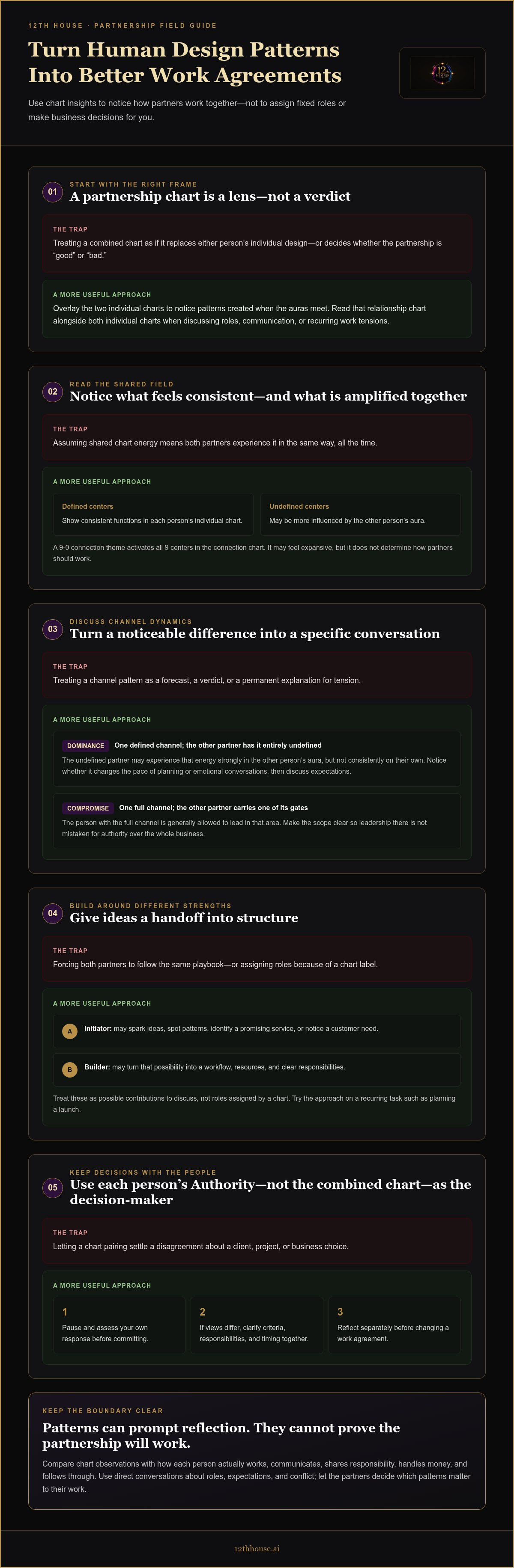
A partnership chart overlays two individual Human Design charts. It maps the connection formed when both auras meet without replacing either person’s design. For business partners, that distinction helps separate individual traits from patterns that emerge together. Read the composite alongside both charts when discussing roles, communication, or recurring work tensions.
One example partnership chart has one undefined function and the rhyme “8 - 1 - Let’s Have some Fun.” Treat the phrase as a prompt for noticing the partnership’s tone, not as a job description or forecast. Ask which work moments feel playful and which need a clear agreement. This gives the less-interested partner a practical entry point without requiring equal study.
Composite Energetic Dynamics
Composite and connection charts show the energetic dynamics created in shared space. A 9-0 connection theme activates all 9 centers in the connection chart. That pattern can feel expansive, but it doesn’t decide how partners should work. Use it to name what arises together, then compare it with each person’s individual chart.
A dominance channel appears when one person has a defined channel and the other has that entire channel undefined. The undefined partner may experience its energy strongly in the other person’s aura, but not consistently on their own. For example, notice whether a shared channel brings a different pace to planning or emotional conversations. Use that observation to discuss expectations, not to treat the chart as a verdict.
Balance observations about your shared field with time in each person’s own energy. Consider a chart insight together, then let each partner reflect separately before changing a work agreement. This matters when one person wants to analyze every channel and the other prefers a concise takeaway. Human Design can help identify relationship patterns; the partners decide which ones matter to their work.
Individual differences in relationship compatibility
Human Design can frame reflection, but it can’t establish whether a business partnership will succeed. Compare chart patterns with how each person actually works, communicates, and shares responsibility.
Profiles and Relationship Styles
A Human Design profile describes a person’s style through two numbers arranged like a fraction. It matters because profile pairings can suggest themes to explore, not prescribe fixed roles. For example, 2/5 and 5/2 are listed as a harmonious pairing. Treat that as a prompt for discussion, then assess each person’s chart and behavior individually.
If one partner’s profile suggests a preference for learning through experience, discuss how that shows up during a project review. The other partner may approach the same review differently. Name the pattern, then agree on a process that gives both people room to share their perspective.
Strategy and Authority in Relationships
Strategy and Authority describe how each person approaches choices within Human Design. Their practical value in a partnership is that each person can use their own inner Authority rather than treating the combined chart as a decision-maker.
For example, when considering a new client or project, each person can pause to assess their own response before committing. If their views differ, clarify the decision criteria, responsibilities, and timing together. A chart pairing doesn’t replace the conversation or make one person’s Authority more valid.
Relationship Strengths and Challenges
Human Design doesn’t classify relationships as good or bad; it offers patterns to examine. A compromise channel occurs when one person has a fully defined channel and the other carries one of its gates. The person with the full channel is generally allowed to lead in that area.
In business, this may show up as one partner naturally setting direction in a particular area of work. Discuss how decisions are shared so that leadership in that area doesn’t become assumed authority over the whole business. A specific example, such as project planning, makes the pattern easier to address.
Limits of Human Design for Partner Choice
Human Design considers no two designs truly incompatible, but that doesn’t mean every business arrangement is workable. A profile or channel can’t establish whether partners agree on goals, handle money responsibly, or follow through on commitments. Those questions require direct discussion and observation.
Use chart insights alongside concrete conversations about roles, expectations, and conflict. For a closer look at individual chart patterns, explore Human Design chart analysis as one reflective input, not a substitute for assessing the partnership itself.
Building business systems around individual strengths
Turn chart insights into work agreements, not fixed labels. For example, if one partner generates ideas quickly and the other prefers structure, design a handoff that preserves both contributions.
A balanced business partnership can combine an initiator who sparks ideas and spots patterns with a builder who creates systems and infrastructure. The initiator might identify a promising service or notice a customer need. The builder can translate that possibility into a workflow, resources, and clear responsibilities. Treat these as potential strengths to discuss, not roles assigned by a chart.
Build around each person’s working style instead of forcing both partners to follow the same playbook. Take a recurring task, such as planning a launch, and identify where each person contributes most naturally. Then shape the process around those contributions:
- Let the partner who spots patterns gather ideas and identify the opportunity.
- Have the partner who builds systems map the work into tasks, owners, and handoffs.
- Set a shared review point where both partners can adjust the plan before execution.
Use your individual charts and the partnership chart as prompts for that conversation. If one partner consistently demonstrates a particular strength at work, make room for it while keeping accountability visible. For example, an idea-generating partner can propose a direction while the partner who designs infrastructure assesses the operational steps. Neither contribution should automatically override the other.
Compromise is useful when a shared process favors one person’s pace or preference. If fast-moving planning leaves the systems-minded partner without time to evaluate details, add a review stage before committing resources. If extensive analysis stalls an opportunity, agree on the information essential to making a decision. These practical adjustments connect chart insights to everyday work. Judge the system by whether responsibilities are clear and the partnership can carry ideas through to completion.
Exploring business-partner dynamics through Human Design
Human Design offers a framework for examining how partners’ working patterns interact. Use it to bring clarity to collaboration, not to predict a venture’s outcome.
Business Compatibility in Human Design
Human Design compatibility for business partners is a way to explore how two people’s designs may shape their shared work. It matters because recognizing differences can give partners language to discuss collaboration, expectations, and friction. A connection chart offers themes to examine, but it doesn’t determine whether a partnership will work. For example, partners can notice recurring tension around starting projects, then discuss how each prefers to contribute.
Use those insights to ask what practical agreement would help, rather than treating a chart pattern as a verdict. Human Design considers no two designs truly incompatible, so compatibility is better understood as an inquiry into dynamics than a pass-or-fail test.
Types Working Together
Human Design types describe different ways people engage with energy and opportunities. They can help partners compare working approaches. The Business Blender co-founders identify as Generators and say they wait for opportunities that excite them rather than chasing them. They also say they pursue an opportunity only when both feel a yes. Their example shows how shared decision principles can create clarity without requiring identical perspectives.
Use human design compatibility for business partners as a framework for discussing how each person responds to actual work, rather than assigning fixed roles by type. A proposal, for instance, can reveal whether both are ready to commit or need more time.
Pre-Partnership Discussion Topics
Before working together, use Human Design to structure specific conversations. Ask: Which tasks feel engaging, and which drain focus? How does each person prefer to respond to a new idea? What helps each partner reach a decision, and how will you handle different answers? These questions connect chart themes to everyday business mechanics.
Then discuss responsibilities, conflict, and how you’ll decide whether to pursue an opportunity. Record your agreements and revisit them as the work changes. Explore individual patterns with Human Design Profiles as a starting point for that conversation.
12Th House: Ask Lala AI Spiritual Guidance
12th House’s Ask Lala AI Spiritual Guidance can help you explore questions about Human Design charts and compatibility. Turn to it when you want to reflect on a partnership pattern, clarify what you’re noticing in your charts, or frame questions for a conversation with your business partner.
Use the insights as prompts for discussion, then translate relevant observations into practical agreements about roles, decisions, and collaboration. For a broader chart perspective, Astrology Birth Chart & Transit Analysis offers another way to examine personal patterns. These tools support reflection; your business choices remain yours to make.
Visit 12thhouse.ai to explore Ask Lala AI Spiritual Guidance.
Make the Next Conversation Count
A partnership’s next stage can begin with one deliberate conversation. Choose a current decision, such as how to approach a new opportunity, and discuss what each person needs before committing. Focus on workable agreements, not on proving who read the chart correctly.
A useful way to apply human design compatibility for business partners is to treat it as a lens for better questions. What would make collaboration feel sustainable? Where do expectations need to be clearer? Which decision deserves another conversation before it becomes a commitment? Let the answers shape an agreement you can revisit as the work evolves.
When you want another perspective for personal reflection, talk with 12th House. Bring your curiosity, keep your own judgment engaged, and give the partnership room to build its next chapter with intention.
Frequently Asked Questions
How can I use this information in my business?
Use Human Design insights to examine one recurring work situation, then turn the observation into a testable agreement. For example, if meetings repeatedly end without clear ownership, assign a decision owner and record the next action before closing. Review whether the change helps at your next project check-in. Keep the measure practical: clearer handoffs, fewer unresolved tasks, or better-defined responsibilities.
How can a Partnership Analysis be used?
A Partnership Analysis can help partners examine how their charts interact and identify dynamics worth discussing. Bring a specific business question, such as how to divide client communication or handle competing ideas. Then compare chart themes with actual examples from your work. The useful outcome is a shared vocabulary for discussing the issue, followed by an agreement both partners can apply.
What do authority and decision-making styles mean for business partners in Human Design?
Authority refers to each person’s inner decision-making guidance in Human Design. In practice, partners can avoid treating speed, confidence, or majority preference as proof that a choice is right for everyone. For a significant commitment, each person can consider their own response, then discuss timing, risks, and responsibilities. This makes room for different decision-making processes while keeping the choice grounded in the business.
How do Human Design profiles and channels influence team roles and collaboration?
Profiles and channels can offer prompts for examining how people approach work, but they shouldn’t be used as job titles. Compare a chart theme with observable behavior: who enjoys researching options, who communicates with clients, and who follows details through? Use those patterns to shape a trial division of responsibilities. Adjust the arrangement if experience shows that another structure serves the team better.
How can Human Design help resolve conflict between business partners?
Human Design can give partners a neutral framework for naming different needs during conflict. For example, if one person wants an immediate answer and the other needs time, agree to pause the discussion and set a clear time to return to it. Separate the chart interpretation from the business issue, describe each person’s concern, and decide what action addresses the underlying problem. Record the agreement to reduce confusion later.


