

What if a tarot card isn’t telling you what will happen, but helping you notice what you already sense? Using tarot to connect with your intuition can feel uncertain at first, especially if you don’t know every card meaning or worry that hope and fear are shaping your reading. You don’t need to memorize a deck or silence your doubts to begin.
Instead, use each card as a structured mirror: observe its symbols, notice your first response, and ask what that response brings to mind. The card offers a prompt, not an authority. That distinction lets you explore your impressions without turning them into fixed predictions.
This guide walks you through a repeatable practice for asking a clear question, reading a card, and reflecting on what you notice. You’ll learn how to work with symbols without getting lost in conflicting interpretations, and how to turn a reading into thoughtful self-inquiry that supports more self-aware decisions.
Key Takeaways
- Use a simple sequence of settling, asking, drawing, observing, and reflecting to give each reading a clear structure.
- Choose open questions about your perspective to make room for insight without demanding certainty.
- When using tarot to connect with your intuition, notice whether an impression feels curious and flexible or urgent and absolute.
- Record your first observation separately from your interpretation so you can review how your understanding develops over time.
- Explore additional symbolic perspectives, including 12th House tarot readings, as prompts for reflection while keeping your judgment central.
Using Tarot to Connect With Your Intuition Starts With Observation
Not sure whether a thought is intuition, expectation, or simply a reaction to the card? That uncertainty is a useful place to begin. Intuition can feel quiet and ordinary: a word that comes to mind, a memory, or a subtle response you notice before you can explain it. You don’t have to treat that first impression as a message you must obey.
Approach tarot as a symbolic reflection practice. A card offers images and themes to consider, not proof of what’s happening or a fixed prediction of what will happen. Tarot also has a history beyond divination: its earlier use as a card game and later adoption for divinatory purposes are outlined in this overview of the history of Tarot cards.
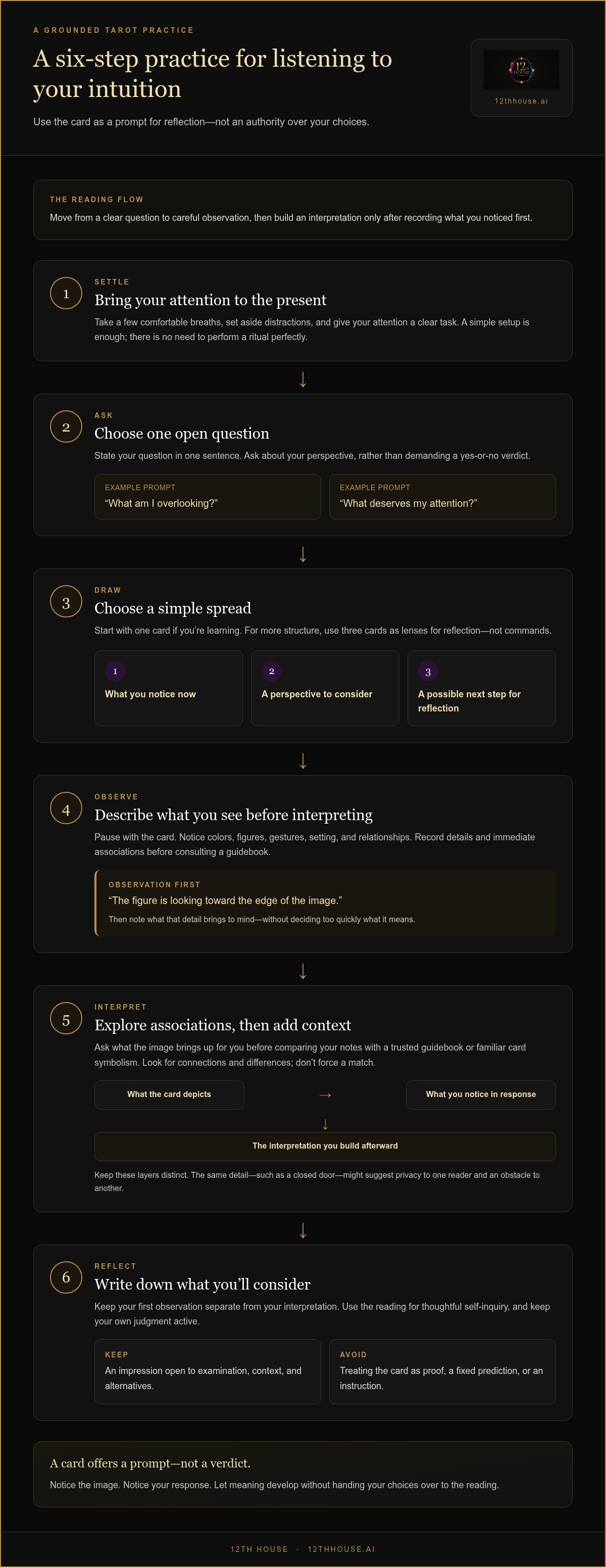
For a grounded reading, keep three layers distinct: what the card depicts, what you notice in response, and the interpretation you build afterward. For example, the card may show a figure facing away. Your immediate response might be the word “distance.” Only then might you interpret that distance as a need for space, a sense of separation, or something else. Examine the impression rather than accepting it as an unquestionable instruction.
Tarot is a prompt for reflection, not an authority over your choices. This distinction is central to using tarot to connect with your intuition while keeping your judgment active.
What does intuition feel like during a tarot reading?
Begin with what arrives before the explanation. You might notice a color, a posture, a phrase, a memory, or a physical response such as a tightened jaw. Another reader may respond differently, and there’s no single sensation everyone must experience. A quiet response is still a response.
Try describing only what you can observe: “The figure is turned away,” or “The scene feels still.” Then ask what, if anything, that detail brings to mind. You’re gathering impressions, not testing yourself for a special feeling or rushing to decide what the card means.
Why tarot can make inner responses easier to notice
An image gives your attention something concrete to meet. Instead of trying to summon an abstract answer, you can study a card’s colors, gestures, objects, and relationships. Those details may prompt associations with a current concern, a past experience, or a question you hadn’t yet put into words. The card doesn’t dictate which association is correct.
Make room for alternatives. A closed door in a card might suggest privacy to one reader and an obstacle to another. Ask, “What does this detail bring up for me?” before consulting familiar meanings. Recording your observation first helps distinguish your response from the interpretation you add later.
This approach makes beginner practice more manageable: you don’t need to memorize every meaning before engaging with a card. As you build a fuller framework for reading, the Tarot Mastery guide offers a broader path into tarot study. For now, stay with the image, notice your response, and let interpretation remain open.
A Simple Tarot Practice for Listening to Your Intuition
A repeatable process can help you hear your own response without demanding a definitive answer from the cards. Keep the reading focused: you’re exploring your perspective on a question, not asking the deck to decide for you. This distinction matters because intuition can be understood as knowledge that arises without conscious reasoning, as described in this psychological perspective on intuition. A tarot reading gives you a concrete prompt for examining what surfaces.
Choose a question and spread that leave room for reflection
Ask an open question such as “What am I overlooking?” or “What deserves my attention?” These prompts invite observation rather than a yes-or-no verdict. Start with one card if you’re learning. If you want more structure, draw three: the first represents what you notice now, the second a perspective to consider, and the third a possible next step for reflection. Treat each position as a lens, not a command.
Before drawing, settle your attention. Take a few comfortable breaths, set aside distractions, and state your question in one sentence. A simple setup is enough. The aim is to give your attention a clear task, not to perform a ritual perfectly.
Record the first impression before looking up meanings
After drawing, pause with the card before consulting a guidebook or another interpretation. Note details such as color, figures, gestures, setting, and any immediate association. You might write, “The figure is looking toward the edge of the image,” then record what that detail brings to mind. This first pass preserves your observations before established meanings shape them.
Next, compare your notes with a trusted guidebook or familiar card symbolism. Look for points of connection and difference. Don’t force a match: a conventional meaning can add context, while your response helps you decide what feels relevant to the question. For a more systematic study of tarot, the Tarot Mastery guide offers a broader learning framework.
Use this sequence as a compact map for using tarot to connect with your intuition:
- Settle. Pause and bring your attention to the present.
- Ask. Choose one open question about your perspective.
- Draw. Select one card or assign clear roles to a simple three-card spread.
- Observe. Describe what you see before interpreting it.
- Interpret. Consider your associations, then compare them with established meanings.
- Reflect. Write down what you’ll consider, without treating the card as an instruction.
Keep the practice small enough to repeat. If you’d like another symbolic perspective to consider alongside your notes, explore 12th House tarot readings. Use the interpretation as a prompt, not a substitute for your judgment.
Intuition or Anxiety? Read Tarot Impressions Without Forcing Certainty
A strong feeling during a reading can be meaningful, but intensity alone doesn’t prove that it’s intuition. Excitement, fear, and a hoped-for outcome can all shape what you notice. Treat an impression as information to examine, not an instruction to follow. The purpose of using tarot to connect with your intuition is not to eliminate uncertainty, but to meet your response with curiosity and discernment.
These contrasts can help you pause and check the tone of an interpretation. They’re reflective prompts, not a diagnostic test or universal rules. A calm impression isn’t automatically accurate, and an urgent feeling doesn’t automatically mean you should dismiss it.
| Notice | A more open cue | A cue to pause |
|---|---|---|
| Attention | Curiosity about what the card brings up | Urgency to get an answer immediately |
| Interpretation | Willingness to consider more than one meaning | Certainty that only one meaning is possible |
| Evidence | Specific details you can point to in the image | A catastrophic conclusion that outruns the image |
Notice when fear or wishful thinking may be shaping a reading
Watch for a pattern, not one feeling. Repeatedly drawing cards about the same question, feeling increasingly pressed for an answer, or treating every symbol as confirmation can signal that the reading is feeding a need for certainty. Wishful thinking can narrow your attention, too: you may focus on a reassuring detail while overlooking parts of the card that complicate your preferred interpretation.
If the reading heightens distress, stop. Set the deck aside rather than drawing again to force reassurance. Return to the question later, or leave it unanswered for now. Taking a break doesn’t mean you’ve failed to listen. It creates space to assess what you’re feeling without adding more symbols to decode.
Use questions to test an interpretation gently
Examine the interpretation without putting yourself on trial. Ask, “Which detail in the image supports this idea?” Then ask, “What doesn’t fit?” If the card suggests a difficult conversation, for example, note which visible details led you there and whether another reading is plausible, such as a need to clarify your own thoughts first. Neither possibility has to become the definitive answer.
A tarot interpretation is a hypothesis to examine, not a verdict to obey. Keep symbolic reflection distinct from decisions that depend on practical information, such as finances, health, or safety. Gather the relevant facts, and seek qualified professional support where appropriate. Cards can help you explore your perspective, but they can’t establish facts or replace informed advice.
Build a Tarot Journaling Practice That Strengthens Self-Trust
A journal gives a reading a traceable record. It helps you see what you noticed at the time, what interpretation you added later, and how your perspective changed. That separation matters: memory can blur an initial impression with what you learned afterward. A dated entry lets you revisit the process without turning each card into a test you must pass.
What to write after drawing a tarot card
Use the same short format each time. Consistency makes entries easier to compare while leaving room for your personal associations. Keep descriptions specific, and write meanings as possibilities rather than universal definitions.
- Question: Record the exact question you asked.
- Card: Name the card and note its position if you used a spread.
- First impression: Describe visible details, such as color, posture, objects, or setting, before assigning meaning.
- Alternate reading: Write one other plausible interpretation, especially one that differs from your first reaction.
- Reflection: End with a grounded question or action you choose for yourself.
For instance, if a figure appears to be looking away, write that observation before deciding it represents avoidance or independence. You might note that the image brings up a conversation you’ve postponed, then ask, “What would help me approach this clearly?” That question connects the entry to your real life without treating the card as a command.
How to learn from readings over time
Review your notes periodically, not after every draw. Look for recurring associations, questions, or interpretations that continue to feel useful on reflection. You may notice that a particular image repeatedly brings your attention to boundaries, even when the question changes. Treat that pattern as material for self-inquiry, not proof that the cards have established a fact or predicted an outcome.
Compare your first impressions with guidebook meanings, but record where personal context changes the emphasis. A conventional meaning can broaden your perspective; it doesn’t erase what you initially observed. Likewise, an event that later resembles a reading doesn’t automatically prove your intuition was right. Outcomes can be ambiguous, and hindsight can make a past interpretation seem more certain than it was. Ask instead: “What did I notice? What did I assume? Does this reading still offer a useful perspective?”
Let the journal support self-trust, not dependence. If you find yourself drawing repeatedly about the same issue, feeling more anxious, or unable to act without another reading, pause the practice. Return when you can use the cards as a reflective tool rather than a source of reassurance. Using tarot to connect with your intuition should leave room for your judgment and ordinary decision-making.
For another perspective alongside your own notes, explore 12th House tarot readings. Bring any interpretation back to your journal, and decide for yourself what is useful.
Continue Your Tarot Reflection With 12th House
A steady tarot practice doesn’t require you to seek an outside interpretation every time a card feels unclear. The aim is to stay curious: notice what a symbol brings up, consider another perspective, and decide what feels relevant to your life. Using tarot to connect with your intuition works best when each reading supports your own reflection rather than becoming a source of instructions or certainty.
At 12th House, tarot readings offer a way to explore symbolic interpretations. A different perspective can help you see a detail you missed or consider a new angle. Keep the final interpretive step with yourself. Ask whether that perspective fits your question and lived experience, and leave it aside if it doesn’t.
When a guided tarot perspective may help
A guided perspective can be useful when you feel stuck in one interpretation or want to broaden your view of a card. Treat what you receive as material for reflection, not a ruling. Compare it with your notes: Which parts resonate? Which assumptions don’t fit? The Tarot Mastery guide can support deeper study as you build familiarity with tarot’s symbolic language.
For another kind of prompt, Lala is an AI spiritual guidance assistant that can support personalized questions. Use its responses to generate ideas or reflective questions, not as guaranteed predictions or a replacement for your judgment. You decide what a suggestion means in context.
Make the next reading your own
Keep your next practice simple. Choose one open question, draw one card, and write a brief journal entry. Start with what you notice; then record an interpretation and one question you want to carry into your day. You don’t need to resolve everything in a single reading. Returning to your notes later can help you see which ideas remain useful and which were shaped by the moment.
- Ask: What deserves my attention today?
- Observe: Note one image detail that draws your focus.
- Reflect: Write one possible meaning and one alternative.
- Choose: Identify a practical next step, or simply leave the question open.
Explore 12th House tarot readings or Lala when another symbolic prompt would be useful, while keeping your own discernment at the center. Explore tarot and spiritual guidance with 12th House as one way to continue your reflection.
Let Your Next Reading Begin With Curiosity
Trust grows through attention, not certainty. Let your next reading be a small experiment: approach one question with openness, notice what arises, and give yourself time to decide what feels useful. Using tarot to connect with your intuition doesn’t mean handing your choices to the cards. It means making space to hear your own perspective more clearly.
If you’d like another prompt for reflection, 12th House offers tarot readings, Lala as an AI spiritual guidance assistant, and membership access to a metaphysical library. Use these resources to explore symbolic ideas while keeping your judgment at the center.
Explore tarot and spiritual guidance with 12th House, and take the next step at your own pace. Your practice can begin with a single question and grow as your self-trust does.
Frequently Asked Questions
Can tarot help you connect with your intuition?
Yes, tarot can give your attention a specific image to respond to, which may help you notice associations you hadn’t consciously considered. For example, a card might bring a work conversation to mind before you understand why. That association is a starting point for reflection, not evidence that the card knows what will happen. Consider what else could explain your response, then weigh it alongside the facts and your own judgment.
How do you use tarot to develop intuition?
Start with a question you can explore, such as “What would help me feel more prepared for this conversation?” Draw one card and note your response in your own words. Later, compare it with a guidebook and record what changed or stayed relevant. Practicing using tarot to connect with your intuition means observing how you make meaning, not trying to produce a dramatic insight. A brief, consistent routine can make personal patterns easier to recognize.
Do you need to know tarot card meanings to trust your intuition?
No, memorizing a deck isn’t a prerequisite for beginning. Describe the scene in plain language first: who or what appears, what seems prominent, and where your attention goes. Then use a reliable reference to learn how the card is commonly interpreted. If your association differs, keep both possibilities in view. Over time, studying symbolism can give your impressions more context without requiring you to discard personal experience or treat a first thought as automatically correct.
How can you tell intuition from anxiety in a tarot reading?
You can’t reliably separate them with a universal test, but certain patterns are useful reasons to pause. If you keep drawing cards to settle the same fear, or one interpretation makes you expect disaster, step away and return to what you know directly. Ask what evidence comes from the card and what comes from worry about the situation. Tarot isn’t a diagnosis or a substitute for practical information or professional support.
Can you read tarot for yourself as a beginner?
Yes. Begin with a question about a manageable situation, such as how you might prepare for a meeting, rather than asking a card to settle a major decision. Keep a record of what you noticed and revisit it after you’ve had time to think. If you feel unsettled, you can leave the reading unfinished. Learning to stop is part of a practice that respects your attention and judgment.
What tarot spread is best for connecting with your intuition?
A one-card draw is a practical starting point if you want to focus on a single image without juggling several positions. A three-card spread may suit a question with distinct layers, provided each position has a clear role. For instance, you might explore your current perspective, a factor to consider, and a question to carry forward. Choose based on what helps you think clearly, not on a belief that a larger spread guarantees a better answer.
Should you look up tarot card meanings before or after a reading?
For personal reflection, write down what you notice before opening a guidebook. Include a detail that caught your eye and the association it prompted, even if it seems ordinary. Then consult a trusted reference and mark which meanings add useful context. This creates a record of how your interpretation took shape. If you look up meanings first, you can still read reflectively by noting which parts you personally connect with and why.


