

What if a number could help you pause and choose your focus, without telling you what must happen? Using numerology in daily life can be simple, but unfamiliar calculations and broad interpretations can make the practice hard to apply. It’s also reasonable to be cautious about treating symbolic guidance as certainty.
A grounded daily practice starts with a clear calculation and ends with your own judgment. In this guide, you’ll learn how to find a daily number theme, connect its symbolism to an ordinary routine or decision, and turn it into a specific prompt for reflection. The number offers a lens, not a forecast or instruction.
We’ll cover a basic method, practical ways to work with number meanings, and a consistent routine that keeps your agency at the center. You don’t need to memorize an entire system or accept every interpretation. Begin with curiosity, notice what resonates, and use the practice to ask better questions of yourself.
Key Takeaways
- Learn a simple calendar-based method for calculating a Personal Day Number, while recognizing that numerology traditions may use different approaches.
- Use number symbolism to shape practical questions about work, relationships, and routines, then choose your next step independently.
- Make using numerology in daily life a grounded habit by separating the calculation, interpretation, and action in your journal.
- Pair a brief morning intention with an evening review to notice how a number’s theme relates to your actual experience.
- Explore 12th House numerology reports or Lala AI spiritual guidance as optional ways to consider number symbolism more personally.
What Does Using Numerology in Daily Life Actually Mean?
Can number symbolism fit into an ordinary day alongside work, errands, and decisions that still need practical thought? Yes, if you use it as a reflective framework rather than a script. Using numerology in daily life means drawing on number meanings to set an intention, consider a priority, or guide a journal entry. The practice can be brief: notice a theme, connect it to something real, and decide for yourself what to do next.
Daily numerology is the reflective use of number symbolism to explore your attention, intentions, or experiences, not a reliable method for predicting what will happen. Numerology is a broad symbolic tradition with varied methods and interpretations. It isn’t a scientifically established way to forecast events, so treat its meanings as prompts to examine, not facts that determine an outcome. The Numerology overview offers context on its history and different systems.
Which numerology numbers can inform a daily practice?
A few number types can offer different frames for reflection. The Life Path Number is calculated from a birth date and is commonly used as a broad lens for considering personal patterns or tendencies. It isn’t a daily forecast. Personal Year and Personal Day Numbers, by contrast, are time-based themes used in some numerology systems to reflect on a year or a particular date.
Calculation conventions and interpretations vary across traditions. Some methods reduce numbers differently or assign special significance to particular values, so no single approach represents every form of numerology. For a useful personal practice, choose one clearly described method, apply it consistently, and keep its limits in view. Consistency helps you reflect on your own responses over time without treating one system as universal.
What daily numerology can and cannot do
A number’s traditional symbolism can help you pause and notice what’s already present: a habit you’re repeating, a priority you’ve neglected, or a question you keep returning to. That pause may support intention-setting or journaling. It won’t establish what another person thinks, guarantee a result, or tell you which choice is objectively correct. For decisions involving health, money, safety, or other substantial consequences, use relevant evidence and sound judgment.
Make the symbolism specific enough to work with. Suppose you associate the number four with structure. Rather than assuming the day will be orderly, use that theme to ask: Where would a little more structure make today easier? You might organize one task, clarify a plan, or decide the theme doesn’t fit your circumstances. The number begins an inquiry; your experience shapes the answer.
This distinction keeps the practice grounded. Record the number and the meaning you’re exploring, then separate that interpretation from what you actually observe and choose. Over time, your notes can reveal which prompts lead to useful reflection and which feel too vague. The measure of a daily practice isn’t whether a number predicts events. It’s whether the question helps you pay attention while leaving your judgment intact.
How to Calculate a Personal Day Number and Use It as a Prompt
A Personal Day Number can give your reflection a time-based focus. The calculation below uses one transparent convention, not a universal numerology standard. Other traditions may combine or reduce the date differently, so keep your method consistent if you want to compare notes from one day to another.
A simple Personal Day calculation, step by step
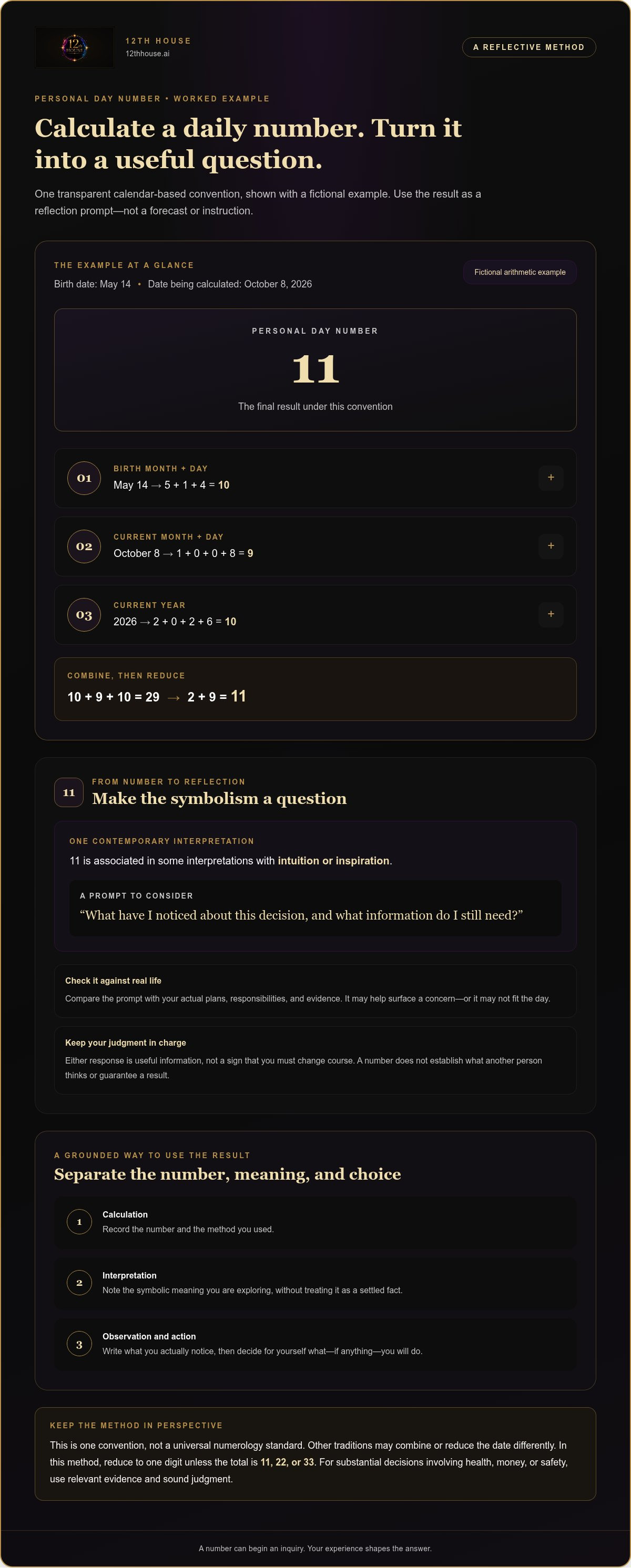
In this method, the Personal Day Number is the sum of the digits in your birth month and day, the current calendar month and day, and the current year, reduced to one digit unless the total is 11, 22, or 33. This convention retains those three totals as master numbers rather than reducing them further. Here’s a fictional example: a person born May 14 is calculating a Personal Day Number for October 8, 2026.
- Write down the birth month and day: May 14 becomes 5 + 1 + 4.
- Add the current month and day: October 8 becomes 1 + 0 + 0 + 8.
- Add the digits of the current year: 2026 becomes 2 + 0 + 2 + 6.
- Combine and reduce: 5 + 1 + 4 + 1 + 0 + 0 + 8 + 2 + 0 + 2 + 6 = 29, then 2 + 9 = 11.
Under this convention, the fictional example’s Personal Day Number is 11. It illustrates the arithmetic only, not a personalized reading, and a different calculation system could produce a different result. Write down the method alongside the number to keep your process clear.
Translate the result into a useful question
In some contemporary numerology interpretations, 11 is associated with intuition or inspiration. Number meanings are symbolic, not settled facts. The Numerology overview describes the diversity of numerological traditions. Use a reference as context, then consider whether an interpretation is useful rather than treating it as a forecast.
Turn one association into an open question. For an 11 theme of intuition, you might ask: What have I noticed about this decision, and what information do I still need? Then compare the prompt with your actual plans, responsibilities, and evidence. Perhaps it helps you identify an unspoken concern. Perhaps it doesn’t fit the day. Either response is useful information, not a sign that you must change course.
Some writing explores numerology’s applications to work, including The Influence of Numerology on Career Choices and Success. Treat that discussion as a perspective on application, not proof that numbers determine career outcomes. For a more personal exploration of number symbolism, 12th House offers numerology reports and Lala AI spiritual guidance. Keep your own judgment at the center.
Applying Numerology to Work, Relationships, and Choices
A number theme becomes practical when it leads to a question you can test against real circumstances. In using numerology in daily life, don’t treat a symbolic association as a command or proof. Use it to examine a situation, then choose a next step based on your responsibilities, evidence, and values. The examples below use themes as prompts, not fixed meanings shared by every numerology tradition.
| Situation | Symbolic theme | Reflection question | Independent next step |
|---|---|---|---|
| Work | Structure | Which task needs clearer priorities? | Review your deadlines, then plan one task in a realistic order. |
| Relationships | Cooperation | Is there an expectation we haven’t discussed? | Ask an open question and listen before deciding what to do. |
| Personal routine | Restoration | What would make this routine more sustainable? | Adjust one small habit and notice whether it fits your day. |
Use number themes to reflect on work and priorities
Suppose a number’s interpretation brings structure to mind. Use it to scan your workload: Is one project stalled because its next step is unclear? Are you spending time on low-priority tasks while a deadline approaches? Those questions can reveal a useful adjustment without suggesting that a number knows which career move is right for you.
Choose a small action, such as breaking a large task into a first step or clarifying a handoff with a colleague. Before acting, check the deadline, your capacity, and any commitments affected. A symbolic theme can direct attention, but it can’t predict workplace events or replace practical planning.
Bring numerology into relationships without making assumptions
In a relationship, let a theme open a conversation rather than assign someone a trait. If you associate a number with cooperation, ask, What would help us share expectations more clearly? That question leaves room for the other person’s perspective. It doesn’t turn a number into a verdict about compatibility, motives, or future behavior.
For example, you might use the prompt to discuss how you’ll divide a shared task, while listening to what feels fair to both people. Readers exploring relationship symbolism can consider numerology compatibility as another lens, not a substitute for communication.
Important choices require real-world evidence and personal judgment; numbers can prompt reflection, but they can’t make the decision for you. For a consequential choice, identify the facts you need, consider possible outcomes, and consult relevant expertise where appropriate. Keep the symbolic question in its proper role: one perspective among many, never the sole basis for action.
Build a Daily Numerology Routine That Stays Grounded
A useful routine creates a clear record, not another rule to obey. Keep three things separate: the number you calculated, the meaning you chose to consider, and the action you took. That distinction helps you see whether using numerology in daily life supports thoughtful reflection or starts shaping your expectations before the day unfolds.
A short morning practice for setting an intention
In the morning, calculate your Personal Day Number with the same method each time. Write down one symbolic theme, turn it into an open question, then set one realistic intention. Keep the intention flexible. If your theme is focus, for instance, you might intend to give one important task your attention while still adjusting to urgent responsibilities or new information.
Use a compact journal entry to keep the stages distinct:
- Calculation: Date, method, and resulting number.
- Interpretation: One theme you’re exploring and where that meaning comes from.
- Question: A prompt that invites reflection rather than predicts an event.
- Action: One practical intention you can revise as the day develops.
Write the interpretation before the day gets underway. That gives you a record of what you expected the theme to mean, rather than letting later events rewrite your original notes.
An evening review that keeps the practice honest
At day’s end, record what happened in plain language before deciding whether it connects to the theme. Note one moment that seemed relevant, if there was one, and one that didn’t fit or felt unrelated. A balanced entry might say, “I planned my tasks, but the day was mostly shaped by an unexpected request.” Don’t force the experience into the symbolism.
This simple check can help you notice confirmation bias, the tendency to give more weight to events that seem to confirm an expectation and overlook those that don’t. Keep the original morning prompt beside your evening observations. As entries accumulate, review them for patterns in your own attention and choices, not as proof that a number caused or predicted an event.
Let the notes challenge your interpretation, too. If a theme seems to match almost any outcome, it may be too broad to guide useful reflection. Narrow the question or leave that day’s symbolism aside. The practice should help you observe your life more clearly, not make ordinary events feel like coded instructions.
If checking numbers begins to create anxiety, pressure, or a need to recalculate until you get a reassuring result, pause the routine or simplify it. You can return to journaling without calculating, or stop for a while. Your judgment and wellbeing take priority over maintaining a ritual.
For a deeper, more personalized way to explore number symbolism, explore 12th House numerology reports and Lala AI spiritual guidance as optional tools for reflection, not authorities over your choices.
Explore Personalized Numerology When You Want to Go Deeper
A simple daily practice can show you which number themes you return to and which questions stay with you. Once you’re comfortable with your chosen method, personalized analysis can offer another structure for exploring those patterns. It’s an optional next layer, not a requirement. Keep your own notes as a reference point, and treat any interpretation as material to consider rather than a conclusion about who you are or what will happen.
When a personalized numerology report may help
A numerology report may be useful if you want to organize questions about recurring themes in your calculations or reflections. For example, you might notice the same number in several parts of your notes and wonder what its symbolism means within a broader numerology framework. A report can provide concepts to explore, while your journal helps you compare those ideas with your lived experience.
Read interpretations actively. Ask what feels relevant, what doesn’t match your experience, and what questions remain. Your own perspective matters more than fitting yourself to a description. If you’re curious about how AI can support spiritual inquiry in a different area, the AI astrology assistant guide offers a related look at AI-guided exploration.
Continue your practice with 12th House
12th House offers numerology reports for readers seeking a more personalized way to explore number symbolism. Its metaphysical library, available through membership, can also support self-guided study. These resources can sit alongside a daily journal: use them to develop questions, then return to your observations and decide what meaning, if any, fits your actual life.
Lala, 12th House’s AI spiritual guidance assistant, can be a companion for questions about numerology and personal reflection. Use it to explore an idea or consider another perspective, not as an oracle that dictates decisions. An AI response is something to evaluate, not a substitute for your judgment, direct communication, or evidence relevant to a real-world choice.
That distinction preserves the value of using numerology in daily life. The number gives you a symbolic language; the report, library, or AI assistant can offer material to examine; and you remain responsible for deciding what is useful. If an interpretation doesn’t resonate, you don’t need to force it. If it prompts a meaningful question, carry that question into your journaling or ordinary routines.
When you’re ready to continue exploring, explore 12th House’s numerology and spiritual guidance tools as an optional part of your self-guided practice.
Let Numbers Open a Better Question
Let your next step be small: choose one daily theme and carry a question from it into your day. The value isn’t in finding a hidden instruction. It’s in making room to notice what you’re prioritizing, what you may be avoiding, and what deserves a closer look. A useful prompt can stay with you even when the number itself fades from view.
That’s the grounded potential of using numerology in daily life. Treat each interpretation as a perspective to examine, not a verdict to obey. Keep what helps you reflect; set aside what doesn’t fit. Your experience remains the measure, and your choices remain your own.
For another space for self-guided exploration, explore 12th House’s numerology tools and metaphysical library. Stay curious, stay discerning, and let each question lead you back to your own considered judgment.
Frequently Asked Questions
How do I use numerology in daily life?
Use numerology as a prompt to examine an ordinary situation, not as a set of instructions. For example, if a number’s symbolism brings communication to mind, pause before a meeting and consider what you need to express clearly. Then rely on the facts of the situation and your own judgment. A short note about what you noticed can help you decide whether that symbolic lens was genuinely useful.
What is a Personal Day Number in numerology?
A Personal Day Number is a date-based number used in some numerology systems to frame reflection on a particular day. Unlike a Life Path Number, which is derived from a birth date and used as a broader interpretive lens, it changes with the date and the calculation method. Its meaning is symbolic: it can suggest a question to consider, but it can’t establish what the day will bring.
Can numerology help with everyday decisions?
It can help you reflect on a decision by prompting questions you might otherwise overlook. If you’re deciding whether to accept an extra task, a theme associated with balance might lead you to consider your workload and existing commitments. The decision should still rest on practical factors, such as time, responsibilities, and consequences. Numerology can frame your thinking, but it can’t identify the objectively correct choice.
How do I calculate my Personal Day Number?
One convention adds the digits of your birth month and day to the digits of the current month, day, and year, then reduces the total to one digit, retaining 11, 22, and 33. For a fictional February 3 birthday on July 12, 2026: 2 + 3 + 7 + 1 + 2 + 2 + 0 + 2 + 6 = 25, then 2 + 5 = 7. Other traditions may calculate differently.
Is numerology scientifically proven?
No. Numerology is a symbolic belief system, not a scientifically established way to predict events or outcomes. A 2016 study published in the Journal of Articles in Support of the Null Hypothesis examined the birth numbers of Nobel Prize winners from 1901 to 2010 and found no significant difference from chance. You can still explore numerology as a personal reflection practice while distinguishing symbolic meaning from empirical evidence.
Can I use numerology without believing it predicts the future?
Yes. You can approach it as a way to generate questions, much like using a writing prompt to examine your priorities or assumptions. You don’t need to believe that a number causes events or reveals a guaranteed outcome. Keep what invites useful thought, and set aside interpretations that don’t fit your experience. This approach leaves room for curiosity without requiring certainty about numerology’s claims.
How can I keep a numerology journal?
Use a notebook or digital document and date each entry. Alongside your calculation, record the interpretation you considered, what was happening in your life, and what you thought about the prompt before acting. Later, note what actually occurred and whether the interpretation fit, partly fit, or didn’t fit. Including context, such as a deadline or an ongoing concern, can help you distinguish a meaningful reflection from a broad interpretation that could match almost anything.


