

What if using astrology to understand my family meant mapping patterns, not assigning roles? When the same tensions or misunderstandings return, simple Sun-sign descriptions rarely explain the full picture. A birth chart can offer a framework for reflection, as long as you don’t reduce anyone to a label.
A birth chart offers symbolic prompts, not proof of why someone behaves a certain way. It can’t diagnose a relative, predict how a conflict will unfold, or excuse harmful behavior. Your family members are more complex than any chart, and your lived experience matters more than a symbolic interpretation.
This guide shows you how to explore chart symbols connected with emotional needs, communication, and family roles, then compare them with real experiences and context. You’ll learn a practical process for asking thoughtful questions, considering different perspectives, and keeping each person’s individuality in view. The aim isn’t to find a cosmic verdict. It’s to create a more precise, respectful map for reflection.
Key Takeaways
- Use the Moon, fourth house, and IC as focused symbolic prompts for exploring emotional needs, home, and roots.
- Distinguish natal-chart reflection from synastry, which compares two charts and highlights possible points of resonance or friction.
- Explore using astrology to understand my family with a repeatable process: choose one question, select a relevant symbol, and record a neutral observation.
- Compare chart symbolism with remembered interactions thoughtfully, rather than treating an interpretation as evidence about someone else.
- Use first-person language such as “I notice” to reflect without assigning relatives fixed traits.
Why use astrology to understand your family dynamics?
Why do familiar family roles return, even when everyone hopes for a different conversation? Using astrology to understand my family can offer a structured way to examine that question, especially when inherited expectations, communication habits, closeness, or recurring tension are hard to put into words. A chart doesn’t supply a final explanation. It gives you symbolic language to consider alongside what you’ve experienced.
Family astrology is the reflective use of birth-chart symbolism to explore relational patterns, not objective proof of why anyone behaves as they do. Astrology draws on symbols such as planets, signs, and houses; Astrology offers a general overview of these concepts and their history. Treat chart interpretations as prompts, not findings. They can help you ask, “What feels familiar here?” They can’t establish another person’s motives, diagnose a relative, predict an outcome, or excuse harm. A symbolic explanation should never outweigh your safety, boundaries, or direct knowledge of events.
What can astrology add to family self-reflection?
Symbolic language can make a recurring experience easier to examine. If a chart theme is traditionally associated with security or emotional response, ask whether you recognize a pattern around reassurance, privacy, or change. Focus on what you’ve observed rather than declaring what a parent or sibling is like. For example, when tension comes up, does one person seek conversation while another needs time alone? What do you know from experience, and what might you be assuming?
The same symbol can also hold different meanings for different people. Privacy might feel protective to one relative and distancing to another. That contrast doesn’t prove either person is “right.” It invites curiosity about how each experiences the same interaction. Keep the interpretation open, and let specific memories, context, and each person’s perspective shape your reflection.
Whose chart can you explore?
Begin with your own chart. You can reflect on your responses, expectations, and role in a family pattern without interpreting anyone else’s birth chart. This keeps the inquiry grounded in what you can know directly: your feelings, memories, and choices. Instead of deciding that a relative “causes” conflict, ask what you tend to do when a disagreement begins and what response you might choose next time.
Exploring a relative’s chart requires their birth details. Birth date, time, and place affect chart calculations, and missing or uncertain information can limit how precisely some placements, especially houses and angles, can be interpreted. Don’t treat an approximate chart as exact. Birth information is personal, too. Seek consent before using someone’s details, and avoid sharing or analyzing them in ways that disregard their privacy. If you don’t have permission or reliable information, stay with your own chart and observations.
Which birth-chart symbols can illuminate family patterns?
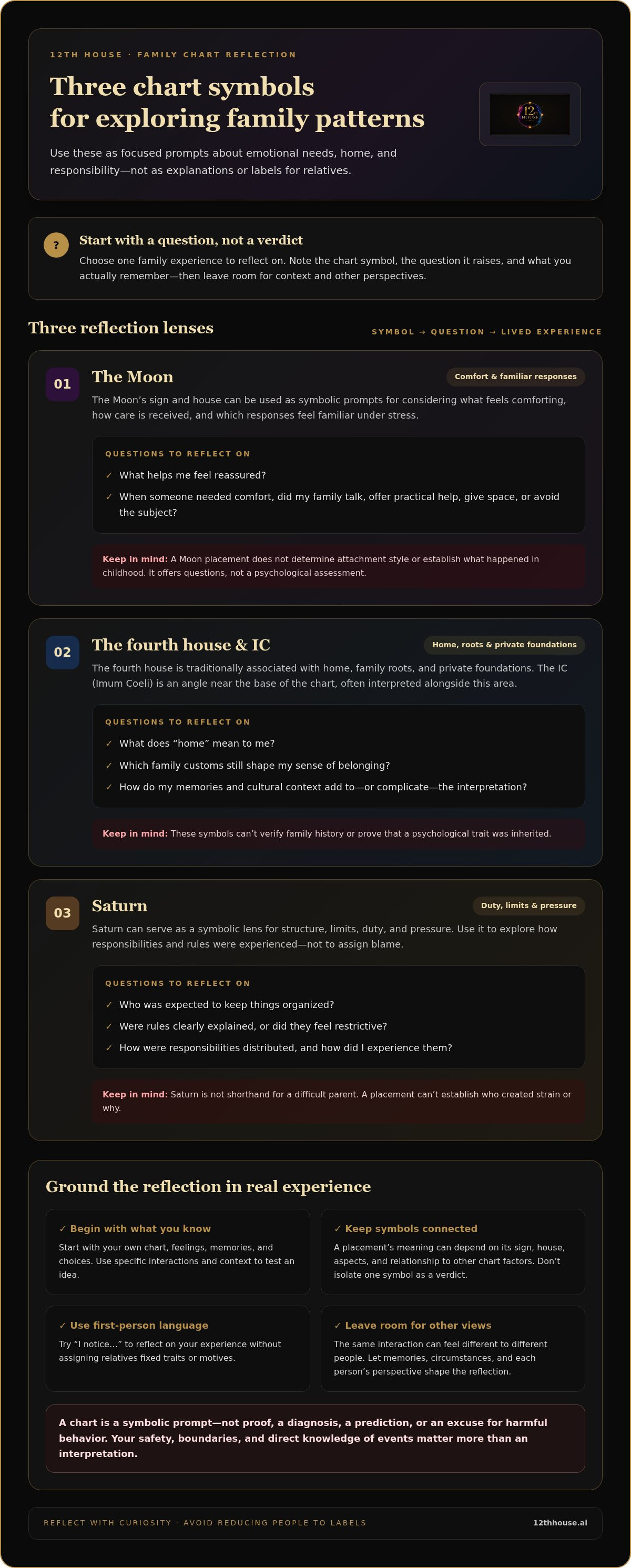
Start with a few chart factors that offer distinct angles on family life. The Moon can prompt reflection on comfort and familiar emotional responses. The fourth house and its associated angle, the IC, traditionally point toward home, roots, and private foundations. Saturn can raise questions about responsibility, limits, and pressure. None works as a standalone explanation. When using astrology to understand my family, treat each placement as one symbol in a larger chart, then compare its themes with lived experience.
The Moon, emotional needs, and familiar responses
Astrologers often read the Moon’s sign and house as symbolic prompts for considering what feels comforting, how care is received, and which responses feel familiar under stress. Ask: What helps me feel reassured? How did people in my family respond when someone needed comfort? Did we talk, offer practical help, give space, or avoid the subject? A Moon placement doesn’t determine attachment style or establish what happened in childhood. It offers questions, not a psychological assessment.
The fourth house, IC, and family roots
The fourth house is traditionally associated with home, family roots, and the private foundations of life. The IC, or Imum Coeli, is an angle near the base of the chart, often interpreted alongside this area. These symbols might lead you to reflect on what “home” means to you or which family customs still shape your sense of belonging. They can’t verify family history or prove that a particular psychological trait was inherited. Compare interpretations with actual memories, cultural context, and what you know of your family’s circumstances.
Saturn, duty, boundaries, and pressure
Saturn is often used as a symbolic lens for structure, limits, duty, and pressure. In a family reflection, it might prompt questions about responsibility: Who was expected to keep things organized? Were rules clearly explained, or did they feel restrictive? Avoid turning Saturn into shorthand for a difficult parent. A placement can’t establish who created a strain or why. Consider how responsibilities were distributed and how you experienced them, while allowing relatives’ accounts to differ from your own.
Read the chart as a connected system
Astrology traditions don’t interpret every placement in the same way. Even within one approach, a symbol’s meaning depends on its sign, house, aspects, and relationship to other chart factors. Don’t isolate one placement and turn it into a verdict. Note the symbol, write down the question it raises, then record what supports or complicates that idea in your experience. 12th House offers astrology birth-chart and transit analysis to help you explore placements and follow-up questions while keeping your interpretation in your hands. Explore personalized birth-chart exploration.
Family birth charts and synastry: what can they show, and what can’t they?
There are two useful scales for family chart reflection. A natal chart focuses on one person’s symbolic patterns; synastry compares two charts to consider how their placements relate. The first can help you examine your own responses. The second can raise questions about interaction. Neither reveals the full story of a relationship or gives a verdict about a relative.
An individual chart versus a family-chart comparison
Begin with your own chart when you want to reflect on your needs, reactions, and interpretation of family experiences. Synastry is a comparison between two charts, such as yours and a sibling’s, or a parent’s and a child’s. It can highlight symbolic themes to consider, not explain every exchange. If a birth time is missing or uncertain, some details, including houses and angles, may be less precise. Don’t present them as exact.
| Method | Focus | Useful question | Limitation |
|---|---|---|---|
| Natal chart | One person’s chart | How do I tend to respond in this family pattern? | Doesn’t establish what another person thinks or intends. |
| Synastry | Two charts compared | What interaction themes might I reflect on with this relative? | Doesn’t measure relationship quality or predict behavior. |
A sibling comparison might prompt you to consider how each of you approaches disagreement. A parent-child comparison could raise questions about different ways of expressing care or seeking space. These are starting points, not assumptions about who is close, who is responsible, or what a family should look like. You can explore any meaningful relationship without presuming a single family structure.
Why chart compatibility is not a relationship verdict
Astrological traditions may describe some chart connections as harmonious and others as challenging. Neither description guarantees closeness or proves incompatibility. A supposedly easy connection doesn’t erase distance, and a tense one doesn’t mean a relationship is doomed. If you’re using astrology to understand my family, keep symbolic observations separate from actual behavior, communication, safety, and boundaries. Those lived realities matter more than a compatibility label.
Ask what a chart comparison helps you notice, then compare that reflection with experience. Do conversations feel mutual? Are boundaries respected? Can people repair misunderstandings? These questions are more useful than scoring a relationship by its aspects. For a broader explanation of chart comparisons, explore birth chart compatibility, while keeping the distinction between symbolism and relationship facts.
How to use astrology to understand your family, step by step
A clear method keeps chart work focused. Instead of searching for a single explanation for a complicated relationship, use one symbol to examine one question about a pattern you’ve noticed. This makes using astrology to understand my family a reflective practice, not an attempt to decode or diagnose another person.
Build a useful question before opening a chart
Begin with a recurring interaction or your own response to it. Ask, “What happens in me when family conversations become tense?” rather than “Why is my relative so difficult?” The first question leaves room for discovery; the second assumes a verdict. Before reading a chart, write down what you know, what you remember, and what you’re interpreting. Keeping these categories distinct makes it easier to separate observation from assumption.
Read, reflect, and reality-check the symbolism
Choose a chart you have permission to explore, then select one relevant placement. Record its sign, house, and a concise traditional association as a prompt, not a conclusion. If you want help shaping a focused question, the guide to an AI astrology assistant discusses using personalized chart questions as part of reflection.
Use this sequence to keep your interpretation accountable:
- Choose one question. Make it specific and open-ended, such as, “How do I respond when I feel responsible for keeping the peace?”
- Gather available details. Use accurate birth information where you have it. Note uncertainty rather than treating a chart detail as precise.
- Select one symbol. Pick the chart factor most relevant to your question. Avoid stacking several interpretations before you’ve considered the first.
- Write a neutral observation. For example: “This placement is traditionally associated with seeking security through familiarity.” Don’t jump straight to “This explains my family.”
- Compare with experience. Recall a specific interaction. What did you observe, and what did you feel? Where does the symbolic idea fit, and where does it not?
- Consider another explanation. Stress, learned communication habits, family circumstances, or differences in perspective may also shape the pattern. A chart doesn’t confirm which explanation is correct.
Finish with a grounded reflection, not a forecast about what a relative will do. You might write, “I notice I often stay quiet when tension rises. Next time, I’ll pause and decide what I want to say.” That intention is yours to choose. It doesn’t depend on anyone else matching a chart description or changing on a predicted timeline.
12th House offers astrology birth-chart and transit analysis, along with Lala, an AI assistant that answers personalized questions about charts and compatibility. Explore your family chart questions and use the results as prompts for reflection, not conclusions about someone else.
Turn family astrology insights into reflection, not labels
A birth chart can organize questions about family patterns, but it can’t establish facts about another person’s character, motives, or history. Keep the interpretation open. “I notice I feel responsible for keeping the peace” describes your experience. “My sibling is selfish because of this placement” turns symbolism into a verdict. The first invites reflection; the second risks narrowing a person to a chart and overlooking what actually happens between you.
Keep interpretations ethical, flexible, and grounded
Use a placement as a question, not as evidence. Astrology can’t diagnose a relative, predict their choices, or justify conduct that causes harm. If an interpretation seems to excuse cruelty or pressure you to ignore your boundaries, set it aside. Protect personal birth information, and don’t interpret someone else’s chart without appropriate consent. Respectful curiosity leaves room for a person’s individuality, their own account, and the possibility that your first reading doesn’t fit.
First-person language helps keep that distinction clear. Try statements such as:
- “I notice I withdraw when family conversations become tense.”
- “I wonder whether I learned to equate helping with being valued.”
- “This symbol gives me a question to explore, not a conclusion about my relative.”
Then compare the thought with specific experiences. What did you observe? What might you be assuming? Could stress, family circumstances, or different communication habits offer another explanation? In using astrology to understand my family, the chart is one interpretive lens, not a substitute for direct conversation or a person’s own perspective.
Know when to pause the chart work
Some situations call for grounded support beyond symbolic reflection. Pause if exploring a family pattern intensifies distress, or if you’re facing coercion, threats, or concerns about safety. A chart can’t assess risk or resolve conflict. Focus on immediate wellbeing and boundaries, and seek appropriate support from trusted people or qualified professionals when needed. You don’t have to keep interpreting a situation to prove that your experience matters.
Continue exploring your chart with 12th House
If you want to continue with your own chart, 12th House’s astrology birth-chart and transit analysis can provide a starting point for personal inquiry. Lala, 12th House’s AI assistant, answers personalized questions about charts and compatibility. Use its answers as prompts for your own reflection, alongside lived experience and judgment. Explore 12th House to continue examining your chart with curiosity, context, and care.
Let your next question open a new perspective
Choose one family pattern you want to understand more clearly, then stay close to what you can observe. A chart can help you shape a question, but insight grows when you remain willing to revise your interpretation. That’s the practice of using astrology to understand my family with curiosity: let symbolism widen your perspective, not narrow your view of someone you love.
If you’d like a structured place to continue, 12th House offers astrology birth-chart and transit analysis, Lala for personalized questions about charts, and a metaphysical library for self-guided learning. Use these resources at your own pace, keeping your judgment at the center.
Explore your chart with 12th House and take your next step with care, clarity, and openness.
Frequently Asked Questions
Is astrology a reliable way to understand my family?
Astrology isn’t a scientifically established way to prove family traits or explain someone’s behavior. It can still give you a symbolic framework for organizing questions. If holidays repeatedly bring tension, for example, a chart might prompt you to reflect on expectations or emotional needs. A careful approach to using astrology to understand my family compares that prompt with real interactions rather than substituting a chart interpretation for direct conversation.
Can my birth chart explain my relationship with my parents?
Your chart can offer traditional symbols for reflecting on your own responses to home, care, and belonging, but it can’t establish what your parents intended or provide a complete record of childhood. Try writing down one specific memory, then list more than one possible interpretation of your response to it. This keeps your reflection anchored in your experience without turning a placement into proof of a parent’s personality or actions.
What part of an astrology chart represents family?
Astrologers commonly consider the fourth house and IC for themes of home, roots, and private foundations, and the Moon for emotional needs or familiar responses. You might use these symbols to ask what makes a place feel like home to you. Interpretations vary across astrological traditions, and these chart factors don’t identify a family member’s character or verify an event in your family history.
Do I need my family members’ birth times to compare our charts?
Birth times can affect details such as the Ascendant and house placements, so an uncertain time may make some chart comparisons less precise. You can still reflect on your own chart without gathering relatives’ information. If you explore a comparison, mark unknown details clearly and avoid building a strong conclusion on them. Respect privacy, too: use someone’s birth information thoughtfully and don’t treat access to it as permission to interpret or share it.
Can astrology tell me why my family keeps repeating the same patterns?
No chart can prove why a pattern repeats. It may help you name a theme you recognize, but also consider practical factors such as stress, changing circumstances, and communication habits. A recurring argument about plans, for example, might reflect different expectations or unresolved logistics, not a fixed family trait. Use astrology to generate questions, then look for explanations in specific interactions rather than assigning blame or predicting what relatives will do.
Is synastry the same as reading a family member’s birth chart?
No. A natal chart focuses on one person’s chart, while synastry compares two charts for symbolic interaction themes. If you’re reflecting on a parent-child relationship, a natal chart can focus your inquiry on your own perspective; synastry adds a comparison, not a complete account of the relationship. Neither method measures closeness or reveals intentions. Keep chart language tentative, especially if either person’s birth details are incomplete.
Can astrology help me understand my siblings?
It can offer a way to reflect on your experience of a sibling relationship, but it can’t settle who is right or explain every difference between you. Choose one concrete situation, such as how you divide responsibilities, and ask what you contribute to the pattern. If you compare charts, treat the result as one perspective among many. Your sibling’s choices, circumstances, and own account matter more than a symbolic label.
To continue exploring your own chart, visit 12th House for astrology birth-chart and transit analysis, personalized questions with Lala, and self-guided learning in the metaphysical library.


