

What if feeling spiritually connected again isn’t a matter of waiting for a revelation, but of making space for small, repeatable moments of attention? Learning how to reconnect with your spirituality can start with one honest question, a quiet pause, or a practice that helps you notice what feels meaningful.
If you feel distant from your intuition or inner steadiness, it can be hard to know where to begin. A routine built around someone else’s beliefs may feel more like a prescription than a path. Your way back doesn’t have to look like anyone else’s, and you don’t need to settle on a label before you start.
This guide offers practical ways to build a grounded, sustainable practice through reflection, everyday observation, and simple rituals. You’ll also learn how astrology, tarot, and dream interpretation can provide prompts for inquiry rather than final answers. The aim is to create meaning through your own discernment, one deliberate step at a time.
Key Takeaways
- Spiritual disconnection can be a reason to pause and reassess what gives your life meaning, not proof that you’ve failed.
- Explore how to reconnect with your spirituality by noticing what feels grounding, then choosing one small practice that fits your beliefs and capacity.
- You don’t need a sudden awakening to find your way back; uncertainty and steady reflection can be part of the process.
- Use a flexible seven-day experiment to notice which actions feel meaningful, then keep, adjust, or set aside each practice.
- Approach astrology, tarot, and other symbolic tools as prompts for reflection, while keeping your own discernment at the center.
What Does It Mean to Reconnect With Your Spirituality?
Feeling distant from meaning, intuition, or the sacred can be a reason to pause and reassess. It isn’t proof that you’ve failed or lost something permanently. Your beliefs and needs can shift as life changes; noticing what has shifted is a useful starting point.
Spiritual reconnection is renewed attention to what gives your life meaning, shapes your values, deepens your inner life, or connects you with what you consider sacred. Organized religion may provide shared beliefs, teachings, and rituals. Personal spirituality describes an individual’s search for meaning or relationship with the sacred, whether or not it takes place within a religious tradition. For a broader overview of the meaning of spirituality and its relationship with religion, explore the range of ways the term is understood.
Spirituality can be religious or nonreligious, practiced alone or with a community, rooted in an established tradition or still taking shape. Learning how to reconnect with your spirituality doesn’t require choosing a label first. Start by noticing what feels significant, grounding, or worthy of your care.
Can You Be Spiritual Without Following a Religion?
Yes. A spiritual practice might draw on faith, time in nature, ethical commitments, contemplation, prayer, creative work, or open-ended personal inquiry. These routes aren’t interchangeable, and none is the required path. Consider whether a practice helps you engage honestly with your values, questions, or sense of connection.
If you’re unsure what to call your experience, leave the label open. Ask yourself: What feels meaningful to me? What do I treat with reverence? Where do I find perspective or a sense of belonging? You can explore those questions without settling on a worldview or explaining your choices to anyone.
Why Might You Feel Spiritually Disconnected?
Disconnection can emerge during a life transition, a period of stress or grief, the repetition of daily routines, or a change in beliefs. These are possible contexts, not diagnoses. Sometimes a practice that once felt sustaining no longer fits; sometimes attention is absorbed by immediate demands. A quiet season doesn’t automatically mean your spiritual life is gone.
Rather than forcing instant certainty, ask what you miss, if anything. Is it a sense of purpose, time for reflection, connection with other people, or a relationship with the sacred? You may want more of one and less of another. Naming the difference gives you a clearer starting point for deciding what to explore next.
How to Reconnect With Your Spirituality Through Everyday Practices
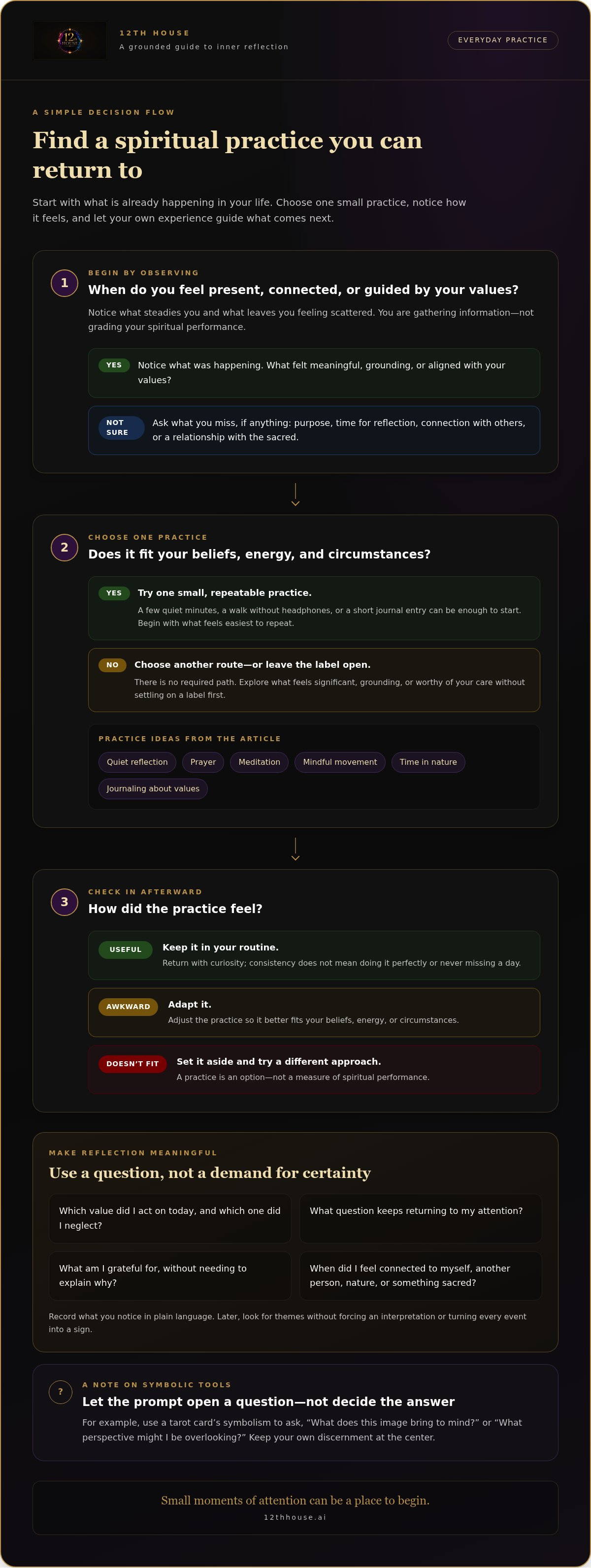
Begin by observing your life as it is. Before adding a ritual or setting a demanding routine, notice when you feel present, connected, or guided by your values. Pay attention to what steadies you and what leaves you feeling scattered. You’re gathering information, not grading your spiritual performance.
A small, repeatable practice creates regular opportunities to pause and notice what carries meaning for you. Consistency doesn’t mean doing it perfectly or never missing a day. It means returning with curiosity when you’re ready. A few quiet minutes, a walk without headphones, or a short journal entry can be enough to start. If you’re choosing between practices, begin with the one that feels easiest to repeat, not the one that sounds most impressive.
Which Simple Spiritual Practices Can You Try?
Choose an approach that fits your beliefs, energy, and circumstances. You might try quiet reflection, prayer, meditation, mindful movement, time in nature, or journaling about the values you want to live by. Start with one practice and notice how you feel afterward. Keep it if it feels useful, adapt it if it feels awkward, or set it aside if it doesn’t fit.
Tarot can also serve as a reflective prompt. Rather than treating a card as a fixed prediction or command, use its symbolism to open a question: What does this image bring to mind? What perspective might I be overlooking? For more on approaching tarot as a practice, read Tarot Mastery: A Professional Guide to Spiritual Clarity. Mental Health America also explores the benefits of spirituality for mental health, offering context for why spiritual life can matter to overall well-being.
How Can You Make Reflection More Meaningful?
Give your practice a clear focus. Instead of asking yourself to find a definitive answer, use a prompt that makes room for observation. Try:
- Which value did I act on today, and which one did I neglect?
- What question keeps returning to my attention?
- What am I grateful for, without needing to explain why?
- When did I feel connected to myself, another person, nature, or something sacred?
Record what you notice in plain language. Don’t force an interpretation or turn every event into a sign. Later, reread your notes and look for themes: a recurring concern, a source of gratitude, or a value you want to honor more often. If symbolic prompts help you reflect, explore spiritual reflection tools while keeping your own experience at the center.
Do You Need a Spiritual Awakening to Find Your Way Back?
No sudden revelation is required. Spirituality doesn’t have to arrive as an extraordinary experience, a dramatic change in identity, or a moment that resolves every doubt. Reconnection can be quieter: noticing a value you want to live by, returning to a question you’ve set aside, or making room for a practice that feels honest.
Uncertainty belongs here, too. Beliefs can change, and you might feel close to a tradition one day and unsure of it the next. That doesn’t automatically mean you’re doing anything wrong. A spiritual framework can help you reflect on meaning; it can’t prove that one interpretation is universal truth. Treat ideas as perspectives to examine, not instructions that override your judgment.
Is Spirituality the Same as Having a Spiritual Awakening?
Some people use “awakening” to describe a significant shift in awareness, belief, or priorities. It’s one way to name an experience, not a requirement for a spiritual life. A gradual change can matter just as much: you may pay closer attention to your values, question an old assumption, or feel drawn to quiet reflection. No dramatic label is needed, and spiritual practice can’t promise a particular psychological, physical, or life outcome.
What If Spiritual Practices Feel Forced or Unfamiliar?
Pause and adjust. A practice that feels inauthentic may need a simpler form, a different rhythm, or a place in your life that better respects your boundaries. Discomfort doesn’t prove you’re failing at spirituality; it may be useful information about what doesn’t fit. You can return to a familiar practice, try another approach, or take a break without demanding an immediate explanation.
If a practice brings up distress that feels difficult to manage, step away and consider seeking support from a qualified mental health professional. Spiritual exploration should leave room for care and discernment. If you want a structured prompt for your own inquiry, explore spiritual reflection tools, then compare any insight with your lived experience. The question isn’t whether a tool can decide what’s true for you, but whether it helps you ask a more useful question.
How to Build a Spiritual Reconnection Practice That Lasts
A practice lasts when it fits your actual life, not an ideal version of your schedule. Treat this seven-day sequence as an experiment, not a required challenge. If you’re exploring how to reconnect with your spirituality, use it to notice what feels grounding, meaningful, or uncomfortable. Then keep only what serves you.
What Could a Gentle Seven-Day Practice Look Like?
Before you begin, check in with your current needs, beliefs, and available time. Choose a few minutes, or less if that feels manageable. After each step, make a brief note: grounding, meaningful, or uncomfortable, plus a word or sentence about why. These are observations, not scores.
- Day 1: Take a baseline. Action: Write what you hope to make space for. Question: What feels absent or important right now? Adjustment: Note a single word if writing feels like too much.
- Day 2: Observe nature. Action: Notice one detail outdoors or through a window. Question: What did I pay attention to when I slowed down? Adjustment: Choose a familiar view or a houseplant.
- Day 3: Sit quietly. Action: Spend a brief pause without trying to solve anything. Question: What is present in my mind or body? Adjustment: Keep your eyes open or shorten the pause.
- Day 4: Try meditation. Action: Rest your attention on a sound or your breathing. Question: What helps me return to the present? Adjustment: Stop if it feels uncomfortable and choose quiet observation instead.
- Day 5: Journal about values. Action: Write about one value you want to honor. Question: Where did it appear in my day? Adjustment: Think it through without writing.
- Day 6: Choose connection. Action: Try prayer, a meaningful reading, or a conversation with someone you trust. Question: What kind of connection feels genuine? Adjustment: Choose a solitary option if community doesn’t feel right.
- Day 7: Review your notes. Action: Look for repeated words or reactions. Question: Which practice felt worth returning to? Adjustment: Keep the experiment open if no clear pattern has emerged yet.
How Can You Adapt the Practice to Your Life?
Attach a chosen practice to a cue that already exists, such as sitting down with a morning drink or winding down for the evening. The cue is a reminder, not a schedule you must obey. On busy days, take one mindful breath or name one thing you value. If shared practice feels more supportive, consider a trusted faith community or a reflective conversation.
Keep what feels useful and personally congruent; revise or release the rest. For another source of questions to bring into your reflection, explore spiritual guidance tools and interpret any ideas through your own experience.
Use Spiritual Tools as Prompts for Your Own Meaning-Making
Symbolic systems can give reflection a structure. They offer images, patterns, or language that help you examine a question from another angle. Their value lies in the inquiry they open, not in any authority to define your identity or make decisions for you.
Use spiritual frameworks as lenses for reflection, not as proof of universal truths or instructions you must follow. An interpretation may resonate, challenge you, or feel irrelevant. Each response can help clarify what you believe, value, or want to investigate next.
How Can Astrology, Tarot, or Human Design Support Reflection?
Each system offers a different symbolic framework. An astrology birth chart can give you themes to consider in relation to your life and current questions. A tarot reading uses cards and their imagery to prompt interpretation. A Human Design profile offers another system for exploring personal patterns. None needs to become a fixed identity.
Ask what an interpretation brings up before accepting it. Does it connect with your lived experience? Does it raise a useful question, or does it feel too narrow? If you’re curious about personalized chart exploration, read The Digital Sage: Why an AI Astrology Assistant is Your New Metaphysical Architect.
How Can You Keep Your Spiritual Practice Personal?
Compare any reading or symbolic insight with your values, current circumstances, and what you’ve observed over time. A tool might suggest a theme, but you decide whether it holds meaning for you and what, if anything, to do with it. Disagreement can be useful information. It may show that a framework doesn’t fit your perspective or that you need a different question.
12th House offers resources for self-guided exploration, including Ask Lala AI Spiritual Guidance, astrology chart and transit analysis, tarot readings, numerology reports, Human Design profiles, dream interpretation, and a metaphysical library. Use them to generate questions or organize reflection, not to outsource your discernment. That distinction matters as you explore how to reconnect with your spirituality on your own terms.
For a gentle next step, choose one question you’re carrying and explore it through a practice or reflection tool that feels relevant. Let the result be a starting point for your own meaning-making, not a final answer.
Make Your Next Step Small and Your Own
Spiritual reconnection doesn’t require a dramatic revelation or a perfect routine. It can begin with one honest question, a small practice you can return to, and the patience to notice what feels meaningful. If you’re considering how to reconnect with your spirituality, let curiosity guide the process rather than pressure to arrive at a final answer.
Keep what supports reflection and adjust what feels forced. Spiritual tools can offer language and perspective, but your lived experience and discernment remain central to the meaning you make.
12th House brings personalized AI spiritual guidance through Lala together with astrology, tarot, Human Design, numerology, and a metaphysical library. Use these resources as prompts for inquiry, not instructions for what to believe. Explore a more personal path of spiritual reflection with 12th House.
Your path can unfold one thoughtful step at a time. Begin where you are, and let the next step be enough.
Frequently Asked Questions
How do I reconnect with my spirituality when I feel lost?
Start by noticing what you miss or want more of, rather than demanding an immediate answer. Ask whether you’re seeking meaning, quiet, connection, guidance, or a way to live closer to your values. Choose one small practice, such as a few minutes of reflection or a walk without distractions, and observe how it feels. You can adjust or stop; the first step is inquiry, not certainty.
Can you be spiritual without being religious?
Yes. Spirituality can exist within a religion, outside organized religion, or in a form that’s still taking shape. Someone might find meaning through nature, ethical commitments, contemplation, personal inquiry, or a sense of connection with something sacred. You don’t need to adopt a label to explore what matters to you. Let your experience and values guide your questions, rather than assuming one belief system is the correct route.
What are simple ways to reconnect with your spirituality every day?
Choose one practice that fits your energy and beliefs. You could pause for quiet reflection, pray, meditate, notice nature on a walk, move mindfully, or write a few lines about a value you want to honor. Keep it brief if that feels more sustainable. Afterward, note what you observed without forcing an interpretation. The aim isn’t to perform a ritual perfectly, but to create a moment of attention you can return to.
How long does it take to reconnect with your spirituality?
There’s no set timeline. A sense of connection may shift gradually, and it can look different from one person or season of life to another. Rather than measuring progress by a dramatic experience, notice smaller signals: a practice feels meaningful, a question becomes clearer, or you’re paying closer attention to your values. Give yourself room to experiment. You can change your approach as your needs and beliefs evolve.
What happens if meditation or prayer does not feel right for me?
You can choose another practice. Meditation and prayer aren’t required routes to spirituality, and feeling uncomfortable with them doesn’t mean you’re doing anything wrong. Try nature observation, mindful movement, journaling, creative reflection, or a values check-in instead. You can also simplify or pause a practice that feels forced. If an activity brings up distress that feels difficult to manage, step away and consider seeking support from a qualified mental health professional.
Can tarot or astrology help me reconnect with my spirituality?
Tarot and astrology can offer symbolic prompts for reflection, but they don’t have to dictate your identity or decisions. You might use a tarot card’s imagery to explore a question, or consider what an astrology chart interpretation brings to mind. Compare any insight with your lived experience and values. If a reading doesn’t resonate, you can set it aside. The useful measure is whether it opens thoughtful inquiry, not whether it supplies certainty.
Is it normal to feel spiritually disconnected during a major life change?
Feeling disconnected can happen during a major transition, as attention and energy shift toward new demands, grief, uncertainty, or changing priorities. It doesn’t automatically mean your spiritual life has failed or disappeared. Give yourself time to notice what has changed and what you might need now. You may return to a familiar practice, adapt it, or wait before choosing a new one. There’s no need to force immediate clarity.


