

What if your child’s Human Design chart could help you notice their preferences without telling you who they are? That’s the heart of understanding your child's human design: using the chart as a lens for reflection, not a script for their personality, future, or needs. It’s natural to want clearer answers when unfamiliar terms appear, and just as natural to worry about reading too much into them.
This guide explains basic chart elements often discussed in relation to children and offers practical ways to consider them alongside everyday observations. You’ll learn how to notice your child’s responses to choices, energy, and interaction without treating a symbolic framework as a diagnosis or a set of instructions.
Your child remains the authority on their changing experience. Use chart concepts to form thoughtful questions, stay curious when your observations don’t match an interpretation, and make room for preferences to evolve. A structured profile can organize unfamiliar ideas, but your attention, patience, and respect for your child’s agency matter more than any chart.
Key Takeaways
- Approach understanding your child's human design as a reflective practice, not a child-development assessment or a fixed account of who they are.
- Learn how Type, Strategy, Authority, and defined or open Centers can prompt questions without prescribing how your child should behave.
- Notice when chart interpretations risk becoming labels, and check your assumptions against your child’s words and actions.
- Explore one concept at a time: observe without prompting, reflect, then adapt only when it genuinely supports your child.
- Use a Human Design Profile to organize chart concepts while keeping your child’s agency and changing preferences at the center.
Understanding Your Child’s Human Design: What the Chart Can, and Cannot, Offer
Could a chart help you ask better questions about your child without supplying ready-made answers? Human Design is a symbolic system for self-reflection, not a child-development assessment. Its BodyGraph presents chart information visually, using details such as birth date, time, and place to generate a map. Those inputs create a chart within the system; they don’t guarantee that its interpretations will describe your child accurately.
The Human Design system draws on several symbolic traditions. Its concepts can offer a vocabulary for reflection, but they aren’t scientifically validated measures of a child’s personality or needs. Think of the BodyGraph as a map of ideas to explore, not an instrument that measures your child. Type, Strategy, Authority, and Centers are among the elements parents may encounter. The next section explains these terms in plain language without treating them as proven traits.
What does a child’s Human Design chart describe?
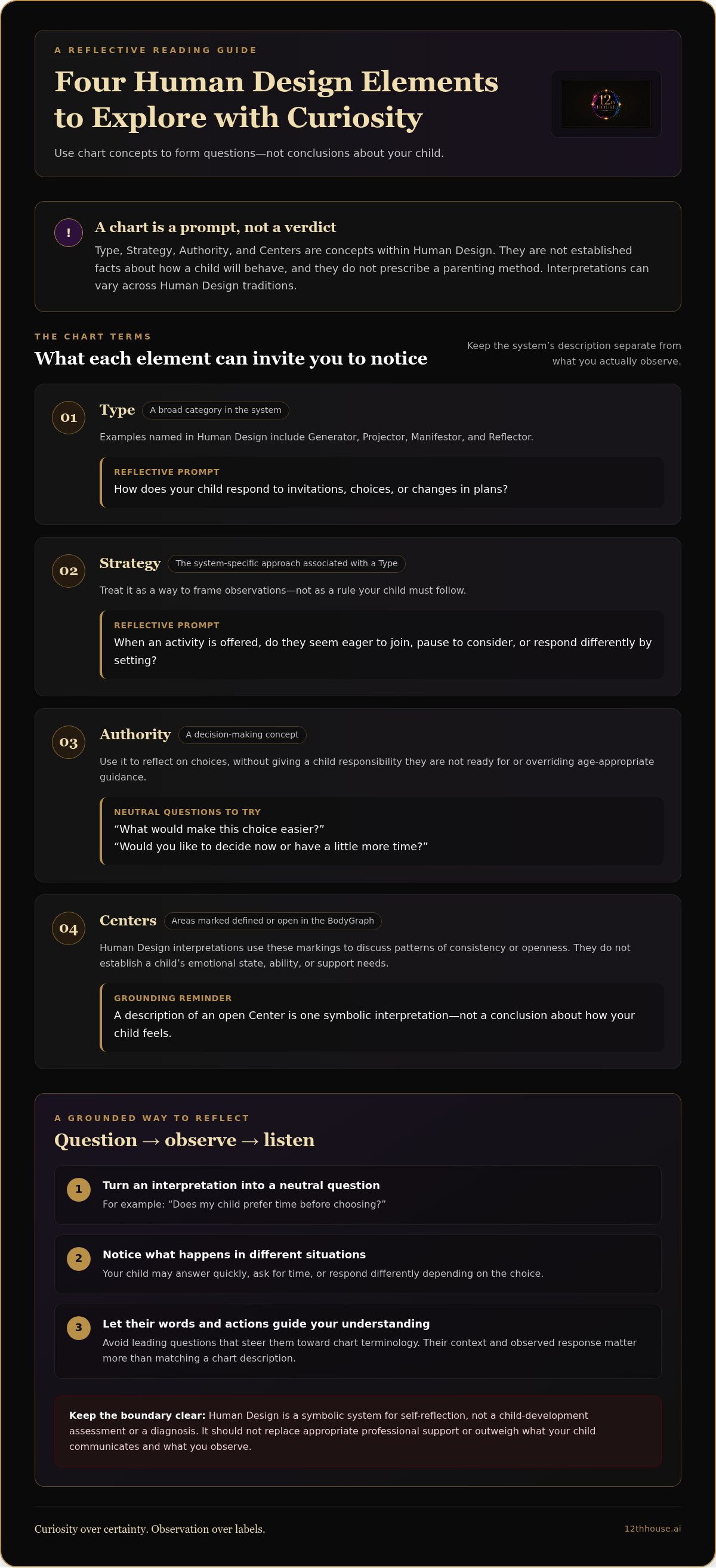
Within Human Design, Type and Strategy offer a framework for considering how someone engages with decisions or opportunities. Authority refers to a proposed way of making decisions, while Centers are areas of the BodyGraph marked as defined or open. These are concepts within the system, not established facts about how a child will behave. Interpretations can also vary across Human Design traditions, so avoid treating one explanation as definitive.
Turn an interpretation into a question you can test through ordinary observation. If a chart prompts you to wonder whether your child prefers time before choosing, notice what happens in different situations. Do they answer quickly, ask for time, or respond differently depending on the choice? Let their actual response guide your understanding. Avoid leading questions such as, “Does your chart mean you need more time?”
Why should parents use the chart as a lens, not a label?
A lens invites curiosity: “What seems to help my child feel comfortable making this choice?” A label turns an interpretation into a rule: “My child is this Type, so they must respond this way.” That shift can narrow what you notice. Children grow, learn, and react differently across settings, relationships, and stages of development. A chart should never outweigh what your child communicates or what you observe.
Understanding your child's human design responsibly means holding interpretations lightly. Use them to reflect, then check them against real interactions. Human Design cannot diagnose learning, health, or emotional needs, and it shouldn’t replace appropriate professional support. Your child is not a chart to decode. The chart is one possible prompt for paying closer attention.
How to Read the Human Design Elements That May Prompt Useful Questions
A BodyGraph can look like a dense diagram at first. Start with a few central terms: Type, Strategy, Authority, and Centers. Within Human Design, these concepts form a symbolic framework for thinking about interaction, decisions, and areas of consistent or variable expression. They aren’t established facts about a child, and they don’t prescribe a parenting method.
What can Type and Strategy suggest parents explore?
Type is a broad category in the system, such as Generator, Projector, Manifestor, or Reflector. Strategy is the system-specific approach associated with that category. Rather than turning it into a rule your child must follow, use it as a prompt to notice how they respond to invitations, choices, or changes in plans.
For example, suppose a chart interpretation makes you wonder whether your child prefers being asked before joining an activity. Treat that as an illustrative question, not a prediction. Notice what happens in different settings: Do they seem eager to join, pause to consider, or respond differently with familiar people? Their context and observed response matter more than whether they match a chart description.
How should parents approach Authority and the Centers?
Authority refers to a decision-making concept within Human Design. Use it to reflect on how your child approaches choices, not to give them responsibility they aren’t ready for or to override age-appropriate guidance. A young child may need help understanding options, time limits, or safety. A chart shouldn’t replace that care.
Centers are areas in the BodyGraph shown as defined or open. In Human Design interpretations, these markings are used to discuss different patterns of consistency or openness. They don’t establish a child’s emotional state, ability, or support needs. If a reading describes an open Center in a particular way, regard that as one symbolic interpretation, not a conclusion about how your child feels.
A chart interpretation offers a question; your child’s behavior offers the observation. Keep that distinction visible as you read. Ask neutral questions, such as “What would make this choice easier?” or “Would you like to decide now or have a little more time?” Then listen without steering the answer toward chart terminology.
If you’re exploring understanding your child's human design, a structured Human Design Profile can help organize the system’s concepts for reflection. Use it as a reference point, then compare each idea with your child’s words, actions, and changing preferences.
Can Human Design Limit a Child? Avoiding Labels and Fixed Expectations
It can, if adults treat an interpretation as fact. A chart category may begin as a metaphor for reflection, then quietly become a filter: a child’s hesitation is read as proof of a Type, while moments that don’t fit the description are overlooked. This is confirmation bias. Once you expect an idea to be true, supporting examples can stand out more than contradictory ones.
Reflection can still be useful, as long as the interpretation remains open to question. A child’s Human Design chart offers a narrow symbolic framework, while their behavior unfolds within relationships, routines, culture, age, and circumstance. No single category can contain all that context.
What are the risks of assigning a child a Human Design label?
Repeated labels can harden into expectations. Calling a child “the one who needs to wait” may lead adults to interpret ordinary uncertainty as a fixed trait or offer fewer chances to make choices. Describe what you see instead: “They asked for more time with that decision.” This keeps the observation specific and leaves room for a different response next time.
How can parents keep the interpretation flexible?
Hold chart language as a question, not a conclusion. If an interpretation suggests a preference, look for examples and counterexamples across situations. Revisit the idea as your child grows or circumstances change. Keep spiritual reflection separate from decisions about health, education, or development, which should be based on your child’s actual needs and appropriate guidance.
A simple check can help distinguish a chart-based hypothesis from what your child communicates:
- Hypothesis: “This chart concept makes me wonder whether transitions feel difficult.”
- Observation: “My child seemed unsettled when we changed plans today.”
- Curious follow-up: “Would a warning or a little more time help next time?”
The observation is not proof of the chart interpretation. A difficult transition could reflect tiredness, surprise, or something else entirely. Listen to your child’s response and allow it to change your first idea. If a pattern appears in some situations but not others, that variation matters too.
No chart should override a child’s expressed needs or appropriate care. This is especially important if a concern relates to learning, health, emotional wellbeing, or development. Human Design is not a diagnostic tool, and chart language shouldn’t delay practical support or replace professional advice.
Responsible understanding your child's human design leaves your child more room to be known, not less. Let interpretations remain provisional. Your child can surprise you, change, and describe their experience in ways a chart cannot anticipate.
How to Use Your Child’s Human Design as a Gentle Parenting Reflection Tool
Keep the practice small and grounded. You don’t need to interpret an entire chart before applying anything. Choose one concept, then let your child’s everyday responses guide what you make of it. A useful sequence is to learn one chart concept, observe without prompting, reflect on what you noticed, and adapt only if a small change seems helpful.
For example, if a chart concept makes you curious about how your child handles transitions, observe a few different moments without announcing what you expect to see. Do they respond better to a visual reminder, a brief warning, or no noticeable change? You’re gathering context, not proving the chart right. Note the situation too: whether your child was tired, rushing, or moving from a preferred activity can affect their response.
What questions can parents ask without leading the child?
Ask about your child’s experience in language they understand. Keep questions open, and let “I don’t know” or disagreement stand. Avoid chart-based prompts that suggest the answer you’re looking for.
- At home: “Which part of getting ready feels easy, and which part feels tricky?”
- During a transition: “Would you like a reminder before we leave, or would you rather decide together?”
- After a busy day: “What felt fun? Was anything tiring?”
A younger child might answer by pointing, choosing between two options, or showing you what they mean. An older child may prefer to talk later or write their thoughts down. Follow their communication style. If they reject your interpretation, don’t correct them to fit the chart. Their account is valuable information, even when it challenges your first impression.
How can chart reflection inform everyday support?
Look for patterns across contexts before changing a routine. One difficult morning doesn’t establish a preference. Notice whether the same challenge appears at home, during activities, or only when your child is tired or rushed. Then test one small, reversible adjustment. You might try laying out two clothing options the night before, using a simple transition reminder, or giving your child a choice about when to talk. Observe whether it helps, and stop if it doesn’t.
Keep practical responsibilities distinct from chart interpretation. Safety rules, caregiving decisions, and professional advice should be guided by the situation and your child’s needs, not by a symbolic framework. A chart can prompt reflection; it can’t decide what care is appropriate.
If a structured reference would help you organize the concepts you’re exploring, explore Human Design profiles. Use the profile to generate questions, then keep your attention on the child in front of you. That’s the practice at the center of understanding your child's human design: stay curious, observe without steering, and adapt only when the change genuinely serves your child.
Explore Your Child’s Human Design with Curiosity, Context, and Care
The most useful question isn’t, “What does this chart prove about my child?” It’s, “What can I explore, and what do I notice in real life?” Human Design can offer a symbolic vocabulary for reflection, but your child’s words, behavior, changing needs, and circumstances remain the primary context. Let the chart open a line of inquiry, not close the conversation.
When might a Human Design profile help a parent?
A Human Design Profile can organize chart terminology into a structured starting point, especially if the BodyGraph feels unfamiliar. Read one concept at a time. Pause to consider what it means within the system, then compare it with specific observations rather than searching for proof that the interpretation fits. For a focused introduction to Type, explore the five Human Design types. Treat the overview as a map of system language, not a description your child must match.
How can parents explore chart questions responsibly?
You can also use Lala, 12th House’s AI assistant, to explore questions about chart concepts. Keep its role clear: AI-generated interpretations are prompts for your own reflection, not authoritative conclusions about your child. Consider asking what a term means or how an element is interpreted within Human Design. Then assess the response thoughtfully, notice what remains uncertain, and compare any idea with your child’s actual experience.
Protect your child’s privacy as you explore. Avoid entering unnecessary sensitive details into digital tools. General questions about a chart concept may be enough to support learning; personal or identifying information isn’t needed to reflect on what a term means.
Understanding your child's human design is an ongoing practice of curiosity, not a final reading. A profile or AI response can help you organize ideas, but it can’t speak for your child. Keep listening, make room for disagreement, and revisit your understanding as your child grows. Their voice and real-world context come first.
For a structured place to continue exploring Human Design, explore Human Design with 12th House. Use what you learn as a resource for thoughtful questions, while leaving conclusions open.
Keep Your Child at the Center of the Exploration
Understanding your child's human design works best as an open-ended practice. Type, Authority, and Centers can offer concepts to reflect on, but they don’t define your child or establish what they need. Notice real behavior across different situations, ask neutral questions, and let your child disagree or change as they grow.
A Human Design Profile can help organize unfamiliar chart concepts into a structured starting point. Lala AI can answer personalized questions about charts, too. Treat its responses as prompts for your own consideration, not authority on your child’s personality or needs. Your observations, your child’s voice, and appropriate care remain central.
To keep learning with curiosity and care, explore Human Design with 12th House. Use the framework gently, stay open to what your child shows you, and remember that understanding grows through attention, conversation, and time.
Frequently Asked Questions
What is Human Design for children?
Human Design for children is a symbolic system that uses a BodyGraph and concepts such as Type, Strategy, Authority, and Centers. Parents may use these ideas as prompts for reflection, but they aren’t clinical or scientifically validated measures of a child’s personality or development. Treat interpretations as optional perspectives. Give greater weight to your child’s own words and behavior, and remember that responses can change with age and circumstances.
How do I understand my child’s Human Design chart?
Start with the basic terms, then choose one chart element to explore at a time. Consider what an interpretation brings to mind, but don’t assume it explains your child. For understanding your child's human design, compare your reflections with what you observe across real situations, such as how your child responds to a new activity. A chart can organize questions, but it can’t establish needs, diagnose a concern, or predict behavior.
Can a child’s Human Design type change as they grow?
Within Human Design, a chart’s calculated elements are presented as fixed, but a child’s behavior, preferences, and circumstances can change as they develop. Don’t treat a Type as a forecast or permanent description of who they are. Use interpretations as flexible reflection prompts. Keep noticing how your child responds in different situations, and let current observations and your child’s perspective update your understanding.
Is Human Design scientifically proven for understanding children?
No. Human Design is a spiritual and symbolic framework, not a scientifically validated assessment of child development. Its interpretations shouldn’t be used to diagnose a child, predict outcomes, or replace guidance from qualified health or education professionals. If you explore the chart, keep its role clear: it may inspire reflection, but decisions about your child should be grounded in their real-world needs and appropriate support.
What information do I need to create my child’s Human Design chart?
Human Design chart tools commonly use a person’s birth date, birth time, and birthplace. The details entered affect the chart produced, so avoid treating uncertain information as exact. A chart is a calculation within the system, not a guarantee that an interpretation will describe your child. Because these details are personal data, consider what you share with digital services and whether storing them is necessary for your purpose.
How can I use Human Design without labeling my child?
Use chart descriptions as questions, not definitions. Observe your child in different contexts and ask open questions such as, “What would make this easier?” Let them disagree without correction, and avoid repeating a Type as an identity statement. If a reflection suggests changing a routine, make one small, reversible adjustment. Judge it by your child’s response, not by whether the chart seems to confirm the interpretation.


