

What if a transit didn’t tell you what to do, but helped you ask a sharper business question? That’s the grounded premise of using astrology for business strategy: treat chart themes as prompts for reflection, not guarantees about what will happen.
If astrology has ever felt too abstract to apply to a launch, career shift, or visibility decision, you’re not alone. A chart can offer symbolic language for exploring work patterns and timing, but it can’t replace customer feedback, financial data, or sound judgment. The useful question isn’t “What does the forecast promise?” It’s “What can I investigate, and what evidence would support my next step?”
This guide gives you a repeatable process for turning birth-chart and transit themes into focused planning questions, then testing possible actions against real-world conditions. You’ll learn how to approach chart factors related to work and public visibility, use timing as a reflection tool, and set boundaries so decisions remain yours. Astrology can open the inquiry; evidence helps shape the decision.
Key Takeaways
- Use chart symbolism to generate business questions, not to predict revenue or guarantee outcomes.
- Start with one decision, review relevant chart context, and turn a theme into a testable hypothesis.
- Weigh astrological prompts alongside customer feedback, cash flow, workload, and deadlines.
- Build a repeatable decision log that records your prompt, evidence, action, and review date.
- Explore personalized chart and transit themes with 12th House, and use Lala AI to organize follow-up questions.
What Does Using Astrology for Business Strategy Actually Mean?
Business astrology uses astrological symbolism as a reflective lens for examining business choices and timing, not as a decision-maker or forecast. A birth chart or transit can offer a prompt: Where might you need clearer communication, a more sustainable workload, or a fresh approach to visibility? The value lies in the inquiry it opens, not in a promise about what will happen.
Astrology draws on interpretations of celestial objects, zodiac signs, and houses. For a concise foundation, see What is Astrology? Applying those symbols to business is interpretive. It isn’t a validated method for predicting revenue, customer demand, or the outcome of a launch. Treat astrology as one lens for reflection, alongside the practical conditions your business operates within.
That distinction matters. A symbolic reading may help you examine your assumptions, but it can’t replace conversations with customers, cash-flow planning, or an honest assessment of your capacity. If an astrological theme suggests expansion, for example, turn it into a question: “What would need to be true for us to take on more work responsibly?” Then examine demand, costs, deadlines, and available resources before acting. This is the grounded core of using astrology for business strategy.
Which business questions can astrology help you examine?
Use chart symbolism to frame questions about areas you can influence, such as the timing of a communications push, your workload, public visibility, or a possible change in direction. Keep the prompt specific. Instead of asking, “Will my business succeed?” ask, “What should I review before deciding whether to introduce this offer?” The chart can suggest a line of inquiry; it can’t guarantee the right answer.
Focus on choices with identifiable next steps: revise a message, review a launch schedule, set a boundary around capacity, or gather feedback before shifting your offer. A useful prompt leads to investigation, not passive waiting for a favorable forecast.
What astrology cannot establish about a business decision
Planetary placements aren’t evidence of market demand or financial success. Keep personal meaning and measurable indicators distinct: a transit may feel significant to you, while sales, retention, cash flow, and runway show how the business is performing. Neither should be mistaken for the other.
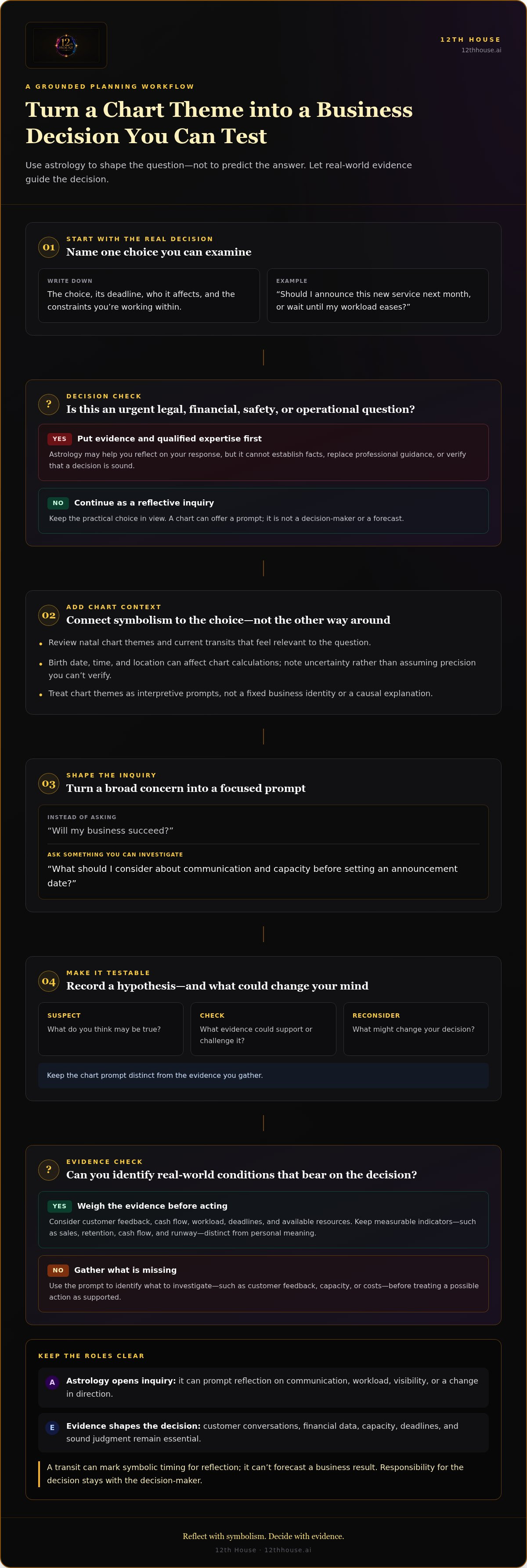
For urgent legal, financial, safety, or operational questions, use relevant evidence and qualified expertise. Astrology may help you reflect on your response, but it can’t establish facts, replace professional guidance, or verify that a decision is sound. Keep responsibility with the decision-maker, and let symbolism inform the questions you test.
How to Translate a Birth Chart and Transits into Business Questions
Start with the business question, not a horoscope. A chart can support reflection when it’s connected to a choice you can name, examine, and revisit. This four-step process keeps symbolism in its proper role: an interpretive prompt that helps shape inquiry, not a causal explanation for what happens next.
- Define one decision. Write down the choice, its deadline, who it affects, and the constraints you’re working within. For example: “Should I announce this new service next month, or wait until my workload eases?”
- Gather chart context. Review natal chart themes and current transits that feel relevant to the question. Birth date, time, and location can affect chart calculations, so use the details available to you and note any uncertainty rather than assuming a level of precision you can’t verify.
- Frame a focused prompt. Turn a broad concern into something you can investigate: “What should I consider about communication and capacity before setting an announcement date?”
- Record a hypothesis. State what you suspect, what evidence could support or challenge it, and what might change your decision. Keep the chart prompt distinct from the evidence you’ll gather.
Start with the business decision, not the horoscope
Set the practical frame first. Identify the decision, timing, people affected, and constraints such as available hours or a fixed delivery date. Then open the chart with a defined purpose. If you’re considering a change in direction, ask what needs review before committing, rather than whether the change is destined to succeed. That shift makes the question answerable.
Use chart factors as structured prompts
A natal chart can be treated as a reflective map of themes, not a fixed business identity. Transits can offer a way to consider cycles, priorities, or moments to review a plan. In traditional astrology, Saturn, Jupiter, and Mercury have symbolic associations, but those meanings don’t establish universal business outcomes. Professional Astrology Organizations can offer context for approaching astrological practice thoughtfully.
A transit can mark symbolic timing for reflection; it can’t forecast a business result. Use the symbolism to generate a question, then decide what observations would help answer it. A personalized birth chart and transit exploration can help you examine themes and organize further questions, while keeping your hypothesis open to revision as evidence comes in.
Astrological Timing vs. Business Evidence: How to Weigh Both
Astrological timing can give you a moment to pause, review priorities, or prepare for a choice. Business evidence shows what’s happening in the business: what customers are asking for, whether cash flow supports the plan, how much work your team can absorb, and which deadlines are fixed. Keep the two forms of information distinct. Astrology can support reflection, but it can’t establish cause or predict business performance.
Astrological timing may frame a question, but evidence guides the decision. This boundary matters most when your preferred timing conflicts with an urgent need. If customers need a response now, a contract has a deadline, or a safety issue requires action, address the practical need. You can still use the astrological theme afterward to reflect on how you handled the situation.
| Input | What it can do | What it can’t establish |
|---|---|---|
| Astrological symbolism | Prompt reflection on timing, priorities, or preparation | Market demand, revenue, or the outcome of a decision |
| Business evidence | Show customer response, cash position, workload, and deadlines | Every future risk or personal meaning behind a choice |
| Combined review | Help you form a question and choose what to investigate | That a planetary pattern caused a business result |
When astrological timing is useful as a planning prompt
Use timing themes when you have room to choose the pace. A symbolic period that invites review might be a cue to revisit messaging, check a launch plan, or prepare for a conversation. Mercury retrograde, for example, is traditionally associated with review and reconsideration. That association can prompt careful checking, but it isn’t a reason to avoid every launch, agreement, or communication.
If the decision isn’t urgent and your interpretation is uncertain, keep the plan reversible. You might test a small campaign, gather feedback, or set a review date before making a larger commitment. Let the symbolism shape what you examine, not dictate the outcome.
When business evidence should take priority
Prioritize time-sensitive customer needs, contractual obligations, safety, and financial realities. Assess demand through market research and performance data, not chart symbolism. If a preferred window conflicts with a deadline or customers are waiting, act on the reliable information in front of you. Use astrology as a reflective layer around the decision, never as a reason to ignore material conditions.
Write down what the chart prompted you to consider, then list the evidence that supports or challenges the action. This is the discipline behind using astrology for business strategy: symbolism can sharpen the inquiry, while observable conditions determine whether a plan is workable.
A Practical Workflow for Applying Astrology to a Business Plan
A repeatable process keeps astrological reflection connected to action and review. Use this sequence for one decision at a time:
- Set the decision. State what you need to decide, by when, and what practical limits apply.
- Review the symbolism. Note the chart themes or transit that prompt reflection. Keep the interpretation open rather than treating it as an instruction.
- State your assumptions. Write what you think may be true and what evidence could support or challenge that view.
- Choose an action. Select a proportionate next step that fits your resources and doesn’t depend on an astrological prediction.
- Evaluate. Set a review date and compare what happened with your original assumptions and chosen measures.
Build an astrology-informed decision log
Keep a simple record of the decision, symbolic prompt, practical evidence available, chosen action, and review date. Before acting, define what would count as a useful outcome. Later, note which parts of the reflection were practical, unclear, or unsupported. The log helps separate what the chart brought to mind from what the business data showed.
For example, suppose you’re deciding whether to test a new marketing message. A chart theme might prompt reflection on communication or visibility. Record that prompt, then note current customer feedback and the channel you’ll use. Define a measure in advance, such as qualified inquiries or customer response, and review the results on the date you set. The test won’t prove the symbolism caused an outcome; it will show how the message performed in that context.
Turn symbolic insight into a low-risk business experiment
Choose a small action you can measure within existing operations, such as trying revised copy with one audience segment before changing all your materials. Keep the test limited enough to adjust or stop, and don’t postpone essential work while waiting for a preferred astrological window. This is the practical discipline of using astrology for business strategy: reflection informs the question, while observation informs the next move.
Personalized chart and transit analysis can give you a structured way to explore themes and develop follow-up questions. Explore personalized chart and transit analysis with 12th House as one reflective input for your planning process.
Make Astrology for Business Strategy a Reflective Practice with 12th House
Once you’ve defined a business decision and how you’ll assess it, personalized chart exploration can help you examine the symbolic themes around it. 12th House offers a digital space for birth-chart and transit analysis, AI-guided chart questions, and self-guided learning through its metaphysical library. Use these tools to deepen reflection, not to hand over responsibility for a business choice.
Use personalized chart and transit analysis to deepen reflection
Bring a specific question to your chart exploration. If you’re weighing how to communicate a change, for example, ask what themes might help you reflect on your communication patterns or priorities. Follow up with focused questions about timing or preparation. Lala AI can answer personalized questions about your chart and help organize those inquiries into a clearer line of reflection.
Keep the interpretation in context. An AI response can offer a perspective to consider, but it can’t guarantee a business outcome or replace customer feedback, operational judgment, or financial evidence. For a closer look at how an AI astrology assistant can support chart exploration, read The Digital Sage: Why an AI Astrology Assistant is Your New Metaphysical Architect.
Continue the work with a structured learning practice
Self-guided study can help you build familiarity with the symbolic frameworks you’re using, rather than relying on a single interpretation. 12th House membership includes access to a metaphysical library for continued learning. As you explore, return to your decision log: compare the original chart prompt with the action you took and the evidence you gathered. That review can clarify which reflections were useful, which remained ambiguous, and what you might frame differently next time.
Resist repeating readings simply to find certainty. Keep the business question stable, note any new insight, and let your review date guide when you assess the decision. This makes using astrology for business strategy a reflective practice with a clear boundary between symbolic meaning and measurable results.
Ready to explore your chart themes in relation to a business question you’ve already defined? Explore personalized astrology with 12th House.
Bring Symbolic Insight into Your Next Business Decision
Astrology can add a thoughtful layer to business planning when you use it to form questions, not declare outcomes. Define one decision, identify the chart themes that invite reflection, and weigh any next step against customer feedback, cash flow, workload, and other practical evidence. A decision log helps you review what proved useful and refine your process over time.
That’s the grounded approach to using astrology for business strategy: let symbolism widen your perspective while evidence and your judgment guide the action. You don’t need certainty from a forecast. You need a clear question, a considered choice, and a way to learn from what follows.
To continue exploring, 12th House offers personalized birth-chart and transit analysis, Lala AI for chart-related questions, and a metaphysical library for self-guided learning. Explore personalized astrology with 12th House and bring your next business question into a more structured reflective practice.
Frequently Asked Questions
Is astrology useful for business strategy?
Astrology can be useful as a reflective framework for examining timing, priorities, communication, and personal patterns. It doesn’t reliably predict revenue, customer behavior, or whether a venture will succeed. Treat chart themes as prompts for better questions, then compare any idea with customer research, financial information, operational capacity, and the needs of people affected. For example, a timing theme might prompt you to review readiness, not assume that a launch will succeed.
How do you use astrology for business planning?
Start with one real business decision and its deadline. Review relevant natal chart themes or transits as sources of reflection, then write a specific question or hypothesis. Check it against practical constraints and available evidence before choosing an action you can evaluate. Record what you did and review what you learned. This process keeps using astrology for business strategy in a supporting role, rather than letting a chart make the decision for you.
Can astrology predict business success?
Astrology shouldn’t be treated as a reliable way to predict business success, revenue, or market response. Its interpretations are symbolic and may help you reflect on priorities or timing, but they don’t replace business research. For a significant decision, assess customer demand, cash flow, competition, and capacity. Use an astrological insight as one prompt among several, not as proof that an outcome is assured or that a business risk is acceptable.
What parts of a birth chart are used in business astrology?
Astrological interpretations may consider natal placements, houses, and planetary aspects as symbolic prompts about work, resources, communication, or public presence. Approaches vary, so don’t assume a particular placement has the same business meaning for everyone. Begin with the decision you’re considering, use a coherent interpretive framework to develop questions, and test any useful ideas against the facts and constraints of your business.
Is Mercury retrograde a bad time to launch a business?
Mercury retrograde is traditionally associated with review, communication, and revision, but it doesn’t establish that a launch will fail. Consider readiness, customer needs, contractual timing, and operational capacity when setting a launch date. If the symbolism feels relevant, use it as a prompt to check your messaging and systems. Don’t delay an urgent or well-prepared decision solely because of an astrological calendar.
How can I use astrology without making risky business decisions?
Keep astrological reflection separate from the evidence you use to assess risk. In a decision log, record the practical choice, symbolic interpretation, and measurable facts in distinct fields. Don’t rely on a reading for legal, financial, safety, or time-sensitive decisions. When appropriate, test an astrology-inspired idea on a small scale, choose a review date, and adjust based on results rather than treating an interpretation as a guarantee.
Can an AI astrology assistant help with business strategy?
An AI astrology assistant can help organize chart themes and generate follow-up questions for reflection. It shouldn’t be treated as a business consultant, financial forecaster, or guarantee of a successful decision. Use it to clarify what you want to examine, then validate important choices with relevant business evidence and qualified expertise. As with any digital tool, share only business information you’re comfortable entering, and avoid including sensitive details unnecessarily.


