

What if a defined channel in your Human Design chart describes a pattern you can observe, rather than a rule you have to follow? If gates and centers seem like a tangle of technical terms, you’re not alone. Understanding the human design channels starts with one basic structure: two activated gates form a channel, linking two centers in the Bodygraph.
That connection can point to a recurring theme in how energy moves through your chart. It doesn’t define your whole identity or predict exactly what you’ll do. A channel’s meaning depends on its place in the larger Bodygraph, including the other defined and open elements around it. Human Design includes 36 channels, each with its own symbolic pattern to explore.
This guide explains how gates, channels, and centers relate, then offers a practical way to read channel definitions in context. You’ll have a framework for noticing what resonates in your chart without turning an interpretation into a fixed verdict about who you are.
Key Takeaways
- Trace a channel from one gate to its paired gate to see which two centers it links in the Bodygraph.
- Use understanding the human design channels to distinguish a channel-level theme from the details of a single gate.
- Read channel names and interpretations within Human Design’s symbolic framework, not as scientific personality measurements.
- When exploring your chart, separate what it visibly defines from what an interpretation suggests.
- Consider channels alongside centers, gates, type, and authority. Use the system as a prompt for reflection, not a verdict.
Understanding Human Design Channels: What They Mean in a Bodygraph
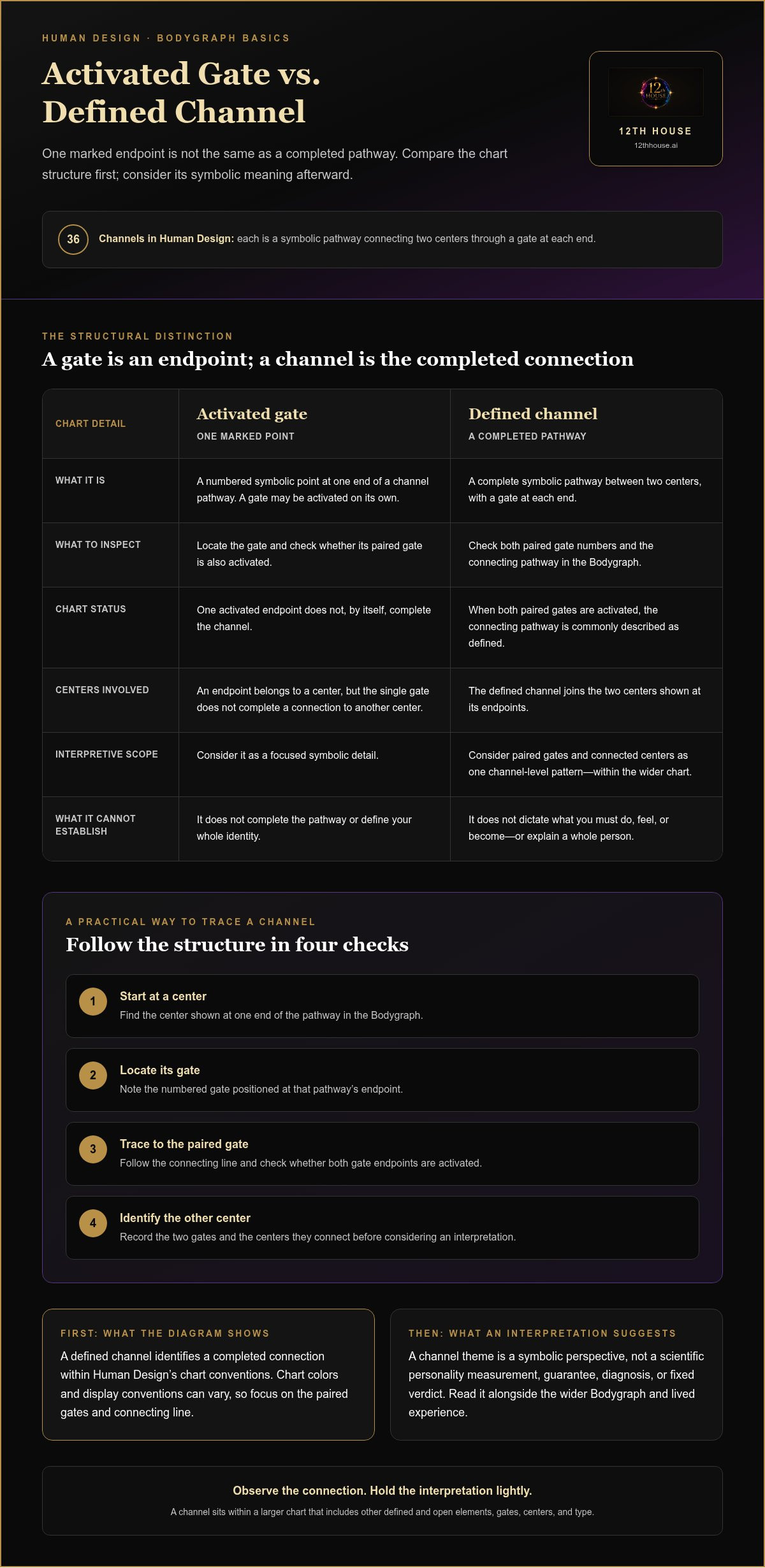
A Human Design channel is a complete symbolic pathway connecting two centers in a Bodygraph through a gate at each end. That’s a useful starting point for understanding the human design channels: a channel is not a single gate or just a line on a diagram. It is a specific connection within Human Design’s symbolic map.
Human Design combines concepts from several traditions into a chart-based framework. Its channels can offer a language for reflection, but they are not scientifically established measurements of personality or behavior. Keep the distinction clear: the chart displays a structure according to Human Design conventions, while an interpretation assigns meaning to that structure. One is a feature of the diagram; the other is a way of exploring it.
How a channel appears in the Human Design Bodygraph
Picture the Bodygraph as a map. It contains geometric shapes called centers, numbered gates positioned around them, and pathways connecting gates across the chart. A channel follows one of those pathways from a gate at one center to its paired gate at another. Human Design describes 36 channels in total.
When both gates in a pair are activated in a chart, the connecting pathway is commonly described as defined. This helps you locate a channel, but it doesn’t tell you what you must do, feel, or become. Treat the graphic as a diagram to examine, not a verdict about your character.
How channels relate to Human Design gates and centers
Gates are numbered symbolic points at the ends of channel pathways. You can consider a gate on its own, but a complete channel requires both paired gates and the two centers they connect. To follow the structure, start at a center, find its gate, trace the pathway to the paired gate, and identify the other center. That sequence keeps the terms distinct.
Channels also sit within a wider chart architecture. Human Design includes centers, gates, channels, and elements such as type; no single pathway should be read as the whole design. For context on how the system describes its foundational concepts, see the Human Design Wikipedia entry. You can also explore how channels fit alongside the five Human Design types.
As you study a chart, separate what’s visible from what a description proposes. A defined channel identifies a connection within Human Design’s framework. Its theme may prompt a question, but your lived experience is more complex than any one chart feature.
How Human Design Channels Form: Gates, Centers, and Definition
To read a channel, follow its structure before turning to an interpretation. Start at one center, locate the gate at the pathway’s endpoint, then trace the line to its paired gate and the second center. A channel forms in Human Design when both paired gates linking two centers are activated, completing the pathway in the chart.
This distinction matters because a gate can be activated without its partner. One highlighted endpoint doesn’t automatically mean the entire channel is defined. In Human Design terminology, a defined channel is the completed connection shown by both gate endpoints. That’s chart logic within a symbolic system, not a scientific measurement of how someone will behave.
What is the difference between an activated gate and a defined channel?
Think of a gate as one marked point on a route. It may be activated in the chart, but on its own it doesn’t complete the path to another center. A channel is defined when both endpoints, the paired gates, are activated in the Bodygraph.
To check your chart, follow one pathway and inspect both gate numbers. Chart colors and display conventions can vary, so focus on the paired gates and the connecting line rather than relying on color alone. If only one endpoint is activated, read it as a gate detail, not a complete channel.
What does a defined channel connect in the chart?
A defined channel joins the two centers shown at its endpoints. Identify those centers from the diagram itself; don’t assume that every channel involving a particular center has the same personal meaning. In Human Design’s structure, a completed connection contributes to the chart’s definition pattern alongside any other defined channels.
Interpretation comes after observation. First record the two gates and the centers they connect. Then consider what a channel description suggests, while keeping the rest of the Bodygraph in view. One line can add context, but it can’t explain a whole person or replace the wider chart. This sequence supports understanding the human design channels without treating a single activation as a fixed identity.
To examine a channel as part of your full chart, explore a personalized Human Design profile as a structured starting point for reflection.
How to Interpret Human Design Channels Without Overreading Them
A channel description can sound precise and personal. Read it as a symbolic perspective within Human Design, not as proof of a trait or a forecast of what you’ll do. Understanding the human design channels means noticing what the chart identifies, then holding the interpretation lightly enough to compare it with your lived experience.
Keep three layers distinct: a gate offers a focused symbolic detail, a channel brings paired gates and their connecting centers into one pattern, and a whole-chart reading considers that pattern alongside other chart elements. Channel names and themes make sense within Human Design’s framework. They aren’t clinical diagnoses, guarantees, or labels that should narrow your choices.
Do Human Design channels describe fixed traits?
No channel description can establish how you’ll act in every situation. It may suggest a theme to reflect on, but a chart interpretation isn’t evidence about your actual behavior. Ask whether the idea fits your experience in specific contexts. If it doesn’t, you don’t need to force a match or reinterpret your life to make the description seem true.
Why the full Bodygraph matters when reading one channel
A channel is one element in a Bodygraph that contains multiple interacting features. Avoid using a single line to explain every decision, relationship pattern, or life outcome. For example, if a channel description suggests a particular way of expressing ideas, treat that as a prompt. Notice when it feels relevant, and consider other chart elements and circumstances rather than assuming it applies universally.
Use this comparison to keep each layer in proportion:
| Chart layer | What it can suggest | What it cannot establish |
|---|---|---|
| Gate | A focused symbolic theme linked to one chart point | A complete channel or a fixed personal trait |
| Channel | A paired pattern connecting two centers in Human Design | A guarantee about behavior or outcomes |
| Whole Bodygraph | A broader framework for considering chart elements together | A definitive account of your identity, choices, or future |
Let the chart generate questions, not conclusions. You might ask, “Where have I noticed this theme?” or “What context changes how it shows up?” That leaves room for complexity. Your experience can confirm, complicate, or challenge an interpretation, and no description needs to override your judgment.
A Practical Method for Reading Your Human Design Channels
Use a consistent sequence: inspect the chart first, then consult an interpretation. This keeps what the Bodygraph displays separate from what a description suggests, making understanding the human design channels a reflective practice rather than a search for instant certainty.
Where to start when locating a channel in your chart
Begin with a clearly generated Bodygraph. Look for a complete pathway between two centers. Before reading its meaning, write down the gate numbers at both endpoints and the names of the centers it connects. If you’re unsure whether the chart reflects your birth information accurately, review the details entered, especially anything you’re uncertain about, before drawing conclusions from its pattern.
Then work through these steps:
- Locate the pathway. Trace the full connection between its endpoint centers. Don’t mistake a single activated gate for a complete channel.
- Record the chart details. Note both gate numbers and both centers as they appear in your Bodygraph.
- Separate observation from interpretation. Write down what the chart shows in one column and what a channel description proposes in another.
- Track your questions. Record where the theme seems relevant, where it doesn’t fit, and what examples come to mind over time.
This simple record creates useful distance between the map and the meaning you assign to it. A description may offer a lens, but it doesn’t need to settle what the channel means in your life.
Questions to ask as you reflect on a channel theme
Stay curious. Ask: “Where have I noticed this theme?” “Where does it not fit?” “Am I seeing a recurring pattern, or reacting to one memorable event?” Look for examples across different situations instead of treating a single moment as proof. You can return to your notes later and see whether your understanding has changed.
Reflection isn’t a test you can pass or fail. If an interpretation resonates, consider what specifically feels familiar. If it doesn’t, leave room for that too. The purpose isn’t to make your experience match a chart description or use a channel to dictate a decision. It’s to explore a symbolic framework while keeping your own judgment intact.
To explore channel themes within your full Bodygraph, use a personalized Human Design profile as a resource for continued chart reflection.
Integrating Human Design Channels Into Your Wider Chart Exploration
A channel is more useful to explore when you place it beside the other elements of your Bodygraph. In Human Design, channels, gates, centers, type, and authority describe different layers of the same symbolic system. Understanding the human design channels doesn’t mean isolating one pathway. It means noticing how its themes relate to the wider chart without turning every element into one explanation.
How channels relate to type, authority, and centers
Each chart element has its own interpretive role. A channel maps a connection between two centers through paired gates. Centers and gates add their own layers of symbolism, while type and authority are separate parts of the Human Design framework. A channel alone doesn’t determine your type, authority, or entire design.
Look for relationships rather than verdicts. If a channel description raises a question about a theme, consider how that idea sits alongside your centers, gates, type, and authority. Does it add a perspective, or seem to conflict with another description? You don’t have to force the pieces into perfect agreement. Keep a distinction between what the chart shows and what you make of it.
Most importantly, treat the system as a prompt for reflection. It can offer language for examining patterns, but it isn’t an instruction manual that overrides your judgment. Your choices remain yours. A chart interpretation should invite observation, not tell you what you must do or who you must be.
Continue exploring your Human Design chart with 12th House
12th House Human Design Profiles let you explore personal chart themes as part of the full Bodygraph. For follow-up questions, Lala, the platform’s AI assistant, can support your spiritual exploration. Use its responses as prompts to consider, not as final authority over your identity or decisions.
Move at your own pace. Revisit a channel description alongside the rest of your chart, note what resonates, and leave room for what doesn’t. The value is in the inquiry, not in arriving at a fixed conclusion.
Explore your Human Design profile with 12th House to continue your chart exploration.
Keep Exploring Your Bodygraph With Curiosity
A channel is a complete connection between paired gates and two centers, but its meaning belongs within the wider Bodygraph. Read the chart’s structure first, then consider what an interpretation might suggest. Understanding the human design channels also means remembering that symbolic themes aren’t fixed predictions or labels you have to accept.
As you explore, compare channel themes with gates, centers, type, and authority. Notice what resonates in your experience and what doesn’t, without asking one chart feature to explain your whole life. Let your observations develop over time.
12th House offers Human Design Profiles for personalized chart exploration. Lala, the platform’s AI spiritual guidance assistant, can support follow-up questions while leaving interpretation and decisions in your hands. Explore your Human Design profile with 12th House and continue your inquiry at your own pace.
Your Bodygraph can be a useful map for reflection. Keep asking thoughtful questions, and let your lived experience remain part of the reading.
Frequently Asked Questions
What are channels in Human Design?
Channels are symbolic pathways that connect two centers in a Human Design Bodygraph through a pair of gates. Each gate sits at one endpoint of the pathway. When both gates are activated in the chart, the channel is commonly described as defined. Channel meanings belong to Human Design’s interpretive framework; they aren’t scientifically established measurements or instructions about how a person must behave.
How many channels are there in Human Design?
Human Design includes 36 channels. Each channel corresponds to a specific pair of gates and links two of the nine centers in the Bodygraph. The number describes the system’s set of possible channel pathways, not how many channels every chart will show as defined. To read your own chart, look for complete connections rather than assuming every possible channel is active for you.
What is the difference between a Human Design gate and a channel?
A gate is one numbered symbolic point in the Bodygraph, associated with an endpoint of a channel. A channel is the complete pathway formed by two paired gates connecting two centers. A chart may show one activated gate without showing the full channel as defined. Keeping these layers distinct helps you tell a gate-level theme from a channel interpretation.
Can you have a Human Design channel with only one gate activated?
In Human Design terminology, one activated gate alone doesn’t complete a defined channel. It marks one endpoint, while the paired gate at the other end of the pathway is not activated in the chart. You can still consider the activated gate as its own symbolic detail, but don’t read it as a completed connection between centers. Check both endpoints in your Bodygraph.
What does a defined channel mean in Human Design?
A defined channel means that both paired gates forming a pathway between two centers are activated in the chart. The pathway is therefore treated as complete within Human Design’s chart logic. This describes a feature of the Bodygraph, not a guarantee about personality, behavior, or future events. Interpret its theme alongside the rest of the chart rather than treating one channel as a full portrait.
Do Human Design channels determine your personality or future?
No. Human Design channel interpretations are symbolic perspectives, not definitive predictions, diagnoses, or scientifically established personality measurements. A channel description may give you a question to consider, but it can’t prove how you’ll act or what will happen. Compare the interpretation with your lived experience, including moments that don’t seem to fit. You don’t need to force your identity or choices into a chart description.
How do I find the channels in my Human Design chart?
Start with a clearly generated Bodygraph and review the birth information used to create it, especially if any details are uncertain. Then locate a complete pathway connecting two centers. Note the gate number at each endpoint and check whether both are activated. This practical approach to understanding the human design channels helps separate what the chart displays from what a written interpretation suggests.
Are Human Design channels the same as centers?
No. Centers are the shapes in the Bodygraph, while channels are the pathways that connect two centers through paired gates. A channel’s endpoints show which centers it links; the centers and channel remain distinct chart elements. To read the diagram, identify the centers first, then trace the connecting pathway and its gates. Interpret each feature within the wider Bodygraph rather than treating the terms as interchangeable.


