

Why can two people with the same Sun sign experience life so differently? The answer may lie in the houses of their birth charts. Understanding the 12 houses in astrology starts with seeing them as life arenas: a house shows where a planet’s energy is expressed, while its sign describes how that energy takes shape. If house meanings seem abstract or overlap, this distinction gives you a practical place to begin.
In this guide, you’ll learn what each house represents, how houses differ from signs and planets, and how to read them together in a birth chart. You’ll also learn why birth time matters and how house systems can shift a chart’s layout without changing the basic framework.
Start with one placement at a time. Identify the house, note the sign on its cusp, then consider any planets in the house. This approach helps you explore themes from identity and home to relationships, work, and shared resources without treating one symbol as a complete reading.
Key Takeaways
- Build understanding the 12 houses in astrology by tracing how the chart’s life arenas connect, rather than treating each house as an isolated prediction.
- Use a simple reading framework: identify the house, note its sign, then consider the planet’s role.
- Follow a clear sequence to locate the Ascendant, house numbers, signs, and planets in your birth chart.
- House systems can arrange chart placements differently, so interpret your chart within one consistent system.
- Use recurring chart patterns as prompts for self-understanding, not as fixed outcomes.
What Are the 12 Houses in Astrology, and What Do They Map?
A house is a division of a natal chart associated with a distinct area of lived experience in astrological interpretation. Together, the twelve houses create a symbolic map of life themes, from identity and home to relationships and public roles. They aren’t twelve separate predictions. Their meanings connect, showing different arenas in which a chart’s planetary placements may be explored.
Astrology is a symbolic interpretive framework, not a scientifically established system for predicting events. Read a chart as a language for reflection, not a fixed account of what must happen. A useful starting model is simple: houses show where a theme may unfold, signs describe its style, and planets represent functions or drives. For a foundational overview of the 12 houses in Western astrology, see the history and house-division approaches summarized by Wikipedia.
How the houses organize a natal chart
In common chart presentations, the houses appear as numbered sectors arranged around the wheel, with the first house beginning at the Ascendant. The exact house cusps, or boundaries, depend on birth time, birthplace, and the calculation approach used. Different house systems can divide the chart differently, so a planet’s house placement may vary between systems.
For example, imagine Mars in Gemini. Gemini is the planet’s sign, describing its style of expression; the house containing Mars points to the life arena where its drive is interpreted. Mars in Gemini in the third house might be read through communication or learning, while Mars in Gemini in the tenth might be considered through public life or career. These are symbolic interpretations, not guaranteed outcomes.
Why birth time matters when locating houses
The Ascendant and house boundaries are time-sensitive. A difference in recorded birth time can shift the Ascendant or move a planet across a house cusp, changing how a house-based interpretation is framed. Birthplace also matters because the chart is calculated for a specific location as well as a moment.
If your birth time is uncertain, don’t assume the entire chart is unusable. Some placements, such as a planet’s zodiac sign, may still be stable, while the houses and Ascendant deserve more caution. Keep that uncertainty in view as you explore understanding the 12 houses in astrology, and avoid treating a house placement as definitive when the birth data may be imprecise.
The Meaning of All 12 Houses in Astrology
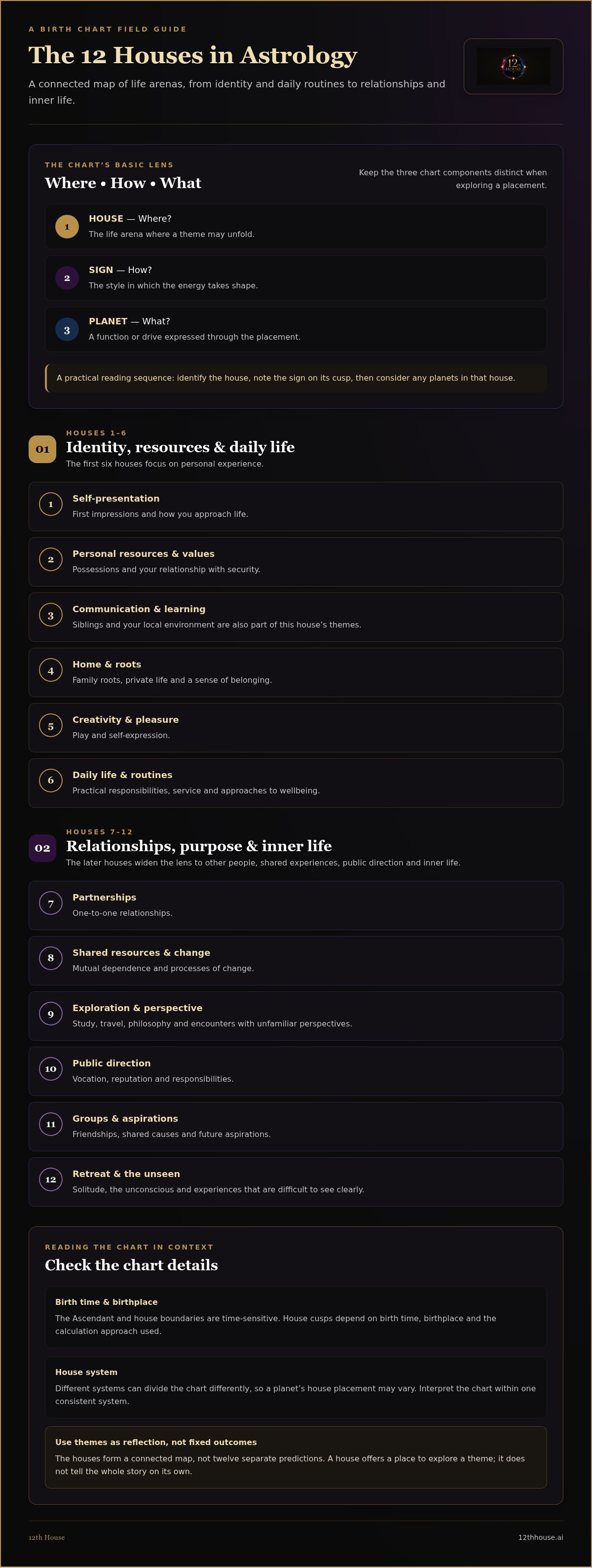
The houses form a connected map, not a set of twelve isolated predictions. Their themes move from personal identity and everyday needs toward relationships, wider ambitions, and inner life. These concise meanings offer a starting point for understanding the 12 houses in astrology, though traditions may emphasize or phrase particular themes differently.
Houses 1 through 6: identity, resources, and daily life
The first six houses focus on personal experience. They describe how you meet the world, what you value, how you communicate, and the routines and foundations that shape daily life. Use them as areas to explore, not outcomes assigned to you.
- 1st house: Self-presentation, first impressions, and how you approach life.
- 2nd house: Personal resources, values, possessions, and your relationship with security.
- 3rd house: Communication, learning, siblings, and your local environment.
- 4th house: Home, family roots, private life, and a sense of belonging.
- 5th house: Creativity, pleasure, play, and self-expression.
- 6th house: Daily routines, practical responsibilities, service, and approaches to wellbeing.
For instance, a placement connected with the third house might prompt reflection on how you learn or share ideas. It doesn’t determine what you’ll say or whether a particular conversation will happen.
Houses 7 through 12: relationships, purpose, and inner life
The later houses widen the lens to include other people, shared experiences, public direction, communities, and what happens beyond immediate awareness. Their themes can overlap in real life. Partnership, money, loss, and wellbeing can’t be fully explained by one house alone.
- 7th house: Partnerships and one-to-one relationships.
- 8th house: Shared resources, mutual dependence, and processes of change.
- 9th house: Exploration through study, travel, philosophy, or encounters with unfamiliar perspectives.
- 10th house: Public direction, vocation, reputation, and responsibilities.
- 11th house: Groups, friendships, shared causes, and future aspirations.
- 12th house: Retreat, solitude, the unconscious, and experiences that are difficult to see clearly.
Use this list as a reference, then consider how a house’s theme connects with the rest of the chart. The eighth house, for example, may invite thought about shared resources, but it doesn’t explain every financial situation or experience of grief. You can explore these themes in context with personalized astrology birth-chart analysis.
How Houses Differ from Signs and Planets, and Why Systems Vary
A birth chart combines three kinds of information. The house locates a theme in a life arena, the sign describes its style, and the planet represents a function or drive. Keeping these roles distinct is a practical step toward understanding the 12 houses in astrology without treating a single placement as a complete story.
| Chart component | Core question | Role |
|---|---|---|
| House | Where? | The life arena |
| Sign | How? | The style or manner of expression |
| Planet | What? | A function, need, or drive |
Read houses, signs, and planets as one chart sentence
Hypothetical example: Venus in Capricorn in the seventh house. Venus is associated with relating, attraction, and values. Capricorn suggests a measured, practical style. The seventh house provides the arena of partnership and one-to-one bonds. Read together, these symbols might invite reflection on how someone approaches commitment or shared values. They don’t establish a guaranteed relationship pattern or predict a specific event.
Change the sign or house and the interpretation shifts. Venus in Gemini in the third house, for instance, combines relating and values with a curious style in an arena associated with communication and learning. Venus remains the planet being interpreted; the sign and house add context for how an astrologer might frame its expression.
What Placidus and Whole Sign houses change
House systems use different methods to establish house boundaries. Placidus, common in modern Western astrology, uses a time-based calculation and can produce houses of varying sizes. In Whole Sign, the zodiac sign containing the Ascendant becomes the first house, and each house corresponds to one complete sign. Neither approach is universally accepted as the only correct system.
Because the boundaries differ, a planet near a cusp may fall in one house in Placidus and another in Whole Sign. When comparing interpretations, keep the system consistent. Switching methods to obtain a preferred answer can blur the framework instead of clarifying it.
An empty house doesn’t mean its life area is missing, unimportant, or destined to remain inactive. It simply has no natal planet placed there. Astrologers may also consider the sign on that house’s cusp, its ruling planet, and other chart factors. Interpret the full pattern rather than assigning meaning to one blank space.
How to Read the Houses in Your Birth Chart Step by Step
A chart becomes easier to read when you move through it in a consistent order. Start with the birth data and chart layout, then interpret one placement at a time. This method supports understanding the 12 houses in astrology without turning a single symbol into a verdict about your life.
Find the house, sign, and planets in your chart
Use this sequence to examine a house placement. Chart designs vary, but most label the Ascendant and number the houses around the wheel.
- Check the birth data. Note the date, recorded time, and birthplace used to calculate the chart. Identify the house system too, since different systems can assign some planets to different houses.
- Locate the Ascendant. Look for “ASC” or “AC.” This marks the start of the first house in common chart layouts and gives you an anchor for following the house numbers.
- Find the house you want to explore. Follow the chart’s numbering and identify the life arena associated with that house.
- Record its sign and planets. Note the zodiac sign at the house cusp, the boundary where the house begins, and any planets shown inside that house. A planet’s sign and house are separate details.
- Mark uncertainty. If the birth time is approximate or unknown, treat the Ascendant and house placements cautiously. Other chart details may still be useful, but house-based conclusions may be less precise.
Synthesize a placement without overreading it
Interpret in layers. Begin with the house topic, then consider the sign’s style and what any planets in the house symbolize. Next, identify the sign’s ruling planet and examine its placement elsewhere in the chart. Finally, compare the placement with other chart patterns before forming a tentative interpretation.
Illustrative example, not a client case: Imagine Mercury in Virgo in the sixth house. The sixth house brings attention to routines and practical responsibilities; Virgo offers an organized, detail-focused style; Mercury relates to thinking and communication. Together, these symbols could prompt reflection on how someone approaches planning or everyday tasks. They don’t prove that the person is always organized or predict a particular work outcome.
Look for themes that recur across placements rather than building a whole reading around one planet. Ask reflective questions: Does this interpretation resonate with your experience? What other chart factors support or complicate it? Treat the result as a lens for exploration, not fixed fate or professional advice.
To apply this framework to your own chart, explore personalized astrology birth-chart analysis and use Lala to ask follow-up questions about chart placements.
Bring the 12 Houses Together in a Personalized Chart Reading
Read a birth chart as a system of relationships. The house indicates the life arena, the sign describes its style, and planets add specific functions or drives. A placement gains meaning through its connections to other placements, not in isolation. Understanding the 12 houses in astrology can give you a structure for reflection, but it doesn’t remove your agency or determine what you must experience.
Turn house meanings into useful reflection prompts
Look for themes that repeat across houses, signs, and planetary placements. If several chart factors touch communication, for example, consider how that theme appears in different parts of life rather than treating one placement as the answer. Journaling can help you test an interpretation against your own experience.
- Which life arena is this house associated with, and what does that topic mean to me right now?
- How might the sign’s style and any planets in the house shape the way I approach this area?
- Do other chart placements echo or complicate this theme?
Keep your conclusions open. Astrology offers symbolic prompts, not medical, financial, legal, or other professional guidance. Use it to develop questions and self-awareness, not as a substitute for qualified support or your own judgment.
Explore your chart with guided metaphysical tools
Personalized chart analysis can help place individual house meanings in context, bringing birth data, signs, planets, and house placements into one interpretation. If a symbol raises a question, follow it through the chart instead of assigning it a fixed meaning. Consider how a house theme connects with its ruling planet or whether similar patterns appear elsewhere.
Lala, 12th House’s AI spiritual guidance assistant, can help you ask personalized astrology and chart questions as you explore those connections. For example, ask what a particular planet’s house placement may symbolize, then compare the response with the chart’s wider pattern and your lived experience. Explore the AI astrology assistant through 12th House’s resources.
12th House brings together personalized astrology birth-chart and transit analysis, Lala for chart-related follow-up questions, and a metaphysical library for self-guided learning. Use these tools to deepen your inquiry while keeping interpretation thoughtful, flexible, and grounded in your own choices.
Use Your Birth Chart as a Map for Reflection
Understanding the 12 houses in astrology gives you a framework for reading your chart with greater clarity. Each house points to a life arena; signs describe the style of expression, and planets add their distinct functions. House systems may place some planets differently, so use one approach consistently and treat interpretations as symbolic possibilities, not fixed outcomes.
As you explore, notice themes that repeat across your chart. Ask what a placement brings to mind, then consider the wider context before drawing conclusions. Your chart can be a tool for reflection while your choices remain your own.
Begin with curiosity. Study one symbol and connection at a time, and use a personalized chart reading to see how the placements fit together.
Frequently Asked Questions
What are the 12 houses in astrology?
The 12 houses are divisions of a natal chart, each associated with a different area of lived experience in astrological interpretation. Together, they map themes such as identity, resources, relationships, and inner life. Understanding the 12 houses in astrology means reading them as symbolic contexts, not fixed predictions. A house’s position is calculated using birth details and a chosen house system, so chart layouts can vary.
What does each house represent in a birth chart?
In brief, the first house relates to self-presentation; the second to resources and values; the third to communication and learning; the fourth to home and roots; the fifth to creativity and pleasure; and the sixth to routines and service. The seventh concerns partnership, the eighth shared resources and change, the ninth exploration, the tenth public direction, the eleventh groups and aspirations, and the twelfth retreat and the unconscious. These are interpretive themes, not isolated predictions.
How do I find the houses in my astrology chart?
Use a natal chart calculated from your birth date, time, and place. Find the Ascendant, often marked “ASC” or “AC,” which anchors the first house in common chart layouts. Follow the house numbers around the chart, then note the sign at the relevant house cusp and any planets placed inside that house. Check which house system the chart uses, since that can affect house boundaries and some planetary placements.
Do you need an exact birth time to know your astrological houses?
A reliable birth time is important for locating the Ascendant and house boundaries, which can shift as the time changes. If your birth time is uncertain, house placements may be less dependable, so treat interpretations based on them cautiously. That doesn’t automatically make every chart detail unusable. Some planetary sign placements may still be considered, but avoid treating an uncertain house position as definitive or building a complete reading around it.
What is the difference between houses, signs, and planets?
Houses, signs, and planets describe different parts of a chart. A house indicates the life arena, a sign describes the style or manner of expression, and a planet represents a function, drive, or need. For example, Mars in Gemini in the third house could be interpreted through Mars’s drive, Gemini’s curious style, and the third house’s communication themes. The combination offers a symbolic prompt, not a certain description or prediction.
What does it mean if a house in my birth chart is empty?
An empty house has no natal planet placed inside it; it doesn’t mean that its life area is absent, unimportant, or destined to be inactive. Astrologers may consider the sign on the house cusp, that sign’s ruling planet, and other chart factors when exploring the theme. Read the whole pattern rather than treating an empty space as a warning or a complete answer about that part of life.
Do different house systems change your birth chart interpretation?
Yes. House systems use different methods to calculate house boundaries, so a planet may fall in a different house depending on the system used. Placidus uses a time-based approach and can produce houses of varying sizes; Whole Sign assigns one zodiac sign to each house. Neither is universally accepted as the only correct method. For a clear comparison, keep the system consistent rather than switching approaches to force a preferred interpretation.
Explore your birth chart and ask Lala your astrology questions with 12th House.


