

What if your South Node isn’t a flaw to overcome, but a map of patterns you already know how to navigate? If you’ve searched for “understanding my south node” and found readings that make it sound like a fixed past-life story or a habit you must escape, the mixed messages can leave you more confused than curious. The South Node can offer insight without defining your limits.
In astrology, the South Node is a mathematical point opposite the North Node. Its symbolism is often associated with familiar instincts, learned patterns, and natural strengths. It isn’t a verdict on who you are. Understanding its place in your birth chart can help you notice what feels automatic and decide how you want to respond.
This guide explains what the South Node represents, how to find its sign and house, and why birth-time accuracy matters, especially for house placement. You’ll also learn how astrologers relate it to the North Node without treating either point as a command. Use your own experience to assess what resonates: a chart is a framework for reflection, not a substitute for personal agency.
Key Takeaways
- Use understanding my south node as a starting point for noticing familiar patterns, not as a fixed description of your character.
- Read your placement in context: the sign and house offer different layers of symbolism, and birth-time accuracy can affect house interpretation.
- Consider where familiar skills support you and where an automatic response might narrow your choices.
- Turn a chart placement into a practical reflection question, then compare the symbolism with your lived experience.
- Personalized birth chart analysis and reflective tools like Lala can help you organize questions beyond a sign-only reading.
What Does My South Node Mean in Astrology?
The South Node is one of two opposing lunar nodes shown in a birth chart. Astrologers interpret it as a symbol of familiar patterns, accumulated experience, and responses that may feel instinctive. This can be a useful lens for reflection, but it doesn’t prove a particular personality, history, or future.
Think of the nodes as a connected axis, not a test with a right and wrong answer. The South Node can point to skills or strategies that feel well rehearsed. Those same strategies may become limiting if you rely on them automatically. The North Node, opposite it, is often interpreted as a direction for development. Neither point makes one side worthless or the other morally superior.
What are the North and South Nodes?
A Lunar node is a point where the Moon’s orbital path crosses the ecliptic, the Sun’s apparent path across the sky. The North and South Nodes mark the two opposite crossings, so they appear opposite one another in a birth chart. They aren’t planets or physical objects; their positions are calculated from the motions of the Moon and Earth.
The calculation is astronomical, while the meanings attached to the nodes belong to astrology, a symbolic system. Keeping those categories distinct helps you read a chart precisely: the node’s location can be calculated, while its personal significance is interpreted.
Is the South Node a weakness or a past-life verdict?
No. Traditional interpretations don’t require you to treat the South Node as a flaw. A familiar response can reflect real competence. For example, someone who instinctively takes charge when a group feels uncertain may bring useful organization. That same response might leave little room to ask for help or hear other approaches. The chart can prompt the question, but it can’t settle the answer.
Some astrologers use past-life language to describe the South Node, while others understand it through ancestry, early conditioning, or deeply familiar habits. Past-life readings are a spiritual framework, not a verifiable biography. You can explore the symbolism without accepting a literal account of who you were.
Symbolic astrology invites reflection; it doesn’t prove destiny. For understanding my south node, start with curiosity rather than judgment. Notice what feels familiar, then ask whether that pattern serves you in the situation at hand. The placement offers a framework for inquiry, not an instruction you must follow.
How Do I Find My South Node Sign and House?
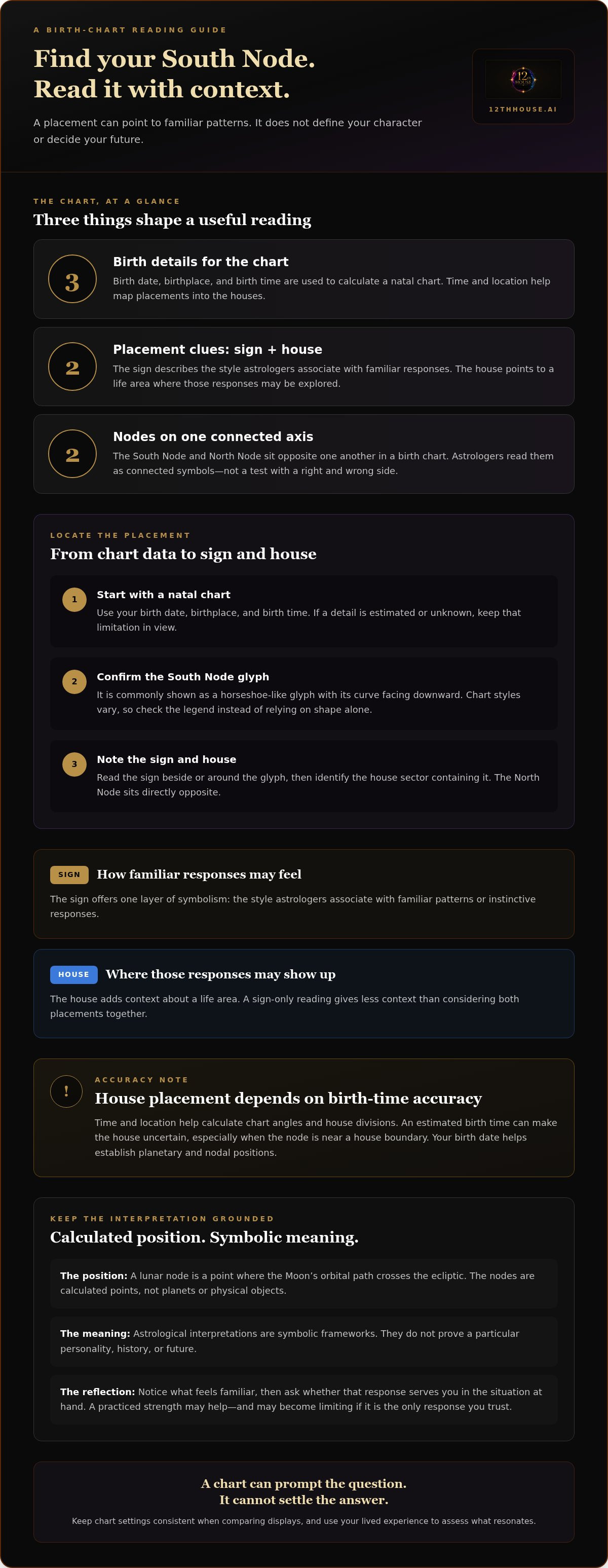
Start with a natal chart calculated from your birth date, birthplace, and birth time. Locate the South Node glyph, note its sign, and trace its position to the numbered house. You don’t need to decode every symbol on the chart. Focus on these placements first, and use the chart’s legend to confirm which glyph represents the South Node.
How to locate the South Node on a natal chart
The South Node is commonly shown as a horseshoe-like glyph with its curve facing downward. Symbols vary between chart styles, so verify the glyph against the legend rather than relying on its shape alone. Once you’ve identified it, note the zodiac sign printed beside or around it, then see which house sector contains the symbol. The North Node sits directly opposite, forming the other end of the same axis.
Why sign and house provide different clues
The sign describes the style astrologers associate with familiar responses; the house points to a life area where those responses may be explored. A sign-only reading gives one layer of symbolism, while a house placement adds context about where it might show up. Some astrology interpretations connect this familiar territory with karmic paths, but treat that language as a symbolic framework, not a verified account of your life.
Birth time matters most for house placement. Time and location help calculate the chart’s angles and house divisions, so an estimated time can make the house uncertain, especially if the node lies near a house boundary. Your birth date helps establish planetary and nodal positions; location and time also shape how those positions map into the houses. If you don’t know your exact birth time, note that limitation rather than treating a house result as certain.
Chart tools may use different calculation settings, including house systems or conventions for calculating the nodes. This can lead to differences in chart displays or interpretations. To compare results, keep the settings consistent and record them alongside your placements. This makes understanding my south node a clearer process: confirm the chart data first, then consider what the sign and house suggest without forcing either to fit.
For more context than a placement alone provides, explore personalized birth chart analysis to organize questions about your chart and its symbolism.
How Should I Interpret My South Node Without Feeling Trapped?
A chart placement can describe a pattern worth examining, but it can’t define your character or decide what you’ll do next. If a reading says you’re “stuck” in a trait or destined to repeat a story, pause. Astrological interpretations are frameworks, not diagnoses or instructions. Your choices, circumstances, and experience matter more than any single symbol.
What the South Node can symbolize, and what it cannot
Astrologers often associate the South Node with comfort, repetition, and practiced responses. These may include useful abilities: staying composed under pressure, taking responsibility, or knowing how to restore routine. A strength may become limiting when it’s the only response you trust. Self-reliance, for instance, can help you act decisively, yet make it harder to accept support when you need it.
These themes don’t prove trauma, a particular relationship outcome, karma, or a specific past life. Traditions differ in how they interpret the nodes, and even within one approach, a placement gains nuance from the rest of the chart. Treat a description as a prompt: Does it match your experience? In which situations? Where does it fail to fit? Understanding my south node means testing an interpretation, not adopting it automatically.
How the North Node adds context
The North and South Nodes form a symbolic relationship between familiar tendencies and qualities an astrologer might encourage you to develop. The North Node isn’t a compulsory destination, and the South Node isn’t something you must erase. Read together, they can help you notice when an established strength is useful and when another approach might give you more room to respond.
For example, if you’re accustomed to taking charge, the point isn’t to stop being capable or responsible. You might instead ask whether a situation calls for leadership, collaboration, or letting someone else contribute. The familiar skill remains available; it simply isn’t your only option. This keeps interpretation practical and preserves your agency.
A South Node placement is a lens for reflection, not a fixed prediction about your life. Use it to observe patterns across real situations, not to explain away every choice or challenge. If an interpretation feels overly certain, compare it with the chart as a whole and your own experience. A helpful reading makes room for complexity, contradiction, and change.
How Can I Apply My South Node to Everyday Self-Reflection?
Move from chart symbolism to observation. Note your South Node’s sign and house, then ask what familiar response those placements might describe. Treat the answer as a question to investigate, not a conclusion about who you are. The goal of understanding my south node is to recognize patterns clearly enough to choose how you respond.
Questions to ask about familiar patterns
Look for specific moments when a response feels practiced or instinctive. Perhaps you tend to smooth over tension, stick to a known routine, or rely on careful preparation. These are possibilities, not outcomes assigned to a sign or house. For each pattern, ask:
- What ability or response feels reliable in this situation?
- How does it help me here?
- Does it narrow my options, and might another response serve me better?
Write down a recent example: what happened, what you did, and what followed. Add what you might try next time. Concrete notes help you distinguish an actual pattern from a broad description that simply sounds familiar. Avoid grading your response as good or bad. You’re gathering evidence about when it works and when it doesn’t.
Read the nodal axis in the wider birth chart
Before drawing conclusions, consider the South Node’s sign and house together. The sign offers one symbolic layer; the house suggests an area of life to examine. Other chart placements and aspects can add context or complicate a simple reading, so don’t treat one point as a complete account of your motivations or behavior. If the house placement depends on an uncertain birth time, hold that layer lightly.
Then bring in the North Node as part of the same axis. Rather than treating it as a destination you must reach, use it to consider what alternative qualities or responses could balance a familiar approach. For instance, if you often retreat into private reflection, you might ask whether sharing an unfinished thought would help in a particular setting. That possibility doesn’t define your chart; it gives you a concrete choice to consider.
To explore personalized chart questions beyond a single placement, read this guide to using an AI astrology assistant as a reflective tool for organizing your questions. You can also explore your birth chart and use its symbolism as a starting point for your own observations.
How Can Personalized Birth Chart Analysis Deepen My South Node Understanding?
A South Node sign can offer a useful first clue, but it can’t describe the full architecture of your birth chart. The sign suggests one symbolic style; the house adds a life area to consider. Other placements and aspects may provide further context, showing how that symbolism interacts with the chart as a whole. This broader view can make understanding my south node more specific without turning it into a fixed judgment.
Personalized astrology analysis can help organize these connections and shape better questions. It doesn’t establish certainty or guarantee outcomes. Instead, it gives you a structured way to explore possible themes, compare them with lived experience, and decide what feels relevant.
What to bring to a personalized chart exploration
Gather your birth date, birth location, and the most accurate birth time you have. Time can affect house placement, so mark it as approximate if you’re unsure. Then bring one focused question about a recurring response, such as: “When does this familiar way of handling responsibility help me, and when might another approach serve me better?” A clear question gives the interpretation a practical point of focus.
Keep your judgment in the process. Treat the reading as a framework for reflection, not an authority over your decisions. Notice where a chart interpretation fits, where it doesn’t, and what questions it opens up. You remain the best judge of how your choices and experiences connect to the symbolism.
Continue exploring your chart with Lala
12th House offers astrology birth chart and transit analysis to explore chart symbolism in context. Lala, its AI spiritual guidance assistant, can answer personalized questions about your chart and help you organize follow-ups. You might ask how the nodal axis relates to other placements, or what chart context could add nuance to a simple South Node reading. Use its responses as prompts for inquiry, not unquestionable conclusions.
Approach the chart as a map for reflection. You don’t need to accept every interpretation or resolve every question at once. If you’d like to explore your placements in context, explore your chart with 12th House.
Use Your Chart as a Map for What Comes Next
Understanding my south node starts with reading its symbolism as a prompt, not a verdict. Its sign and house can help you notice familiar responses, while the North Node adds a complementary perspective. Read both within the wider chart, then compare possible patterns with your lived experience. Your choices remain your own.
A personalized chart view can add context beyond a sign-only reading. 12th House offers astrology birth chart and transit analysis, while Lala, its AI spiritual guidance assistant, can help you explore personal chart questions and organize reflections. The digital library of books, videos, and ritual frameworks offers another way to continue learning at your own pace.
Explore your chart with 12th House and bring a question you’re curious about. Let the symbolism open a thoughtful inquiry, then decide what feels useful in your life. You can honor familiar strengths while making room for new responses, one choice at a time.
Frequently Asked Questions
What does my South Node mean in astrology?
Your South Node is commonly interpreted as a symbol of familiar patterns, practiced responses, and abilities that may feel instinctive. It sits opposite the North Node, so astrologers often read them as a connected axis rather than separate instructions. For understanding my south node, treat its symbolism as a prompt to reflect on what feels well rehearsed, not as a proven description of your personality or a prediction of your future.
How do I find my South Node sign?
Generate a natal chart using your birth date, birthplace, and birth time, then find the South Node symbol and note the zodiac sign beside it. The symbol often resembles a horseshoe with its curve facing downward, but chart styles can vary, so check the chart legend. The North Node is directly opposite. If comparing chart tools, use consistent calculation settings so differences in conventions don’t confuse your reading.
Is the South Node the same as a past life?
No. The South Node is a calculated point in a birth chart, while a past-life interpretation is one spiritual framework some astrologers use to understand its symbolism. Other readings focus on familiar habits, early conditioning, or accumulated experience. Astrology can’t verify a specific past-life biography. You can explore that perspective if it resonates, while keeping room for other interpretations and your own lived experience.
Can my South Node be a good thing?
Yes. Astrologers often associate the South Node with familiar skills and resources as well as responses that can become automatic. A practiced ability, such as staying organized under pressure, may be useful in some situations. The reflection is whether relying on it every time limits other choices. You don’t need to reject the strengths associated with your placement; consider how to use them deliberately and flexibly.
What is the difference between my South Node sign and house?
In astrological interpretation, the sign describes the style or qualities associated with familiar responses, while the house points to a life area where those patterns may be explored. Read them together for more texture, rather than treating either as a complete explanation. House placement can depend on birth-time accuracy and the house system used, so an uncertain birth time may make that part of the reading less precise.
What happens if I ignore my South Node?
Nothing is fated to happen if you ignore it. The South Node doesn’t impose consequences or control your decisions. You can use its symbolism as one way to notice recurring responses, but you’re not required to interpret or act on it. If a placement doesn’t feel relevant, set it aside. Your experience and choices provide the context for deciding whether a chart interpretation is useful.
Do I need my exact birth time to understand my South Node?
You can often identify the South Node sign without an exact birth time, but the house placement may be uncertain because houses depend on birth time and location. If your time is approximate or unknown, treat house-based interpretations cautiously rather than assuming they’re precise. Record the information you do have and note any uncertainty. A chart can still prompt reflection, even when one layer of its interpretation remains unclear.


