

What if your North Node isn’t a fixed life purpose, but a symbol that helps you notice where growth may begin? If you’re understanding my north node and wondering whether it overrides your choices, you’re not alone. Astrology often describes it in absolute terms, which can make a birth chart feel more like a directive than a tool for reflection.
The North Node is best read alongside its opposite, the South Node, and within the wider context of your birth chart. Its sign and house each add perspective, but neither dictates a single path. You can use the symbolism to notice familiar patterns, consider new possibilities, and make more intentional choices without treating astrology as a prediction.
This guide explains how to find your North Node, read its sign and house together, and distinguish its growth themes from the South Node’s familiar tendencies. You’ll also find practical questions to help translate chart language into reflection you can use in everyday life.
Key Takeaways
- Find your North Node in a birth chart by locating its symbol, identifying its sign, and noting its house.
- Read the sign and house together, then consider the South Node and other chart factors for context.
- Understanding my north node can start with asking what qualities its symbolism invites me to explore, not what destiny it assigns.
- Use a simple reflection sequence: notice a familiar pattern, name a quality you want to develop, and try one small experiment.
- Record your observations and revisit them over time. Chart symbolism can guide inquiry, but your choices remain your own.
Understanding My North Node: What It Means in Astrology
What does your North Node suggest, and what doesn’t it decide? In astrology, it’s often associated with growth, which can sound like a fixed instruction to pursue one destined calling. A more grounded reading treats it as a symbolic prompt: a way to examine emerging qualities, recurring choices, and the tension between what feels familiar and what asks for attention.
The North Node is a symbolic growth direction in your chart, not a prescribed life mission or a guarantee of what will happen. If you’re focused on understanding my north node, keep that distinction in view. Astrology offers a language for reflection; it isn’t scientific proof that a chart determines your character or future.
What are the North Node and South Node?
The lunar nodes are calculated points where the Moon’s orbital path intersects the ecliptic, the apparent path of the Sun across the sky. The Lunar Nodes are not planets or physical celestial bodies. The North Node marks one intersection; the South Node lies directly opposite it. Astrologers interpret the pair as an axis, reading each point in relation to the other rather than treating either as a standalone force.
In common astrological language, the North Node is linked with qualities or experiences to develop, while the South Node is associated with familiar tendencies and resources. That contrast doesn’t make the South Node an enemy or a flaw to erase. Familiar skills can still be valuable. The axis invites you to consider when comfort supports you and when it may be narrowing your choices.
Does the North Node reveal your one true purpose?
Purpose can be a useful shorthand, but it can also imply that there’s one correct career, relationship, or life direction hidden in your chart. A North Node placement doesn’t establish that. It offers a reflective lens for noticing where you might be willing to stretch, which patterns you rely on, and which qualities you’d like to strengthen. Its meaning takes shape through your lived circumstances and the rest of your chart.
For example, imagine that you often stay quiet in group discussions, even when you have something useful to contribute. You might use your chart’s growth symbolism to ask what a more expressive choice could look like, then try sharing one considered idea at your next meeting. That experiment doesn’t prove the chart predicted your behavior. It turns an abstract symbol into a question you can test, while leaving the decision and its meaning in your hands.
How to Find and Interpret Your North Node in a Birth Chart
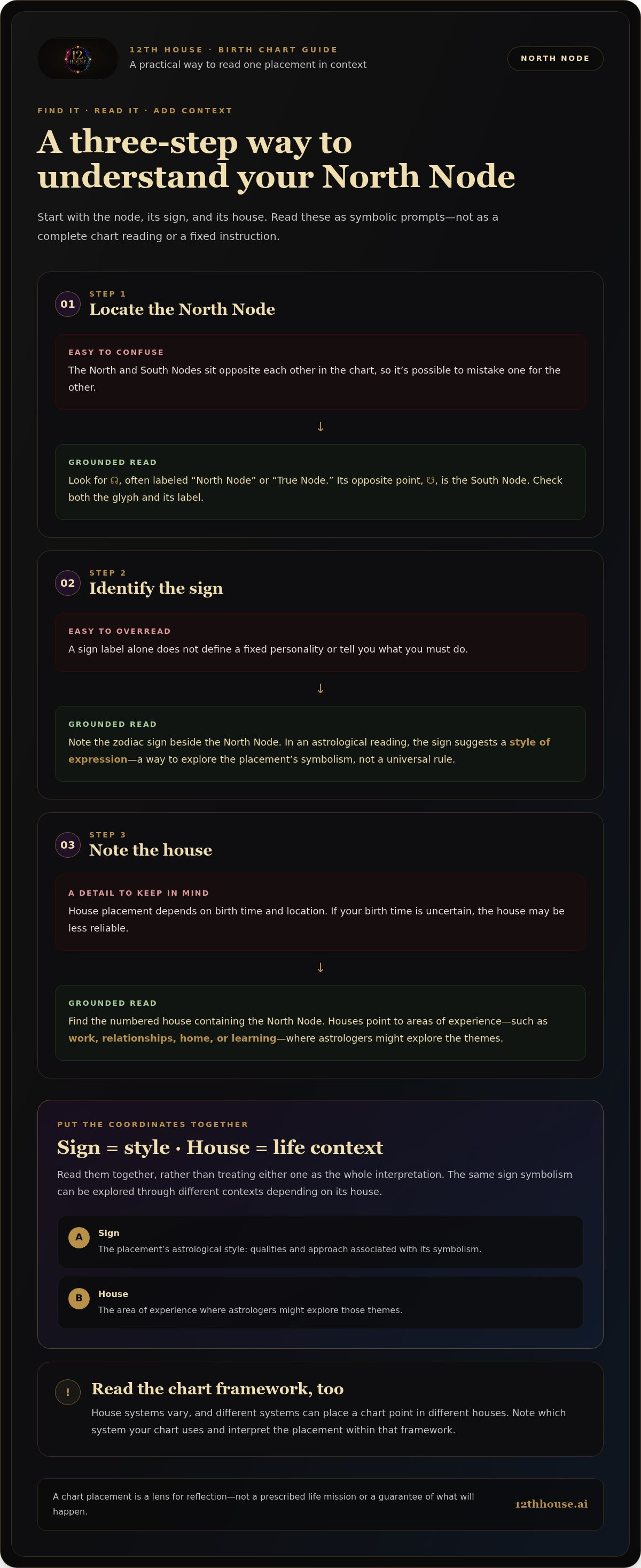
Once you have your birth chart, read the North Node in sequence instead of trying to decode every chart detail at once. Start with three pieces: the node itself, its zodiac sign, and its house. Together, they give you a practical framework for understanding my north node without treating one placement as a complete reading of your chart.
- Locate the North Node symbol. Look for the glyph ☊, often labeled “North Node” or “True Node” in a chart or placement list. Its opposite point, ☋, is the South Node. Check the label and glyph, since the two points always sit opposite each other and are easy to confuse.
- Identify its zodiac sign. Note the sign printed beside the North Node or the sign of the chart section where it appears. This gives you the placement’s astrological style: the qualities and approach associated with its symbolism.
- Note its house. Find which numbered house contains the North Node. The house adds a life-context lens, indicating the area of experience where astrologers might explore the placement’s themes.
The sign describes the style of the North Node’s symbolism; the house points to the area of life where that symbolism may be explored. Neither answers the whole question alone, and the rest of the chart can add nuance. An accurate birth time matters particularly for house placement because houses are calculated using time and location. If your birth time is uncertain, the house may be less reliable, though that doesn’t mean every other chart factor changes with it.
What does my North Node sign describe?
In an astrological reading, the sign suggests a mode of expression, not a fixed personality or instruction. For example, a North Node in a sign astrologers associate with careful analysis might prompt someone to reflect on how they approach details and problem-solving. That isn’t a universal rule or a claim about what every person with that placement must do. Compare any interpretation with your actual choices and experience. Keep what opens a useful question; don’t force what doesn’t fit.
What does my North Node house add?
Houses map different areas of life, such as work, relationships, home, or learning. The same sign symbolism can therefore be explored through different contexts, depending on its house. Think of sign and house as two coordinates, not competing interpretations. House systems also vary, and different systems can place a chart point in different houses. Note which system your chart uses, then read the placement within that framework rather than assuming one system is required for everyone.
Some popular explanations describe the North Node as a guide toward your highest destiny. Treat that as symbolic language, not a verdict. To explore how your sign and house interact with the wider chart, explore your birth chart in context.
North Node Meaning in Context: Sign, House, and the Rest of Your Chart
A North Node sign can offer a useful starting point, but it can’t carry the full interpretation on its own. A placement gains nuance from its chart context, not from a sign label alone. To build that context, consider how the sign, house, opposite node, and any notable aspects contribute different layers to the reading.
| Chart factor | What it adds |
|---|---|
| North Node sign | The style or qualities associated with the placement in an astrological interpretation. |
| North Node house | The area of life through which those themes may be explored. |
| Node axis | The contrast between the North Node’s developing direction and the South Node’s familiar patterns and resources. |
| Aspects | Relationships between the nodes and other chart points that can add emphasis or tension to the reading. |
Why the North Node and South Node belong on one axis
The nodes sit opposite each other, so astrologers interpret them as a connected polarity rather than separate instructions. The South Node can describe familiar responses, existing skills, or patterns that feel easy to reach for. The North Node can point toward qualities or approaches a person may want to develop. These themes can coexist: you don’t need to reject a strength simply because it feels familiar. Instead, ask whether that strength is helping in the situation at hand or becoming the only response you trust.
How chart context changes the reading
Aspects add another layer by showing how astrologers understand the nodes in relation to other chart points. An aspect isn’t a verdict with one fixed effect. Its interpretation depends on the points involved and the wider chart themes. Treat it as a prompt for closer inquiry: does this relationship seem to reinforce, complicate, or draw attention to a particular growth theme in your experience?
For example, the sign may suggest a style to consider, while the house points to a life area where that style could become relevant. The node axis adds contrast, and aspects may bring other parts of the chart into the conversation. No single factor cancels out the others. A useful reading maps their relationships, then checks whether the interpretation resonates with lived experience. That’s a stronger method for understanding my north node than relying on a sign description in isolation.
For a related perspective on using digital tools to explore chart symbolism, see The Digital Sage: Why an AI Astrology Assistant is Your New Metaphysical Architect. Let it complement your own observation, not replace it: the chart supplies a framework for questions, while your choices give those questions meaning.
How to Work With Your North Node Without Treating It as Fate
A North Node reading isn’t a command, a prediction, or a test you have to pass. It can’t tell you which career to choose, whom to love, or what decision will guarantee success. Use it as a structured prompt for reflection, then let your circumstances and judgment guide what you do with the insight.
Try this simple sequence:
- Notice a pattern. Where do you tend to fall back on the same response, especially when a situation feels uncertain?
- Name a quality to practise. What approach feels worth exploring, even if it’s unfamiliar or imperfect?
- Choose one small experiment. Test that quality in a low-stakes situation. Observe what you learn, rather than judging yourself by the outcome.
For example, if you often postpone a conversation because you want to find the perfect words, you might experiment with raising one clear question sooner. That doesn’t mean your chart has instructed you to confront someone. It gives you a way to examine your habits and make a deliberate choice.
Reflection questions for your North Node placement
Use open-ended questions to keep the interpretation connected to your life. Which part of the placement makes you curious, challenged, or willing to practise a different response? Where do its themes appear in your actual choices, relationships, and circumstances? What would a small, realistic experiment look like this week? Keep what helps you see more clearly; set aside interpretations that don’t fit your experience.
Understanding my north node can be an ongoing practice, not a one-time answer. Revisit your notes periodically. Your context changes, and so can the questions you bring to a chart. A reflection that feels useful now may take on a different meaning after a new experience.
Common North Node interpretation mistakes
A sign-only reading can flatten a complex placement. Consider the house and the wider chart before drawing conclusions, and remember that a symbolic interpretation is a lens, not a diagnosis of your character. Don’t shame or try to erase South Node patterns, either. Familiar responses may include strengths; the useful question is whether they serve you in a particular moment.
Astrology can support personal reflection, but it doesn’t replace clinical care, financial guidance, or other professional advice. Keep practical decisions grounded in relevant evidence and qualified support where needed. The chart can help you frame questions. It can’t make choices for you or guarantee their results.
Want to explore questions about your placement in the context of your chart? Ask Lala about your North Node as a starting point for reflection.
Turn North Node Understanding Into a Personal Chart Practice
A chart becomes more useful when you treat it as a working map, not a verdict. Build a small practice around your North Node: record what you’ve found, reflect on its themes, test one idea in daily life, and return to your notes later. The aim isn’t to prove astrology right. It’s to see whether its symbolism helps you ask clearer questions about your choices.
Build a repeatable North Node reflection practice
Keep your placement and observations together in a journal or digital note. Start with the basics, then add context as you learn:
- Record: Write down your North Node sign, house, and a brief interpretation that feels plausible to you.
- Reflect: Note a question the placement raises about a current choice, relationship, or circumstance.
- Test: Choose one modest response to try, and record what you noticed without expecting a particular result.
- Revisit: Read your notes later. Mark which ideas still feel grounded, which need more context, and which no longer seem applicable.
Notice meaningful experiences, but don’t treat a coincidence as proof that a chart prediction came true. Your record is a tool for observing your own interpretation and decisions, not evidence that the North Node caused an event. Over time, this distinction can make understanding my north node a more thoughtful, personal process.
Explore your North Node in the wider birth chart
A sign and house provide important coordinates, but personalized chart exploration can place the node alongside other natal placements. This broader view may help you consider how its themes relate to the chart as a whole, rather than interpreting the placement in isolation. Let the interpretation remain open to your lived experience.
Lala, 12th House’s AI spiritual guidance assistant, answers personalized questions about your chart and helps you explore possible interpretations. You might ask how your North Node sign and house fit together, or what other chart factors could add context. Use the response as a starting point for reflection, not a final authority. Astrology can prompt inquiry, but it can’t guarantee outcomes or replace your agency.
If you’d like a chart-specific reflection aid, explore personalized astrology guidance with Lala.
Use Your North Node as a Starting Point
Your North Node offers a symbolic direction to explore, not a fixed destination. Its sign and house provide different clues, while the South Node and wider chart add context. Read the placement as an invitation to reflect, then test a small, intentional choice in your own life.
Understanding my north node doesn’t mean finding one perfect answer. It means asking better questions, comparing chart symbolism with lived experience, and letting your interpretation evolve. Astrology can prompt inquiry, but your agency shapes what you do next.
If you want to explore your placement alongside the rest of your chart, 12th House offers astrology birth chart and transit analysis. Lala can also answer personalized questions about your chart and help you consider possible interpretations. Explore personalized astrology guidance as your next step.
Stay curious, stay grounded, and let each insight open a choice rather than close one.
Frequently Asked Questions
What does my North Node mean in astrology?
In astrology, the North Node is commonly interpreted as a symbolic direction for development, learning, or unfamiliar experiences. It isn’t a planet, a guaranteed prediction, or a fixed instruction about what your life must become. Astrologers generally read it with the opposite South Node and the rest of the birth chart. Treat the interpretation as a prompt for reflection, not proof of destiny or a substitute for your own judgment.
How do I find my North Node in my birth chart?
Find it by generating or consulting your natal chart, then look for the North Node symbol, often shown as a horseshoe-like glyph. A practical first step in understanding my north node is to note its zodiac sign and house, then identify the opposite South Node. An accurate birth time is especially useful for house placement. If symbols or house systems are unfamiliar, learn what they indicate before interpreting the placement.
Are the North Node and South Node always opposite each other?
Yes. In an astrological birth chart, the North Node and South Node are opposite points on the lunar node axis. Astrologers interpret them together because the North Node may suggest qualities or experiences to explore, while the South Node offers contrast and can represent familiar patterns or resources. Neither point needs to be labeled wholly positive or negative. The axis describes a symbolic relationship, not a demand to reject one side.
Does my North Node show my life purpose?
Some astrology traditions describe the North Node in terms of purpose or growth, but it doesn’t establish one objectively provable destiny. Its sign and house offer symbolic themes for reflection, while the rest of the chart adds context. Your values, circumstances, and choices remain central. Use a reading to generate questions about what you want to develop, not to outsource important decisions about your work, relationships, or direction.
Can my North Node sign change?
Your natal North Node sign is calculated from your birth chart and doesn’t change as you move through life. The transiting lunar nodes move over time, which is a separate astrological concept and may explain why a chart source shows a different current position. If your natal results vary, check that your birth details and chart settings match, and make sure the chart is showing your birth placement rather than a transit.
What if I don’t relate to my North Node interpretation?
Not relating to an interpretation doesn’t mean you’ve failed a test or misunderstood your life. First, check that your birth details are accurate and that you’re reading the North Node, sign, and house correctly. Then consider whether the interpretation is too general or missing wider chart context. Keep questions that help you reflect, and set aside claims that feel imposed or unsupported by your choices and experience.
Should I focus on my North Node or South Node?
Astrologers generally interpret both points as one axis rather than choosing one and ignoring the other. The South Node can describe familiar patterns or established resources, while the North Node may point toward qualities to explore. That doesn’t mean you need to reject your past or discard useful strengths. Consider how what you already know can support new choices, while staying open to what each placement means in your own chart and circumstances.


