

What if the patterns that keep returning aren’t proof that your future is already written, but an invitation to look more closely? If you’re searching for understanding my karmic path astrology, you may feel drawn to the idea of past lives while also wondering how anyone can verify those claims. That tension deserves a grounded approach. A birth chart can offer a symbolic map for reflection, not a verdict about who you are or what must happen.
Karmic astrology can feel mysterious because different traditions interpret its symbols in different ways. You don’t have to accept every past-life explanation as fact to explore what a recurring theme might reveal about your choices, relationships, or sense of direction.
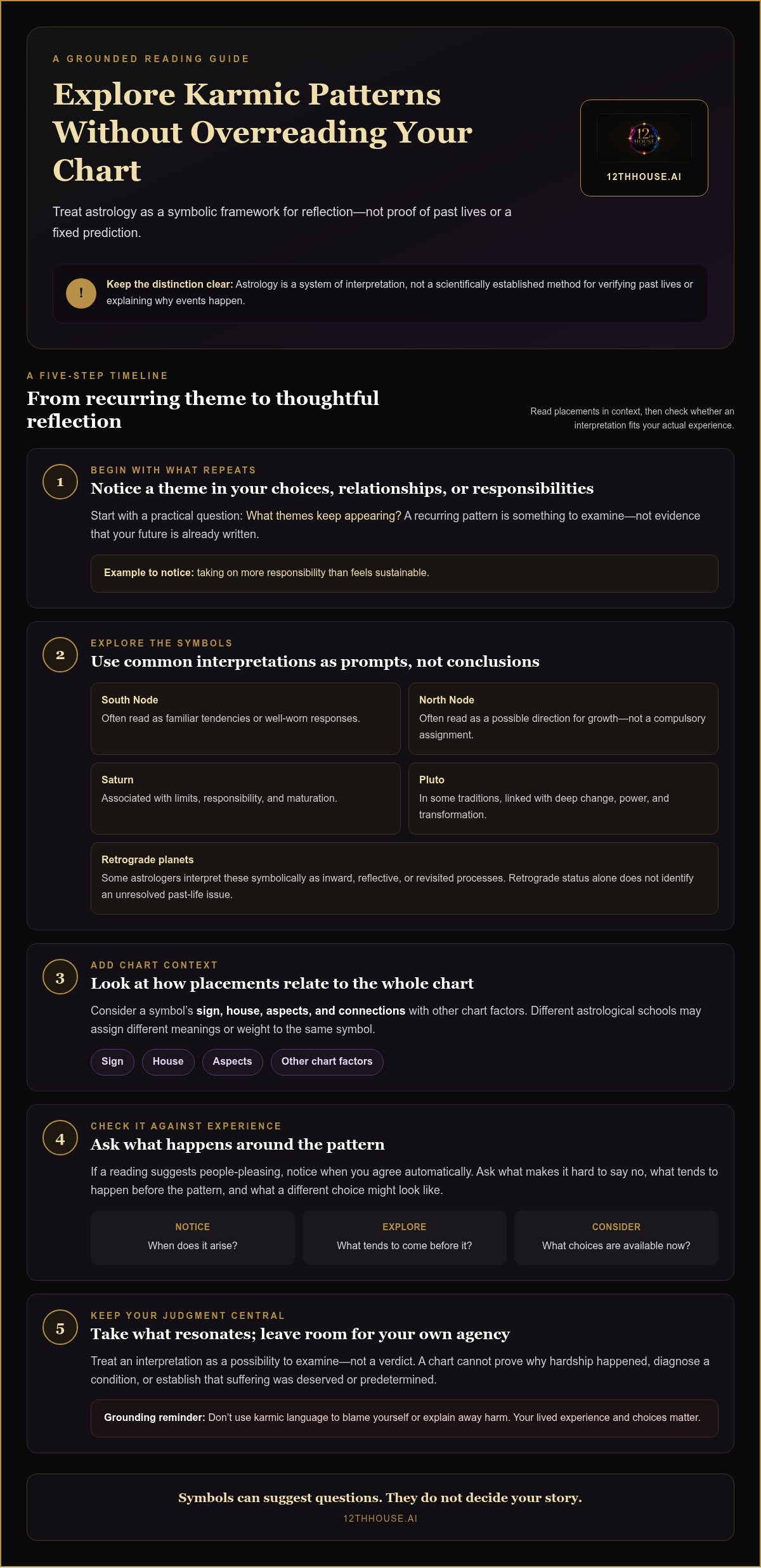
This guide introduces chart symbols commonly linked with karmic themes, including the lunar nodes, Saturn, retrograde planets, and the 12th, 4th, and 8th houses. You’ll learn how astrologers interpret these placements, how to connect them with practical self-reflection, and which questions can help you examine repeating patterns without turning symbolism into certainty. Treat the chart as a framework for inquiry, then decide what resonates with your lived experience.
Key Takeaways
- Use karmic astrology as a symbolic framework for exploring recurring themes, not as proof of past lives or a fixed prediction.
- Learn how astrologers interpret the lunar nodes, Saturn, Pluto, and retrogrades, while considering the full chart rather than one placement alone.
- Understanding my karmic path astrology starts with noticing a recurring pattern and the context in which it appears.
- Use journal prompts to examine repeated choices, boundaries, responsibilities, and the lessons you choose to take forward.
- Organize chart symbols with a birth-chart tool, then use thoughtful follow-up questions to clarify their meanings without giving up your own judgment.
What Does Understanding Your Karmic Path in Astrology Mean?
Understanding my karmic path astrology can begin with a practical question: what themes keep appearing in my choices, relationships, or responsibilities? Karmic astrology offers one symbolic framework for exploring that question. It treats a birth chart as a map of possible patterns and growth areas, not as proof that a person has lived before or must repeat a particular story.
The distinction matters. Astrology is a system of interpretation, not a scientifically established method for verifying past lives or explaining why events happen. A chart may prompt useful reflection, but it can’t deliver an unavoidable verdict about your character or future. Treat its symbols as questions to examine alongside your own experience.
Karma, past lives, and astrology: where interpretations differ
Karma has varied meanings across religious and philosophical traditions; it isn’t one universal doctrine. A general overview of the concept of karma can help show how broad its history and interpretations are. Astrologers also differ in how they connect karma with a birth chart. Some use past-life language; others focus on habits, consequences, or personal development within this life.
Past-life explanations are an interpretive lens, not a fact a chart can verify. You can explore the symbolism without adopting a specific belief about reincarnation.
What a karmic reading can and cannot tell you
A reflective reading can help you name a theme, such as avoiding difficult conversations or taking on more responsibility than feels sustainable. It can then prompt useful questions: where does this pattern arise, what tends to happen before it, and what choices are available now? The value is in the inquiry, not in treating an astrological interpretation as a final answer.
A chart placement can’t prove why a hardship happened, diagnose a condition, or establish that suffering was deserved or predetermined. Don’t use karmic language to blame yourself or explain away harm. Let the symbols suggest possibilities, test them against lived experience, and keep your agency at the center of the reading.
Which Birth-Chart Symbols Do Astrologers Read as Karmic?
Some modern astrological interpretations associate karmic themes with the lunar nodes, Saturn, Pluto, and retrograde planets. These symbols don’t carry one universal meaning, and different schools of astrology may assign them different weight. Read them as parts of a larger chart, not as separate verdicts about your past or future.
Chart context matters more than any isolated placement: meaning emerges from how symbols relate to the whole chart and to the questions you bring to it.
North Node and South Node: familiar patterns and direction
In some modern readings, the South Node describes familiar tendencies or well-worn responses, while the North Node suggests a direction for growth. If a reading connects the South Node with people-pleasing, for example, that doesn’t prove a past-life identity or predict that you’ll always struggle with boundaries. Instead, notice when you agree to something automatically, what makes it hard to say no, and what a different choice might look like.
Think of the North Node as an invitation, not a compulsory assignment. Its symbolism can frame questions about what feels unfamiliar but potentially constructive. The nodes alone can’t establish which events have happened in your life or what you must do next.
Saturn, Pluto, and retrogrades in karmic interpretations
Saturn is often read as a symbol of limits, responsibility, and maturation. An astrologer might interpret its placement as pointing toward an area where patience or sustained effort feels relevant. Pluto, in some interpretive traditions, is linked with deep change, power, and processes of transformation. Neither symbol proves that a challenge is deserved or inevitable.
Retrograde motion is an apparent change in a planet’s direction as viewed from Earth, rather than a planet physically reversing its orbit. Some astrologers read a retrograde planet symbolically as an inward, reflective, or revisited process. The interpretation depends on the planet and its connections in the chart; retrograde status by itself doesn’t identify an unresolved past-life issue.
As you explore understanding my karmic path astrology, keep interpretation proportional to what you know about your own experience. Ask how a symbol might illuminate a choice or recurring response, then check whether that reading genuinely fits. 12th House’s birth-chart and transit analysis can help you view placements in context, while your judgment remains central to what you take from them.
How Do You Interpret Karmic Patterns Without Overreading Your Chart?
A single-placement reading can sound definitive: “Your South Node means you always repeat this pattern.” A contextual reading is more careful. It considers a symbol’s sign, house, aspects, and relationship to other chart factors, then treats the interpretation as a possibility to examine rather than a verdict.
Astrologers may prioritize different factors and reach different readings. For example, imagine someone who notices they often take responsibility for a group’s emotional needs. An astrologer might consider several placements associated with responsibility or relationships, but the chart doesn’t establish the cause of that behavior. The person’s history and present circumstances matter too.
Read patterns in context, not as isolated verdicts
Use the chart to develop a question, not to close the inquiry. If the theme concerns relationships, look at how multiple chart factors are interpreted together, alongside the actual dynamics between people. For another framework for considering relationship patterns, explore the architecture of a birth chart compatibility reading.
Birth time accuracy matters most for chart features tied to time and location, including houses and angles. An uncertain birth time can make those details less reliable. It doesn’t mean every chart placement depends on an exact time; planetary signs and some other placements may still be considered, depending on the chart and method.
Use symbols as prompts, not conclusions
Before assigning an astrological explanation, describe the pattern you can observe. What happens? In what situations? What choices or boundaries are involved? Then compare that account with a symbolic interpretation. This sequence keeps reflection anchored in experience rather than letting a chart claim to have caused an event.
| Symbol | Common interpretation | Reflection question | Caution |
|---|---|---|---|
| Lunar nodes | Familiar patterns and growth direction | What response feels familiar, and what alternative could I try? | They don’t prove past-life events or dictate a path. |
| Saturn | Responsibility, limits, and maturation | Where might clearer boundaries or steady effort help? | Don’t treat difficulty as deserved or unavoidable. |
| Pluto | Deep change and transformation | What am I ready to reconsider or release? | A symbol isn’t a prediction of crisis. |
| Retrogrades | Reflection or revisiting a theme | What deserves a second look? | Retrograde motion alone doesn’t define a problem. |
For understanding my karmic path astrology, combine symbolic reflection with real-world context. Use your values, relationships, available information, and practical consequences when making meaningful decisions. A chart can broaden the questions you ask; it shouldn’t replace your judgment.
How Can You Explore Your Karmic Path Through Reflection?
Turn a chart interpretation into a practice of observation. Rather than searching for a hidden verdict, track what repeats, consider the circumstances around it, and choose one response you can test in everyday life. This keeps the inquiry connected to your experience and leaves room for change.
Use this four-step process:
- Name the pattern. Describe what keeps happening in plain language, such as agreeing to tasks before checking your capacity.
- Notice its context. Record who is involved, what tends to happen beforehand, and what you feel or need in that moment.
- Consult the symbols. Consider whether a chart theme offers a useful question. Don’t force a match if the interpretation doesn’t fit your experience.
- Choose a grounded next action. Try a clear boundary, pause before making a commitment, or gather more information before deciding.
Journal prompts for recurring themes
Write freely, then look for details you can observe rather than conclusions you feel pressured to reach. These prompts can help:
- What situations or choices seem to recur? What conditions do they share?
- What need, assumption, or boundary might be relevant in these moments?
- What responsibilities are truly mine, and which ones have I taken on by habit?
- What lesson do I choose to take from this experience, regardless of what a chart suggests?
- What are two possible explanations for this pattern, one spiritual and one rooted in circumstances, relationships, or learned behavior?
Keep both explanations in view. If an astrological idea resonates, treat it as a prompt to investigate, not as evidence that the chart caused the experience. Your lived experience remains the test: does this interpretation help you see the pattern more clearly, or are you reshaping your story to fit it?
Keep spiritual reflection grounded and compassionate
Reflection supports agency; it doesn’t establish cosmic blame. Hardship isn’t proof that you deserved it, chose it, or failed to resolve karma. If an interpretation increases shame, fear, or helplessness, pause and set it aside. You can return to the question later, or choose a different framework that supports clear thinking and self-compassion.
Tarot can offer another set of reflective prompts, but it is also an interpretive practice rather than proof of a past-life explanation. To continue understanding my karmic path astrology with chart-based questions, explore personalized astrology guidance from 12th House and use follow-up questions to clarify symbolism while keeping your own judgment central.
How Can Birth-Chart Tools Support Your Karmic Astrology Exploration?
A birth-chart tool can bring placements into one organized view before you decide what they might mean. That structure helps separate chart information from interpretation: first identify a symbol and its position, then consider how it relates to other factors and to a pattern you’ve actually observed. The chart provides a framework for inquiry, not an automatic explanation of your life.
Start with chart context, then ask focused questions
For each symbol you want to explore, note what it is, where it appears in the chart, and the question it raises. For example: “I’m looking at Saturn in this area of my chart. How might its sign, house, and connections with other placements shape possible interpretations?” Asking about several factors together can provide more context than asking for a fixed meaning from one placement alone.
Birth-chart and transit analysis can help organize that information for self-guided reflection. Lala, 12th House’s AI assistant, answers personalized questions about your chart and spiritual topics. Use follow-up questions to clarify terms or compare interpretations. An AI response is interpretive support, not proof of a past-life claim or a substitute for your discernment. Ask what assumptions an interpretation makes, whether it fits your experience, and what other readings might be possible.
Turn symbolic insight into a grounded next step
Keep the work small and practical. If a reading brings a recurring response into focus, choose one action to observe or try. You might notice when you take on a responsibility automatically, or practice stating a boundary clearly. Record what happens. Then revisit the interpretation when you have more context, rather than treating an early reading as final.
Spiritual tools work best alongside lived experience and trusted support. A chart cannot decide what a relationship means, establish why a difficult event occurred, or make an important decision for you. Let symbolism widen your perspective, then weigh it with relevant facts, personal values, and the perspectives of people you trust.
If you’re exploring understanding my karmic path astrology, begin with one chart question and follow the thread at your own pace. For personalized chart questions and structured birth-chart exploration, visit 12th House.
Let Your Chart Open a Question, Not Close One
Karmic astrology offers a symbolic way to examine recurring themes, not a verdict about past lives or a fixed script for your future. Lunar nodes, Saturn, Pluto, and retrogrades can suggest questions for reflection, but their meaning depends on the wider chart and your lived experience.
As you continue understanding my karmic path astrology, begin with a pattern you can observe. Consider its context, explore chart symbolism with curiosity, and choose one grounded action that supports your values. Reflection should increase your clarity and agency, never assign blame for hardship.
For a structured starting point, explore 12th House’s astrology birth-chart and transit analysis. Lala can help you ask follow-up questions about your chart, while the metaphysical library supports self-guided learning. Explore your chart with 12th House, and let each insight become an invitation to make thoughtful choices.
Frequently Asked Questions
What does karmic path mean in astrology?
In astrology, a karmic path is a symbolic way to explore recurring themes, choices, and opportunities for growth. Some modern interpretations connect these themes with past lives, while others focus on habits or development in this lifetime. If you’re seeking understanding my karmic path astrology, treat a chart as a framework for reflection rather than proof of a spiritual history or a fixed account of what must happen.
How do I find my karmic path in my birth chart?
Start by locating your lunar nodes, then consider how astrologers interpret them alongside Saturn, Pluto, retrogrades, and other chart factors. Note each symbol’s sign, house, and connections with other placements. A reliable birth time helps establish houses and angles, though not every planetary placement depends on exact birth time. Treat any interpretation as a question to test against your lived experience, not a label you must accept.
What do the North Node and South Node mean in karmic astrology?
In some modern readings, the South Node represents familiar patterns or tendencies, while the North Node suggests a possible direction for growth. These meanings are symbolic, not a record of specific past-life events or a mandatory life assignment. For example, a North Node interpretation might invite you to try a less familiar response. Consider whether that idea fits your choices and circumstances instead of assuming it defines your future.
Does karmic astrology prove that I had a past life?
No. Astrological symbols can’t scientifically verify that you had a past life or establish a specific identity or event from one. Astrologers may use past-life language as one spiritual interpretation, while others read karmic themes through habits and personal growth in this lifetime. You can explore the symbolism without treating reincarnation claims as facts. Keep your own beliefs and the limits of what a chart can show in view.
Can karmic astrology predict what will happen to me?
Karmic astrology can’t determine your future with certainty. An astrologer may interpret chart symbols as themes or possible areas of reflection, but they don’t remove your agency or account for every real-world circumstance. Use a reading to consider choices, not to make decisions from fear of a predicted outcome. For important matters, weigh practical information, your values, and trusted perspectives alongside any spiritual interpretation.
What does Saturn mean in karmic astrology?
In some karmic interpretations, Saturn symbolizes limits, responsibility, discipline, and maturation. Its chart position may prompt reflection on where patience, structure, or clearer boundaries could be useful. That symbolism doesn’t mean you deserve hardship or that a challenge is inevitable. Consider Saturn in the context of the whole chart and your actual experience. One placement alone can’t define your character, explain every obstacle, or dictate what you should do.
Can a karmic birth-chart reading explain repeated relationship patterns?
A karmic reading may offer symbols and questions for exploring recurring relationship themes, but it can’t prove why a pattern occurs or establish that a relationship was destined. Notice what repeats in real situations, such as difficulty expressing needs or taking on too much responsibility. Then consider chart interpretations as one reflective lens. Include communication, boundaries, personal history, and each person’s behavior in your understanding of the pattern.


