

What if the Moon’s monthly rhythm could tell you more about your own patterns than a general horoscope ever could? If Moon-sign forecasts feel too broad, look closer. Tracking lunar cycles with my birth chart means following each phase through the specific houses and placements it activates, then noting what actually unfolds in your life.
A birth chart can seem technical at first, but you don’t need to interpret every transit or treat the Moon as a source of predictions. Start with a few consistent observations. Over time, they can help you distinguish a recurring theme from a one-off event.
This guide shows you how to locate the houses connected to each New and Full Moon, record useful details, and build a simple journaling practice you can return to each month. You’ll learn to use astrology as a structured lens for reflection, not a script for what must happen. Birth chart and transit analysis, along with tools like Lala, can help you explore specific questions as they arise.
Key Takeaways
- Learn how natal placements and current lunar transits work together to give each Moon phase personal chart context.
- Use the Moon’s phase, sign, and house as a simple framework for observing themes without treating them as predictions.
- Approach tracking lunar cycles with my birth chart as a steady reflection practice, not a reason to monitor every transit.
- Record a few relevant details at each lunar phase to help distinguish recurring patterns from one-off experiences.
- Know when to revisit a chart question and when to pause interpretation.
What tracking lunar cycles with your birth chart actually means
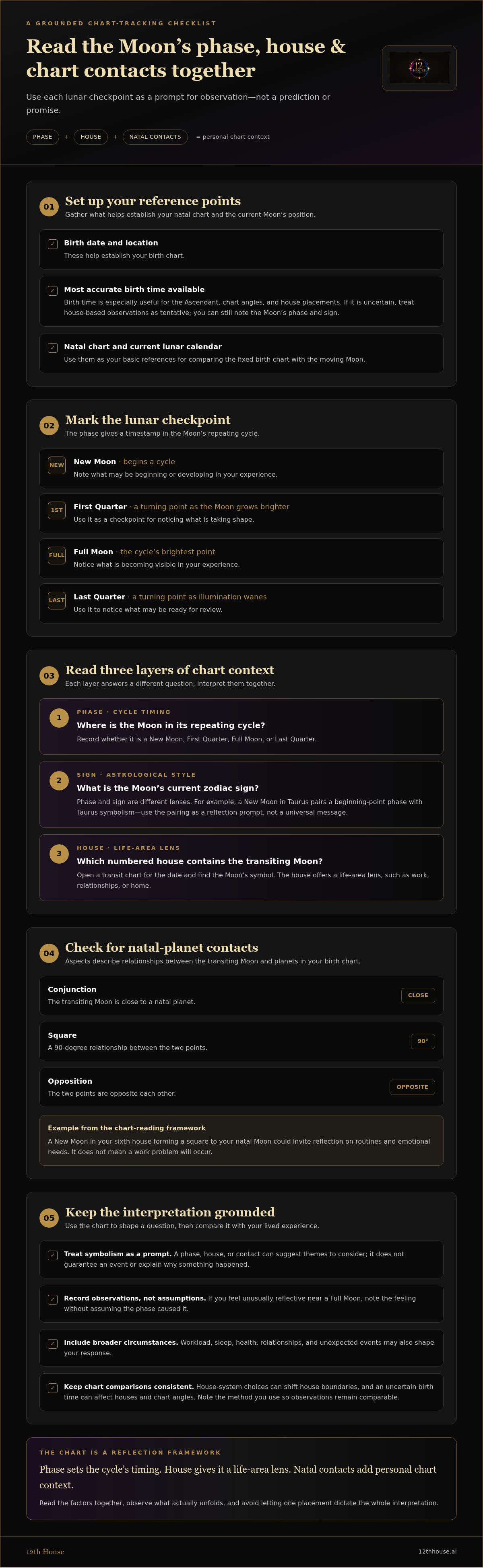
Tracking lunar cycles with your birth chart means observing the Moon’s changing phases and zodiac position in relation to the placements in your natal chart. Your birth chart maps the sky at your birth; transits describe where celestial bodies are now. Comparing the two gives you a personal framework for reflection, not a forecast of fixed outcomes.
A lunar phase describes the Moon’s stage in its repeating cycle; a lunar transit describes where the moving Moon is positioned in relation to your birth chart. The New Moon, First Quarter, Full Moon, and Last Quarter mark recurring stages. In astrology, their symbolism can help you frame questions about beginnings, decisions, culmination, or release. The phase does not determine what will happen. Its meaning depends on how you interpret and observe it.
A general Moon-sign horoscope focuses on one placement. Chart-based tracking adds context: the house the transiting Moon moves through, its relationship to natal planets, and your observations over time. A natal chart maps celestial positions at birth, as outlined in this overview of the astrological chart. This fixed map gives you a reference point for following the Moon’s movement.
How the lunar cycle differs from your natal Moon
Your natal Moon is a permanent placement in your birth chart. In astrology, it’s commonly associated with emotional needs, instinctive responses, and what feels familiar or sustaining. The transiting Moon is different: it continues moving through the zodiac, changing signs and making contacts with chart placements. Tracking lunar cycles with my birth chart means comparing this moving position with the natal map, rather than confusing it with your birth Moon. These interpretations are symbolic frameworks, not scientifically established predictions.
What information you need before you begin
Gather your birth date, birth location, and the most accurate birth time available. Date and location help establish the chart. Birth time is especially useful for calculating the Ascendant, chart angles, and house placements. If the time is uncertain, those parts of the chart may shift, so treat house-based observations as tentative. You can still note the Moon’s phase and sign. Use a natal chart and current lunar calendar as your basic references, then record observations without forcing a meaning.
How lunar phases move through your birth chart
Think of the Moon’s monthly movement as a sequence mapped onto your natal chart. The phase marks the Moon’s position in its cycle of illumination, while its sign shows its current zodiac position. NASA’s guide to the lunar cycle explains the physical phases. Astrology adds a symbolic layer by locating those phases in your chart.
The four familiar checkpoints describe different stages: the New Moon begins a cycle, the First Quarter marks a turning point as the Moon grows brighter, the Full Moon brings the cycle to its brightest point, and the Last Quarter signals another turning point as illumination wanes. These are not instructions or promises. Use them as timestamps for noticing what is developing, becoming visible, or ready for review in your experience.
Read the Moon’s phase and sign together
Phase and sign answer different questions. Phase describes illumination and the Moon’s position in its recurring cycle; sign describes its astrological style. For example, a New Moon in Taurus combines a beginning-point phase with Taurus symbolism. Treat that pairing as a prompt for reflection, not a universal message. Consider where it falls in your chart and what is happening in your life before assigning meaning.
Locate the Moon’s house and natal aspects
Open a transit chart for the date you’re tracking. Find the transiting Moon’s symbol and note which numbered house contains it. The house offers a life-area lens, such as work, relationships, or home. Natal aspects show how the transit relates to planets in your birth chart.
A conjunction places the transiting Moon close to a natal planet, a square describes a 90-degree relationship, and an opposition places the two points opposite each other. Astrologers may interpret these contacts as emphasis or tension, but none guarantees an event. For instance, a New Moon in your sixth house forming a square to your natal Moon could invite reflection on routines and emotional needs. It does not mean a work problem will occur.
Phase sets the cycle’s timing, house gives it a life-area lens, and natal contacts add personal chart context. Read these factors together rather than letting one placement dictate the whole interpretation. House-system choices can shift house boundaries, and an uncertain birth time can affect houses and chart angles. Note the method you use and keep it consistent so your observations remain comparable.
For support examining how a current Moon transit relates to natal placements, 12th House birth chart and transit analysis and Lala can support your self-guided exploration.
How to interpret a lunar transit without overreading it
A lunar transit is one piece of a larger chart, not a verdict. Its phase, house, and contacts with natal planets can suggest themes to consider, but they do not establish why an event happened or guarantee what comes next. Use the symbolism to shape a question, then compare it with your lived experience and broader circumstances.
One Moon phase does not determine your mood or dictate a decision. If you feel unusually reflective near a Full Moon, note the feeling without assuming the phase caused it. Workload, sleep, health, relationships, and unexpected events may also shape your response. The value of tracking lunar cycles with my birth chart is observing possible connections over time, not treating a single transit as proof.
| Chart factor | Symbolic lens | Reflective prompt |
|---|---|---|
| Phase | Cycle stage, such as beginning or culmination | What feels new, visible, or ready for review? |
| House | Area of life receiving attention | Where am I noticing activity or a shift in focus? |
| Natal aspect | Contact between the transiting Moon and a birth-chart placement | What response or familiar theme is coming into view? |
Separate symbolic themes from concrete predictions
Astrological meanings are interpretive prompts, not evidence-based forecasts. Instead of deciding that a transit means a relationship will change, ask, “What am I noticing in this relationship?” or “Which habit is asking for attention?” If a transit feels emotionally charged, consider what else is happening before drawing conclusions. Don’t make high-stakes choices solely because of a lunar phase. Use relevant facts, practical judgment, and your own values.
Notice recurring patterns without forcing a conclusion
Keep brief notes across multiple lunar cycles before calling something a pattern. Record the date and chart factors alongside ordinary context, such as sleep, workload, health, major life events, and your mood. Then compare entries. Do similar questions recur when the Moon activates a particular house or natal placement, or does the theme appear at other times too?
A single coincidence is an observation, not proof of astrological causation. You might notice that several Full Moons coincide with busy weeks. Keep the note, but don’t assume the phase created the workload. Let repeated observations refine your questions. If a connection does not hold up over time, release the interpretation and continue observing with curiosity.
A simple monthly method for tracking lunar cycles in your chart
Make the practice repeatable, not elaborate. At the lunar phases you choose to track, record what the chart shows and what is happening in your life. Keep observation separate from interpretation so a symbolic idea does not rewrite your memory of an event. This makes tracking lunar cycles with my birth chart a record you can review, rather than a stream of moment-by-moment predictions.
Set up a lunar-cycle journal
Create one entry for each phase you want to observe. A notebook or digital document is enough. Use the same fields each time:
- Date and phase: Note the date and whether it’s the New Moon, First Quarter, Full Moon, or Last Quarter.
- Moon sign and house: Record the sign and, if your birth time is reliable, the house the transiting Moon occupies.
- Natal contacts: Note any close aspects to natal placements that you’re tracking.
- Observation and context: Describe what happened in neutral terms, then note relevant circumstances such as sleep, workload, or a major event.
- Interpretation and review: Add a tentative symbolic reading, then revisit it after the cycle. Did the theme recur, change, or seem less relevant in hindsight?
For example, write “deadline moved; slept poorly” before adding an interpretation about a busy house or lunar contact. At the next phase, make another brief entry. You don’t need to check the chart constantly; a few deliberate notes make comparisons easier. When you review them, look for questions worth exploring, not proof that the Moon caused an outcome.
Chart placements also make more sense in relation to one another than in isolation. For a related look at how astrologers compare placements across charts, see this birth chart compatibility guide.
Adjust the method when your birth time is uncertain
If your birth time is approximate, keep tracking the lunar phase and sign, but treat house-based notes as tentative. House boundaries and chart angles depend on birth time, so avoid building a firm pattern around a house placement that may shift. Focus instead on repeated observations and natal planetary placements or contacts that remain dependable for your chart data.
Keep your method consistent from one cycle to the next. To explore natal placements alongside current transits, use 12th House personal chart and transit guidance as you develop your journal practice.
Use lunar-cycle tracking as a grounded practice for self-understanding
A chart is most useful when it helps you ask clearer questions, not when it claims to settle them. Let consistency matter more than certainty. Over time, compare what you expected a transit to mean with what you actually noticed. If a theme keeps appearing, explore it carefully. If an interpretation starts to feel forced or makes you anxious, pause and return to your direct experience.
Turn chart notes into useful reflection
Revisit an entry when you have enough distance to assess it fairly, such as at the next phase or when reviewing a full cycle. Ask one open question for the next entry: What deserves my attention right now? Keep astrology alongside practical judgment, trusted support, and the real circumstances shaping your choices. It can offer a reflective lens, but it shouldn’t replace professional guidance or determine a high-stakes decision.
Explore personal chart questions with 12th House
If you’re tracking lunar cycles with my birth chart and want to examine how a current transit relates to a natal placement, Lala is an AI assistant for personalized questions about astrology charts and transits. Use it to explore a specific question, then compare the interpretation with your notes and experience. For more on guided chart exploration, read the AI astrology assistant guide.
Keep your discernment at the center. Return to a chart question when new observations give you something concrete to examine; step back when you’re repeating the same interpretation without gaining insight. That boundary keeps the practice grounded and leaves you in charge of what meaning, if any, you take from the symbolism.
12th House brings together chart exploration and self-guided learning through its astrology tools and metaphysical library.
Let each lunar cycle sharpen your perspective
Tracking lunar cycles with my birth chart is most useful as a practice of observation, not prediction. Note the Moon’s phase, sign, house, and natal contacts, then compare your interpretation with what you actually experienced. Over time, brief entries can help you notice recurring themes without treating one transit as the explanation for everything.
Stay curious and keep your agency. A chart can offer a symbolic framework, but your context, judgment, and choices remain central. When you want to explore natal placements and current transits in greater depth, 12th House offers astrology birth chart and transit analysis, Lala AI for personalized spiritual guidance, and a metaphysical library for self-guided learning.
Explore 12th House to continue building a reflective practice that feels grounded, personal, and entirely your own.
Frequently Asked Questions
How do I track lunar cycles with my birth chart?
Use a natal chart and lunar calendar as your references. A practical approach to tracking lunar cycles with my birth chart is to note the date, phase, and Moon sign at each New Moon, First Quarter, Full Moon, and Last Quarter. If your birth time is accurate, record the house and any relevant contacts to natal placements. Journal what you observe, then compare several cycles before deciding whether a theme repeats. Treat the symbolism as reflection, not prediction.
What part of my birth chart should I look at during a Full Moon?
Start with the house containing the transiting Full Moon, then check whether it forms a close aspect to a natal planet or chart angle. Astrologers often associate the Full Moon with visibility or culmination, but this is symbolic language, not a guaranteed event. Consider your notes and broader circumstances too. One placement can offer a useful lens, but it can’t fully explain your feelings, choices, or experiences.
Can lunar cycles affect my birth chart?
Your natal chart doesn’t change as the Moon moves. It represents planetary positions at your birth, while the transiting Moon moves through the zodiac and forms contacts with natal placements. Astrologers interpret those changing positions symbolically, as a lens for reflection. That’s different from proving a direct causal effect. You can observe what a transit brings to your attention without assuming the Moon determines your mood, decisions, or events.
How often should I check lunar transits in my birth chart?
For a simple practice, check around the four main lunar phases and make a brief journal entry at each one. Note the date, phase, sign, relevant house or aspect, and your observations. You don’t need to monitor every lunar movement. Choose a rhythm that feels useful rather than distracting, then review entries after several cycles. Comparing notes over time can help distinguish a recurring theme from an experience that stood out once.
Do I need an exact birth time to track Moon cycles in my chart?
An accurate birth time matters most for identifying chart houses and angles, which can shift with time and location. If your birth time is uncertain, you can still follow the Moon’s phase and zodiac sign and note contacts to natal planets. Mark house interpretations as tentative rather than treating them as precise. This lets you keep observing while being clear about which chart details may depend on an approximate birth time.
What does it mean when a New Moon falls in the same house as my natal Moon?
In astrology, this placement can prompt reflection on how a new lunar cycle relates to the natal Moon and the themes associated with that house. Its interpretation depends on the chart, exact placements, and astrological tradition. It doesn’t guarantee a fresh start or an emotional shift. Write down what you expect, then record what you actually notice separately. That distinction helps you reflect without fitting every experience to a symbolic reading.
Is tracking lunar cycles with astrology scientifically proven?
Astrology is a symbolic interpretive tradition, not a scientifically established method for predicting personal events or proving that lunar phases cause individual experiences. You can still use chart tracking as a structured reflection practice. Record observations honestly and include ordinary context, such as sleep, workload, and major life events. Don’t rely on astrological interpretations alone for medical, financial, or other high-stakes decisions. Keep practical judgment and appropriate support in view.


