

What if the Three of Swords describes emotional pain without deciding how a relationship will end? If you’re asking what someone feels about you, the three of swords as feelings can seem like a blunt verdict of heartbreak or rejection. Its imagery does evoke grief, conflict, and painful truth, but a tarot card isn’t proof of another person’s feelings or a fixed prediction.
The card may point to someone who feels hurt and has withdrawn to protect themselves. It may also reflect tension in the situation, your own fears, or a truth that needs attention. Distance doesn’t always mean indifference, and pain doesn’t always mean a breakup.
This guide explains the card’s emotional symbolism, how upright and reversed meanings can differ, and what surrounding cards may add. Use it to consider whether the reading suggests raw grief, healing, or feelings that are difficult to express. Treat the card as a prompt for reflection, not certainty about someone else’s inner world.
Key Takeaways
- The three of swords as feelings can point to hurt, grief, disappointment, or difficult clarity, but it cannot verify another person’s private emotions.
- Read the upright card with care: emotional pain may reflect what someone feels within themselves, not necessarily how they feel about you.
- A reversed Three of Swords can suggest healing or release, but context may also reveal lingering pain or emotional avoidance.
- Don’t treat this card alone as confirmation of a breakup, rejection, or betrayal; consider the question, spread position, and neighboring cards.
- Record your first interpretation and its context, then compare it with observable behavior to keep symbolic insight in perspective.
Three of Swords as Feelings: The Core Meaning Behind the Card
The Three of Swords can point to hurt, grief, disappointment, or difficult emotional clarity. In a feelings reading, it may describe pain someone is experiencing, tension in a connection, or the emotional weight of facing a truth. Tarot offers symbolic possibilities, not verified access to another person’s private thoughts.
The Three of Swords signifies emotional pain or painful clarity, not a guaranteed breakup or rejection. Keep that distinction in view as you interpret the card. It offers a theme to examine, not proof of what another person feels or what will happen next.
What does the Three of Swords represent in tarot?
The Three of Swords belongs to the Minor Arcana and the suit of Swords. In tarot symbolism, Swords are associated with thought, communication, conflict, and difficult truths. Their edge can represent words or realizations cutting through confusion, sometimes bringing clarity at an emotional cost.
In the Rider-Waite-Smith image, a heart pierced by three swords appears beneath dark clouds and rain. The heart evokes vulnerability, the swords suggest painful thoughts, words, or events, and the storm creates an atmosphere of sorrow. These are interpretive symbols, not a code with one universal translation. Traditional card themes provide a framework, while a reader’s associations may add personal nuance. For broader historical and cultural context, see the Three of Swords.
Why does this card feel so intense in a feelings reading?
The pierced heart is direct imagery. It can bring separation, exposure, or the fear of being wounded into sharp focus, especially when you’re asking about someone important to you. A strong reaction to the image is understandable, but fear is not evidence that rejection or betrayal has occurred.
Pause before turning the card into a verdict. Ask what the image brings up for you, then separate that reaction from what you can observe in the relationship. Is there a difficult conversation, an unresolved disappointment, or a concern you may be projecting onto the reading? That distinction helps keep the three of swords as feelings grounded in context.
If you want a broader framework for interpreting cards and their positions, explore Tarot Mastery: A Professional Guide to Spiritual Clarity. A structured approach can help you read intense imagery without letting it dictate the whole story.
Upright Three of Swords as Feelings: Hurt, Distance, or Honest Clarity?
Upright, the Three of Swords may suggest sadness, disappointment, emotional strain, or a painful realization. Its meaning depends on the question and the card’s role in the spread. In a position about someone’s inner state, it may describe pain they’re carrying. In a position about their feelings toward you, it may point to hurt connected with the relationship, but it doesn’t establish that you caused it.
The upright Three of Swords commonly signifies sadness, disappointment, emotional strain, or painful honesty, without predicting what happens next.
Could the card mean they feel heartbroken or disappointed?
It can, especially if the question and surrounding cards also suggest grief, conflict, or separation. But the source of that pain isn’t automatically you. It may come from a past experience, current tension between you, or a difficult circumstance elsewhere in their life. The card alone doesn’t prove betrayal, infidelity, or any specific hidden event.
Can the Three of Swords also point to difficult honesty?
Yes. Swords connect with thought and communication, so this card can symbolize a truth being spoken or recognized, even when it hurts. It could describe an honest conversation bringing clarity rather than someone withdrawing or rejecting you. Treat this as a possibility to reflect on, not a way to read another person’s mind.
Emotional pain and the direction of someone’s feelings are not the same thing. A person may be sad because they care about a connection, hurt by a disagreement, or overwhelmed by something unrelated. If they seem distant, the card could mirror emotional strain or self-protection, but it can’t explain that behavior on its own. Check the question, spread position, and surrounding cards before drawing a conclusion.
For another perspective on the card’s traditional themes, compare these meanings for the Three of Swords with the specific context of your spread. The goal isn’t to select the most dramatic interpretation. It’s to notice which reading fits the question without turning a symbol into evidence.
If you want to explore a personal tarot question through a broader reading, personalized tarot guidance can offer another way to consider the card in context.
Reversed Three of Swords as Feelings: Healing, Suppression, or Release?
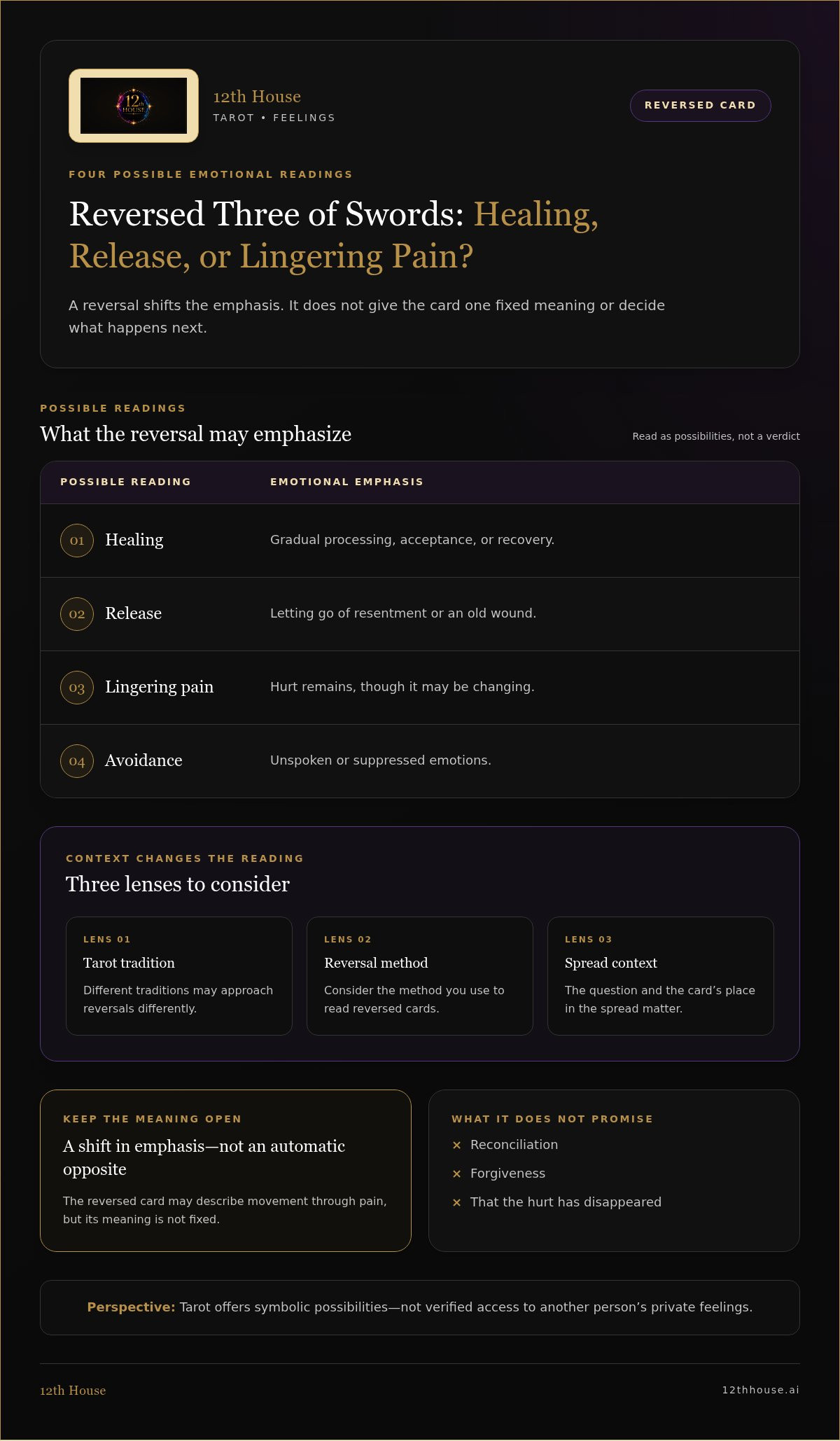
The reversed Three of Swords doesn’t have one fixed meaning. Depending on the tarot tradition, your reversal method, and the spread, it may suggest emotional recovery, pain that still lingers, or feelings being avoided. Treat reversal as a change in emphasis, not an automatic opposite of the upright card. The three of swords as feelings can describe movement through pain, but it doesn’t promise reconciliation, forgiveness, or that the hurt has disappeared.
| Possible reading | Emotional emphasis |
|---|---|
| Healing | Gradual processing, acceptance, or recovery |
| Release | Letting go of resentment or an old wound |
| Lingering pain | Hurt remains, though it may be changing |
| Avoidance | Unspoken or suppressed emotions |
Does the reversed Three of Swords mean someone is healing?
It can point to someone beginning to process what hurt them, accepting a difficult experience, or slowly regaining emotional balance. Look to the surrounding cards for clues: cards associated with renewal or support may reinforce a sense of movement, while cards suggesting conflict or withdrawal may indicate recovery is incomplete. Healing describes an emotional process, not a promise that a relationship will resume.
Can the reversed card suggest feelings are being suppressed?
Yes. Some readings interpret the reversal as pain being pushed aside rather than acknowledged. That possibility doesn’t justify labeling someone emotionally unavailable based on one card. Consider the spread position: a card about inner feelings may speak differently from one representing advice or an obstacle. Neighboring cards can help distinguish quiet recovery from avoidance.
Choose a reversal method before you interpret the spread, then apply it consistently. You might read reversals as blocked or internalized energy, as a shift in intensity, or read every card upright. Each method creates a different interpretive structure. Don’t switch approaches midway just to reach the answer you fear or hope to find.
For another perspective, compare this reading with the Three of Swords in context, then return to the exact question and card position in your spread. Ask what the surrounding cards support and what remains only a possibility. Reversal can mark a turning point, but the cards don’t verify another person’s private feelings.
Does the Three of Swords Mean a Breakup? Read the Card in Context
No. The Three of Swords alone doesn’t confirm a breakup, rejection, or betrayal. It may bring emotional pain or conflict into focus, but a tarot card can’t establish another person’s intentions or guarantee a relationship outcome. To interpret the three of swords as feelings, read the whole spread rather than letting its most dramatic image determine the story.
How do surrounding cards change the feelings interpretation?
Neighboring cards can shift the emphasis, but combinations are prompts for interpretation, not universal formulas. Consider these hypothetical examples:
- With a supportive card: The spread might emphasize care, support, or the possibility of working through hurt.
- With a conflict-oriented card: The emphasis may fall on tension, painful words, or unresolved disagreement.
- With a reflective card: The reading might invite patience, private processing, or a closer look at what the pain means.
First check the question and each card’s assigned position. A Three of Swords in an obstacle position may describe strain affecting the connection; in an advice position, it may suggest facing a difficult truth. Read every card in relation to the spread before isolating one symbol. For another perspective on relationship dynamics, explore birth chart compatibility as a distinct framework for reflection.
| Useful contextual clue | Overconfident conclusion to avoid |
|---|---|
| The question asks about emotional tension, and nearby cards also suggest conflict. | “This proves they’re ending the relationship.” |
| The card appears in a position about your concerns or expectations. | “This confirms they betrayed me.” |
| Other cards suggest reflection or support alongside emotional strain. | “The pain means they don’t care about me.” |
What can one tarot card tell you, and what can’t it tell you?
A single card offers a symbolic snapshot to consider. It isn’t proof, a diagnosis, or a guaranteed forecast. Revisit the exact wording of your question: “What feelings might be present?” leaves more room for reflection than “Are they going to leave me?” Then note the spread position and compare the interpretation with observable behavior, such as what the person has actually said or done.
Tarot symbolism can support reflection, but it can’t establish another person’s intentions. For a personalized spiritual question, explore your reading with Lala and use the interpretation as one perspective, not a verdict.
How to Work with the Three of Swords as Feelings Without Losing Perspective
An emotionally charged card can make you want to reach a conclusion quickly. Slow the reading down instead. Recording the question, the card’s position, and the evidence around it can help you explore the three of swords as feelings without letting a symbol stand in for a conversation or a decision.
A simple four-step method for interpreting the card
- Write the exact question and orientation. Note what you asked and whether the Three of Swords appeared upright or reversed. “What might be affecting this connection?” sets a different frame from “How does this person feel about me?”
- Record the emotional themes first. List words the card brings up, such as hurt, disappointment, grief, clarity, or recovery. Don’t decide yet who feels them or what caused them.
- Map the spread context. Write the card’s assigned position and note what the neighboring cards contribute. Record more than one plausible interpretation, especially if the spread supports both emotional strain and reflection.
- Separate symbols from observable behavior. Consider what the person has actually communicated or done. Use real-world communication and behavior patterns when making relationship decisions, rather than relying on a card draw alone.
Journaling can make this process clearer. Try two columns: “What the card suggests” and “What I know from experience.” In the first, record symbolic possibilities. In the second, note direct conversations and observable actions, not guesses about what they secretly mean. Then ask: What feeling does this card bring up in me? and What would help me respond thoughtfully?
Keep the entry open-ended. The card might prompt you to acknowledge sadness, consider a difficult conversation, or notice a fear of rejection. It doesn’t require you to confront someone, end a relationship, or make a major decision. Let reflection clarify your questions before choosing a next step.
When can personalized tarot guidance add useful context?
A personalized reading can help organize a question, consider the card’s spread position, and explore different symbolic interpretations without treating one as certain. 12th House offers tarot readings, and Lala provides AI-based answers to personalized spiritual questions. These are ways to deepen reflection while keeping your own judgment and real-world context in view.
If you’d like to explore your question through a personalized spiritual lens, Explore 12th House.
Read the Card with Clarity and Care
The three of swords as feelings can bring hurt, grief, disappointment, or painful honesty into focus. Upright or reversed, its meaning depends on the question, spread position, and surrounding cards. It doesn’t confirm a breakup or reveal another person’s private intentions.
Use the card as a structure for reflection: record what it raises for you, consider more than one interpretation, and compare symbolism with observable words and actions. A reading can clarify what you’re thinking and feeling, but it shouldn’t make decisions for you.
For a more personal exploration, 12th House offers tarot readings, and Lala answers personalized spiritual questions using AI. Explore tarot reflection with 12th House and continue your inquiry at your own pace. Let the card open a question, not close the story.
Frequently Asked Questions
Does the Three of Swords as feelings mean they are heartbroken?
It can suggest heartbreak, sadness, or disappointment, but it doesn’t prove that someone feels heartbroken or reveal what caused their pain. In a reading, the three of swords as feelings may describe hurt connected to the relationship, an older wound, or stress unrelated to you. Check the question, card position, and surrounding cards before deciding who the symbolism may represent.
Does the Three of Swords mean a breakup is coming?
No, the card alone can’t confirm that a breakup is coming. It may bring conflict, grief, or a difficult truth into focus, but those themes can appear within an ongoing relationship or reflect emotional strain elsewhere. Read the full spread and consider observable communication and behavior. Treat the card as a prompt to reflect, not a forecast that requires an immediate decision.
What does the reversed Three of Swords mean as someone’s feelings?
Reversed, the card may suggest someone is beginning to heal, releasing resentment, or gradually processing a painful experience. It can also point to lingering hurt or emotions being avoided. Reversal meanings vary by reading method, so apply your chosen approach consistently and consider the card’s position and neighboring cards. It doesn’t automatically mean the pain has disappeared, forgiveness has occurred, or a relationship will resume.
Can the Three of Swords mean someone still loves you?
It can coexist with care or love, since emotional pain doesn’t automatically mean indifference. The card may suggest that a person feels hurt within a meaningful connection, but it can’t confirm whether they still love you. Consider what the rest of the spread indicates and compare the interpretation with what they’ve actually said or done. Use the card to examine possibilities, not to claim certainty about private feelings.
What does the Three of Swords mean in a love reading?
In a love reading, the Three of Swords can highlight sadness, disappointment, conflict, separation, or painful honesty. Its specific emphasis depends on the question and the card’s spread position. For example, in an obstacle position it might point to unresolved strain, while in an advice position it could invite you to face an uncomfortable truth. It doesn’t automatically predict a breakup or establish betrayal.
How do surrounding cards change the Three of Swords as feelings?
Surrounding cards add context rather than a guaranteed translation. Supportive cards may shift attention toward care or working through hurt; conflict-oriented cards may emphasize tension or difficult communication. Reflective cards might suggest private processing. These are possible combinations, not fixed rules. Read the whole spread, including each card’s assigned position, before deciding what the Three of Swords may be expressing in that particular reading.
Is the Three of Swords always a negative card in a relationship reading?
No. Its themes can be painful, but the card may also bring an avoided truth into view, creating a chance for honest reflection. Depending on the spread, it might describe grief, emotional strain, or the beginning of processing a wound. That doesn’t make the experience easy or guarantee a positive outcome. Read it as meaningful information to consider, not a final judgment on the relationship.


