

What if the Ten of Swords points to emotional pain, not proof that someone feels nothing? If you’ve asked, “How does this person feel about me?” and drawn this stark card, its imagery can make the answer seem frighteningly final. The ten of swords as feelings often reflects exhaustion, hurt, or emotional shutdown, but context matters. Numbness isn’t the same as hatred, and a difficult moment isn’t automatically a permanent verdict.
This guide explains how to interpret the Ten of Swords in a feelings reading, including upright and reversed meanings. You’ll learn how the card can suggest painful endings, recovery, resistance, or fear of being hurt again, and how to distinguish those themes from a prediction about what someone will do.
Use the card as a prompt to examine what may be ending, what still needs honesty, and where healing could begin. Its symbolism offers a framework for reflection, not certainty about another person’s private feelings or what will happen next.
Key Takeaways
- The Ten of Swords can symbolize hurt, emotional exhaustion, or a perceived ending, but it can’t verify another person’s private thoughts.
- Separate what the card may suggest about someone’s emotional state from what they intend to do in the relationship.
- When reading the ten of swords as feelings, consider the card’s position, orientation, and surrounding cards before settling on an interpretation.
- A single card doesn’t prove hatred, infidelity, or a permanent breakup. Use the spread to explore possibilities, not declare certainty.
- Reflect on your own feelings, the evidence you have, and your boundaries before making a consequential decision based on a reading.
What Does the Ten of Swords Mean as Feelings?
The ten of swords as feelings can symbolize emotional overwhelm, hurt, exhaustion, or the sense that a situation has reached its limit. If you pulled this card while asking how someone feels about you, it may point to pain or defeat in the emotional landscape. Tarot offers a symbolic framework for reflection, though, not verified access to another person’s private thoughts.
Emotional pain can signal hurt, overwhelm, or a perceived ending; it doesn’t prove that someone has no feelings. Someone may care and still feel guarded, depleted, or unsure how to respond. The card can help you explore the emotional tone of a dynamic, but it can’t establish what another person thinks or intends.
The core emotional themes of the Ten of Swords
This card often represents a point where emotional resources feel depleted. It may suggest disappointment after unmet expectations, a painful realization, or the feeling of having carried too much for too long. Sometimes the theme isn’t a sudden rupture, but recognizing that a familiar pattern has become unsustainable.
Start by asking whose experience the spread is meant to describe. In a position for your feelings, the card may reflect your own exhaustion or fear of an ending. In a position about the relationship’s emotional climate, it may describe a shared dynamic shaped by hurt or discouragement. In a position about someone else’s feelings, treat it as a possible interpretation, not a finding. Feeling defeated doesn’t, by itself, reveal whether someone plans to leave, reconcile, or take another action.
Why the card’s imagery can feel so final
In the familiar Rider-Waite-Smith image, a figure lies face down with ten swords across their back, while a dark sky and a narrow band of light frame the scene. The composition evokes crisis and an apparent low point. You can explore the card’s history and symbolism in this overview of the Ten of Swords tarot card.
That stark image can make a reading feel like a verdict, but the image alone doesn’t settle the meaning. The card’s position, orientation, surrounding cards, and the question asked all matter. Avoid turning a visual association with an ending into a fixed prediction of betrayal or separation. For a broader foundation in interpreting cards through structure and context, explore this Tarot Mastery guide to card reading.
How the Ten of Swords Can Describe Different Emotional States
The Ten of Swords doesn’t point to one universal emotional state. It may reflect hurt after a difficult exchange, exhaustion from repeated tension, a sense of defeat, or the painful clarity that something can’t continue as it has. Depending on the spread, it may describe the person you asked about, your own response, or the relationship dynamic.
The question, card position, and nearby cards help show which emotional theme is most relevant. A card in a “current feelings” position addresses a different layer than one in “recent events” or “likely direction.” Keep feelings separate from intentions, too. Someone may feel overwhelmed without having made a settled decision about the relationship.
When the card suggests hurt, exhaustion, or overwhelm
The card may suggest that a person feels emotionally spent, as though they can’t keep responding to a situation in the same way. That strain might follow conflict, uncertainty, or prolonged disappointment. It can describe a low point rather than a firm choice to end a relationship. Check the spread’s time frame: is it asking about present feelings, what has recently shaped them, or where the dynamic may be heading?
For example, if the card is in a position for current feelings after a period of tense exchanges, you might read it as emotional depletion or hurt. That interpretation describes a possible state, not the reason for it or what the person will do next. Look for what the spread actually supports before adding a story about blame or intent.
When the card points to an ending or a painful realization
An ending is one possible symbolic theme, not the automatic outcome of every relationship reading. The card may describe recognizing a limit, accepting that a pattern has run its course, or seeking closure while still feeling sad. A relationship can reach a difficult turning point without the card proving betrayal or confirming a permanent separation. HowStuffWorks discusses the card’s profound impact on our relationships, including themes of heartbreak and partnership endings.
Use the question itself as an interpretive boundary. If you asked how someone feels, don’t turn the answer into a prediction of what they’ll do. If the card appears in a position about the connection, consider whether it describes strain between you rather than one person’s inner state. Then compare the interpretation with surrounding cards and what you know from real-world interactions.
12th House offers tarot readings and spiritual reflection tools to help you explore symbolism and context. Use a reading to support reflection while keeping your own judgment at the center.
Does the Ten of Swords Mean They Hate You or the Relationship Is Over?
No. The Ten of Swords by itself doesn’t prove hatred, infidelity, or a permanent breakup. Its stark symbolism can bring fears of rejection to the surface, but a tarot card isn’t evidence of another person’s private thoughts or a reliable verdict on what will happen. Read it as a prompt to examine emotional strain, not as confirmation of your worst fear.
Tarot can support reflection, but it can’t establish another person’s feelings as fact. Symbolism can help you name concerns and consider patterns. Direct communication and observable behavior offer a different kind of information.
What this card can suggest, and what it cannot prove
The card may bring attention to hurt, exhaustion, painful clarity, or a cycle that feels as though it has reached its limit. Those themes might describe a difficult emotional climate, someone’s experience of stress, or your own concern about where things stand. They don’t independently identify why the strain exists.
A grounded interpretation might be: “There may be pain or depletion in this situation. What evidence supports that, and what remains uncertain?” An overread jumps from the image to a claim such as, “They hate me,” or, “They’re definitely leaving.” The card can’t confirm motives, future actions, infidelity, or the relationship’s final outcome. Keep the symbolic reading separate from what the person has actually said and done.
How surrounding cards change the interpretation
Neighboring cards can add context, bringing themes such as conflict, repair, distance, or transition into focus. They don’t guarantee a particular result. Interpret each card through its position and its relationship to the original question, rather than using a nearby symbol to force a dramatic conclusion.
For example, a card in a position about the relationship’s current atmosphere speaks to a different layer than one in a position about your own fears. If the Ten of Swords appears beside cards that suggest openness, consider whether hurt may be present alongside the possibility of dialogue. If the spread emphasizes distance, explore what that means in context instead of treating it as automatic proof of a breakup.
Return to the question you actually asked. Was it about present feelings, the relationship dynamic, or what may need attention? A structured tarot reading can help clarify the symbolic pattern, but it shouldn’t replace conversation, evidence, or your judgment. Let the cards support reflection, then consider what you need based on the full picture.
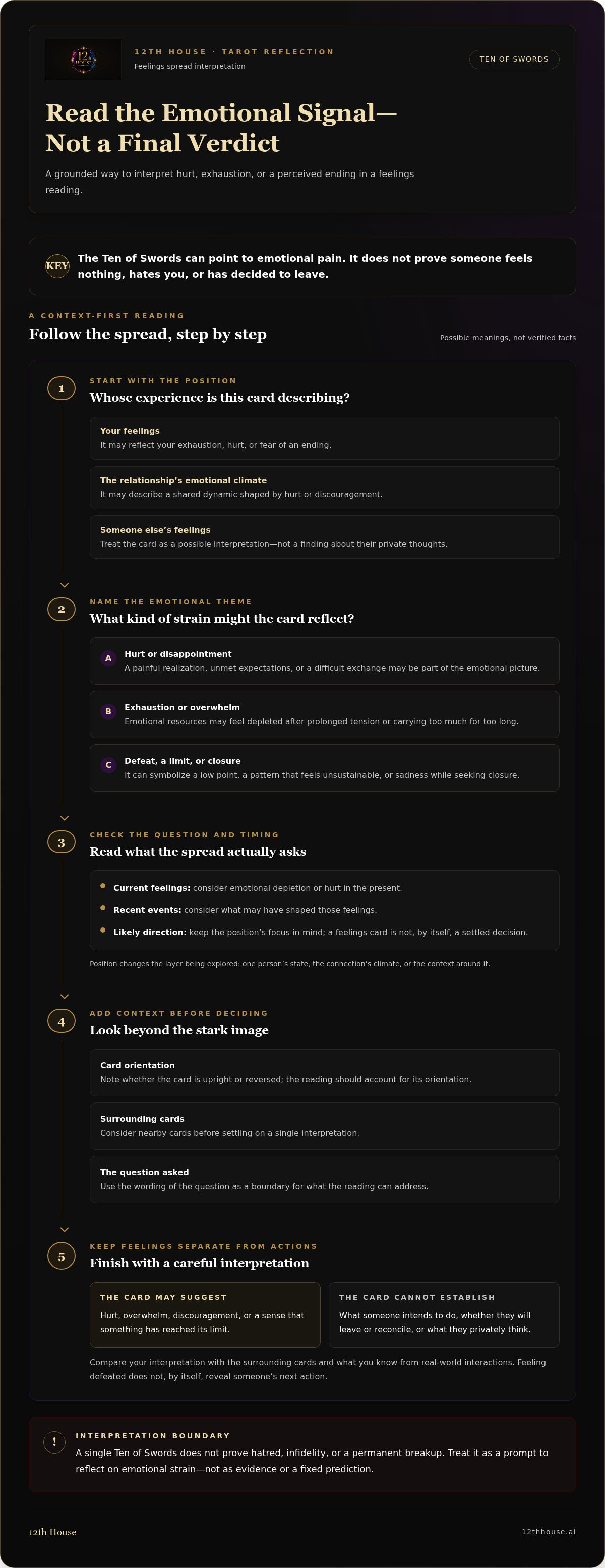
How to Read the Ten of Swords in a Feelings Spread
Use a clear sequence before interpreting the Ten of Swords. This keeps the reading anchored to the question instead of letting a dramatic image become a prediction. The ten of swords as feelings can point to several emotional themes, so let the spread’s structure guide your interpretation.
Read the question, position, and surrounding cards first
- Restate the question. Write it down as you asked it. “What are their current feelings?” is not the same as “Where is this relationship heading?” Keep that distinction visible as you read.
- Identify the card’s position. A position for current feelings may speak to an emotional state. An obstacle position may show what complicates the situation, while an advice position points toward your response, not someone else’s private thoughts.
- Note the orientation. Record whether the card is upright or reversed, using the method you chose for the reading. Apply your interpretive rules consistently rather than changing them because one meaning feels more reassuring.
- Examine the surrounding cards. Consider how the rest of the spread adds context. It may draw attention to conflict, distance, repair, or transition, but neighboring cards don’t guarantee a specific event.
Before analyzing, jot down your first reaction in a few words. Then test it against the position, the original question, and the rest of the spread. If your first thought was “it’s over,” ask what supports that conclusion and what could point to emotional strain without a settled outcome. A feelings reading explores a symbolic emotional snapshot; it isn’t automatically a forecast of future relationship events.
Use reversed orientation as context, not a universal rule
Reversed meanings depend on tarot tradition and the reader’s chosen method. Some readers interpret a reversed Ten of Swords as processing pain or beginning to recover; others see resistance to an ending or use a different approach. Name the framework you’re using, then apply it consistently. Treat the interpretation as a lens for reflection, not a settled fact about another person.
Relationship questions can stir strong expectations. For a broader framework for reflecting on them, read this AI Love Readings guide. You can also use 12th House’s AI spiritual guidance to explore the symbolism and context while keeping your own judgment at the center.
What to Do After Pulling the Ten of Swords as Feelings
Let the card open a question, not make a decision for you. If the Ten of Swords brought up fear, sadness, or urgency, pause before acting on your first reaction. Don’t end a relationship, confront someone, or assume their intentions based on one tarot card alone. Give yourself room to separate the reading’s emotional impact from what you know through experience.
Turn the card’s message into a reflection prompt
Use the symbolism to examine your own position. Ask yourself:
- What feels painful, depleted, or ready to change in this situation?
- What do I know from direct experience, and what am I imagining or fearing?
- What boundary or honest conversation might help me feel clearer?
Write down the question you asked, your interpretation, and any perspective that emerges after sitting with the card. For example, you might first read it as rejection, then notice that the spread could reflect your own exhaustion after a period of uncertainty. Keep both observations in your journal. The aim isn’t to force a reassuring meaning, but to make room for a more considered one.
If the reading raises a relationship concern, use it to clarify what you want to understand. Direct conversation and observable behavior can offer information that a symbolic reading can’t verify. Let tarot support your reflection while your judgment and boundaries guide what you do next.
Continue exploring tarot with structure
For a deeper look at the Ten of Swords, return to the spread’s positions and the interpretive method you chose. 12th House’s tarot readings and metaphysical library offer ways to keep exploring card symbolism and tarot practice. Lala, the platform’s AI spiritual guidance assistant, can help you reflect on spiritual questions. Treat these as tools for exploration, not sources of guaranteed answers.
Explore 12th House’s tarot and spiritual tools for guided reflection on card symbolism and spiritual questions. Use what resonates, question what doesn’t, and make consequential choices from a fuller understanding of your situation rather than a single card.
Read the Card With Clarity and Care
The Ten of Swords can bring painful themes into focus: emotional exhaustion, hurt, or the sense that a familiar pattern has reached its limit. But the ten of swords as feelings isn’t a guaranteed verdict on someone’s private thoughts or the future of a relationship. Read the card through its position, orientation, and surrounding symbols, then distinguish what the spread suggests from what you know through experience.
Let the reading create space for reflection, not pressure for an immediate decision. Notice what the card stirs in you, consider your boundaries, and seek clarity through honest communication where appropriate. Your judgment remains essential.
12th House offers tarot readings, a metaphysical learning library, and Lala, its AI spiritual guidance assistant, to help you explore tarot symbolism and spiritual questions. Use these tools for reflection, not as substitutes for your own discernment. Explore 12th House’s tarot and spiritual tools and take your next step with greater steadiness and self-trust.
Frequently Asked Questions
Does the Ten of Swords mean someone hates me?
No. A tarot card can’t establish that someone hates you. The Ten of Swords may point to hurt, strain, defeat, or a painful realization, but these themes don’t prove another person’s attitude. Read the card within the full spread and in light of observable context, such as what the person has said or done. If the question matters deeply, use the reading to identify your concerns, not to replace direct communication.
Does the Ten of Swords mean a relationship is over?
Not necessarily. The card can symbolize an ending or a situation reaching a painful limit, but one card can’t guarantee a breakup or predict what someone will do. Its meaning depends on the spread position, surrounding cards, and the tarot tradition you’re using. Treat it as an invitation to consider what feels unresolved or depleted. Then weigh that reflection against real-world circumstances before deciding what the relationship means to you.
What does the reversed Ten of Swords mean in a feelings reading?
Reversed meanings vary across tarot traditions. Some readers interpret the card as beginning to process pain, resisting an ending, or slowly recovering; others use a different framework. Identify the approach you follow and read the reversal in the context of the question and spread. Don’t assume that reversed means positive, or that it proves a relationship will recover. The card alone can’t establish what someone feels or how the situation will end.
Can the Ten of Swords represent my feelings instead of theirs?
Yes. Depending on your question and the card’s position, it may reflect your own hurt, exhaustion, fear, or perception of the connection rather than the other person’s inner state. Check what the position was designed to describe. Notice, too, whether the card’s dramatic image is intensifying your reaction. This distinction helps you use tarot for self-reflection without treating your interpretation as proof of someone else’s feelings.
How should I interpret the Ten of Swords with other tarot cards?
Start with the spread position and the exact question, then read neighboring cards as context rather than a fixed formula. Depending on your deck and method, they may add themes of conflict, distance, repair, or change. Don’t let one combination override the full spread or become a certain prediction. Record your interpretation, compare it with what you know from real life, and leave room for more than one symbolic possibility.
Should I pull more cards after getting the Ten of Swords?
You can draw another card if you have a focused question, such as, “What perspective could help me respond thoughtfully?” Repeatedly pulling cards to cancel an upsetting interpretation may create more confusion than clarity. Pause first, note your initial reading, and consider what information you’re seeking. One card can prompt reflection, but it isn’t an instruction to act immediately or a substitute for your judgment.


