

What if moving on doesn’t require one final answer about the past, but a clearer way to meet what comes next? A tarot spread for moving on can help you name what you’re ready to release, notice what still holds your attention, and choose one grounded step forward. But if every reading sends you back to the same questions, the cards can deepen rumination instead of offering perspective.
That uncertainty is understandable. A difficult card isn’t a fixed prediction, and no spread can decide when you’re ready to heal. The value lies in the structure: each position gives you a focused question, so you can reflect without treating the cards as a verdict on your future.
This guide will help you choose a spread that fits your situation, interpret each position with care, and turn the reading into one practical act of closure. You’ll find prompts for release, lingering attachment, self-compassion, and a new direction, along with ways to pause rather than keep pulling cards when a message feels uncomfortable. Use the spread as a map for reflection, not a command.
Key Takeaways
- Choose a tarot spread for moving on that matches your question and emotional capacity, from a simple three-card layout to a deeper reflection.
- Read each card through its position, imagery, traditional symbolism, and personal context rather than treating it as a fixed prediction.
- Shape your reading around your own agency with an open-ended question, then close by identifying one grounded next step.
- Use the spread to explore what you’re releasing, what still holds your attention, and where self-compassion can guide your focus.
- For continued self-guided learning, explore 12th House’s tarot readings and metaphysical library as optional resources for further reflection.
What a tarot spread for moving on can, and cannot, help you explore
A breakup may leave you sorting through longing, anger, and unanswered questions. Grief can bring a different kind of disorientation, while the end of a friendship, role, or long-held plan may unsettle your sense of what comes next. A tarot spread for moving on gives these experiences a structure: each card position focuses reflection on a particular part of the transition.
Think of the spread as a map, not a verdict. It can help you name what you’re releasing, notice what still asks for attention, and consider a choice within your control. Tarot has a long history, from its origins as playing cards to its later use in divination; see this overview of the history of tarot cards. In a reflective reading, the cards offer symbolic material to examine, not proof of what will happen.
When a moving-on spread may be useful
Use a reading when you want to clarify your feelings, needs, boundaries, or available choices. After a breakup, you might reflect on what you need to reclaim for yourself. After a friendship changes, you could consider which boundary would support you now. In grief, you might explore what helps you carry a meaningful connection while attending to your present needs. These are distinct experiences; a spread doesn’t make them interchangeable.
One focused reading can create space to think. Repeatedly drawing cards to get a more reassuring answer can instead keep your attention fixed on uncertainty. If you feel compelled to ask the same question again, pause and record what the first reading brought up. Then ask what you can act on, rather than seeking certainty the cards can’t provide.
What tarot cannot decide for you
Cards can’t establish whether an ex will return, verify another person’s feelings, or determine what someone else will choose. A card’s meaning isn’t a fixed forecast or instruction. Read it through its position, imagery, traditional associations, and your circumstances. For example, a card associated with endings might prompt you to ask what has changed, not declare that reconciliation or permanent separation is certain.
If you’re building confidence in this interpretive approach, Tarot Mastery: A Professional Guide to Spiritual Clarity offers broader foundations for reading tarot with care. In the sections ahead, you’ll find a practical spread, a grounded method for interpreting its positions, and a next-step exercise. None guarantees closure. The aim is to leave with a clearer perspective and one choice that belongs to you.
How to interpret moving-on tarot cards without treating them as predictions
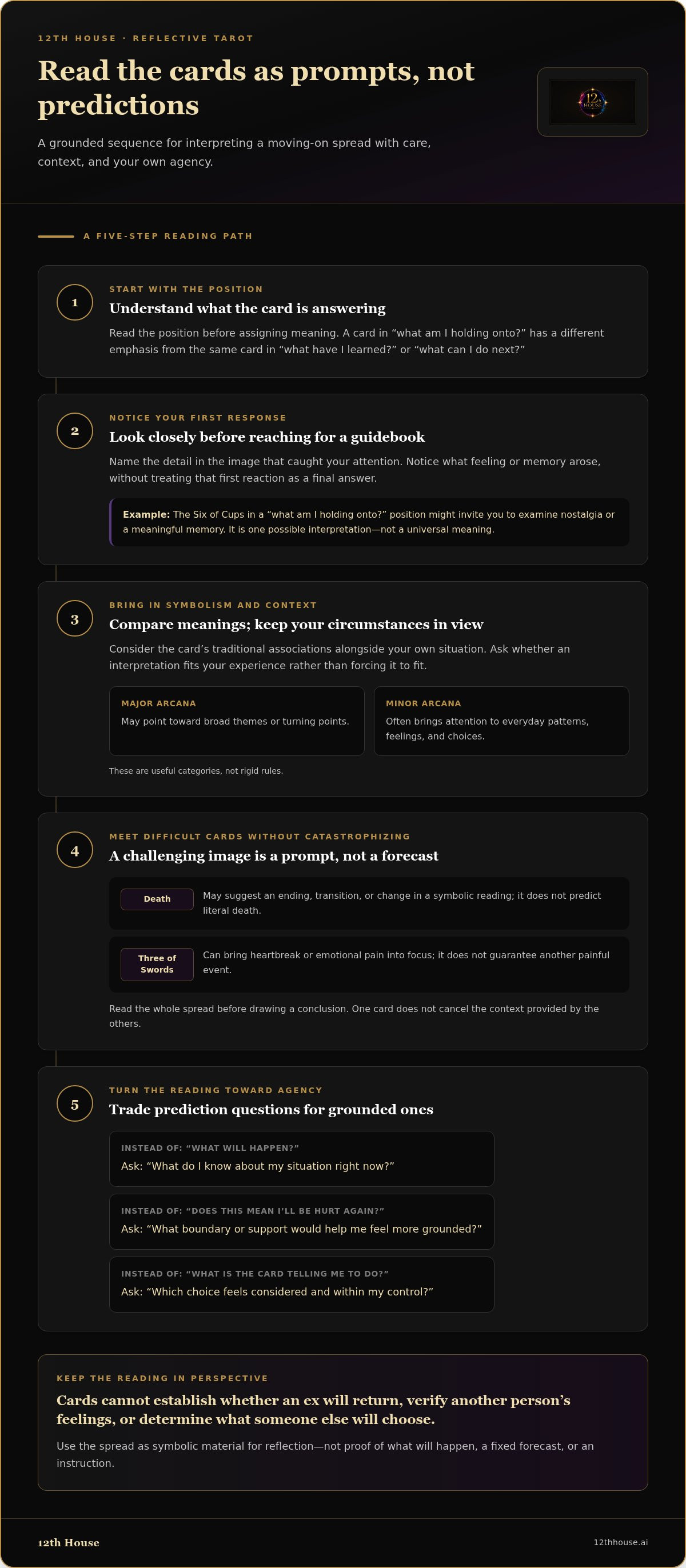
A card’s meaning depends on where it appears and what question it answers. In a tarot spread for moving on, read each position first, then look at the card’s imagery, consider its traditional associations, and bring in your own circumstances. This sequence keeps a striking image from becoming a verdict before you’ve understood its role in the spread.
A reflective tarot reading is symbolic interpretation, not certainty about what will happen. The cards can give you a language for considering your experience, but they can’t verify someone else’s thoughts or settle your future.
Read the position before assigning a card meaning
The same card can carry a different emphasis in a position about what to release, what you’ve learned, or what to do next. Before checking a guidebook, note your first response: What detail in the image caught your attention? What feeling or memory arose? Then compare that response with the card’s traditional meanings and the purpose of the position.
For example, imagine the Six of Cups appears in a “what am I holding onto?” position. You might read it as an invitation to examine nostalgia or a meaningful memory. That’s one possible interpretation, not a universal meaning of the card. Ask whether it fits your experience instead of forcing it to.
Work with difficult cards without catastrophizing
Death may suggest an ending, transition, or change in a symbolic reading; it does not predict literal death. The Three of Swords can bring heartbreak or emotional pain into focus, but it doesn’t guarantee another painful event. A difficult card is a prompt to investigate, not a sentence handed down about your future.
Major Arcana cards can point toward broad themes or turning points, while Minor Arcana cards often bring attention to everyday patterns, feelings, and choices. These are useful categories, not rigid rules. Read the whole spread before drawing a conclusion. One card doesn’t cancel the context provided by the others.
When a card unsettles you, shift your questions from prediction to agency:
- Instead of “What will happen?”, ask “What do I know about my situation right now?”
- Instead of “Does this mean I’ll be hurt again?”, ask “What boundary or support would help me feel more grounded?”
- Instead of “What is the card telling me to do?”, ask “Which choice feels considered and within my control?”
The academic review Tarot and Psychology explores connections between tarot, personal narrative, and therapeutic practice. Treat that as context for reflective use, not evidence that cards diagnose or replace professional care. For continued, self-guided tarot exploration, 12th House offers tarot readings and metaphysical learning resources.
Which moving-on tarot spread fits your question and emotional bandwidth?
Choose a layout you can approach with steadiness, not the one with the most positions. A brief check-in may suit a day when you need one clear focus. A larger spread can help separate several parts of a transition, but it also asks you to hold more symbols in view. More cards don’t mean greater accuracy or a more complete answer.
Research at the University of Victoria explores tarot as a tool for self-reflection during difficult times. That perspective supports a useful principle: let the spread organize your attention, then decide what resonates for you. Use this research on tarot for self-reflection as context, not as a promise of a particular outcome.
A three-card spread for a focused check-in
Try: What am I releasing? What am I learning? What can I do next? This compact layout can make reflection feel contained when you’re tired, overwhelmed, or unsure where to begin. Draw once, write down your first impressions, and give the reading time to settle before considering another pull.
A five-card spread for a more layered transition
Use five positions to distinguish the parts of a change: the present pattern, what is ending, what remains, a boundary I need, and one next step. Adjust the wording to fit your experience. For a friendship shift, “what remains” might explore what you value; for a personal transition, it could point to a skill or commitment you want to carry forward. For adjacent relationship reflection, see AI Love Readings: A Professional Guide to Seeking Clarity.
A larger reflective layout can add positions for support, a lesson, or a source of resistance. Consider it only if you have the attention and calm to interpret the whole pattern, rather than isolating each card as a separate answer.
| Layout | Positions | Suitable use | Caution |
|---|---|---|---|
| Three cards | Release, learning, next step | A contained check-in or one focused question | Don’t keep drawing to chase reassurance. |
| Five cards | Present pattern, ending, what remains, boundary, next step | Exploring several connected parts of a transition | Keep each position distinct to avoid tangled interpretations. |
| Larger layout | Core spread plus support, resistance, or lesson | A slower, more detailed reflection | Extra cards can create noise if you’re already overwhelmed. |
The best tarot spread for moving on is the one you can read calmly and clearly. If a layout leaves you more scattered than grounded, simplify it. Start with fewer positions and let one useful insight be enough for now.
How to do a tarot spread for moving on, step by step
Set aside a quiet, private space where you can focus without needing an immediate answer. Choose a question about your own needs or choices, such as: What can help me move forward with care and self-respect? This keeps the reading centered on your agency rather than someone else’s feelings or decisions.
Set an intention, lay out five positions, draw and record one card for each, interpret the cards in context, then close by choosing one practical action.
- Settle and set your intention. Take a moment to notice how you’re feeling. You don’t need to feel calm or certain; simply name what you hope to understand.
- Arrange five card positions. Use these prompts: What pattern am I experiencing now? What am I ready to let end? What remains valuable or meaningful? What boundary would support me? What is one next step within my control?
- Draw one card for each position. Place the cards in order. Write down each card’s name and your first reaction before consulting a reference. Note the image, feeling, or memory that stood out.
- Interpret the layout as a whole. Start with each position’s prompt, then consider the card’s imagery and traditional associations alongside your own context. Look for connections across the spread, but don’t force every card into a single explanation.
- Close with a grounded choice. Write one insight, one boundary, and one action you can take. Keep the action specific and within your control, such as setting aside time for rest or deciding what communication feels appropriate for you.
Let the first reading be enough for now. If uncertainty tempts you to pull again for reassurance, pause and return to your notes later instead. A little distance can help you see which reflections remain useful without turning the spread into a search for certainty.
For further study in tarot interpretation, Tarot Mastery: A Professional Guide to Spiritual Clarity offers broader foundations for reading tarot with care. 12th House also provides tarot readings and learning resources for structured personal exploration: 12th House tarot readings and learning resources.
Continue your moving-on practice with structured tarot exploration
A reading can offer a useful pause, but moving forward doesn’t depend on pulling more cards. Continued study is an option, not a requirement. Let your tarot spread for moving on support reflection while you make choices, seek support, and attend to your life beyond the reading.
Build a reflective practice that does not depend on repeated readings
Keep a simple record of the spread, including the date, your question, each card’s position, and your interpretation in your own words. Note what felt clear and what remained uncertain. This creates a reference point without turning every difficult feeling into a reason to draw again.
After time has passed, revisit your notes. Ask what you see differently now, which insight still feels relevant, and whether the next step you chose supported you. A change in perspective doesn’t mean your earlier reading was wrong. It may show how your understanding has developed.
Keep the cards in proportion. Your decisions, boundaries, relationships, and sources of support remain central to your process. Tarot can accompany reflection, but it doesn’t replace practical action or the care you may need from people you trust.
Explore tarot and metaphysical learning with 12th House
If you’d like to continue exploring at your own pace, 12th House is a membership platform offering tarot readings and access to a metaphysical library. These resources support ongoing tarot exploration and self-guided learning. Lala is an AI spiritual guidance assistant.
12th House brings tarot readings and metaphysical learning resources together in one membership: Explore 12th House.
Take One Clear Step Forward
A tarot spread for moving on works best as a structure for reflection, not a verdict about what comes next. Choose a layout that fits your emotional bandwidth, read each card through its position and personal context, and let difficult symbols open questions rather than dictate outcomes.
When you finish, carry one insight into daily life. Name a boundary or action within your control, then give yourself space to see how your perspective develops. You don’t need another reading to prove that you’re ready to move forward.
12th House offers tarot readings and membership access to a metaphysical library, with Lala as an AI spiritual guidance assistant. Explore tarot and metaphysical learning with 12th House at your own pace.
Let the cards support your reflection while your choices shape the path ahead. One steady step is enough to begin.
Frequently Asked Questions
What is the best tarot spread for moving on after a breakup?
A five-card spread can help you examine a breakup from several angles without making the reading unwieldy. Try positions for the pattern you’re experiencing, what’s ending, what remains meaningful, a boundary you need, and one next step within your control. If you feel overwhelmed, use three cards instead: what you’re releasing, what you’re learning, and what you can do next. Choose the layout you can interpret calmly.
Can tarot help you move on from someone?
Tarot can support reflection, but it can’t make you move on or guarantee emotional closure. A reading may help you name what you miss, identify a need that’s going unmet, or consider a boundary that would support you. Treat the cards as prompts, then connect any insight to your choices and real-life support. The work of moving forward remains yours, and it may unfold at its own pace.
How many cards should I pull for a moving-on tarot reading?
Start with three cards for a focused check-in, or choose five if you want to explore several parts of the transition. A larger spread may add detail, but more cards don’t make a reading more accurate or certain. Pick a number of positions you can hold in mind without becoming overwhelmed. Draw once, record your first reactions, and give yourself time to reflect before considering another reading.
What tarot card means it is time to move on?
No single tarot card proves that it’s time to move on. Death may invite reflection on change or an ending, while the Eight of Cups can prompt questions about leaving something behind. Their meaning depends on the card’s position, imagery, and your circumstances. Rather than treating a card as an instruction, ask what it brings into focus and which choice feels grounded, safe, and genuinely yours.
Can a tarot spread tell me if my ex will come back?
No. A tarot spread can’t establish whether your ex will return, what they feel, or what they’ll choose. Questions about another person’s future actions can keep you focused on what you can’t control. Shift the reading toward your own needs: “What would help me feel grounded while this remains uncertain?” or “What boundary supports my well-being now?” Use the answer to reflect, not to predict reconciliation or rule it out.
How often should I do a tarot reading about moving on?
There’s no required schedule. Consider another reading when your circumstances or perspective have meaningfully changed, rather than repeating the same question to seek reassurance. If you feel more anxious after pulling cards, pause and return to your notes instead. Recording the date, question, cards, and interpretation can help you notice how your understanding shifts over time without relying on repeated readings for certainty.
What should I ask tarot when I am trying to let go?
Ask an open-ended question that centers your own choices, such as, “What can help me release what I’m ready to leave behind?” You might also ask, “What need deserves my attention now?” or “What is one practical step I can take toward a new direction?” Avoid questions that ask the cards to verify another person’s feelings. Write down what stands out, then identify one action within your control.


