

What if a difficult tarot card isn’t a warning, but a prompt to pause and look more closely? A tarot spread for healing can offer structure when emotions feel tangled, without delivering a verdict or promising repair. You may want clarity and still worry that a challenging image means something bad is coming. It doesn’t have to.
Use the cards as symbols to consider, not instructions to obey. A thoughtful spread can help you name what you’re feeling, notice what needs care, and explore what might support you now. You stay in charge of the meaning and the pace.
This guide will help you choose or create a simple spread for present-tense reflection, interpret difficult cards with curiosity and clear boundaries, and finish with one grounded next step. You’ll also find a calm way to prepare for a reading, so the practice feels supportive rather than overwhelming. Think of the spread as a reflective map: a way to orient yourself, not a prediction of where healing must lead.
Key Takeaways
- Use a tarot spread for healing as a framework for reflection, not a prediction or promise of repair.
- Prepare with a clear focus and personal boundary, then ask an open-ended question about your present experience.
- Choose a one-, three-, or five-card layout based on the depth you can comfortably hold.
- Read each card through its position first, then consider how the cards work together in the spread.
- Close with one insight, one open question, and one small action. Revisit your notes instead of drawing cards repeatedly for certainty.
What Does a Tarot Spread for Healing Offer, and What Can It Not Do?
During grief, a major transition, or a season of self-doubt, wanting clarity makes sense. A tarot spread gives that search a shape: each card has a position, and each position invites you to consider one part of your experience. The cards don’t need to provide a final answer for the reflection to be useful.
A healing tarot spread is a structured prompt for exploring feelings, needs, and possible next steps. It can offer perspective, but it can’t promise repair, diagnose a condition, or establish what will happen. Tarot’s uses have changed over time, as the history of tarot illustrates. In a reflective reading, treat the imagery as symbolic material to interpret, not as evidence or instruction.
When might a reflective tarot spread feel useful?
Use a spread to name an emotion you’ve struggled to describe, notice a recurring pattern, or approach a tender question from another angle. You might reflect on what grief is bringing forward, what a transition is asking you to reconsider, or what could help you rebuild trust in your judgment. A card can open a question; it doesn’t have to settle it.
This practice is personal. You decide whether tarot fits your beliefs, your needs, and the moment you’re in. If drawing cards feels distracting or uncomfortable, set them aside and use another form of reflection.
How can you keep tarot within supportive boundaries?
Set a clear limit: the reading is for reflection, not diagnosis, treatment, or certainty about the future. Don’t treat a card as a label for your mental or physical health, a fixed outcome, or a command to make a major decision. If an image feels difficult, ask what associations it brings up for you. You can disagree with any interpretation.
Pay attention to your response as you read. If the process increases your distress, makes you feel unsafe, or leaves you more overwhelmed, stop. Put the cards away, take a grounding pause, and decide whether to return another time. You don’t need to finish a spread.
Tarot reflection is distinct from professional mental health support. It may help you organize your thoughts, but it isn’t a substitute for care from a qualified mental health professional. Keep the roles clear: the cards offer symbols to consider, while decisions about your wellbeing deserve support suited to your needs.
Prepare for a Healing Tarot Reading Without Forcing an Answer
A few deliberate choices can keep a reading focused without making it rigid. Before drawing, decide what you’re reflecting on and what you don’t want the cards to decide for you. This gives your tarot spread for healing a clear frame while leaving room for your interpretation.
What question should you bring to a healing tarot spread?
Choose a question rooted in your present experience and within your agency. Try, “What deserves my attention right now?” It invites observation rather than a verdict. A focused question also makes a reading easier to interpret: consider each card in relation to one defined concern instead of a tangle of unrelated worries.
Reframe questions that demand certainty or turn pain into blame. Instead of “Will I feel better soon?” ask, “What might support me as I move through this?” Replace “Why do I always ruin things?” with “What pattern am I noticing, and what choice is available to me now?” Don’t ask cards to diagnose a condition or determine another person’s private thoughts. Bring the inquiry back to what you can notice, choose, or care for.
How do you set an emotional boundary before drawing cards?
Set a limit before the reading begins. Decide which spread you’ll use, how many cards you’ll draw, and what will signal that it’s time to stop. Keep a journal nearby to note first impressions and questions without rushing to settle on a single meaning. You can pause, close the reading, or return another day.
Use this short sequence to prepare:
- Pause. Notice how you feel before beginning. If you’re already overwhelmed, waiting is a valid choice.
- Name a focus. Write down one present-tense concern, such as adjusting to a change or rebuilding self-trust.
- Set a boundary. Choose your spread and card limit. Remind yourself that the reading won’t make decisions for you.
- Shuffle. Keep your question in mind as you shuffle. When you’re ready, draw only the cards your chosen layout calls for.
There’s no need to keep drawing until the cards seem to agree. If you want another framework for exploring a personal spiritual question, you can explore spiritual guidance and learning through 12th House.
Choose a Healing Tarot Spread That Matches Your Reflection
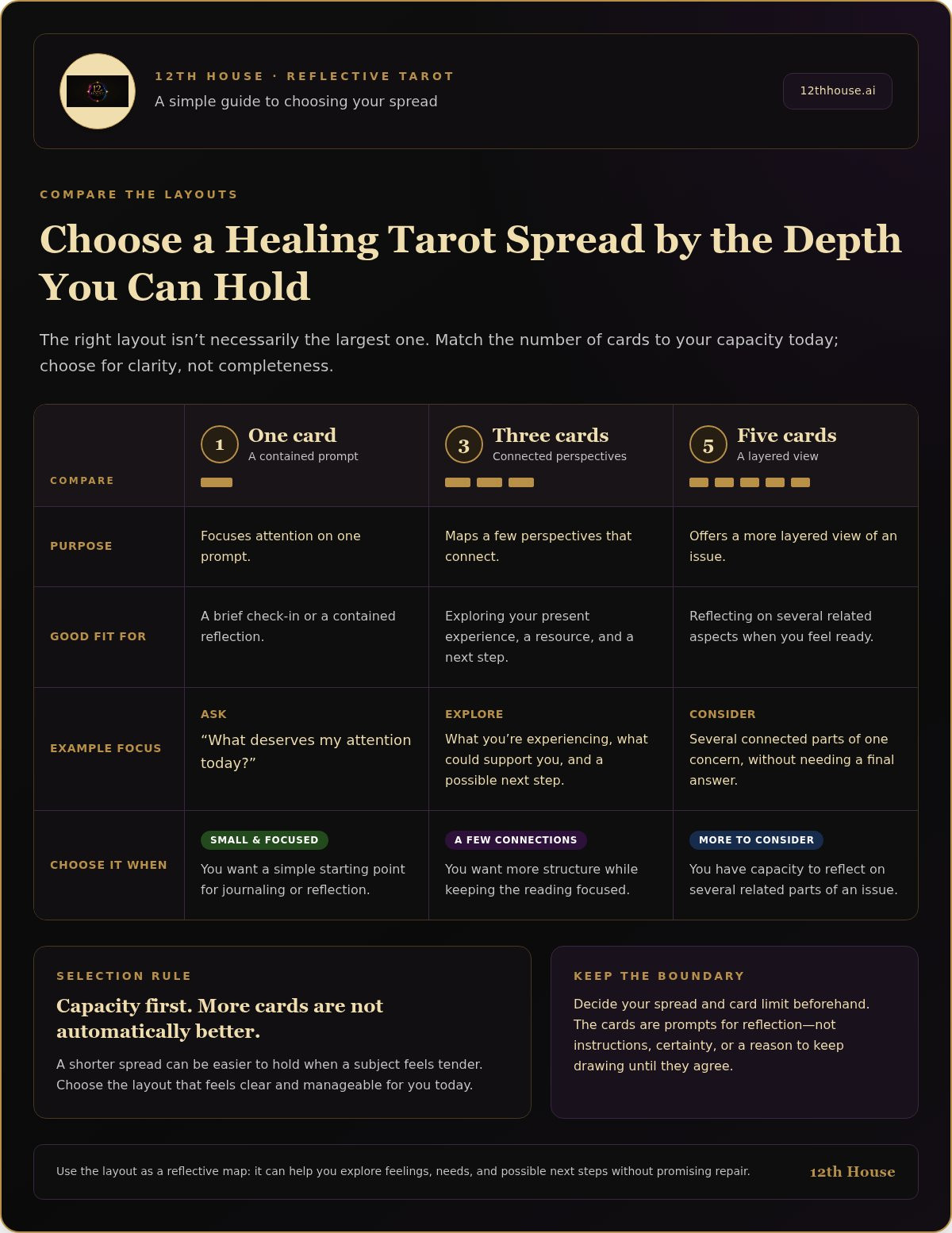
The right layout isn’t necessarily the largest one. Match the number of cards to the depth you have capacity for today. A shorter tarot spread for healing can be easier to hold when a subject feels tender, while a longer layout gives you more positions to consider. Choose for clarity, not completeness.
| Layout | Purpose | Suggested use |
|---|---|---|
| One card | Focuses attention on one prompt | A brief check-in or contained reflection |
| Three cards | Maps a few connected perspectives | Exploring your present experience, a resource, and a next step |
| Five cards | Offers a more layered view | When you feel ready to reflect on several related aspects of an issue |
Is a one-card or three-card healing spread better for beginners?
Start with one card if you want a small, contained prompt. Ask, “What deserves my attention today?” and use the image as a starting point for journaling. A three-card layout adds structure without becoming too complex: draw one card for your present experience, one for a supportive resource, and one for a possible next step.
These positions are prompts, not authoritative verdicts. A card in the “resource” position doesn’t prove what you must do. It offers a theme to explore, adapt, or set aside.
When might a five-card healing spread be useful?
Choose five cards when you want to examine an issue from several angles and feel steady enough to stay with the reflection. More positions can reveal connections, but they also ask for more attention. Don’t add cards just to seek a more reassuring answer. If you’re unsure, begin with one or three, then stop when you have enough to reflect on.
You can also choose a symbolic focus. The Star is often associated with hope, but it isn’t a required card or a guarantee of recovery. You might use it as a reflection prompt if its imagery resonates, or choose a different card that feels meaningful to you. For broader foundations in interpreting cards and spreads, explore the tarot resources in 12th House’s metaphysical library.
How to Read a Healing Tarot Spread, Card by Card
Read the position before deciding what a card means. In this five-card tarot spread for healing, each position offers a separate lens: present experience, a need, a resource, a boundary, and a small next step. The sequence moves from observation toward practical reflection without treating the cards as objective facts.
What positions can a five-card healing spread include?
- Card one, what’s asking for attention? Notice a feeling, tension, or question that stands out in your present experience.
- Card two, what need deserves acknowledgment? Consider what may need more care, space, rest, or honest attention.
- Card three, what resource could you draw on? Reflect on a strength, supportive practice, or person you choose to rely on.
- Card four, what boundary might help? Explore a limit that could protect your energy or clarify what you can take on.
- Card five, what’s one manageable next step? Look for a small action you can choose, rather than a sweeping solution.
How can you interpret difficult or reversed cards gently?
Start with the card’s position, then consider its imagery and your own associations. A challenging image in the resource position, for example, might prompt you to ask what feels difficult about receiving support. It doesn’t prove you lack support or predict what will happen. Write down more than one possible reading, then notice which interpretation fits your actual circumstances.
Reversals are optional. You can read every card upright, or include reversed meanings if that’s part of your practice and feels useful. There’s no need to treat a reversed card as negative or force a special meaning from it. If an interpretation feels frightening or overly certain, step back and return to the position’s open-ended prompt.
For example, imagine a card with imagery of restriction appears in the first position. Describe what you see, then ask, “Where do I feel constrained right now?” In the boundary position, the same card could lead to a different question: “What limit would make this situation feel more manageable?” Neither response is a fact revealed by the deck. They’re possibilities to compare with your experience. Then look across the spread: does the need connect with the resource, and does the next step respect the boundary? Leave any connection that doesn’t fit.
Record the questions and meanings that feel useful, not just the card names. For another perspective on a personal spiritual question, explore personalized spiritual guidance with Lala.
Integrate Your Healing Tarot Reading Into a Grounded Next Step
A reading becomes useful through what you notice and choose afterward, not through how many cards you draw. Close your tarot spread for healing by turning its symbols into a reflection you can carry into ordinary life. The cards can suggest questions; you retain agency over your decisions.
What should you do after a healing tarot reading?
Before putting the deck away, record three things: one insight, one open question, and one small action. Note the card positions and your first impressions, then keep only interpretations that feel grounded in your experience. Let uncertainty remain where it belongs. You don’t need to force every card into a complete explanation.
- Insight: What did the reading help you notice?
- Open question: What are you still considering without needing to resolve it now?
- Small action: What’s one voluntary step within your control?
Make the action specific and manageable. If your reflection points to needing more rest, you might protect a quiet moment in your day. If it highlights a boundary, consider one simple way to communicate or uphold it. The step should support your choices, not act as an order from the cards.
Then mark the reading as complete. Take a breath, close your journal, or use another brief ritual that feels meaningful to you. Revisit your notes later with fresh perspective instead of drawing more cards right away. Repeated pulls can blur the original question and turn reflection into a search for certainty.
When should you pause tarot and seek additional support?
Pause if reading cards increases fear or urgency, or if you find yourself drawing repeatedly for reassurance. Set the deck aside and do something grounding. If you have concerns about your mental health, tarot reflection is distinct from professional care and isn’t a substitute for support from a qualified mental health professional.
Tarot can be part of a self-guided spiritual learning practice. 12th House offers tarot readings as another way to engage with symbolic reflection. Keep the same boundary: use the reading to consider your perspective, not to surrender your judgment or outsource a decision.
Carry One Clear Insight Into Your Next Step
A tarot spread for healing works best as a reflective framework, not a verdict. Choose a layout that feels manageable, read each card through its position, and let your own associations guide the interpretation. Before closing the reading, capture one insight, one question to leave open, and one small action you can choose for yourself.
You don’t need to solve everything in a single session. Give your notes time to settle, and pause if drawing cards starts to create pressure or fear. Reflection can support your perspective, while decisions and care remain yours.
If you’d like to continue exploring, 12th House offers tarot readings within its digital spiritual guidance platform. You can also use Lala, an AI assistant for personalized spiritual guidance questions. Explore tarot readings and spiritual guidance with 12th House.
Let curiosity set the pace. One grounded next step is enough for now.
Frequently Asked Questions
Is a tarot spread for healing a form of therapy?
No. A tarot spread for healing can support personal reflection, but it isn’t therapy, diagnosis, or treatment. Treat the cards as symbolic prompts, not clinical guidance. For example, a card might help you explore what support you need, but it can’t assess a mental health condition. If you’re experiencing significant distress or have a mental health concern, consider support from a qualified professional. Tarot may sit alongside other care if it feels appropriate.
Can tarot help with grief or emotional pain?
Tarot may give you a structured way to reflect on feelings, needs, and possible sources of support during a difficult period. It can’t remove grief, guarantee recovery, or reveal one correct path forward. Keep your question focused on your present experience, such as, “What would help me feel supported today?” If reading increases distress or feels overwhelming, stop. Reach out to trusted or professional support when reflection alone isn’t enough.
What is the best tarot spread for healing beginners?
A one-card or three-card layout is often a manageable place to start. For three cards, try prompts for what needs attention, a resource you can draw on, and a gentle next step. Read each position as a question to consider, not a verdict about what you must do. If the topic feels emotionally intense, choose one card or pause the reading; a smaller spread can be easier to hold.
How many cards should I pull for a healing tarot reading?
There’s no required number. One card can focus a brief reflection, while three can add structure by separating your experience, a possible resource, and a next step. A larger spread may create more interpretations without bringing greater clarity. Decide your card limit before you begin, and resist drawing extra cards just because an answer feels uncomfortable. You can leave a question open and return to it later.
What does The Star mean in a healing tarot spread?
The Star is commonly associated with hope and renewal, but its meaning depends on the deck, its position, and your own context. In a healing tarot spread, you might use its imagery to consider what restores hope or helps you imagine a way forward. Treat that meaning as a symbolic prompt, not proof that recovery is guaranteed or that a particular outcome will happen.
Can I create my own tarot spread for healing?
Yes. Begin with one focused, open-ended question, then give each card a clear role. You might use positions for your present experience, a need to acknowledge, a resource to consider, and a small next step. Keep the layout manageable and centered on choices within your control. Avoid asking cards to diagnose a condition, predict a fixed future, or determine another person’s private thoughts.


