

What if a difficult tarot card isn’t a verdict on your worth, but a prompt to look more closely at what you need? If you’re unsure how to arrange the cards or worried about reading a challenging symbol as a bad omen, you’re not alone. A tarot spread for self-love can give you a structure for reflection without turning the reading into another reason to criticize yourself.
This six-card layout gives each position a clear purpose, from noticing how you treat yourself to choosing where more care may help. You’ll learn how to place the cards, interpret each one with curiosity rather than judgment, and connect the symbols to your real-life experience. No single card defines you. Its meaning takes shape through its position, the surrounding cards, and the questions you bring to the reading.
Use the spread as a grounded mirror, not a prediction or a test you can pass or fail. The steps below take you through each position, show you how to approach challenging cards, and help you choose one practical action to carry into daily life.
Key Takeaways
- Use a tarot spread for self-love as a reflection tool, not a verdict on your worth or a prediction of what must happen.
- Give each of the six cards a clear position, from your current relationship with yourself to one supportive action you can take.
- Interpret challenging cards through their imagery, position, and relevance to your lived experience before drawing conclusions.
- Make the reading manageable: record your question, note your impressions, and choose one kind, specific next step.
- Return to the spread when it feels useful, and deepen your understanding by studying how tarot symbols and positions work together.
What a Tarot Spread for Self-Love Can, and Cannot, Tell You
A tarot spread for self-love is a structured prompt for examining how you relate to yourself. Each position gives a card a specific role, helping you consider needs, boundaries, strengths, and recurring patterns. The spread isn’t a score of your worth. It’s a framework for asking clearer questions.
Reflective tarot uses symbols to open inquiry; fortune-telling treats cards as fixed answers about what will happen. A reading can help you notice what deserves attention, but it can’t diagnose a mental-health condition or guarantee a particular outcome. Let the cards inform your reflection, not replace your judgment or professional support when you need it.
How does tarot support self-reflection?
Cards work as symbolic prompts. Their meaning depends on the spread position, the surrounding context, and your own considered response. For a neutral overview of the practice and its interpretive process, see Tarot card reading.
Imagine a card showing a figure standing at a crossroads. Rather than deciding it predicts a crisis, ask: “Where do I feel pulled in different directions, and what would help me choose with care?” The image gives you a point of entry. Your lived experience helps you decide whether the question is relevant.
Stay curious. If one interpretation feels forced, set it aside and consider another. A card doesn’t have one compulsory message, and noticing your own response is part of the reading.
What self-love means in this reading
Here, self-love means treating your needs as worthy of attention. It can look like rest, honest self-respect, a boundary, or asking for support. It doesn’t require constant confidence, relentless positivity, or freedom from painful feelings. Care can begin while things are still difficult.
If you want more context for reading cards and building a sound interpretive foundation, explore the Tarot Mastery guide. Keep one distinction in mind: the cards can help you name what you’re noticing, but you decide what to do with that insight.
A Six-Card Tarot Spread for Self-Love, Position by Position
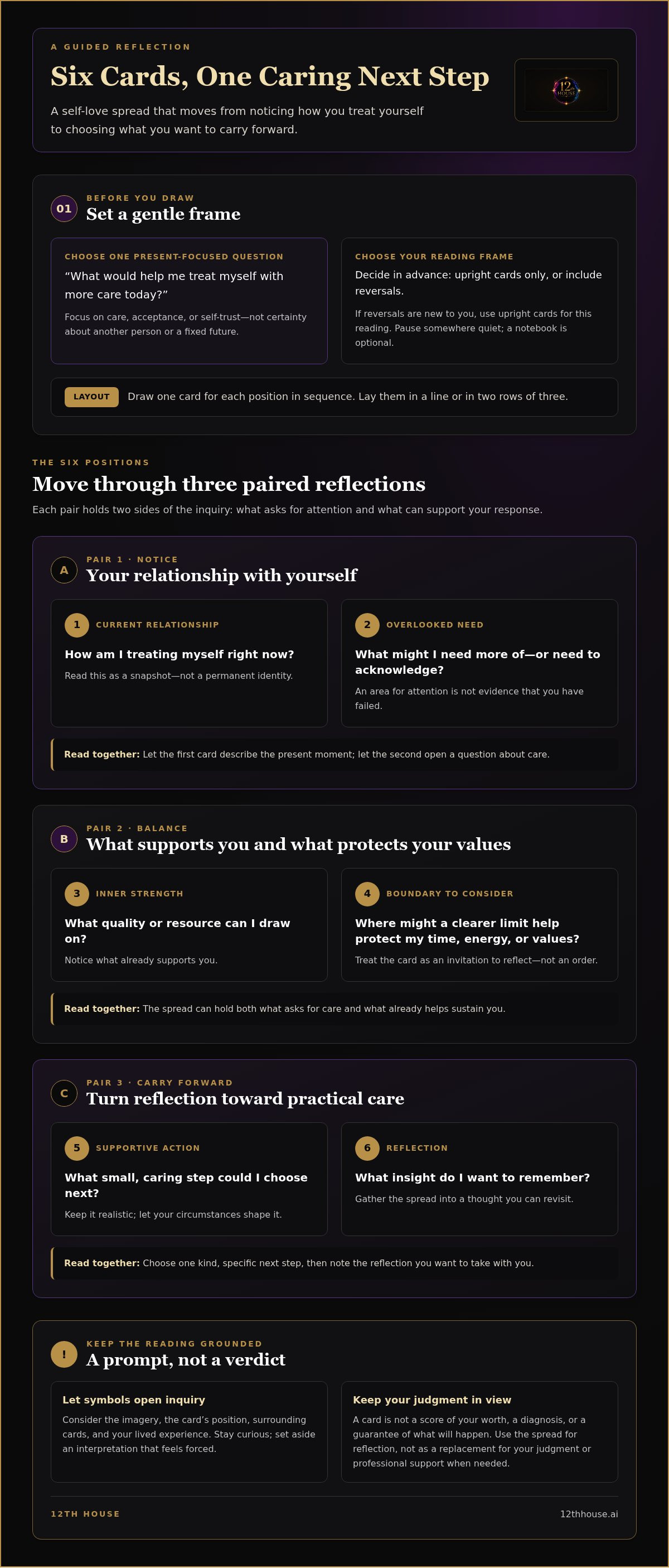
This tarot spread for self-love maps six aspects of your relationship with yourself, moving from awareness toward a considered next step. Before drawing, decide whether you’ll read cards upright only or include reversals. If reversals are new to you, use upright cards for this reading and add reversals later if you wish. There’s no single required method, but choosing in advance gives your interpretation a consistent frame.
How to set an intention before drawing
Choose one present-focused question about care, acceptance, or self-trust, such as, “What would help me treat myself with more care today?” Avoid questions that demand certainty about another person or a fixed future. Pause somewhere quiet, take a breath, and keep a notebook nearby if useful. You don’t need special tools. A clear question is enough to orient the reading.
What each of the six card positions asks
The positions are: your current relationship with yourself, an overlooked need, an inner strength, a boundary to consider, a supportive action, and a reflection to carry forward. Lay the cards in a line or in two rows of three, drawing one card for each position in sequence. The layout is a guide, not a command structure.
- Current relationship with yourself: What does this card suggest about how I’m treating myself right now? Read it as a snapshot, not a permanent identity.
- Overlooked need: What might I need more of, or need to acknowledge? This position can point to an area for attention without implying that you’ve failed.
- Inner strength: What quality or resource can I draw on? Read this alongside the need card: the spread holds both what asks for care and what already supports you.
- Boundary to consider: Where might a clearer limit help me protect my time, energy, or values? Treat the card as an invitation to reflect, not an order to make a particular choice.
- Supportive action: What small, caring step could I choose next? Keep the action realistic and let your circumstances shape it.
- Reflection: What insight do I want to remember after this reading? This card helps you gather the spread into a thought you can revisit.
Notice what each image brings up before reaching for a memorized meaning. The need and strength positions work as counterweights, while the final three help you turn reflection toward practical care. You can also explore 12th House tarot readings as another way to engage with tarot symbolism.
How to Interpret Difficult Cards Without Turning Against Yourself
A card with tense imagery can stir fear or self-doubt, especially in a reading about self-love. But a challenging card doesn’t prove you’re failing at self-care or destined for harm. It offers material to consider, not an objective verdict on who you are. In a tarot spread for self-love, interpretation should open a question, not close the case against you.
A challenging card can prompt inquiry without defining the person who draws it. Keep that distinction in view as you read. Tarot symbolism can support reflection, but it isn’t a mental-health diagnosis, proof of a hidden truth, or a guarantee of what will happen.
Can a challenging tarot card still support self-love?
Yes. Tension, change, or discomfort in a card’s imagery can invite you to ask what feels unsettled and what kind of care might help. It doesn’t have to signal disaster. Consider more than one interpretation before settling on one that fits your situation. A symbol’s meaning depends on the position it occupies and the context of your question, not on a single fixed emotional outcome.
Use a three-part interpretation check
Before deciding what a difficult card means, slow down and examine three points:
- Card image: What do you notice first? Describe the figures, actions, and atmosphere without labeling them good or bad.
- Spread position: What question is this card answering? A tense image in a position about boundaries may raise a different inquiry than the same image in a position about inner strengths.
- Real-life context: What current experience, need, or choice might connect with the image? Look for a plausible connection, not proof that the card has revealed an unavoidable outcome.
For example, if a card feels intense in the “overlooked need” position, ask what need comes to mind and whether it reflects something happening in your life. Don’t jump from discomfort to a sweeping judgment about yourself. If there’s no clear connection, leave the meaning open.
How to avoid confirmation bias in a reading
Write down your first impression separately from your later interpretation. Then compare both with what you know about your present circumstances and needs. Are you noticing a real pattern, or fitting the card to a fear you already had? Use what you know from your life to test an interpretation rather than treating the card as confirmation.
You can pause, take a break, or set a card aside if the reading feels overwhelming. You don’t have to force certainty or keep interpreting until you feel worse. The purpose is reflection with care. Return only if and when you feel ready.
Turn Your Self-Love Tarot Reading into a Grounded Practice
A reading becomes useful when you connect its symbols to a considered choice. Keep the process simple: record your question, lay out the cards, note your first impressions, interpret each position, then choose one action. The cards can frame your reflection; you decide what fits your life and what to do next.
Keep the action specific, kind, and manageable. If a card brings your need for rest into focus, you might protect one quiet break in your day. If it raises a question about boundaries, you could draft a sentence you’d like to use in a future conversation. These are options, not instructions. Choose a step that feels supportive and realistic for you.
A simple tarot journaling method
Use a notebook, notes app, or any format you’ll return to. For each tarot spread for self-love, make an entry with these fields:
- Date and intention: When are you reading, and what present-focused question are you exploring?
- Card positions and names: Record each card beside the position it occupies.
- Observation: Describe what the card depicts, such as a figure, gesture, or setting, before assigning meaning.
- Possible interpretation: Note what you think the image might suggest in that position, and what feelings or questions it brings up.
- Next step: Write one small action you choose, or note that you need more time to reflect.
Keep observation separate from interpretation. “A figure is holding a lantern” describes the image; “I may need more clarity before acting” is your possible reading of it. Both notes matter, but they aren’t the same kind of information. Review old entries later to notice how your perspective has shifted, not to search for proof that the cards were right.
When to revisit the spread
Return when a new reflection question emerges, rather than drawing again simply to seek reassurance or certainty. Give yourself time to consider or act on the previous insight first. When you revisit the cards, choose a fresh question rooted in what’s happening now.
A self-reflection spread is different from a question focused on another person or the direction of a relationship. For more on that distinction, read the AI Love Readings guide. For another way to explore symbolic questions, explore tarot readings through 12th House.
Continue Exploring Self-Love Through Tarot and Guided Reflection
The six-card spread is yours to return to when reflection would be useful, not a ritual you must repeat to reach certainty. Let each reading respond to your present circumstances. A question about self-trust may matter now; a later reading might focus on rest, boundaries, or how you recognize your own strengths.
How to keep a self-love reading useful over time
If a theme appears across readings, record it as an observation, not a fixed label about your personality. For example, you might note that boundaries have come up more than once, then ask what has changed in your life or what support would help. Revisit your questions as your needs shift. The cards can prompt reflection, but your choices remain yours.
Additional tarot study can deepen your familiarity with card symbolism, spread positions, and the context that shapes interpretation. Over time, you may become more precise about separating what a card depicts from what you think it suggests, and more comfortable holding several possible meanings without forcing one answer. That knowledge can enrich independent readings, including this tarot spread for self-love.
When guided tarot exploration may help
A structured prompt can be useful as you explore a symbol or question at your own pace. 12th House offers tarot readings, a metaphysical library, and Lala, its AI spiritual-guidance assistant, as digital tools for continued exploration. Use any interpretation as material to consider, not as a substitute for your judgment, professional care, or meaningful human connection.
Keep the focus on the question you’re actually asking. A self-love reading turns inward toward your needs and relationship with yourself; a question about another person or a relationship calls for a different frame. Clarifying that distinction can help you choose a more useful prompt and avoid asking the cards to provide certainty they can’t guarantee.
You now have a complete method: set an intention, lay out six cards, interpret each position in context, and choose a grounded next step. You can practice on your own, return when a new question arises, or deepen your symbolic study as you go. To continue exploring, visit 12th House.
Carry Your Reflection into Daily Life
A tarot spread for self-love is most useful as a thoughtful structure, not a verdict on your worth. Its six positions help you notice your current relationship with yourself, recognize needs and strengths, and consider a boundary or supportive next step. If a card feels difficult, read its image alongside its position and your real-life context before drawing conclusions.
Keep the practice grounded. Record what you noticed, choose one kind and manageable action, and return to the spread when a new question genuinely arises. The cards can prompt reflection, but your choices remain your own.
If you’d like to continue exploring symbolic questions, 12th House offers tarot readings, Lala as an AI spiritual-guidance assistant, and members’ access to a metaphysical learning library. Explore 12th House and continue your tarot reflection.
Take what resonates, leave room for uncertainty, and let self-care begin with one considered choice.
Frequently Asked Questions
What is a tarot spread for self-love?
A tarot spread for self-love is a planned arrangement of cards, with each position focused on an aspect of self-understanding or care. It can prompt reflection on needs, strengths, boundaries, and supportive actions. The cards don’t measure your worth or guarantee an outcome. Notice the imagery, consider each card’s position, and relate possible meanings to your circumstances and judgment.
How many cards should I use for a self-love tarot reading?
There’s no required number of cards. A one-card draw can focus your attention on a single question, while a six-card spread can explore several related themes in more detail. Choose a layout you can interpret without feeling overwhelmed, especially for your first reading. Clear positions and thoughtful reflection matter more than drawing a large number of cards.
Can beginners do a tarot spread for self-love?
Yes, beginners can start by looking at each card’s imagery, considering its assigned position, and recording their first impressions. You don’t need to memorize every traditional meaning before you begin. Keep your question specific and compassionate, and allow more than one interpretation. A tarot guide or reference can help you learn, while your own discernment remains central to the reading.
What should I ask the tarot about self-love?
Ask an open, present-focused question that invites reflection rather than a fixed prediction. You might ask, “What need deserves my attention?” or “What strength can support me right now?” Avoid treating the reading as a test of whether you’re lovable. A useful question helps you consider a perspective and identify a choice you can make for yourself.
What happens if I draw a negative card in a self-love spread?
A card that feels difficult isn’t a verdict, diagnosis, or prediction of harm. Consider its imagery, the position it occupies, and what’s happening in your life before deciding what it might mean. Ask what the card invites you to examine, and leave the interpretation open if the connection isn’t clear. If the reading increases your distress, pause and return when you feel grounded.
Is tarot a substitute for therapy or mental-health care?
No. Tarot can be a personal reflection practice, but it can’t diagnose a condition or replace qualified mental-health support. If emotional distress is persistent or difficult to manage, consider reaching out to a licensed mental-health professional or a trusted support person. You can still use tarot thoughtfully, as one reflective tool, rather than relying on it as the sole basis for care or important decisions.
How often should I do a self-love tarot reading?
Choose a frequency that supports reflection without encouraging repeated draws for reassurance. You might revisit the spread when a new question arises or when you want to notice how your perspective has changed. Record your question and any action you choose, then give yourself time to live with the insight. If you feel compelled to keep drawing, take a break instead.


