

What if forgiveness isn’t a decision to excuse someone or restore a relationship, but a way to understand what you need now? A tarot spread for forgiveness can help you examine the hurt without turning a card into a command or treating reconciliation as the required ending.
If you’re unsure whether forgiveness means forgetting what happened, or struggling to ask the cards a focused question, that uncertainty makes sense. Painful situations rarely fit a simple yes-or-no reading. A useful spread makes room for complexity, including accountability, boundaries, and the possibility that you’re not ready to forgive.
This six-card guide gives each part of the reflection its own position: the wound, its impact, what accountability looks like, the boundary you need, what forgiveness means to you, and a grounded next step. You’ll learn how to read challenging cards as prompts for inquiry, not instructions to override your judgment. The aim isn’t to dictate an outcome. It’s to map your choices with care, so your next step can respect your agency and safety.
Key Takeaways
- A tarot spread for forgiveness can help you examine hurt and choices without making forgiveness, forgetting, or reconciliation an obligation.
- Open-ended questions keep a reading focused on your needs, boundaries, and readiness instead of forcing a yes-or-no verdict.
- Choose a three-card check-in for a brief reflection or a six-card layout to explore the situation in greater depth.
- Read difficult cards as prompts for reflection, not commands. Use what resonates to identify a grounded next step that feels safe and genuinely yours.
What a Tarot Spread for Forgiveness Can, and Cannot, Help You Explore
A tarot spread for forgiveness is a structured arrangement of card positions, each designed to examine a different part of a difficult experience. Instead of asking the deck for a verdict, use the positions to reflect on what hurts, how the situation affects you, what accountability means, and what choices are available now. The spread offers a map for inquiry, not a ruling on what you must feel or do.
Tarot works here as symbolic reflection. A card may help you name a feeling or notice a perspective you hadn’t considered, but it can’t verify another person’s intentions, establish blame, or predict whether they’ll change. Tarot’s history includes its origins as a 15th-century card game and its later adaptation for divination and esoteric purposes; this history of tarot cards helps distinguish the practice’s symbolic language from factual evidence.
Forgiveness has no single required definition. For one person, it may mean loosening the hold an experience has on their attention. For another, it may not feel relevant or possible right now. A reading can help you explore the question, but you decide what forgiveness means for you, if you choose to pursue it at all.
Does forgiveness mean reconciliation or approval?
No. Forgiveness as an internal process is separate from restoring contact, trust, or closeness. You can reflect on letting go of resentment while keeping distance, maintaining a boundary, or deciding not to resume a relationship. Forgiveness doesn’t make harmful behavior acceptable, erase its effects, or require an apology. There’s no moral deadline, and you don’t owe anyone a particular outcome.
When a tarot reading may not be the right first step
Pause if drawing or interpreting cards feels overwhelming or intensifies your distress. You don’t need to push through a reading to prove you’re ready. If you continue, focus on your needs, choices, and boundaries rather than trying to diagnose trauma, determine who is to blame, or use a card to decide whether a situation is safe. Cards can prompt reflection, but they shouldn’t replace your judgment about safety.
The sections ahead offer a practical structure for turning reflection into a next step without treating forgiveness as an obligation. Let the cards offer questions, while you keep the authority to answer them.
How to Frame a Forgiveness Reading Around Your Own Agency
A focused question gives the cards a useful boundary. Instead of asking for a verdict about whether you should forgive, ask what you can understand, protect, or choose. Open questions leave room for mixed feelings and unexpected insight; yes-or-no questions can compress a layered experience into a false binary.
Ask what you can understand or choose, not what another person will do. This keeps the reading within your agency. Tarot can help you reflect on your response, but it can’t establish someone else’s private thoughts or guarantee how they’ll behave. For broader context, the Greater Good Science Center at UC Berkeley discusses the health benefits of forgiveness. That information isn’t a reason you must forgive; your own timing and boundaries still matter.
Questions that keep the reading centered on you
Choose a question that invites reflection rather than a prescribed outcome. For example:
- What need of mine did this hurt bring into focus?
- What boundary or support would help me feel more grounded?
- What would accountability look like from my perspective?
- What might help me understand whether I’m ready to consider forgiveness?
Readiness is something to explore, not something the cards decide. You might feel curious about forgiveness and still need distance. Both can be true. If you use a digital tarot reading or another symbolic tool, keep the question in your own words. You can also use 12th House’s personalized spiritual guidance to explore the reflection that follows.
Questions to avoid when reading about forgiveness
Avoid prompts that ask tarot to certify another person’s motives, such as “Do they regret what they did?” A card can’t verify a private thought. Reframe the question around what you can observe or choose: “What information would help me decide how much trust feels appropriate?”
Likewise, don’t ask the cards to authorize contact, grant pardon, or make a safety decision for you. Replace “Should I reach out?” with “What do I need to consider before deciding whether contact serves me?” If a question leaves you searching for permission, pause and return to your own needs, limits, and available choices. The cards can offer a perspective, but the decision remains yours.
Choose a Tarot Spread for Forgiveness That Fits the Question
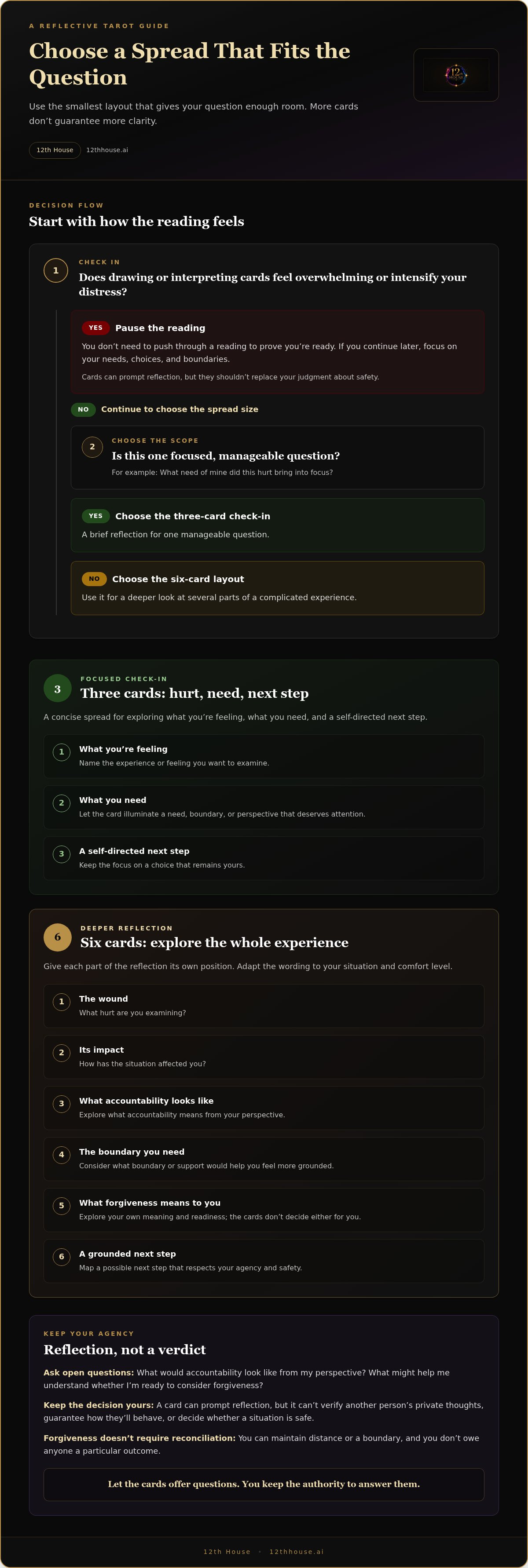
Match the spread to the scope of what you want to explore. A brief check-in may need only three cards; a more layered situation can benefit from six distinct positions. More cards don’t guarantee more clarity. Choose the smallest layout that gives your question enough room, and adapt the wording of any position to fit your situation and comfort level.
| Spread length | Best use | Reflective focus |
|---|---|---|
| Three cards | A focused check-in or one manageable question | What you’re feeling, what you need, and a self-directed next step |
| Six cards | A deeper look at several parts of a complicated experience | The hurt, its impact, your needs, accountability, boundaries, and a possible next step |
Three-card spread: hurt, need, and next step
Use the first card to name the experience or feeling you want to examine. Let the second illuminate a need, boundary, or perspective that deserves attention. The third points toward an action within your control, such as taking time to reflect or writing down a boundary. It isn’t a prediction about what someone else will do.
Six-card spread: a fuller map of forgiveness
Choose six cards when one prompt can’t hold the whole situation. Give each card a distinct function: what hurts, how it affects you, what you need, what accountability means here, which boundary or support matters now, and one possible next step. That final position leaves the future open; it doesn’t assume forgiveness or renewed contact.
The six-card layout is a practical tarot spread for forgiveness when you want to separate emotional impact from accountability and choice. Rename a position to make it gentler or more precise. For instance, if “accountability” feels too charged, ask, “What would help me recognize responsibility clearly?” The structure should support honest reflection, not force a conclusion.
Forgiveness may be worth exploring for deeply personal reasons, but no reading should turn it into a duty. Johns Hopkins Medicine outlines potential health benefits tied to forgiving others; that context doesn’t dictate your timing or decide what’s right for your circumstances. Choose the spread that fits your question today. You can return to a fuller layout later, or stop when you have enough to reflect on.
How to Read the Six-Card Forgiveness Tarot Spread
Settle somewhere you can focus, then keep your question in view. Shuffle in whatever way feels natural, draw six cards, and place them in a line or two rows in the order below. No special ritual is required. If you prefer, write down your first impressions before consulting a guidebook. This lets you notice your own response alongside familiar card meanings.
The six card positions and what each one asks
Read each card through three layers: its assigned position, the question you brought to the spread, and the details of your own situation. The position gives the card a specific job, so the same symbol can prompt different reflections in different places.
- What hurts: What part of this experience feels most present to you?
- How it affects you: Where do you notice its impact in your thoughts, feelings, or choices?
- What you need: What need deserves attention now?
- Accountability: What actions or responsibilities should be considered, without turning the card into a verdict?
- Boundary: What limit or support could help you feel more grounded?
- Next step: What manageable action is available to you, without assuming reconciliation?
The first card names the hurt, the second traces its impact, the third reveals a need, the fourth examines accountability, the fifth clarifies a boundary, and the sixth points toward a self-directed next step.
Keep the first three positions close to your experience and present needs. Accountability isn’t a courtroom ruling or a way to assign certainty from a card; use it to reflect on actions, responsibilities, and what you would need to see. The final two positions bring the reading back to your agency: a boundary can remain in place, and a next step can be as small as taking time before deciding what comes next.
Interpret difficult cards without forcing a verdict
A reversed card or an image that feels difficult doesn’t automatically predict a negative outcome. Start with the artwork and its position. In the boundary position, for example, a card associated with indecision might invite you to ask where your limits feel unclear. Treat that as a question to consider, not a command.
If a card’s meaning doesn’t land, record that uncertainty. Don’t reshuffle until you get a preferred answer. You can revisit the reading later with fresh perspective, or leave the interpretation open. The purpose of this tarot spread for forgiveness is reflection, not certainty.
To explore a question that surfaces as you read, use Lala, 12th House’s AI spiritual guidance assistant, as a companion for reflection.
Turn Your Forgiveness Tarot Reading Into a Grounded Next Step
A reading can surface a feeling or question. It doesn’t decide whether you forgive, restore contact, or trust someone again. Translate what you noticed into your own language, then choose an action that respects your needs and boundaries. Your next step can be small, or it can be to wait.
To keep an emotionally charged card in perspective, separate its image from the conclusion you might draw. Note what you see, what it brings up for you, and what practical question it raises. A tense image in the boundary position, for example, might prompt you to ask what limit would help you feel more settled. It doesn’t prove what another person intended or tell you what you owe them.
A short journaling practice after the reading
Before looking up card meanings, write down your question, the six positions, and your first reactions to each card. Then add reference meanings if they help, while distinguishing those interpretations from your own impressions. This creates a record of how you reached your reading rather than treating a single keyword as the answer.
Complete three sentences in your own words:
- One insight: “I’m noticing…”
- One boundary: “For now, I need…”
- One action: “My next manageable step is…”
Add one sentence about what remains unresolved. You don’t have to settle it today. Choose a proportionate action, such as resting, writing more, or maintaining a boundary you’ve already set. If the reading has left you feeling more distressed, pause instead of forcing a conclusion.
Continue exploring tarot with 12th House
If you want to build your understanding of card symbolism and interpretation, explore the Tarot Mastery guide. A learning framework can help you distinguish a symbol’s traditional associations from what it means in your reading and circumstances.
12th House offers tarot readings, Lala’s personalized AI spiritual guidance, and a metaphysical learning library with books, videos, and ritual frameworks for self-guided exploration. Use these resources to examine questions raised by your spread, not to seek a required outcome. If ongoing reflection would support your practice, explore 12th House and its membership resources.
A tarot spread for forgiveness can help organize reflection, but the choices remain yours. Carry forward one insight, one boundary, and one action that feels appropriate now. That is enough for a next step.
Carry Your Reflection Forward at Your Own Pace
A tarot spread for forgiveness is a framework for reflection, not a verdict. The six positions help you distinguish the hurt from its impact, consider accountability, name a boundary, and identify a next step that belongs to you. Choose a shorter spread when that’s enough, and pause if the reading feels overwhelming.
Keep your takeaway simple: one insight, one boundary, and one action. Forgiveness doesn’t require excusing harm, forgetting what happened, or reopening contact. Your meaning and timing remain your own.
If you’d like continued support for self-directed tarot exploration, 12th House offers tarot readings, an AI spiritual guidance assistant, and a membership library with books, videos, and ritual frameworks. Explore 12th House for continued tarot reflection.
Let clarity arrive in its own time. One considered step is enough to begin.
Frequently Asked Questions
Can tarot help me forgive someone?
Tarot can offer symbolic prompts for examining your feelings, needs, accountability, and boundaries. A tarot spread for forgiveness can help organize those reflections, but the cards can’t decide whether you should forgive, prove that another person has changed, or guarantee reconciliation. Treat the reading as a tool for self-inquiry, not a verdict. You choose what forgiveness means to you, how much time you need, and what next step feels right.
What is the best tarot spread for forgiveness?
The best spread is the one that gives your question enough space without making the reading feel burdensome. A three-card layout can explore the hurt, a need or boundary, and a possible next step. A six-card layout can add the impact of the experience and reflection on accountability. Neither is universally best. Adapt the position wording to your situation, and keep the focus on your own perspective and choices.
How do you do a tarot reading for forgiveness?
Write an open-ended question, choose a spread, and assign each card one clear position. Draw the cards and consider them one at a time, relating the imagery to both the position and your personal context. Note what resonates and what remains uncertain. End by identifying one manageable action, such as journaling or maintaining a boundary. The reading can support reflection, but it doesn’t require forgiveness or renewed contact.
What tarot cards represent forgiveness?
No single tarot card has a universal, fixed meaning of forgiveness. A card may bring up themes such as balance, compassion, reflection, or renewal, but its meaning depends on the deck, its position, and the question you asked. Before reaching for a familiar keyword, describe what you notice in the imagery and how it makes you feel. Treat that response as a prompt to consider, never as a command.
Can tarot tell me whether someone is truly sorry?
No. Tarot can’t verify another person’s private feelings or establish remorse as fact. A reading can help you explore what accountability would mean to you and which boundaries you need, but it can’t confirm what someone thinks or intends. Consider observable actions and patterns over time when reflecting on trust. Use the cards to clarify your own questions, not as proof or a substitute for your judgment.
Does forgiving someone mean I have to reconnect with them?
No. Forgiveness and reconciliation are separate choices. You can consider forgiveness while maintaining distance, declining contact, or setting firm boundaries. A spread may help you reflect on your needs and possible next steps, but it shouldn’t pressure you to restore a relationship or trust. You decide whether contact is right for you, and you can take the time you need before making that choice.
What should I do if a forgiveness tarot reading makes me feel worse?
Stop the reading, set the cards aside, and take time to ground before interpreting further. You don’t have to finish the spread or act on a difficult card. Return to the question later only if reflection feels useful; leaving it unanswered is also a valid choice. If the situation calls for care beyond personal reflection, consider reaching out to someone you trust for support.


