

What if a creative block isn’t a sign to wait for inspiration, but a prompt to look at your work from another angle? A tarot spread for creativity can help you do exactly that. When a project stalls, it’s easy to feel stuck at the beginning or lost halfway through. If your question is too broad, the reading may feel vague; if it’s too rigid, the cards can seem to dictate what you should make.
A focused spread gives the reading structure without taking your judgment out of the process. You’ll learn how to phrase an open-ended question and use card positions to examine the idea taking shape, the obstacle affecting it, and a grounded next action. The aim isn’t to predict whether your project will succeed. It’s to treat the cards as symbolic prompts, then turn what you notice into a manageable creative experiment.
Use this reading as a repeatable studio practice: draw, interpret, choose one small step, and see what it reveals about your work.
Key Takeaways
- A tarot spread for creativity offers symbolic prompts to examine your process, not fixed predictions or instructions.
- Shape the reading with an open-ended question and three positions: creative energy, point of friction, and possible next step.
- Use familiar card imagery, personal associations, and each card’s position to build an interpretation without forcing a single meaning.
- Record one practical takeaway and turn it into a small creative experiment you can try.
- Return to the spread as a project check-in when it supports reflection, not repeated reassurance seeking.
What a tarot spread for creativity can, and cannot, help you explore
A creativity tarot spread is a set of card positions designed to examine an idea, a creative process, or a point of resistance. Each position gives a card a specific role, helping you consider a project from more than one angle. The cards don’t guarantee an outcome or provide instructions you must follow. They offer symbolic prompts; you decide what resonates and how to apply it.
This approach can support different stages of creative work: starting a project, revising a draft that feels flat, or returning to a practice you paused. Tarot’s history also offers useful context. The cards began as playing cards before later being adapted for occult and divinatory purposes; explore this history of tarot cards for a broader overview. For foundational guidance on interpreting cards, see the Tarot Mastery guide.
When a creativity-focused tarot reading is useful
Use a spread when you can name the project but aren’t sure how to move forward. “What should I create?” asks you to consider an entire field of possibilities. A more focused inquiry, such as “What’s making it difficult to begin this short story?” gives the reading a clear point of reference. You might also ask what deserves attention in a draft or what first step could make a paused practice easier to resume. Specificity keeps the reading centered on the work at hand rather than a sweeping verdict.
Set an intention without asking tarot to decide for you
Before drawing, frame the question as an invitation to examine, not a request for permission. Try: “What deserves my attention in this project?” or “What perspective could help me work with this resistance?” These prompts leave room for discovery while keeping the reading anchored to your creative concern.
Yes-or-no questions can reduce a layered process to a binary answer. “Should I abandon this project?” may obscure more useful inquiries: what feels difficult, what still matters, or what could be tested before making a decision? Treat each card as one perspective to consider, not a command. If a card suggests a new direction, weigh it alongside your goals, constraints, and judgment. The reading can help you notice a possibility; it can’t make the creative choice for you.
Build a useful creativity tarot spread from question to card positions
The question sets the reading’s frame. A question about a project’s direction calls for different positions than one about a stalled routine. Keep the inquiry specific enough to focus your attention, but open enough to allow more than one useful interpretation. This balance helps prevent a card from becoming a vague verdict or a literal instruction.
A flexible tarot spread for creativity can use three positions: present creative energy, point of friction, and possible next step. Together, they map what’s active, what may be complicating the process, and one direction worth considering. Writers and artists have also described using tarot as a sounding board to get through creative blocks, rather than as a substitute for making their own choices.
Choose a question that opens inquiry
Shape the prompt around process, attention, or possibility rather than prediction. For an emerging idea, ask, “What quality could give this new concept a stronger foundation?” For a draft, try, “What perspective might help me shape this unfinished scene?” For a routine, ask, “What would make my daily sketching practice easier to sustain?” Each prompt gives the cards a defined subject without demanding a guaranteed result.
If you catch yourself asking, “Will this work?”, narrow it to something you can reflect on: “What should I examine before developing this approach further?” The answer won’t certify success. It can help you identify a useful consideration or a small test.
Give each card a distinct job
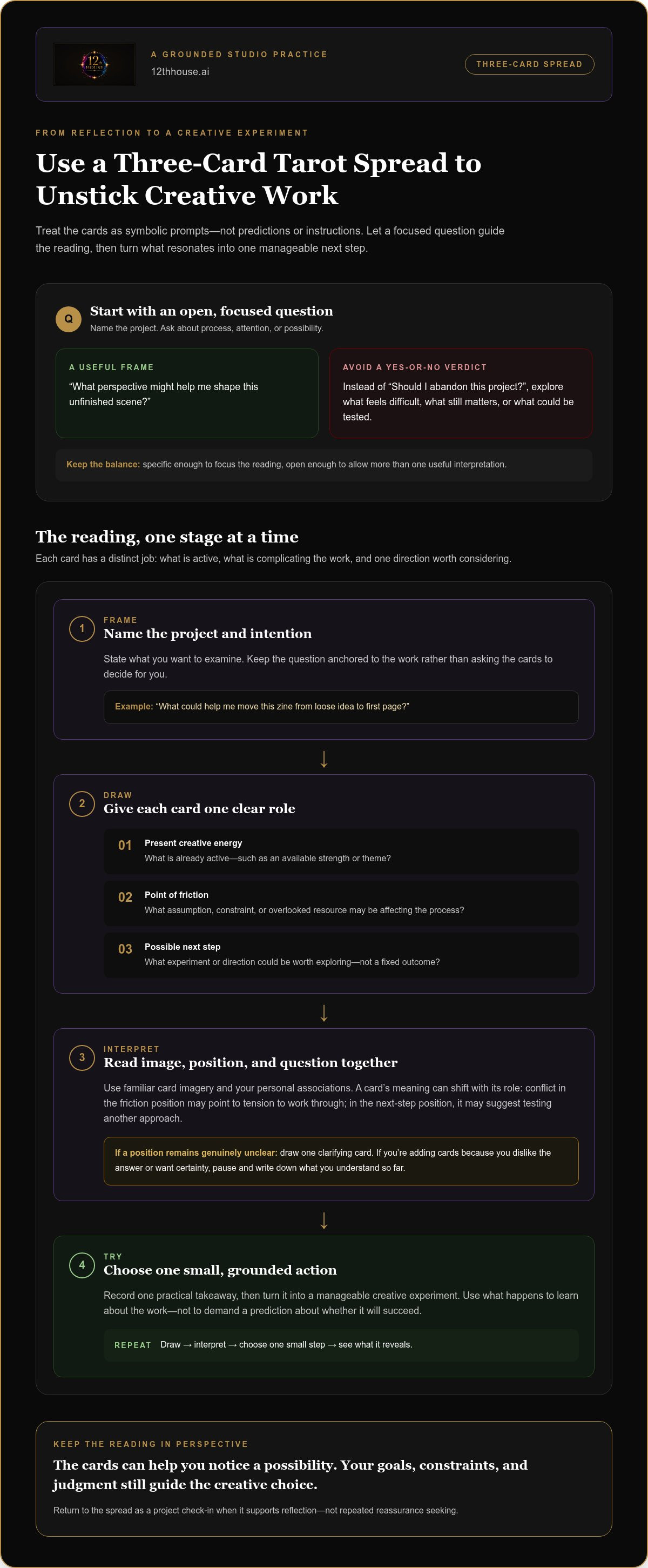
Assign each position one clear function. The first shows what’s already present in the creative process, such as an available strength or an active theme. The second examines friction: a challenging assumption, a constraint, or a resource you haven’t considered. The final position points to an experiment or direction to explore, not a fixed outcome.
Positions create context. A card associated with conflict, for instance, might point to tension worth working through in the friction position. In the next-step position, it could suggest testing a different approach to that tension. Read the image and symbolism in relation to the question and assigned role. Don’t force every card into a literal prediction.
Keep the structure simple at first. Draw one clarifying card only if a position remains genuinely unclear after you’ve considered its imagery and context. If you’re adding cards because you dislike the first answer or want certainty, pause instead. Write down what you understand so far, then decide whether another perspective would add meaning or just give you more to interpret.
Digital tarot resources can support structured reflection alongside your own notes and creative judgment. Explore 12th House’s tarot and learning tools as companions to your practice, not authorities over what you make.
How to use a three-card tarot spread for creativity, step by step
Use the layout you’ve defined to turn reflection into a short working session. Keep your project question nearby, and let the cards suggest angles to consider rather than decide what the work means. This example follows a fictional illustrator developing a short zine. The cards and interpretations are illustrative, not universal.
- Set an intention. Name the project and state what you want to explore. The illustrator asks, “What could help me move this zine from loose idea to first page?”
- Shuffle and draw. Use a familiar, comfortable method. There’s no need to adopt a particular tradition. Draw three cards and place them in order: present creative energy, point of friction, possible next step.
- Observe before interpreting. Look at each card’s image, suit, and number. Notice your immediate response, then consider how those details relate to the position and project.
- Connect the sequence. Read the cards as a progression: what’s present, what complicates it, and what might be worth trying.
- Record a takeaway. Write one observation and translate the final position into a manageable action for your next work session.
Lay out and read the cards in context
Imagine the illustrator draws the Page of Pentacles for present energy, the Eight of Swords for friction, and the Three of Wands for a possible next step. Instead of assigning fixed meanings, they notice the Page’s careful attention to a tangible task, the Eight’s enclosed scene, and the Three’s outward-looking stance. Their first response is that they’re collecting references but treating the opening page as a high-stakes decision.
Position matters. The Eight of Swords here might prompt a question about a limiting assumption, not declare that the illustrator is trapped. The Three of Wands could invite them to test a direction, not predict how the zine will be received. Together, the cards suggest a possible sequence: value the preparation, examine the pressure around starting, then make a small move toward the larger project.
Turn the reading into a small creative experiment
Ask what the spread brought into focus. The illustrator writes: “I’m waiting for the opening page to feel complete before I begin.” They turn the final card into a low-pressure experiment: sketch three rough opening-page options in the next work session, without choosing a final design. The action is specific, limited, and easy to review.
Choose a review point, such as after that session. Note what happened: Did the sketches reveal a direction, another question, or nothing decisive yet? The aim isn’t to judge the reading as right or wrong. It’s to see whether the experiment helped you engage with the work and decide what to try next.
Interpret creativity tarot cards without forcing a meaning
A card’s meaning isn’t a sealed instruction. In a tarot spread for creativity, interpretation comes from three interacting elements: familiar symbolism, your personal associations, and the card’s assigned position. Start with what you can observe, then connect it to the question. This keeps the reading open to insight without turning it into a verdict about your talent or project.
Read imagery and symbolism as prompts, not verdicts
Describe the image before consulting a guide. What is happening? Where does your eye go? What mood or detail stands out? Then ask what feels relevant to your project and what may be unrelated. A striking image can prompt reflection, but it doesn’t have to carry a message about every part of your life.
For example, The Magician might bring to mind the tools, skills, or materials already available to a creator. The Empress might suggest conditions that support growth, such as time to experiment or space to gather ideas. These are possibilities, not fixed definitions. If an unsettling card appears, use it to examine an assumption or concern. Don’t treat it as a forecast of failure.
The Major Arcana often carries broad, archetypal themes, while the Minor Arcana can point toward everyday patterns and circumstances. Neither category is inherently good or bad. A card’s scale and tone can inform your reflection, but its position and your question shape how it applies.
Reflective interpretation asks, “What might this image help me notice?” Forced interpretation asks, “What does this prove will happen?” Stay with the first question. It leaves room for your judgment and for details that don’t fit neatly.
Work with reversals, blank moments, and conflicting cards
Readers handle reversed cards in different ways: some use distinct reversed meanings, while others read every card upright. Choose an approach that feels coherent and apply it consistently within the reading. If a card leaves you blank, record that uncertainty. You don’t need to draw repeated clarifiers until an answer feels comfortable.
Apparent contradictions can reveal competing needs rather than a mistake. A card that evokes free exploration beside one that suggests structure may prompt a useful question: does this project need room for discovery, or a boundary that helps it progress? You could test both by setting aside a short, unstructured idea session, then choosing one concept to develop. Let the cards generate a question; let the experiment show you what works for your process.
For another perspective on card symbolism, explore 12th House’s tarot resources alongside your own interpretation.
Make a creativity tarot spread part of a grounded creative practice
A reading becomes more useful when it leads back to the work. Treat tarot as one reflective tool among others, alongside drafting, sketching, rest, and feedback. The cards can help you notice a question or shift in perspective; practice and revision show you what develops from there.
Create a simple reading-and-making ritual
Begin with a brief intention about the project. After the reading, write down one observation and choose one concrete action for your next session. Keep the ritual light enough to repeat without turning it into another task to perfect.
Pair reflection with a time-limited activity. You might freewrite, sketch several rough options, or revise one paragraph. In a journal, record the date, question, cards, interpretation, and action you chose. Later, these notes can help you notice patterns: perhaps you return to the same concern, or find that a particular working condition supports your focus. Use the journal as a record of inquiry, not a scorecard for whether a reading was “right.”
You can revisit the same spread as a project check-in when it helps you observe what has changed. If you’re drawing again and again because you need reassurance before acting, set the deck aside and return to the project itself. A tarot spread for creativity should support engagement with your work, not become a gate you must pass through before making something.
Continue exploring tarot with structured digital guidance
Personalized digital reflection can offer another way to explore a question, especially when you want to examine your interpretation from a fresh angle. Ask Lala, 12th House’s AI spiritual guidance assistant, answers personalized questions about charts, spells, compatibility, and other spiritual topics. Treat its responses as material for reflection, not guaranteed answers or replacements for your creative judgment. The platform also brings together tarot readings and a metaphysical library for self-guided learning.
Let the reading open a door, then take the next step in your own practice: make a mark, draft a line, or return to the page. Explore 12th House’s tarot and spiritual guidance tools as companions to your ongoing reflection.
Bring One New Perspective Into Your Creative Work
A tarot spread for creativity works best as a structured pause, not a verdict. A clear, open-ended question gives the cards a useful frame, while positions for creative energy, friction, and a possible next step help you read each card in context. Notice the symbolism and your own response without forcing a single meaning.
Then carry the reading into your practice. Record what you noticed, choose one manageable action, and return to your work through drafting, sketching, revising, or rest. Over time, your notes can help you observe how your process shifts without turning each reading into a test of whether you were right.
12th House brings tarot readings, Ask Lala for personalized AI spiritual guidance, and a metaphysical library for self-guided learning together as companions to reflection. Explore 12th House’s tarot and spiritual guidance tools, and let your next creative step be small, grounded, and yours to choose.
Frequently Asked Questions
What is the best tarot spread for creativity?
A simple three-card spread is a useful starting point: present creative energy, point of friction, and possible next step. These positions create a clear frame without overwhelming the reading with too many symbols. Ask one focused question about a specific project, then interpret each card according to its position. Treat the final card as an idea to explore, not a directive or prediction about how the project will turn out.
Can tarot help with a creative block?
Tarot can help you examine a creative block by offering images and symbols to reflect on, but it can’t guarantee inspiration or remove the obstacle for you. Ask what might be contributing to the block, or what deserves your attention in the project. Use what you notice to choose a small action, such as drafting one paragraph or making a rough sketch. The value lies in reflection and follow-through, not certainty.
How do you ask tarot cards about creativity?
Ask an open-ended question about your process, attention, or options. For example: “What could help me begin this project?” or “What perspective might help me revise this draft?” Avoid asking the cards to guarantee success or make a complex decision for you. If your prompt is “Will this work?”, reframe it as “What should I explore before developing this idea further?” A focused question gives the reading useful context.
How many cards should I use for a creativity tarot reading?
Start with three cards if you want enough structure to explore an idea without creating too many threads to interpret. Assign each card a distinct role, such as current energy, friction, and possible next step. One card can also work for a brief prompt, while a clarifying card may help if a position remains genuinely unclear. Avoid drawing repeatedly just to find an answer that feels more reassuring.
What tarot cards represent creativity?
No single tarot card represents creativity in every reading. The Magician may suggest skills, tools, or resources available to you; The Empress may evoke generative conditions or room for growth. Page cards can prompt thoughts about learning and experimentation. Read these as possibilities, not fixed definitions. Consider the card’s imagery, your personal associations, your question, and its spread position before deciding what it might illuminate about your creative work.
What should I do if a tarot card does not make sense?
Pause and describe what you see before looking up a definition. Note the image, your first reaction, and how the card relates to its assigned position. If the connection still isn’t clear, record that uncertainty and continue with the rest of the spread. You can return to the card later. Repeatedly drawing clarifiers may add more material without resolving the question, so let the reading remain open.
Can beginners use a tarot spread for creativity?
Yes. A beginner can use a tarot spread for creativity by keeping the layout simple and the question specific. Choose clear positions, draw using a familiar method, and write down what stands out before consulting a guidebook. You don’t need to know every traditional meaning to reflect on an image. Treat your interpretation as a possibility to consider, then choose one manageable creative action based on what feels relevant.


