

What if the clearest tarot reading begins not with more cards, but with a better question? When a concern feels tangled, it’s easy to reach for a large spread, then feel overwhelmed by unfamiliar positions or uncertain meanings. A tarot spread for clarity works best as a focused map: it helps you examine a situation without treating any card as a fixed answer.
You don’t need to read every symbol perfectly or make the cards confirm what you already hope is true. Shape a vague concern into an open, useful question, then choose a spread with enough structure to explore it without adding noise. Interpret each card in relation to its position and the full reading. Let the symbols prompt reflection rather than dictate a decision.
This guide walks you through that process step by step. You’ll learn how to frame your question, select a fitting spread, and connect the cards to your real circumstances. By the end, you’ll have a grounded reflection or practical next step, not just a collection of meanings to decode.
Key Takeaways
- Turn a broad concern into an open question about perspective, options, or your own agency.
- Choose a tarot spread for clarity that matches the scope of your question, from a single-card layout to a more layered spread.
- Read each card through its position and the surrounding cards rather than relying on isolated meanings or fixed combinations.
- Use the reading as a prompt for reflection, not as a guaranteed prediction or substitute for professional advice.
- Record your question, first impressions, and takeaway so you can revisit how your understanding develops over time.
What Is a Tarot Spread for Clarity, and What Can It Help You Explore?
A tarot spread for clarity is a layout that gives each card a distinct role, helping you examine a question from several angles. One position might represent what’s influencing a situation; another could point to a perspective to consider or a possible next step. The structure turns a broad concern into a focused reflection.
A clarity spread uses card positions to explore a question from distinct angles, offering prompts for reflection rather than a guaranteed answer. Tarot is a symbolic practice. The cards don’t verify facts or decide what you should do. You bring the context, evaluate what resonates, and remain responsible for your choices. A reading can support reflection, but it isn’t a substitute for professional advice.
When a clarity tarot reading can be useful
Use a spread to weigh options, name a concern that feels difficult to articulate, or examine a pattern that keeps repeating. For example, instead of asking whether to leave a job, explore what matters most in your work, what feels unresolved, and which option deserves closer consideration. The cards can help organize your attention, but they can’t establish objective facts about your workplace or predict what will happen.
Keep the question within the reading’s proper scope. Urgent concerns involving safety, health, legal rights, or finances call for appropriate professional support. Tarot may help you reflect on your feelings while you seek that support, but it shouldn’t replace qualified guidance.
What tarot can and cannot answer
Read each card as a prompt, not a command or fixed outcome. A symbol might invite you to consider a fear, resource, or assumption you hadn’t noticed. Its meaning depends on the deck’s imagery, the reading tradition, the position it occupies, and the circumstances you bring to the reading. The same card can therefore raise different questions in different spreads.
That distinction matters: seeking perspective keeps your judgment active, while asking the cards to make a decision hands your agency to an interpretation. Notice what a card suggests, test it against your lived experience, and decide what is useful. For a broader grounding in how questions and interpretations shape a reading, see Tarot card reading and Tarot Mastery: A Professional Guide to Spiritual Clarity.
Approach the spread as a framework for inquiry, not an oracle delivering a verdict. That boundary makes room for insight without requiring you to force a preferred answer.
How to Prepare a Tarot Spread for Clarity: Question, Focus, and Intention
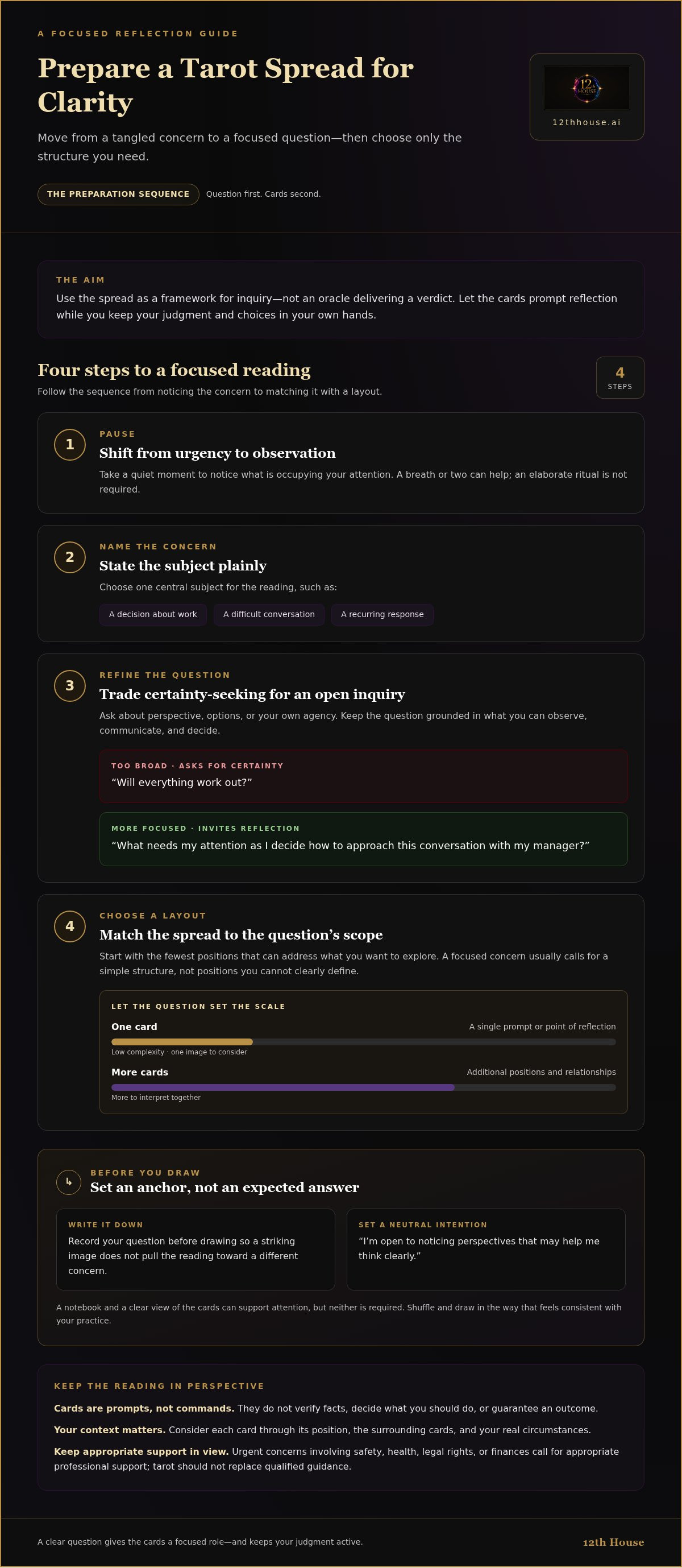
A useful reading begins before you draw. Set a clear boundary for the question, choose a layout that can address it, and set an intention to explore rather than confirm. This preparation keeps the tarot spread for clarity anchored to your concern instead of letting the interpretation drift toward a hoped-for answer.
- Pause. Take a quiet moment to notice what’s occupying your attention. You don’t need an elaborate ritual; a breath or two can help you shift from urgency to observation.
- Name the concern. State the subject plainly, such as a decision about work, a difficult conversation, or a recurring response you’ve noticed.
- Refine the question. Replace a yes-or-no demand with an open inquiry about perspective, options, or your own agency.
- Choose a layout. Select positions that match the question’s scope. A focused concern usually needs a simple structure, not a spread with positions you can’t clearly define.
Turn a vague concern into an open tarot question
“Will everything work out?” asks for certainty the cards can’t establish. Try: “What needs my attention as I decide how to approach this conversation with my manager?” This question names a specific situation and invites insight into your own approach without demanding a guaranteed outcome. Keep one central subject in each reading. Avoid questions that claim access to another person’s private thoughts or seek to control their choices. Focus instead on what you can observe, communicate, and decide.
Set a neutral intention, such as, “I’m open to noticing perspectives that may help me think clearly.” This leaves room for an unexpected interpretation. An intention like “Show me that I’m right” narrows the reading before you draw a card.
Create a calm, focused reading space
A quiet pause, a notebook, and a clear view of the cards can support attention, but none is a requirement. Shuffle and draw in the way that feels consistent with your practice. Before you draw, write down the question. That simple record gives you an anchor if a striking image tempts you to reinterpret the reading around a different concern.
For continued structured reflection, explore tarot and spiritual guidance alongside your own reading practice.
Which Tarot Spread for Clarity Should You Choose? One, Three, or More Cards
The right spread gives your question enough structure to explore without adding unnecessary complexity. A single card can focus your attention on one point; more cards create additional positions and relationships to interpret. Choose based on the scope of your question and how comfortable you are reading several cards together.
Selection rule: Match the spread to the size of the question and your reading experience. Start with the fewest positions that can address what you want to explore.
| Spread size | Useful for | Complexity |
|---|---|---|
| One card | A single prompt or point of reflection | Low; one image to consider in context |
| Three cards | A question with a few connected angles | Moderate; positions and card relationships both matter |
| Larger spread | A layered situation that needs several viewpoints | Higher; more positions create more interpretive connections |
One-card and three-card spreads for focused questions
A one-card draw offers a compact prompt. Ask what perspective might help you approach a specific situation, then use the card’s imagery to guide reflection. A three-card layout can add structure: assign positions such as situation, perspective, and possible next step. These labels are a framework you choose, not universal tarot rules. Keep each position clear so the cards address one central question.
A Major Arcana card or a Minor Arcana card may appear in either layout. Notice its imagery and how it relates to the position; don’t assume its category dictates a single meaning.
When a larger spread adds useful structure
Several viewpoints can help when a situation has distinct parts you want to examine, such as influences, obstacles, resources, and possible approaches. The Celtic Cross is a recognizable larger spread, but its multiple positions and relationships require more interpretive work. More cards don’t automatically mean more clarity.
If you’re still learning, choose a smaller spread when extra positions would blur the question. With a tarot spread for clarity, each added card should have a defined purpose. If you can’t explain what a position is meant to explore, simplify the layout before drawing.
How to Read a Tarot Spread for Clarity Without Forcing an Answer
Interpretation works best as a sequence, not a search for one definitive meaning. In a tarot spread for clarity, let each card contribute to its assigned position, then consider how the positions speak to one another. Keep the original question nearby. It’s your reference point when a striking image or familiar card meaning pulls your attention elsewhere.
Read each tarot card through its position
Start with what you can observe. What figures, objects, gestures, or contrasts stand out? Before consulting a guidebook or relying on memory, describe the image in plain language. Then read the card through its position and question. A card in a “current perspective” position may invite a different reflection than the same card in a “possible next step” position.
For example, The Fool might prompt you to consider openness, uncertainty, or a willingness to begin, depending on the image, tradition, and context. The High Priestess might lead you to reflect on what you haven’t yet examined. Neither card supplies a universal answer. Write down the visual detail first, then note what it could suggest in relation to the position.
Synthesize the spread into a grounded reflection
After considering each card, read the spread as a whole. Look for repeated themes, contrasts, or questions. A card suggesting movement beside one suggesting pause could create useful tension, but that pairing isn’t a fixed formula. The neighboring card may add nuance; it doesn’t dictate a single meaning.
A difficult-looking card also doesn’t automatically predict a negative event. Treat discomfort as a cue to examine what the image brings up, not evidence that something bad will happen. Separate what you see from what you infer. For instance, “the figure is facing away” is an observation; “someone will abandon me” is an assumption. Record interpretations as possibilities, and allow more than one reading if the symbolism remains ambiguous.
Close with one grounded reflection or small, self-directed next step. It might be a question to journal about, a conversation to prepare for, or an option to explore. Keep it proportionate to the reading. The aim is considered action, not certainty.
For further support with your tarot practice, explore tarot readings and spiritual guidance.
After Your Tarot Spread for Clarity: Reflect, Record, and Continue Exploring
The reading doesn’t end when you turn over the last card. A brief written record helps preserve what you noticed before later thoughts reshape the interpretation. It also gives you something concrete to revisit and compare with how your perspective develops.
Turn card reflections into a useful journal entry
Keep the notes simple and separate three layers: what you can see, what the image brings to mind, and what you conclude in relation to your question. For example, describe a figure looking toward a horizon before noting that it evokes possibility for you. Then consider what that association might suggest in the card’s position. This distinction helps you recognize where observation ends and interpretation begins.
Record the question and each card’s position, along with your first impressions and takeaway. Include what remains uncertain. You don’t need to force every symbol into a complete answer; uncertainty can be part of an honest reading. If the spread explored a relationship, use your notes to reflect on your own needs and choices rather than treating the cards as proof of another person’s private thoughts. For a relationship-focused perspective, see AI Love Readings: A Professional Guide to Seeking Clarity.
Finish with one manageable reflection or action within your control. You might write down a question to consider, identify a boundary you want to clarify, or plan how to prepare for a conversation. Keep the step small enough to act on without needing the reading to settle every unknown.
Return to your notes later. Ask what still feels relevant, what you understand differently, and whether your takeaway led to a useful reflection. The purpose isn’t to prove the cards right or wrong. It’s to notice how your interpretation shifts as you gain more context.
Continue studying tarot with structure
Build familiarity gradually. Study a card’s imagery and symbolism, then practise using clear position labels in a spread. You don’t need to memorize every interpretation before you begin; attentive observation and consistent reflection help you develop your own reading framework over time.
For ongoing exploration, 12th House offers tarot readings and a metaphysical library with books, videos, and ritual frameworks. Explore 12th House to continue your tarot and spiritual study.
Carry Your Reading Into Thoughtful Action
A useful tarot spread for clarity doesn’t need to predict what comes next. It gives you a structure for examining a focused question, noticing perspectives you may have missed, and choosing a spread size that fits the issue. Read cards through their positions and your context, then record what you observed, what you’re considering, and what remains uncertain.
Let the reading support your judgment, not replace it. A single grounded reflection or manageable next step is enough to carry the insight forward. Revisit your notes as your understanding develops, and let your interpretation evolve with new context.
12th House offers tarot readings, a metaphysical library with books, videos, and ritual frameworks, and Ask Lala AI spiritual guidance. Explore 12th House tarot readings and spiritual guidance to continue your reflection with digital tarot tools, personalized guidance, and resources for self-guided learning.
Stay curious, trust your discernment, and take the next step at your own pace.
Frequently Asked Questions
What tarot spread is best for clarity?
The best spread is the smallest one that can explore your question meaningfully. A one-card draw can focus on a single perspective, while a three-card spread can compare a situation, perspective, and possible next step. Choose a larger layout only when your question has several distinct parts and you can give each position a clear purpose. More cards add interpretive relationships, not automatic certainty.
How do you do a three-card tarot spread for clarity?
Start with one open question, then assign each card a clear position. For example, use “situation,” “perspective,” and “possible next step.” Draw one card for each position and interpret its imagery in relation to both the label and your question. Then look across the spread for themes or contrasts. These position labels are a flexible framework, not universal rules, so choose ones that suit your inquiry.
Can tarot cards give you clarity about a decision?
Tarot can offer prompts for examining a decision, but it can’t verify facts or choose on your behalf. Ask what you may need to consider, which option aligns with your priorities, or what action is within your control. Compare the reflections with practical information and your lived circumstances. For urgent health, safety, legal, or financial matters, seek appropriate professional support rather than relying on a reading.
Should I ask a yes-or-no question in a tarot reading?
You can, but a yes-or-no question may narrow the reading to a verdict and leave little room to explore context. An open question often gives you more to reflect on: instead of “Will this work out?” ask “What should I consider as I decide how to proceed?” This reframes the reading around perspective and agency, rather than asking the cards to guarantee an outcome.
What should I do if a tarot spread feels confusing?
Pause before drawing more cards. Return to your original question, review each card’s position, and describe the visible imagery before reaching for a fixed meaning. Note what you observed separately from what you’re assuming. If the spread still feels unclear, record the uncertainty and revisit it later. You can also simplify the layout next time, since too many positions may create more interpretive connections than the question needs.
How often should I do a tarot spread for the same question?
There’s no universal schedule, but repeating a reading immediately can encourage you to search for the answer you want rather than reflect on the first spread. Record the question and interpretation, then return to it when circumstances or your understanding have meaningfully changed. If you draw again, refine the question to address what’s new. Treat each reading as a reflection point, not a way to force certainty.
Can beginners use a tarot spread for clarity?
Yes. Beginners can start with one card or a simple three-card layout and use clear position labels. Focus first on what the images show, then consider how each card relates to its position and your question. You don’t need to memorize every meaning before you begin. Keep notes on your observations and interpretations, and build familiarity gradually through practice and study.


