

What if your chart isn’t telling you who you are, but offering a way to notice how you make choices? A human design blueprint can look like a code of unfamiliar terms and symbols at first. Broad descriptions may also feel more like fixed labels than useful guidance. The key is to read it as a map for reflection, not a script you’re expected to follow.
Built from your birth date, time, and location, the chart brings together several symbolic systems to explore patterns in energy, decision-making, and interaction. You don’t need to decode every detail to get started. Begin with a few central features, then compare their themes with what you notice in everyday situations.
This guide explains how Type, Strategy, Authority, Centers, and Profile fit together, and what each can offer without defining your identity for you. You’ll learn where to begin, how to approach broad interpretations with discernment, and how to turn chart concepts into grounded questions about your choices. Treat the blueprint as a structured invitation to observe yourself more closely, one pattern at a time.
Key Takeaways
- Read a human design blueprint as a framework for reflection, not a fixed description of who you are.
- Use the BodyGraph to orient yourself, then explore Type, Strategy, and Authority as distinct starting points.
- Compare chart themes with your lived experience instead of treating them as predictions or rules.
- Begin with a few core elements and connect them to patterns in everyday decisions.
- A Human Design Profile can offer a structured starting point, while follow-up questions help you explore its concepts in a personal context.
What Is a Human Design Blueprint? A Map for Self-Reflection
What does a Human Design blueprint describe? It offers a symbolic framework for exploring how you use energy, approach decisions, and respond to life. Rather than assigning a personality type in the conventional sense, it gives you concepts to consider alongside your own experience.
The system draws on several traditions, including astrology, the I Ching, the Kabbalah, and the chakra system. Your birth date, time, and location are used to generate a chart that arranges these symbolic elements into a personal map. That map can prompt practical questions: Do certain approaches to decisions feel familiar? Where do you notice consistency, and where might your surroundings influence you?
Keep the framework in perspective. Human Design is a spiritual self-inquiry system, not a clinical tool or scientifically established assessment. Wikipedia’s overview of Human Design summarizes the system’s origins and identifies it as pseudoscience. You can explore its language without treating its interpretations as proof, diagnosis, or guaranteed prediction.
What information does a Human Design blueprint represent?
A Human Design blueprint is a chart-based framework for reflecting on patterns, preferences, and decision-making through a combination of symbolic elements. These elements are interpreted together, not as isolated facts about your character. Use them as prompts for observation, then compare an interpretation with what you actually experience. If it doesn’t fit, you don’t need to turn it into a label.
How is a blueprint different from a Human Design chart?
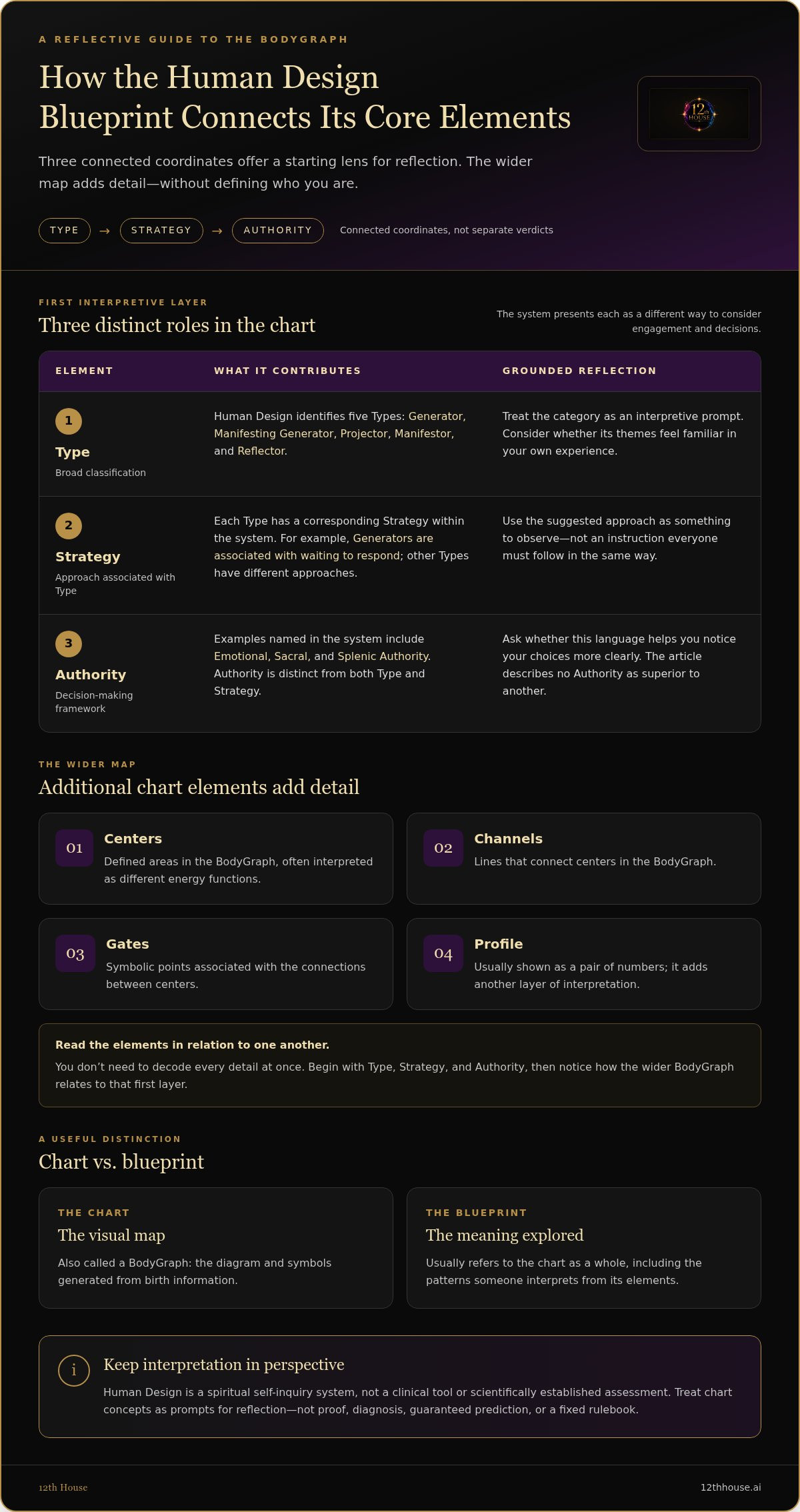
The chart, also called a BodyGraph, is the visual representation: the diagram and symbols generated from birth information. “Blueprint” usually refers to the chart as a whole, including the patterns someone interprets from its elements. The terms are often used interchangeably, but this distinction is useful: the graphic is the map’s format; the blueprint is the meaning you explore through it.
This distinction also helps keep interpretation grounded. A chart can give you a structured vocabulary for reflection, but it can’t account for every choice, relationship, or change in circumstance. Read it as one lens among many, not as a verdict on who you are or a fixed forecast of what you’ll do.
How the Human Design Blueprint Connects Its Core Chart Elements
The BodyGraph is the visual structure of a Human Design chart. Its shapes, lines, and symbols form a system, so a single element is best understood in relation to the others. Type, Strategy, and Authority offer a practical first layer: they provide different ways to consider how you engage with situations and make choices.
Think of them as connected coordinates, not separate verdicts. Type gives the chart’s broad classification. Strategy describes an approach associated with that Type. Authority points to the system’s proposed way of making decisions. Together, these concepts create an initial lens for reflection, while the rest of the BodyGraph adds detail.
Type, Strategy, and Authority: the first interpretive layer
Human Design identifies five Types: Generator, Manifesting Generator, Projector, Manifestor, and Reflector. Each has a corresponding Strategy within the system. For example, Generators are associated with waiting to respond, while other Types have different approaches. Treat these as interpretive prompts, not instructions everyone must follow in the same way. Explore the distinctions in this guide to the five Human Design types.
Authority adds another perspective. It refers to the chart’s decision-making framework, such as Emotional, Sacral, or Splenic Authority. It isn’t the same as Type or Strategy: Type categorizes, Strategy suggests how to engage, and Authority offers a way to reflect on decisions. None is considered superior. The useful question is whether this language helps you observe your choices more clearly.
Centers, channels, gates, and profile: the wider map
Centers are the BodyGraph’s defined areas, often interpreted as different energy functions. Lines connecting centers are called channels, and gates are symbolic points associated with those connections. A profile, usually shown as a pair of numbers, adds another layer of interpretation. You don’t need to decode every detail at once. Start by noticing how these elements relate to Type, Strategy, and Authority.
The system draws on symbolic traditions associated with astrology, the I Ching, Kabbalah, and the chakra system, combining and reinterpreting their concepts within a modern framework. This history gives the chart its layered vocabulary, but it doesn’t make its spiritual claims scientific findings. Treat the human design blueprint as a structured prompt for inquiry, then compare its language with lived experience rather than accepting an interpretation as fact.
If you’d like a structured starting point for exploring your own chart, a Human Design Profile can help organize its elements and support further reflection.
Does Your Human Design Blueprint Define You? Reading It Without Fatalism
No chart can contain the full complexity of a person. A Human Design blueprint may offer language for exploring recurring patterns, but it shouldn’t become a verdict about your identity or a rulebook for every choice. You remain more than any symbolic map can describe.
For readers who find the system meaningful, its value lies in the questions it can prompt. If an interpretation suggests a particular way of approaching decisions, consider whether you see that pattern in your own life. When have you noticed it? When doesn’t it fit? Reflection begins with curiosity, not automatic agreement.
What a Human Design blueprint can support
A Human Design blueprint can support reflection on recurring experiences, but it cannot predict exactly what you’ll do or what will happen. Use chart language as a vocabulary for observing yourself. For example, if a concept seems to describe how you respond to opportunities, look back at actual choices: What information did you have? What mattered in that moment? Did the interpretation clarify your experience, or reduce it to a label?
This approach leaves room for nuance. A theme can resonate in one context and not another. You might use it as a journaling prompt, then revisit your understanding as your circumstances or perspective change. The chart doesn’t need to be “right” in every detail to spark a useful question, and you don’t need to force a fit.
What a Human Design blueprint cannot establish
A chart isn’t a diagnosis, an objective psychological test, or a substitute for medical or mental health guidance. Its symbolic interpretations aren’t empirically established clinical conclusions. Treat spiritual inquiry and professional advice as distinct forms of guidance, and seek qualified support for health concerns.
Interpretations can vary, and no reading should override your context, consent, or personal judgment. If a description doesn’t fit, you’re free to set it aside. If it resonates, consider it alongside your lived experience rather than as proof of an inherent trait or a guaranteed outcome.
- Potential value: It can offer prompts for noticing preferences, habits, and decision patterns.
- Important limit: It can’t establish who you are, diagnose a condition, or determine what you should do.
Keep the inquiry open. Let the framework expand your perspective, not narrow your choices. Your experiences provide context that a chart alone cannot supply.
How to Explore Your Human Design Blueprint in Four Grounded Steps
Move from the chart’s structure to your own observations, one layer at a time. The aim isn’t to interpret everything at once. It’s to see whether a concept gives you a useful question to consider in real life.
- Orient yourself to the BodyGraph. Locate the main chart areas and identify your Type, Strategy, and Authority. These provide a manageable starting point before you explore the smaller symbols. Write down unfamiliar terms instead of opening every interpretation at once. For a focused explanation of Type, use this guide to the five Human Design types.
- Check the information used for your chart. Human Design charts are calculated using birth details, so enter the information as accurately as you can. If you’re uncertain about a detail, note that uncertainty rather than treating an estimate as exact. This keeps the chart’s starting point in view without assuming that every interpretation is definitive.
- Choose one real question. Select a current decision or recurring pattern, such as how you approach a new opportunity or what tends to shape a difficult choice. Read one relevant chart interpretation, then turn it into an open question: “Does this describe something I’ve noticed?” Avoid reshaping your experience just to make the interpretation fit.
- Record what you observe over time. In a journal, note what feels relevant, what remains uncertain, and what conflicts with your experience. Return to those notes as situations arise. Look for context and variation, not proof that the chart is correct. An interpretation may help you notice a pattern, or it may simply not resonate.
This process keeps the map in its proper role: a prompt for inquiry. You decide which ideas are useful, and your real experiences remain part of the interpretation. For a structured starting point, explore a Human Design Profile and use follow-up questions to connect chart concepts with personal reflection.
Explore Your Human Design Blueprint with 12th House
As you notice how chart language relates to your experience, your questions may become more specific. What does a particular element suggest within your chart? How might a concept connect to a choice you’re considering? A structured profile and a way to explore follow-up questions can help you continue the inquiry without treating any interpretation as a final answer.
Build a continuing practice around your profile
A 12th House Human Design Profile offers a structured starting point for exploring your chart. Use the profile to orient yourself, then return to the elements that raise questions instead of trying to interpret every symbol at once. As new situations arise, revisit those concepts and compare them with what you notice in your decisions and relationships.
Self-guided learning can deepen that practice. Membership includes access to a metaphysical library, with books, videos, and ritual frameworks to explore as your questions develop. If you’re curious about using an AI tool to explore personalized chart questions, read this guide to the AI astrology assistant.
Use AI guidance as a tool for inquiry
Lala is an AI assistant for personalized questions about charts and other metaphysical topics. Ask for a concept to be explained in simpler terms, or explore how a chart element could relate to a question you’re considering. Follow-up questions can help you examine an interpretation from different angles and connect abstract language to lived experience.
Keep your own judgment at the center. AI guidance can offer explanations and prompts, but it isn’t an authority on who you are or a source of guaranteed answers. Consider what feels relevant, what remains uncertain, and what doesn’t fit. Your own experience supplies context that no profile or conversation can replace.
To continue exploring your human design blueprint with a profile, personalized chart questions, and resources for self-guided learning, explore 12th House membership.
Keep Exploring Your Chart with Curiosity
Your human design blueprint is most useful as a map for reflection, not a fixed script. Begin with a few core chart elements, then notice how their themes relate to your everyday choices. Let what resonates guide further questions, and leave room for interpretations that don’t fit.
A steady practice matters more than decoding every symbol at once. 12th House Human Design Profiles offer a structured starting point, while Lala can support personalized questions about your chart. Membership also includes access to a metaphysical library for continued self-guided learning. Use these resources to explore possibilities while keeping your own experience and judgment at the center.
Explore your Human Design profile with 12th House and take the next step in your inquiry. You don’t need every answer before you begin. Stay curious, observe your patterns, and let your understanding develop at your own pace.
Frequently Asked Questions
What is a Human Design blueprint?
A Human Design blueprint is a symbolic chart interpreted as a framework for exploring patterns, preferences, and decision-making. It brings chart elements such as Type, Strategy, Authority, and Centers into one personal map. People use these concepts for spiritual self-inquiry, not as a clinical assessment or a fixed description of identity. Treat the chart as a prompt for reflection, then compare its ideas with your own experience.
How do I find my Human Design blueprint?
To find your blueprint, you’ll need your birth date, birth time, and birth location to generate a Human Design chart. Enter those details carefully, since the chart is calculated from them. Once you have the BodyGraph, begin with the main elements rather than trying to interpret every symbol. A Human Design Profile can also provide a structured starting point for exploring your chart.
What does a Human Design blueprint tell you?
A Human Design blueprint offers symbolic interpretations about how you may approach energy, decisions, and interactions. Its Type, Strategy, and Authority are common starting points, while other chart elements add further layers. These ideas can help you form questions about recurring choices or preferences. They don’t guarantee how you’ll act or predict what will happen. Use them as reflection prompts, not as rules that replace your judgment.
Is a Human Design blueprint scientifically proven?
No. Human Design is a spiritual self-inquiry system, not a scientifically established psychological or medical assessment. Its interpretations shouldn’t be treated as objective test results, diagnoses, or evidence about what you must do. You can still find its symbolic language personally meaningful while keeping that distinction clear. For health concerns or decisions requiring professional guidance, rely on qualified support rather than a chart reading.
Can my Human Design blueprint change over time?
Within the Human Design system, a chart is calculated from birth details, so it’s generally treated as a stable map rather than something that changes with your circumstances. Your understanding of its symbols, however, can evolve as you reflect on new experiences. If you discover that your birth information was inaccurate, corrected details may produce a different chart. Interpretations remain prompts, not fixed explanations of your life.
What is the difference between a Human Design blueprint and a BodyGraph?
The BodyGraph is the visual diagram used to display a Human Design chart. The word “blueprint” often refers to the chart considered as a whole, including the patterns someone interprets from its elements. In simple terms, the BodyGraph is the visual structure, while the blueprint is the map as you explore its meaning. The terms are sometimes used interchangeably, so context helps clarify which is meant.
Do I need to understand every Human Design gate to read my blueprint?
No. You can begin without decoding every gate. Start with a few core chart elements, such as Type, Strategy, and Authority, and note unfamiliar terms for later. Choose one real-life question and consider whether an interpretation helps you reflect on it. Gates add detail, but studying them all at once can make the chart harder to approach. Let your questions guide what you explore next.


