

What if a tarot reading for my future could offer direction without dictating what happens next? When a relationship feels uncertain, a major decision is approaching, or life is shifting beneath your feet, it’s natural to want a clear answer. Tarot can help you examine the patterns, hopes, and concerns shaping your question, but it can’t guarantee a specific event or outcome.
A future-focused reading is best treated as a map of possibilities, not a fixed forecast. The cards provide symbolic prompts; your choices shape the route. The clearer your question, the easier it is to connect the cards to the situation you want to understand.
In this guide, you’ll learn what tarot can and can’t reveal about the future, how common spreads organize a reading, and how to choose one for your situation. You’ll also find ways to frame a focused question and turn the cards’ symbolism into practical next steps, so you leave with insight to work with rather than a prediction to wait for.
Key Takeaways
- A tarot reading for my future can help you explore possible directions and current influences, not promise a fixed outcome.
- Interpret cards through their spread positions, imagery, and context. Major and Minor Arcana offer different layers of reflection.
- Match the spread to your question: a three-card layout offers focus, while the Celtic Cross creates a broader map.
- Prepare with a clear, open-ended question, record your reading, and identify one practical next step.
- Use tarot as part of an ongoing, self-directed practice, with 12th House readings and learning resources supporting further exploration.
What Can a Tarot Reading for Your Future Actually Tell You?
When a relationship feels uncertain or a major decision is approaching, it’s natural to ask, “What happens next?” A tarot reading for my future can give that question structure, but it can’t guarantee an outcome. Card imagery and spread positions can help you explore current influences, recurring themes, and possible directions. Think of the reading as a symbolic map: useful for reflection, not a fixed route.
Prediction names a certainty; possibility describes a potential path; personal agency is your capacity to influence what happens next. Tarot can invite you to examine that path and your choices within it. It isn’t an evidence-based forecast, and it shouldn’t replace professional advice on medical, legal, financial, or mental health concerns. For a neutral overview of the practice and its uses, see Tarot card reading.
Does tarot predict the future or explore possibilities?
Responsible interpretations focus on themes, choices, and potential trajectories, not guaranteed events. A card in a future position might prompt you to consider what could develop if current patterns continue. It doesn’t prove that outcome will occur. New information, changing circumstances, and your decisions can all affect how a situation unfolds. Treat unsettling imagery as a reason to reflect, not as evidence that you should fear or expect the worst.
What kinds of future questions work well?
Ask questions that leave room to reflect: “What pattern should I pay attention to in this relationship?” “What options could help me approach this decision?” or “What might support my readiness for a career change?” Each question directs attention to patterns, options, or preparation. By contrast, “What exact date will I meet my partner?” asks for a level of precision tarot can’t reliably provide. A clear question gives the cards a useful interpretive frame without handing them your decision.
If you’re still learning how imagery and card meanings fit together, explore Tarot Mastery: A Professional Guide to Spiritual Clarity for foundational context. Whether a reading is AI-supported or self-guided, stay active in the interpretation: notice what resonates, question what doesn’t, and choose a practical step that makes sense in your real circumstances.
How to Read Future Tarot Cards Without Treating Them as Certainty
A card doesn’t interpret itself. Its meaning takes shape through four elements: the question asked, the position it occupies, the details in its imagery, and the context of the person reading it. A symbol that feels encouraging in one spread may point to a different kind of attention in another. Read the full pattern before settling on an interpretation.
A card’s traditional symbolism offers a lens for reflection, not proof that a specific event will happen. The Major Arcana often point to broad archetypal themes, such as change, choice, or a turning point. The Minor Arcana tend to bring the reading closer to everyday dynamics, including communication, work, emotional responses, and practical decisions. Both can be interpreted in many ways, so treat examples as starting points rather than fixed definitions.
How do spread positions shape a future card’s meaning?
A future position describes a possible direction within that particular reading. It doesn’t stand alone. A present-influence card may show what’s shaping the situation now, while an obstacle position can highlight friction and a resource position can suggest what’s available to draw on. Neighboring cards add context. For example, a future card associated with movement might suggest taking initiative if resource cards support that idea. If the spread also highlights competing demands, it might instead prompt you to consider timing and priorities.
How can you interpret difficult or ambiguous cards?
Start with your own reaction. Before looking up a standard meaning, note what stands out in the image and what it brings to mind. Then consider more than one plausible interpretation and test each against the question. A card often associated with disruption, for instance, might invite you to examine a fragile plan, acknowledge a needed change, or prepare for an honest conversation. It doesn’t establish that harm is coming. Avoid readings that rely on fear or claim certainty.
Use this simple sequence to keep the reading grounded:
- Locate: What does this position ask the card to represent?
- Observe: Which symbols, gestures, or contrasts catch your attention?
- Connect: How might those details relate to the question and surrounding cards?
- Reflect: What interpretation feels useful, and what real-world information could help you assess it?
This method can bring more nuance to a tarot reading for my future, including one supported by AI. Keep the interpretation open to revision as circumstances change. To explore card symbolism in a structured space, you can explore tarot readings with 12th House.
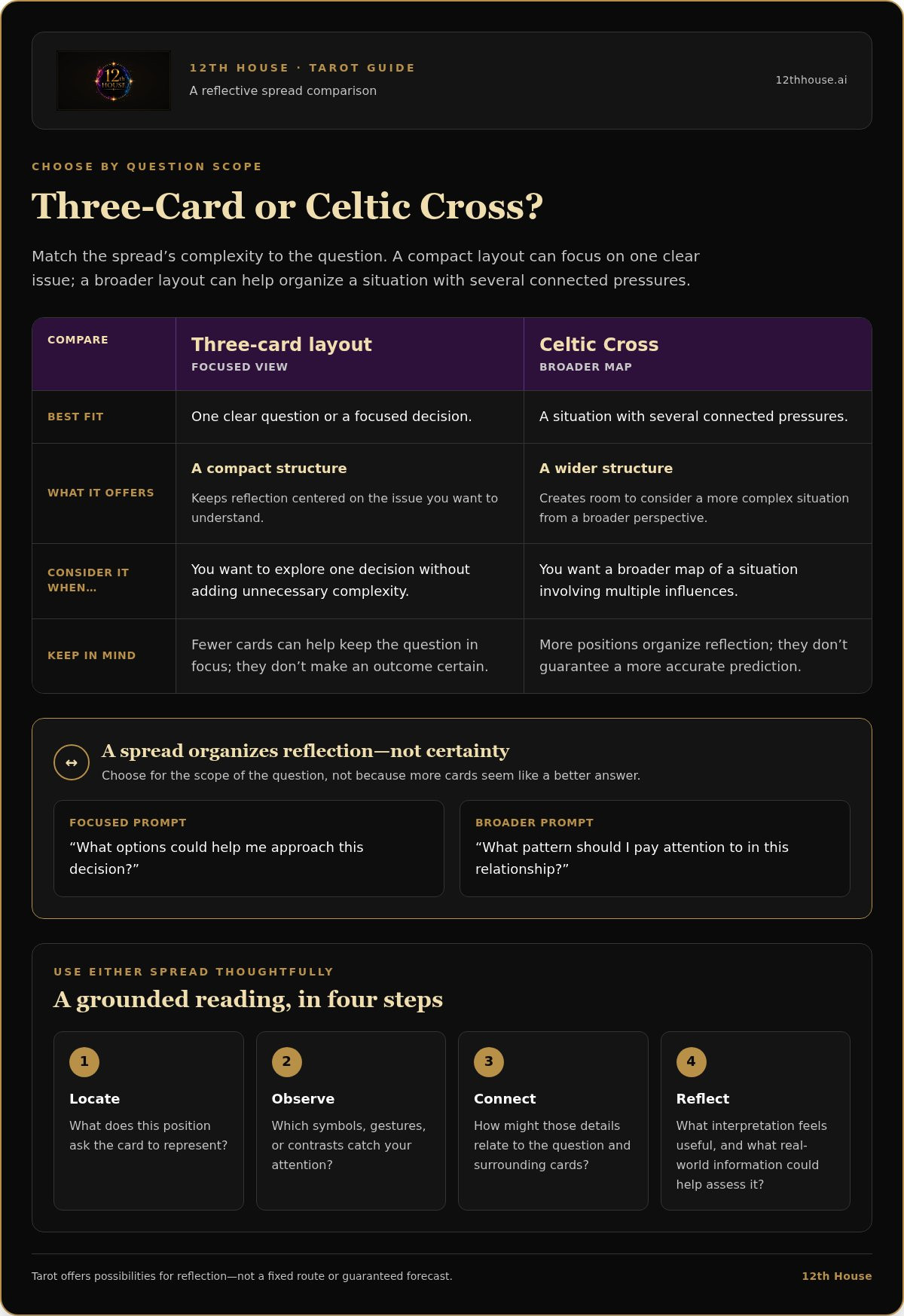
Three-Card or Celtic Cross: Which Future Tarot Spread Fits Your Question?
Choose a spread based on the scope of your question, not on the assumption that more cards produce a better answer. A focused question about one decision may need only a compact layout. A situation with several connected pressures may benefit from a broader structure. In either case, the spread organizes reflection. It doesn’t make the reading more certain or guarantee a more accurate prediction.
Rule of thumb: match the spread’s complexity to the question’s scope. Use fewer positions to examine one clear issue; use a larger layout when you’re ready to consider and connect several influences.
| Spread | Card count | Purpose and depth | Best-fit question |
|---|---|---|---|
| Past Present Future | 3 | Compact; traces context, current influence, and a possible direction. | “What should I understand about this decision as it develops?” |
| Celtic Cross | 10 | Broad; maps a central situation alongside connected influences and perspectives. | “What factors are shaping this complex transition, and what should I consider?” |
When is a Past Present Future spread enough?
A three-card Past Present Future spread works well for one focused question or a quick reflective check-in. Read the past position as relevant context, not a complete history; the present as an influence active now; and the future as one possible direction if current patterns continue. This sequence can help you see how a situation is developing without multiplying interpretations. It isn’t inherently more or less accurate than a larger spread.
When might a Celtic Cross give more context?
The Celtic Cross can help when a question involves several connected influences, such as a career shift shaped by confidence, finances, and competing responsibilities. Its ten positions offer more angles to consider, but each card needs to be read in relation to the others. Take time to synthesize the layout rather than treating every position as a separate prediction. For broader learning about spreads and symbolism, explore Tarot Mastery: A Professional Guide to Spiritual Clarity.
For a tarot reading for my future, let the question set the scale. If you can state the issue in one sentence and want a concise reflection, start with three cards. If you need to examine a network of influences and can give each position careful attention, consider the Celtic Cross. More cards add interpretive detail, not certainty.
How to Prepare for a Future Tarot Reading and Use It Well
A useful reading begins before you draw a card. Give the question a clear frame, then record what you notice before turning symbols into instructions. This helps you distinguish the imagery from your own judgment and revisit the reading later with fresh perspective.
How should you phrase a future-focused tarot question?
Replace yes-or-no demands with questions about influences, options, or preparation. Keep one topic in focus so the cards have a coherent frame. For example, ask, “What should I consider before accepting this opportunity?” or “What pattern is emerging in how I handle conflict?” Avoid asking the cards to make the decision for you.
Use this six-step sequence to prepare and reflect:
- Settle: Pause and give yourself a quiet moment to notice what’s on your mind.
- Focus: Choose one situation or decision for this reading.
- Ask: Phrase an open question about influences, options, or a constructive next step.
- Draw: Select a spread that suits the scope of the question, then note each card’s position.
- Record: Write down the date, your exact question, the cards, and your first impressions.
- Reflect: Separate what the imagery shows from how you interpret it, then consider what feels relevant in your circumstances.
What should you do after a tarot reading?
Keep three notes distinct: the card’s visible imagery, the interpretation you considered, and the decision that remains yours. This makes it easier to revisit the reading without mistaking an interpretation for a fact. Choose one practical action that remains useful even if circumstances change, such as gathering information, setting a boundary, or preparing for a conversation. Add later reflections too, so you can see how your understanding develops.
This approach makes a tarot reading for my future a structured reflection rather than a substitute for your judgment. For another perspective on organizing spiritual questions, explore The Digital Sage: Why an AI Astrology Assistant is Your New Metaphysical Architect.
Ready to put a focused question into practice? Explore tarot readings with 12th House as part of your self-directed reflection.
Explore Future-Focused Tarot as an Ongoing Practice with 12th House
A reading can begin a line of inquiry, not close it. Tarot becomes more useful as a self-directed practice when you return to your questions over time, notice how your perspective changes, and compare earlier interpretations with what you understand now. The cards remain prompts for reflection, not a final authority over your choices.
What can a structured digital tarot practice support?
12th House offers tarot readings within a digital spiritual-guidance platform, giving you a structured way to explore card symbolism and questions that matter to you. You can use the platform’s AI assistant, Lala, to ask personalized questions about your spiritual interests, and draw on its metaphysical tools and library to continue exploring. Keep your own notes about the question and interpretation, then revisit them as circumstances evolve. New information may change how a card’s symbolism feels relevant. Digital guidance can support reflection, but it doesn’t verify or guarantee future events, or replace qualified professional expertise where that’s needed.
The platform’s metaphysical library includes books, videos, and ritual frameworks for continued self-guided learning. Use those resources to deepen your understanding of symbols and reflective practices, rather than searching for a single definitive answer.
How can tarot fit alongside other forms of self-inquiry?
Tarot can sit alongside journaling and other reflective frameworks. You might write down a card’s imagery, note what it brings to mind, and then use a journal entry to examine practical details of your situation. If your question involves a relationship, AI Love Readings: A Professional Guide to Seeking Clarity offers a related perspective on using structured inquiry to reflect on love and connection.
Over time, your notes can reveal which questions return, which interpretations shift, and what actions you chose. That record won’t prove a reading predicted an outcome. It can help you recognize your own patterns and make more considered choices as circumstances unfold.
If you’re ready to continue exploring, use 12th House tarot readings as part of your self-guided practice. Bring one meaningful question, stay curious about the symbols, and decide for yourself what insight is useful to carry forward.
Let the Cards Open a More Considered Path
A tarot reading for my future is most useful when you treat it as a framework for reflection, not a fixed forecast. The cards can help you examine possible directions and current influences, while the question you bring and the choices you make shape how you use that insight.
Choose a spread that fits the scope of your question. Read each card through its position and context, then record your impressions and identify a practical next step. A short spread can focus your reflection; a larger one can help you explore connected influences. Neither removes uncertainty, and neither makes the decision for you.
12th House offers tarot readings within a digital spiritual-guidance platform, alongside a metaphysical library for self-guided learning. Explore the symbolism, stay curious, and return to your interpretations as your circumstances evolve. Explore tarot readings with 12th House and use them to support your judgment, not replace it.
Frequently Asked Questions
Can a tarot reading really predict my future?
A tarot reading can help you reflect on possible directions, but it can’t guarantee what will happen. A card may draw your attention to a pattern, question, or choice worth examining. Treat its symbolism as a prompt, then compare your interpretation with real-world information and your circumstances. Your decisions remain your responsibility, and changing conditions can influence how a situation unfolds.
What tarot spread should I use for a future reading?
Choose a spread based on how much of the situation you want to explore. A Past Present Future spread uses three cards to consider context, current influences, and a possible direction. A Celtic Cross uses more positions to examine several connected factors. Neither layout guarantees a more accurate prediction. If your question is focused, start with three cards; choose a larger spread when you want more angles to reflect on.
How do I ask tarot about my future?
Ask an open, focused question about one situation, choice, or pattern. For example, try, “What influences should I consider as I weigh this decision?” or “What perspective could help me prepare for this change?” These questions give the reading a clear frame without demanding a fixed outcome. Avoid asking the cards to decide for you. Your judgment and new information still matter as circumstances evolve.
Can tarot tell me when something will happen?
Tarot can’t reliably establish an exact date or timeline. Timing interpretations vary by reader, spread, and tradition, so treat them as symbolic possibilities rather than factual schedules. If timing matters, use practical information available to you, such as confirmed deadlines or plans. Don’t make consequential decisions based only on a card-based timing interpretation; consider the real-world evidence and options you have.
What does a difficult card mean in a future position?
A challenging card doesn’t prove that something bad will happen. Its interpretation depends on the question, position, surrounding cards, and your circumstances. Consider whether it might point to a concern, recurring pattern, or choice that deserves attention. Note your first reaction, then weigh more than one plausible interpretation. Finally, identify a grounded step that could help regardless of how the situation develops.
Should I repeat a tarot reading if I dislike the answer?
Pause before repeating the same reading, since drawing again immediately can make it harder to reflect clearly. Record the original question, cards, and interpretation, then consider what the reading brought to your attention. If the situation or question meaningfully changes later, a new reading may offer another perspective. Repeated draws aren’t proof of a fixed outcome, so avoid using them to seek certainty or reassurance.
Is an online tarot reading useful for questions about my future?
An online tarot reading can offer a convenient way to explore card symbolism and reflect on a focused question. Its value depends on how you engage with the interpretation: consider whether it fits your context, and treat it as a possibility rather than a certainty. A digital format doesn’t make a reading a guaranteed prediction. Keep your own judgment central and use practical information when deciding what to do next.


