

What if tarot’s role in a major decision isn’t to tell you which door to choose, but to help you see what you’re carrying toward each one? When every option feels uncertain or emotionally charged, tarot for major life decisions can create a structured pause. It offers a way to examine the choice, not a verdict. You may want a clear sign, especially when the stakes feel high, but no card can take responsibility for your life away from you.
This guide explains how to frame an open-ended question and choose a spread that fits your decision. You’ll learn to read the cards as prompts for examining priorities, assumptions, fears, and possibilities, rather than as predictions or commands. Then you can turn what you notice into practical next steps. The aim isn’t to eliminate uncertainty. It’s to understand what is uncertain, identify what matters most, and leave the reading better prepared to make your own choice.
Key Takeaways
- Use tarot for major life decisions as a framework for reflection, not a forecast or instruction.
- Match the spread to your choice, whether you need to explore one question, compare two options, or map a broader path ahead.
- Reframe yes-or-no questions to uncover the needs, trade-offs, and unknowns beneath the decision.
- Separate symbolic insight from verifiable facts and personal priorities before deciding what to do next.
- End your reading with a grounded action and a short checklist of what resonates, what needs evidence, and what remains uncertain.
Tarot for Major Life Decisions: What a Reading Can, and Cannot, Clarify
A major choice can be difficult even after you’ve thought it through. You might be weighing a new job against steady income, considering a move, or deciding whether a relationship still fits. You don’t need tarot to choose well. Used deliberately, tarot for major life decisions can give your thoughts a symbolic structure and help you consider the choice from more than one angle.
Decision-focused tarot is a reflective practice that uses card symbolism to raise questions about a choice, not to guarantee what will happen. A card’s imagery or traditional meaning can prompt you to notice a priority, fear, assumption, or possibility you hadn’t considered. For a neutral overview of the practice and common interpretive traditions, see Tarot card reading.
What can tarot reveal when a decision feels overwhelming?
Cards can prompt you to notice your emotional response and clarify what matters. In a job decision, a card associated with security might lead you to ask whether stability is a genuine priority or a reason you’re avoiding change. A card suggesting exploration might prompt you to examine what attracts you to a new role and which risks you could be minimizing.
These are questions to investigate, not answers supplied by the deck. Decide which interpretations resonate, then compare them with evidence, such as the role’s terms, your finances, and your priorities.
Can tarot make a major life decision for you?
No. A reading can’t verify which option will produce a guaranteed outcome, and it shouldn’t be treated as a command. If a card feels striking, pause to ask what it brings to mind rather than assuming it predicts an event. Your interpretation matters, as do the facts the cards can’t establish.
Keep spiritual reflection distinct from practical decision-making. Tarot doesn’t replace qualified legal, financial, or medical advice, or the careful review those choices may require. For foundational context on card meanings and interpretation, explore the tarot mastery guide. Use the symbolism to frame better questions, then make the decision yourself.
How Tarot Supports Decision-Making Without Predicting a Fixed Future
A card can suggest a line of inquiry, but it can’t confirm what will happen. Tarot may frame possibilities, but it cannot guarantee the outcome of a decision. That distinction matters most when uncertainty is already uncomfortable. Anxiety can make a warning seem more certain than it is, while a strong preference can make an encouraging card feel like proof. Neither reaction turns symbolism into evidence.
Use a reading as one input in a wider decision process. Set the card’s message alongside verifiable facts, trusted perspectives, and real constraints, such as time, finances, responsibilities, or wellbeing. If an interpretation suggests a risk, identify what information could confirm or challenge it. If it feels reassuring, ask whether you’re weighing less comfortable evidence fairly. This keeps tarot for major life decisions useful without giving it more authority than it can support.
How to interpret tarot cards as prompts instead of predictions
Begin with the card’s traditional symbolism, then notice your personal response to its imagery. A symbol of change might bring up excitement, fear, or a past experience. That reaction may be meaningful to you, but it doesn’t establish what the future holds. Write your first interpretation as a question or hypothesis: “What change am I resisting?” or “What would I need to feel prepared?” Then look for real-world information that can help you explore it.
Keep three things distinct: the card’s common meaning, your emotional response, and the facts you can verify. Recording them separately can help you recognize when an interpretation is being shaped by hope or worry rather than by the decision itself.
When should you pause a decision-making tarot reading?
Pause if you’re drawing cards repeatedly to chase reassurance, or if each reading leaves you more distressed, compelled, or dependent on another answer. Step away and return to the decision through grounded methods. Tarot isn’t a substitute for qualified medical, legal, or financial advice. If safety, coercion, or urgent wellbeing concerns are involved, prioritize trusted support and appropriate professional help.
A useful reading should leave room for your judgment. If you want a digital tool for personal reflection, you can explore 12th House tarot readings, while keeping the final decision in your hands.
Which Tarot Spread Fits Your Major Life Decision?
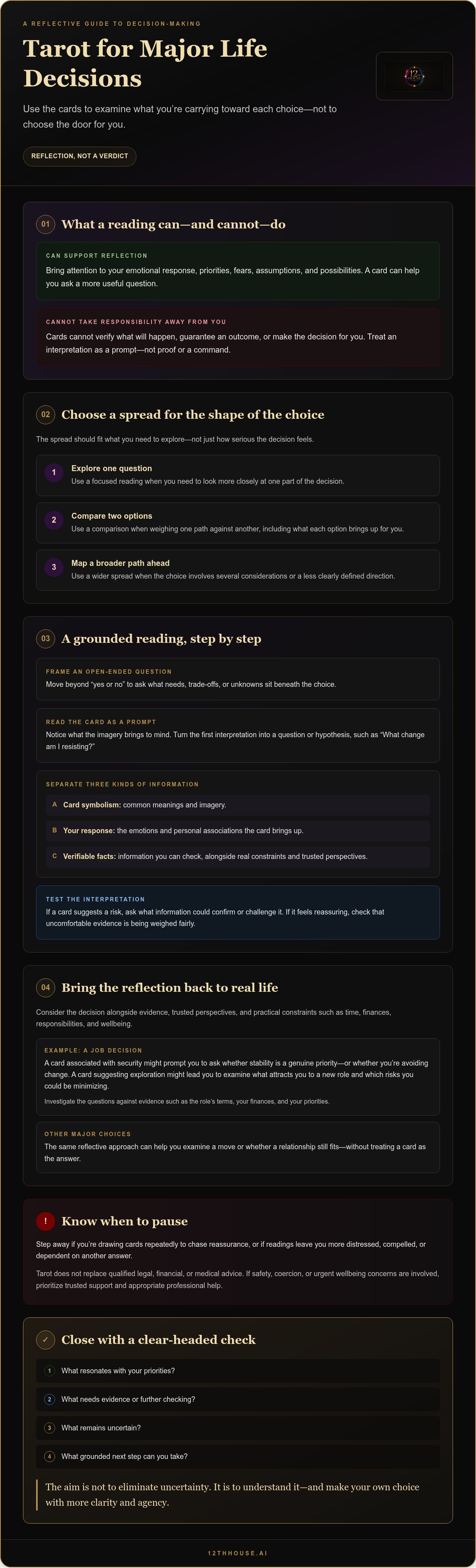
Choose a spread based on the shape of the decision, not simply on how serious it feels. A narrow question may need only one card. A choice with competing priorities may benefit from separate positions for each option. If several influences or a longer horizon are involved, a broader layout can give you more angles to consider. The best structure is one you can interpret clearly.
Published examples range from Labyrinthos’s five-card decision spread to Ibiza Tarot’s four-card, five-card, and six-card layouts. The number of cards doesn’t make a reading more accurate. Spread positions organize reflection by focusing your attention on specific aspects of the choice. They don’t provide certain descriptions of the future.
| Spread | Size | Suitable question | Reflection focus |
|---|---|---|---|
| Focused question | 1 card | “What should I consider before deciding?” | A priority, concern, or overlooked perspective |
| Two-option layout | 4 cards | “What might I need to weigh in each option?” | Concerns and possibilities connected with A and B |
| Path-ahead layout | 5-6 cards | “What influences and values should I account for?” | Several factors, trade-offs, and possible next steps |
When is a simple decision spread enough?
Use a compact layout when the choice is narrow and you can state one clear question. For two options, assign positions to explore a concern and a possibility for each path. This creates a comparison, not a contest: no card declares a winner or guarantees what either option will bring. If a card raises a new question, note it instead of automatically drawing more cards.
When should you use a broader life-path spread?
Choose a broader layout when you need to consider multiple values, influences, or time horizons. A five- or six-card spread can help separate those themes, but each added position also adds interpretive complexity. If the reading starts to feel tangled, simplify the layout. Beginners often get more from a few well-defined prompts than from a large spread with positions that are hard to distinguish.
For tarot for major life decisions, let the complexity of the question guide the spread size. Use fewer cards for a focused choice, and add positions only when each serves a distinct purpose. Keep the question and position meanings specific, so the layout works as a map for reflection rather than a verdict.
How to Do a Tarot Reading for a Major Life Decision
A useful reading has a clear question, a defined structure, and a practical next step. Follow this sequence to keep the cards in the role of reflective prompts. You remain responsible for interpreting what matters and deciding what to do.
Define the choice, ask an open question, select a focused spread, interpret each card as a prompt, test your impressions against evidence, and record one grounded next step.
- Name the decision. State the choice plainly and set a relevant timeframe, such as deciding whether to pursue a move within the next few months.
- Check your question. Notice whether you’re asking for reflection or seeking reassurance that your preferred outcome will happen.
- Choose the spread. Give each position a distinct purpose, such as examining a priority, a concern, or information you still need.
- Read and record. Note the card, your first response, and what the position asks you to consider.
- Ground the interpretation. Separate symbolic impressions from facts you can verify and constraints you need to account for.
- Choose a next step. Write down one practical action that could clarify the decision without requiring an irreversible commitment.
How do you phrase a tarot question about a difficult choice?
Replace “Should I do this?” with “What should I examine before deciding?” Name the choice and timeframe, but don’t build your hoped-for answer into the wording. For example, “What should I consider before deciding whether to move this year?” is more useful than “Will moving make me happy?” Keep the question focused so each spread position has a clear purpose.
Imagine someone considering a move. A card associated with change might bring up excitement, while also prompting questions about support, costs, or what they’d leave behind. Neither reaction establishes that moving is right. Treat the response as a hypothesis: What does it reveal, and what information would help you test it?
How do you turn a card reading into a grounded next step?
For each card, record four things: its position, your initial reaction, an alternative interpretation, and relevant real-world evidence. If the reading points to uncertainty about a new city, a reversible next step might be to research housing or speak with someone who lives there. This turns symbolism into an inquiry you can act on, not an instruction to obey.
For another structured way to explore personal questions, consider personalized tarot and metaphysical guidance. Let it support your reflection, not make the decision for you.
After the Reading: Make Your Decision With Clarity and Agency
A reading is useful only if you can bring its insights back into everyday life. Before acting, sort what came up into three categories: symbolic impressions, facts you can verify, and personal priorities. A card may draw attention to a concern, but it can’t establish whether a contract is fair, whether a plan is affordable, or which value should matter most. Those questions call for your judgment and, where appropriate, reliable information or qualified advice.
How can you tell whether a tarot interpretation is useful?
A useful interpretation opens a relevant question. It doesn’t manufacture certainty or pressure you with fear. Check whether the idea fits your experience and whether credible information supports the assumptions behind it. If an interpretation sounds inevitable, pushes you to act immediately, or leaves you seeking repeated reassurance, set it aside and return to what you can confirm.
Use this short post-reading checklist:
- What resonates? Note insights that connect with your values or experience, without treating resonance as proof.
- What needs evidence? List claims about circumstances, risks, or other people that you can investigate.
- What remains unknown? Identify unanswered questions and decide whether you can gather more information or need support.
Then compare the remaining options against your priorities and constraints. The purpose of tarot for major life decisions is not to remove uncertainty, but to help you see what deserves closer attention. If the reading hasn’t clarified your choice, that’s useful information too. You may need more facts, more time, or a conversation with someone you trust.
How can digital tarot guidance support continued reflection?
Digital guidance can offer a structured space to revisit a question, but it remains optional. 12th House offers tarot readings within a digital metaphysical guidance platform. Its AI assistant, Lala, can help you explore personalized spiritual questions. It isn’t an authority that selects an option or guarantees what follows. Keep your own notes, assess information independently, and retain responsibility for your decision.
For related context on AI-assisted spiritual exploration, read the AI astrology assistant guide. If digital support fits your reflective practice, explore 12th House tarot readings and Lala. Let the tools support your inquiry, then choose in your own time and with your own discernment.
Carry Your Insight Into the Next Step
A major decision doesn’t need to come with perfect certainty. Tarot for major life decisions can help you map the values, fears, and questions surrounding a choice, but the cards don’t choose for you. Ask an open question, select a spread that fits the decision, and treat each interpretation as a prompt to examine rather than a prediction to obey.
After the reading, separate symbolic insight from verifiable facts and personal priorities. Identify what resonates, what needs evidence, and what remains unknown. Then choose one grounded next step that helps you move forward with care and clarity.
If you’d like a digital space for continued reflection, 12th House offers tarot readings and Lala, an AI assistant for personalized spiritual guidance. Use these tools to explore your questions while keeping your judgment at the center. Explore tarot readings and metaphysical guidance at 12th House.
You don’t need every answer before you begin. Trust yourself to take the next considered step.
Frequently Asked Questions
Can tarot help you make a major life decision?
Yes. Tarot can help you reflect on a major decision by bringing priorities, concerns, and assumptions into view. Treat each card as a prompt to examine, not as proof of what will happen. For example, a card might invite you to consider what you value in a potential change. Compare that reflection with practical facts and your own constraints before deciding.
Can tarot tell you which choice to make?
No. Tarot can’t verify which option is right or guarantee the outcome of either choice. A reading may help you notice what matters, but the interpretation belongs to you. If a card seems to favor one path, ask what that response reveals and what evidence supports it. Keep responsibility for the choice with yourself, and seek qualified advice for specialized legal, medical, or financial questions.
What tarot spread is best for making a difficult decision?
The best spread is the simplest one that gives each part of your question a clear purpose. A single-card pull can focus attention on one consideration. A two-option layout can help compare concerns and possibilities without declaring a winner. Choose a broader path-ahead spread if several influences or values need reflection. More cards add complexity, not automatic accuracy.
How do you ask tarot cards about a major life decision?
Ask an open question that names the choice without embedding the answer you hope to hear. Instead of “Should I leave my job?”, try “What should I examine before deciding whether to leave my job this year?” You can also ask what needs, trade-offs, or unknowns deserve attention. Keep the wording focused so each card position contributes a distinct reflection.
Is it a bad idea to use tarot for important decisions?
Not necessarily. Tarot can be one reflective tool, provided you don’t treat it as a command, prediction, or substitute for evidence. For tarot for major life decisions, compare symbolic impressions with facts, personal priorities, and practical constraints. Don’t rely on a reading instead of qualified medical, legal, or financial guidance. If it increases distress or pressure, pause and seek support from someone you trust.
How many cards should you pull for a decision reading?
Pull only as many cards as your question needs. One card can focus a narrow inquiry, while a small two-option layout can organize a comparison. A broader spread may help when several factors need attention, but each added card creates more interpretation to sort through. If the reading becomes confusing, simplify it. Clear positions matter more than a large card count.
Should you do another tarot reading if you are still unsure?
Not immediately if you’re repeating readings to seek reassurance or feeling more anxious with each one. Instead, review your notes and identify what remains unknown. Gather relevant information, talk with a trusted person, or take a reversible step that helps test an assumption. Return to tarot only if you have a genuinely new question. Uncertainty doesn’t mean you need another card to decide.


