

What if a relationship tarot reading could help you make a clearer choice without telling you what someone else will do? It’s natural to want certainty when love feels unsettled. Tarot for love and relationships can offer a structured way to examine what’s happening, but a difficult card isn’t a verdict, and no spread can replace an honest conversation or decide your future for you.
The value lies in the questions the cards help you ask. This guide explains how to choose a relationship spread that fits your concern, read card positions and challenging symbols thoughtfully, and use the result as a prompt for reflection rather than a fixed prediction. You’ll also learn how to keep a reading from feeding anxiety and turn what you notice into one practical next step, such as a question to consider, a boundary to clarify, or a conversation to have.
Key Takeaways
- Match your spread to the question, and begin with a small layout when you’re new or seeking clarity on one concern.
- Read each card through its symbolism, position, and real-life context instead of treating it as a certain prediction.
- Use tarot for love and relationships to explore your feelings and needs, not to claim certainty about another person’s thoughts or intentions.
- Record your first response, then separate what you observed from what you’re assuming before deciding what the reading suggests.
- Turn reflection into one grounded next step, such as a question to ask, a boundary to clarify, or a direct conversation.
Tarot for love and relationships: what a reading can, and cannot, tell you
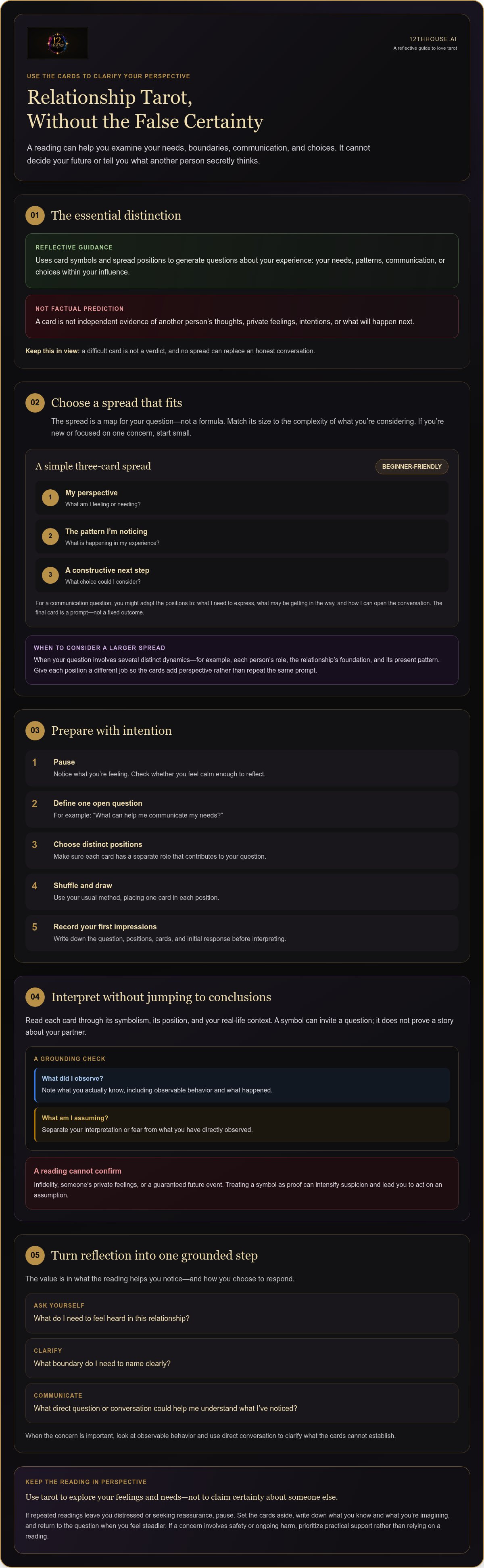
Relationship tarot uses card symbolism and spread positions to reflect on a connection. Each position gives a card a specific role, such as highlighting a need, a communication pattern, or a choice within your influence. The cards offer a symbolic framework for examining the relationship, not independent evidence about what another person thinks or what will happen next.
Reflective tarot guidance uses symbols to generate questions about your experience; factual prediction claims to establish what another person feels or what the future will bring. Keep that distinction in view. If you’re curious about tarot’s wider background, explore this overview of the history of tarot. In a relationship reading, the most useful insight may be a need you haven’t named or a recurring pattern you’re ready to examine.
Tarot for love and relationships can help you clarify your perspective, but a useful reading starts with the question. Choose one that brings attention back to your needs, boundaries, communication, or choices. For example, “What do I need to feel heard in this relationship?” or “How can I communicate my boundary clearly?” These questions invite reflection without assuming what your partner will do.
What questions are useful to ask about a relationship?
Yes-or-no questions can make a complex situation feel as if it has only two possible outcomes. Reframe “Will we stay together?” as “What should I consider as I decide what I need from this relationship?” Instead of asking, “Do they love me?” try “What observable signs of care matter to me, and what do I need to discuss?” The revised questions leave room for context and personal agency.
Keep the wording neutral. Asking “Why are they pulling away?” assumes distance and a reason for it. Try, “What have I noticed in our communication, and what would help me understand it better?” A specific, open question gives the cards less room to echo your fear. Check your interpretation against what you know, not only what you suspect.
What tarot cannot confirm about a partner or future
A card can’t verify infidelity, reveal someone’s private feelings, or guarantee a future event. Treating a symbol as proof can intensify suspicion and lead you to act on an assumption. Look instead at observable behavior, and use direct conversation to clarify what a card cannot establish. If a concern involves safety or ongoing harm, prioritize practical support rather than relying on a reading.
Notice how the process affects you. If repeated readings leave you more distressed or keep you seeking reassurance, pause. Set the cards aside, write down what you know and what you’re imagining, then return to the question when you feel steadier. Tarot is a tool for reflection, not a requirement to keep searching for certainty.
How to prepare a love tarot reading and choose a relationship spread
A useful spread is a map for a question, not a formula you must follow. Choose positions that examine different parts of the issue so each card adds a distinct perspective instead of repeating the same prompt. As you prepare, remember that tarot has a long and evolving history; this overview of the history of tarot cards offers broader context for the practice.
Choose spread size by the complexity of your question, not by the belief that one layout is universally best. If you’re new to tarot or focused on one concern, start small. Before drawing, take a moment to settle and set a clear intention. Then follow this sequence:
- Pause. Notice what you’re feeling and whether you’re calm enough to reflect.
- Define the question. Keep it open and focused, such as, “What can help me communicate my needs?”
- Choose positions. Give each card a separate role that contributes to answering the question.
- Shuffle and draw. Use your usual method, then place one card in each position.
- Record. Write down the question, positions, cards, and first impressions before interpreting.
A simple three-card relationship spread for beginners
Try these positions: my perspective, the pattern I’m noticing, and a constructive next step. Adapt the labels to fit your question. If you’re exploring communication, for instance, rename them “what I need to express,” “what may be getting in the way,” and “how I can open the conversation.” The final card points toward a choice to consider, not a fixed outcome.
When a larger relationship spread may help
A larger spread can help when your question involves several distinct dynamics, such as each person’s role, the relationship’s foundation, its present pattern, and a possible direction if that pattern continues. Labyrinthos offers a five-card relationship spread as one example. Its positions are a starting framework, not a universal template. Before drawing, check that each position addresses a different part of your question.
More cards don’t automatically mean more clarity. If you dislike an interpretation, resist drawing again just to get a preferred answer. Record what you have, step away, and return when you can consider the symbols without searching for reassurance. A digital tarot reading can also provide a structured prompt for self-reflection, while leaving the meaning and next steps in your hands.
Interpreting Love Tarot Without Jumping to Conclusions
A card doesn’t carry one fixed message into every relationship reading. Use this three-part method to build an interpretation carefully: consider the card’s symbolism, read it through its assigned position, then compare it with your real-life context. A card’s position and context shape its interpretation as much as its traditional symbolism.
For example, The Hermit in a position about what you need might invite reflection on solitude or inner clarity. In a position about a communication pattern, it could prompt you to consider whether someone needs space. Neither interpretation proves what your partner feels. Ask what fits the question and what you can verify in your own experience.
| Rigid prediction | Reflective interpretation |
|---|---|
| “The Lovers means this person is your soulmate.” | “What values or choices are shaping this connection?” |
| “The Tower means we’ll break up.” | “What feels unstable or ready for honest examination?” |
| “This card proves they’re hiding something.” | “What have I observed, and what do I still need to ask?” |
This approach keeps tarot for love and relationships focused on reflection rather than certainty. The same card can mean different things depending on the question, its position, and the cards around it. Use a trusted card reference to study traditional interpretations, then note your own associations. Treat personal impressions as possibilities to examine, not facts about another person.
Reading familiar Major Arcana cards in a love spread
The Lovers can raise questions about values, alignment, intimacy, or a choice. It isn’t proof that someone is your soulmate. The Tower may invite you to examine disruption, assumptions, or a structure that needs attention. It doesn’t predict a breakup. Before deciding what either card suggests, consider how it relates to its position and your lived experience.
How to interpret reversed cards and challenging combinations
Readers use reversed cards in different ways. You might interpret one as blocked expression, inward reflection, or a theme in tension with the surrounding cards. Choose an approach you can apply consistently instead of changing the rules to fit a hoped-for answer. When difficult cards appear together, explore what tension they might help you notice. Don’t turn them into claims of betrayal, rejection, or inevitable separation.
When an interpretation feels alarming, slow down. Write down the symbolism, the position’s role, and the real-world details that support or challenge your reading. That pause helps you separate a compelling story from a grounded conclusion.
Turn your relationship tarot reading into grounded reflection
A reading becomes useful when you separate the card’s symbolism from the story you’re building around it. Record what appeared, what you felt, and what you know from your lived experience. This simple record helps you use tarot for love and relationships as a reflective practice, not as evidence about someone else’s motives.
A practical tarot journaling template for relationship questions
Write each card beside its spread position before looking up additional interpretations. Then use this sequence to examine what the reading brings up:
- Question and position: What did you ask, and what was this card meant to explore?
- Card and first response: What symbol or meaning stood out, and what emotion did you notice?
- Alternative interpretation: What is another plausible way to read this card in its position?
- Real-world context: What specific conversation or behavior have you observed? What remains unknown?
- Your next step: What question can you ask, boundary can you name, or choice can you make?
For example, “I felt anxious when this card appeared” is an observation about your response. “My partner must be hiding something” is an assumption about their intention. Keep those entries distinct. Your feelings deserve attention, but they don’t prove a conclusion.
For broader foundational study, explore the Tarot Mastery guide. It can support your understanding of tarot as a symbolic practice while you develop your own interpretation process.
When a reading points toward a real conversation
Translate a theme into a direct, non-accusatory question. If your notes point to distance, you might ask, “I’ve noticed we’ve had less time together lately. How are you feeling about our connection?” Speak from what you’ve observed and what you need, rather than presenting a card as proof.
Choose a conversation only if it feels safe and welcome. Pay attention to consent, consistent behavior, and whether actions align with words. A reading can help you prepare, but it can’t replace those real-world signals. If the concern involves harm, coercion, or distress beyond reflective self-inquiry, seek support from someone you trust or a qualified professional.
Keep the final journal entry small and within your control. Prepare one question, clarify one boundary, or decide what information you need before making a choice. You can also explore tarot reading resources as part of your own reflective practice.
Explore love tarot as one part of a larger relationship inquiry
Use a reading as one stage in a practical process: ask a grounded question, choose a spread with positions that fit it, interpret each card in context, then identify a next step you control. That step might be journaling, preparing a conversation, or taking time to observe what happens. Tarot for love and relationships can support reflection when you’re seeking perspective, but it isn’t the only way to understand a connection.
Sometimes reflection is enough to clarify what you feel or what you want to ask. If the issue depends on your partner’s intentions, a direct conversation and their observable behavior offer information a card can’t provide. If you’re dealing with distress, safety concerns, or a repeated pattern that feels difficult to address alone, consider reaching out to someone you trust or an appropriate professional.
When to pair tarot with another relationship lens
Tarot and birth-chart compatibility offer different symbolic frameworks. A tarot spread can help you examine a present question, your perspective, or a possible choice. A compatibility reading uses astrological chart patterns as a lens for considering how two people may relate. Neither establishes whether a relationship will work or confirms what someone feels. For a complementary perspective, explore birth chart compatibility, or read this guide to AI love readings. Treat each as a prompt for thoughtful inquiry, not a test that can deliver certainty.
Continue exploring with 12th House tools
If you want to keep reflecting, 12th House offers tarot readings, Lala AI Spiritual Guidance, and access to a metaphysical library. These are tools for self-guided exploration, not live consultations or therapeutic services. You might use a reading to consider a focused question, ask Lala a reflective follow-up, or consult the library to deepen your understanding of tarot symbolism.
Keep your agency at the center. Let symbols help you notice a question, then bring that question back to your lived experience, your choices, and, where appropriate, an honest conversation. You can explore 12th House tarot readings and spiritual guidance as part of that inquiry.
Let your next step come from clarity
Use tarot for love and relationships as a structured mirror, not a verdict. A focused question and fitting spread can help you notice your needs and relationship patterns. Interpret each card through its position and your lived experience, then choose a practical next step. The reading may clarify what you want to ask, but honest communication and observable behavior remain essential.
You don’t need to solve the whole relationship in one reading. Start with one thoughtful question, stay open to more than one interpretation, and let your choices remain your own. 12th House offers tarot readings as part of its digital metaphysical guidance platform. Members can also access Lala AI and a library of books, videos, and ritual frameworks for self-guided learning.
Explore 12th House tarot readings and self-guided spiritual tools. Let reflection support your discernment, and take the next step at a pace that feels grounded and right for you.
Frequently Asked Questions
How do you do a tarot reading for love and relationships?
Start with an open question about your needs, choices, or a relationship pattern. Choose a spread with positions that explore distinct parts of the question, draw the cards, and consider each card’s symbolism alongside its position and your real-life context. Record your first thoughts before consulting additional interpretations. This approach to tarot for love and relationships supports reflection, but the cards don’t guarantee a particular outcome or reveal another person’s private thoughts.
What is the best tarot spread for love and relationships?
There isn’t one spread that works best for every relationship question. A three-card spread can suit a focused inquiry or a beginner, with positions such as your perspective, a recurring pattern, and a constructive next step. A larger spread may help when you’re examining several distinct dynamics. Choose positions that add separate perspectives rather than repeating one prompt or trying to establish certainty about another person’s feelings.
Can tarot tell you how someone feels about you?
No. Tarot can’t verify another person’s private thoughts or feelings. A relationship reading can help you examine your perceptions, needs, expectations, and what you’ve observed, but it can’t provide access to someone else’s mind. If you want clarity about their feelings, consider a direct, respectful conversation. Treat the cards as prompts for reflection, not evidence, and weigh what the person says alongside their observable behavior.
Can tarot predict the future of a relationship?
Tarot shouldn’t be treated as a guaranteed forecast of whether a relationship will last or what a partner will do. Cards can prompt you to examine present concerns, patterns, and choices. If your spread includes a future-oriented position, use it to consider possibilities and actions within your control, not a fixed outcome. A relationship’s future depends on people’s decisions and circumstances, not a card draw alone.
What does The Lovers card mean in a relationship reading?
The Lovers can invite reflection on connection, shared values, alignment, or an important choice. It doesn’t automatically confirm a soulmate, marriage, or another person’s feelings. Consider the question you asked, the card’s position, and the surrounding cards before interpreting it. You might ask yourself what values matter most in this connection or what decision calls for greater honesty. Let the card open inquiry rather than close it.
What should I do if a love tarot reading gives me a negative card?
A difficult card doesn’t prove that a breakup, betrayal, or other harmful event will happen. Consider whether it points to a concern, change, or pattern worth examining, and compare your interpretation with observable facts. Write down another possible meaning before drawing a conclusion. If the reading heightens anxiety or leads you to seek repeated reassurance, pause the readings and turn to grounded support from someone you trust or a qualified professional.
Should I ask the same relationship tarot question more than once?
Avoid repeating the same question until you receive an answer you prefer. That can make the reading harder to interpret and increase anxiety. First, record what the original spread raised and consider whether a genuinely new question has emerged. If you choose to draw again, give the new reading a distinct purpose. Don’t use another draw to override a direct conversation, your boundaries, or observable evidence.


